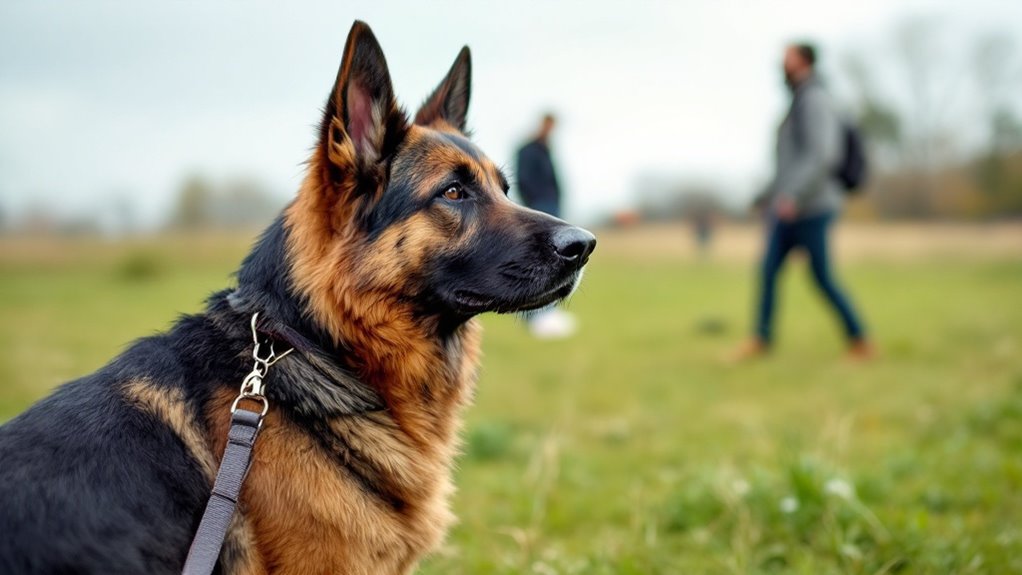
Your German Shepherd isn’t stubborn—she’s choosing environmental rewards over you because connection and reinforcement history are weak. Start by building genuine focus through daily name-recognition and eye-contact games before introducing distractions, then layer challenges gradually from distances where she stays calm. Use high-value rewards delivered within one second, practice short frequent sessions, and teach her to disengage from triggers and refocus on you. A structured four-week timeline paired with consistent engagement drills transforms distraction reliability markedly.
- Key Takeaways
- Why Your German Shepherd Tunes You Out (It’s Not Stubborn)
- Connection Before Commands: The Missing Piece
- Assess Your Dog’s Current Distraction Level
- Start With Name Recognition and Eye Contact
- Layer Distractions Gradually (The Safe Progression)
- Reward Breakthroughs: Jackpot at Trigger Points
- Teach Look and Look Away (The Reset Game)
- Your 4-Week Focus Training Timeline
- What’s Normal vs. When You Need Help
- Your German Shepherd’s First Focus Training Session
- Frequently Asked Questions
- Conclusion
Key Takeaways
- German Shepherds’ strong instincts prioritize environmental stimuli over handler cues; build connection before introducing distractions systematically.
- Start distraction training at 20–30 feet distance where the dog notices triggers but remains calm and focused.
- Use engage/disengage framework with jackpotting (5–7 rapid treats) to reward brief eye contact within one second at trigger points.
- Progress distraction difficulty incrementally: introduce one variable at a time, halving distance only after 5–10 seconds of reliable focus.
- Establish 90%+ consistency in low-distraction settings for name recognition and eye contact before advancing to real-world distracting environments.
Why Your German Shepherd Tunes You Out (It’s Not Stubborn)
When your German Shepherd ignores you in the middle of a walk or refuses to look away from a squirrel despite your repeated calls, it’s not because he’s being stubborn or defiant—it’s because his brain is working exactly as his breed was designed to work.
German Shepherds possess strong scenting, herding, and patrol instincts that make environmental stimuli far more rewarding than a distant handler cue, especially when you haven’t built sufficient value through your focus exercises.
Dog owners often assume their shepherd should naturally prioritize them, but without a consistent reinforcement history, your dog hasn’t learned that choosing you reliably beats novel distractions.
The training process requires recognizing this isn’t disobedience—it’s preference based on immediate reward value.
Connection Before Commands: The Missing Piece
Understanding that your German Shepherd’s attention problem isn’t stubbornness opens the door to a more effective approach: you need to build genuine connection before you can expect reliable focus. Your dog won’t focus right when you’re just another voice competing for attention.
Instead, spend 5–10 daily minutes doing high-energy play, name games, and hand-targeting, making yourself the most rewarding presence in your dog’s world. This foundation teaches your dog that you’re predictable and worth watching.
Once your shepherd voluntarily offers eye contact within 2–3 seconds of their name in different rooms and during walks, you’ve established the connection necessary for real training success. This relationship transforms how your dog responds to commands and distractions alike.
Assess Your Dog’s Current Distraction Level
Before you can design a training plan that actually works, you’ll need an honest picture of where your German Shepherd stands right now—because training difficulty isn’t one-size-fits-all, and jumping to advanced distraction work before your dog’s ready will only create frustration and inconsistency.
Rate your dog’s distraction level on a 1–5 scale, noting specific triggers like other dogs, bicycles, or squirrels, and measure the distance at which each reliably steals attention. Record three timed recalls across progressively busier environments—home, quiet park, busy street—tracking success rates and response speed. Watch for emotional signs including stiff posture, raised tail, intense staring, and heavy panting, as these indicate arousal levels that affect learning capacity. This baseline data guides your graded exposure strategy.
Start With Name Recognition and Eye Contact
The foundation of reliable focus in German Shepherds rests on two connected behaviors: name recognition and eye contact, which you’ll build together in low-distraction environments until your dog responds with automatic consistency. These foundational skills create the structure you need before introducing distractions through your progressive roadmap.
Build name recognition and eye contact in low-distraction settings to create the foundation for reliable focus in German Shepherds.
- Pair your dog’s name with high-value rewards on a 1:1 schedule for 20–30 quick trials per session until they look within 1–2 seconds
- Mark the first brief gaze with a click or “yes,” then reward immediately to reinforce the behavior
- Build eye contact duration gradually from 1–2 seconds to 5+ seconds across multiple short daily sessions
- Practice both behaviors until achieving 90%+ consistency before systematically adding distractions
Avoid repeating the name if your dog doesn’t respond; instead, manage the situation by reducing distraction or moving closer, then re-present the cue cleanly.
Layer Distractions Gradually (The Safe Progression)
Once your German Shepherd responds reliably to their name and holds eye contact with 90%+ consistency in calm settings, you’re ready to add the real-world layer that separates trained focus from reliable focus: managing distractions while maintaining that connection.
Start at a distance where your dog notices the distraction—another dog or busy street—but stays calm, around 20–30 feet away. Mark and reward any brief look toward you within one second. Only progressively halve the distance once your dog holds focus for 5–10 seconds at the current level, using short 30–90 second sessions repeated 3–5 times daily.
Introduce one variable at a time: distance first, then movement, then proximity. If your dog becomes reactive, drop back two steps and employ engage/disengage drills, rewarding attention shifts toward you consistently until reliability returns.
Reward Breakthroughs: Jackpot at Trigger Points
Your German Shepherd’s progress through calm environments and controlled distractions now needs anchoring at the moments that matter most—the trigger points where focus naturally fragments. Jackpotting—delivering 5–7 rapid-fire high-value treats over 2–3 seconds—creates powerful positive associations at exactly these critical moments.
- Identify specific trigger points on your walking routes: other dogs, doorways, bike paths, or crowds where your dog typically loses focus.
- Start at distances where your German Shepherd notices the trigger but remains below threshold, only rewarding calm eye contact or reorientation toward you.
- Deliver jackpots consistently when the correct behavior occurs, building reliability before gradually shortening distance.
- Shift to intermittent reinforcement once established, jackpotting every fourth correct response to maintain motivation while preventing satiation.
This structure transforms trigger points into opportunities for focus.
Teach Look and Look Away (The Reset Game)
You’ll now anchor your German Shepherd’s focus through two complementary behaviors—the “Look” response that builds visual engagement on cue, and the “Look Away” disengagement that trains your dog to break fixation with distractions and redirect back to you.
These paired skills create what’s called the Reset Game, a structured practice that gives your dog a reliable way to reset attention during high-distraction moments, and you a consistent tool to prevent escalation before lunging or barking occurs.
Building The Look Response
The foundation of reliable focus work rests on teaching your German Shepherd two complementary behaviors: a strong “look” response that brings attention to you, and a “look away” response that teaches disengagement from distractions, together known as the Reset Game.
Building the Look response requires precise timing and consistent reinforcement:
- Say your cue, then mark and reward eye contact within 200–500 milliseconds using high-value treats initially
- Start the Reset Game (Look Away) by rewarding your dog for breaking focus on mild distractions
- Progress difficulty in small steps, beginning indoors at 2–3 meters from low-level triggers
- Add distance, movement, and stronger stimuli across multiple short 3–5 minute daily sessions
This structured approach teaches your dog that attention earns rewards, establishing the foundation for reliable focus amid increasing environmental challenges.
Mastering The Disengagement Sequence
Once your German Shepherd reliably makes eye contact on cue, the next layer involves teaching him to disengage on command—a skill that transforms focus training from one-directional attention into a dynamic cycle of engagement and reset.
You’ll introduce a consistent “Look Away” cue by rewarding him for breaking eye contact and reorienting to you, such as touching your hand or nose target, within 1–2 seconds. Gradually increase the delay before marking to 2–4 seconds, building reliability through repetition.
This engage/disengage framework creates a predictable structure where your dog learns that choosing you over distractions earns reinforcement, shifting his emotional response from fixation to calm curiosity and establishing the foundation for reliable focus in increasingly challenging environments.
Your 4-Week Focus Training Timeline
Building a German Shepherd’s focus isn’t something that happens overnight, and rushing through the stages will only set you back—so this four-week structure breaks the process into manageable phases, each one preparing your dog for the next level of distraction and real-world demands.
- Week 1: Establish foundation skills using connection-building games in low-distraction rooms, spending 10–15 minutes daily on name-to-eye contact and hand-targeting until your dog consistently offers attention.
- Week 2: Introduce mild distractions gradually, rewarding immediate refocus with high-value treats and increasing intensity only when responses reach 80% reliability.
- Week 3: Practice progressive recalls and shift-focused exercises across doorways, cars, and leash changes in real-life settings with 2–3 short sessions daily.
- Week 4: Move into higher-distraction environments like busy sidewalks, using intermittent reinforcement and fading food rewards as reliability strengthens.
What’s Normal vs. When You Need Help
Your German Shepherd’s distraction level depends partly on age—adolescents (6–18 months) naturally struggle with impulse control and recall due to ongoing brain development, so some high distraction is expected during this stage.
You’ll want to distinguish between normal developmental phases and genuine red flags, which include dangerous behaviors like bolting toward traffic, aggressive lunging at other dogs, or escalating reactivity despite consistent practice.
If you’re repeating cues frequently, relying heavily on treats to compete with environmental distractions, or avoiding real-world training situations, you’ve likely hit a plateau where professional guidance can provide the structured assessment and hands-on help you need to move forward.
Developmental Stages And Distraction
As your German Shepherd progresses from puppyhood through adulthood, their capacity for focus and their response to distraction will shift dramatically, and understanding what’s developmentally normal helps you avoid misinterpreting natural changes as behavioral problems or training failures.
- Puppies (8–16 weeks): Expect 30–60 second attention spans with frequent exploratory sniffing, requiring play-based focus games rather than formal recalls.
- Adolescence (6–18 months): Hormonal changes double distraction frequency as interest in other dogs, scents, and movement increases markedly.
- Adults (2+ years): Most GSDs sustain multi-minute focused engagement in moderately distracting environments with consistent training and proper motivation.
- Persistent issues: Sudden focus loss or intense reactivity after 6–8 weeks of short daily sessions suggests gaps in motivation, timing, or connection rather than stubbornness, warranting professional evaluation.
Red Flags Requiring Professional Support
Because German Shepherds develop in predictable stages, you’ll naturally see shifts in focus and distraction that aren’t signs of failure—they’re signs of maturation—but you also need to recognize which behaviors fall outside the normal range and warrant professional guidance.
If your adolescent German Shepherds consistently ignore high-value recalls under 10 meters in everyday settings, that signals insufficient generalization and real-world safety risk, so contact a force-free professional.
Watch for escalating reactivity toward dogs or people—barking, snarling, charging—that doesn’t improve with engagement exercises or management.
Sudden aggressive lunges, freezing, or panic during distraction work also require trainer input.
If progress stalls beyond six to eight weeks despite consistent short sessions and clear progression, seek professional coaching to evaluate your timing, reinforcement value, and handler cues.
Building Focus At Home First
Start with the foundation that matters most: making yourself the most rewarding thing in your dog’s world before you ever ask for focus in distracting environments.
You’ll begin at home with short (5–10 minute) daily sessions using high-value rewards and games to build consistency and trust.
Track your progress systematically:
- Measure baseline eye contact duration in your living room, aiming for 20–30+ seconds
- Practice name game and touch/hand target exercises as primary reinforcement tools
- Gradually introduce mild distractions like TV or family members moving nearby
- Move to busier rooms only after your dog demonstrates reliable focus at home
Expect normal attention variability during social maturity (6–24 months).
If your dog consistently fails after 2–4 weeks or shows overwhelm signs, consult a force-free trainer rather than escalating difficulty.
Your German Shepherd’s First Focus Training Session
Your German Shepherd’s first focus training session sets the foundation for all the attention work you’ll build together, so preparation and timing matter more than you might think. Start with a 5–10 minute warm-up of high-energy play or quick obedience repetitions to arrive mentally ready, then move to a low-distraction area like a quiet room or fenced yard.
| Element | Duration | Action | Result |
|---|---|---|---|
| Warm-up | 5–10 min | Play or obedience | Mental readiness |
| Teaching | 8–12 reps | “Look” cue + reward | Eye contact shaped |
| Reward timing | 0.5–1 sec | Deliver treat | Strong association |
| Session pace | 5 min | Three daily | Enthusiasm maintained |
Use high-value treats like tiny chicken pieces, deliver them within 0.5–1 second of contact, and keep short and frequent sessions throughout your dog training routine. End successfully on a calm note, recording what rewards worked.
Frequently Asked Questions
What Is the 7 7 7 Rule for Dogs?
You’ll ask your dog for 7 seconds of eye contact, reward, then 7 seconds of a low-distraction task, reward, then 7 seconds of slightly higher distraction to progressively build focus.
What Is the 3-3-3 Rule for Dog Training?
Like building a house on a solid foundation, you start with 3-second focus reps, repeat for 3 minutes total, then introduce 3 mild distractions before increasing difficulty. You’re gradually strengthening your dog’s reliability.
How to Train a Dog Who Gets Distracted Easily?
You’ll build focus by starting with short daily engagement games before adding distractions. Progress slowly through a difficulty hierarchy, reinforcing attention at each level before advancing to harder challenges.
How Do You Say “Come Here” in a Dog?
You’ll literally move mountains faster than your dog responds to a poorly trained “come.” Use a single, sharp syllable—”come”—paired with open arms and high energy. Your enthusiastic body language speaks louder than words.
Conclusion
You’ve built a bridge between you and your German Shepherd through consistent focus training, transforming scattered attention into steady connection. Like a lighthouse beam cutting through fog, your dog now orients toward you amid chaos. Continue reinforcing this foundation with daily practice, gradual distraction layers, and patience, knowing that focus isn’t inherited but constructed through structure and repetition. Your effort becomes their reliability.