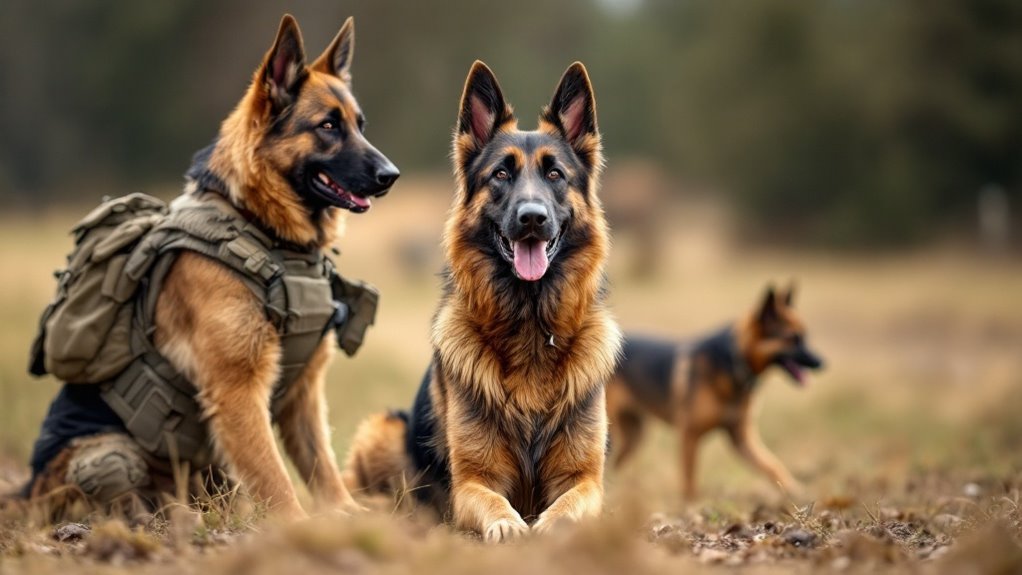
Male German Shepherds mature mentally around 18–24 months and typically need firmer, consistent boundaries and structured leadership to manage emerging dominance tendencies. Females reach mental maturity faster—around 12–18 months—and respond exceptionally well to positive reinforcement and social bonding. Males thrive with high-value rewards and 60–90 minutes of daily vigorous exercise, while females benefit from shorter, frequent training sessions combined with affection-based motivation. Both sexes require early socialization and consistent rules, though your experience level and chosen approach will ultimately determine success more than gender alone. Understanding these patterns helps you select the right strategy.
- Key Takeaways
- How Male and Female German Shepherds Learn Differently
- Why Male German Shepherds Need Firmer Leadership
- Why Female German Shepherds Respond to Positive Reinforcement
- Socialization Strategies for Each Gender
- Territorial Males vs. Protective Females
- Why Females Focus Better in Training
- Building Obedience in Male vs. Female German Shepherds
- Exercise and Mental Stimulation for Trainability
- Quick Assessment: Which Training Style Fits Your GSD?
- Frequently Asked Questions
- Conclusion
Key Takeaways
- Females mature mentally 6–12 months earlier and develop longer attention spans, enabling 10–15 minute focused training sessions.
- Males require firmer boundary-setting, shorter 5–10 minute sessions repeated three to five times daily, and high-energy physical outlets.
- Females respond exceptionally well to positive reinforcement and social bonding; males need consistent rules and high-value rewards.
- Males display stronger territorial and dominance tendencies during adolescence, requiring structured obedience and boundary training to prevent aggression.
- First-time handlers benefit from females’ reward-based responsiveness; experienced owners can effectively channel males’ protective drive with leadership.
How Male and Female German Shepherds Learn Differently
Male and female German Shepherds often develop their learning abilities on different timelines, which means you’ll need to adjust your training approach based on your dog’s sex and maturity level.
Male and female German Shepherds develop learning abilities on different timelines, requiring adjusted training approaches based on sex and maturity level.
Female German Shepherds typically show faster cognitive development, demonstrating longer attention spans and quicker comprehension of obedience basics as early as six to twelve months.
Male German Shepherds, conversely, mature mentally later, commonly requiring eighteen to twenty-four months before reaching comparable focus levels. This difference means you should expect extended adolescent phases with males, necessitating more repetition and structured training sessions.
Females respond exceptionally well to positive reinforcement and food-based rewards, often requiring fewer corrections to learn desired behaviors.
Males may test boundaries more frequently, so consistent leadership and clear rules become essential for successful training outcomes.
Why Male German Shepherds Need Firmer Leadership
During adolescence, German Shepherd males commonly display stronger territorial and dominance tendencies than their female counterparts, and consistent, firm leadership is what prevents these natural instincts from developing into serious behavioral challenges like resource guarding and mounting.
You’ll notice these behaviors emerge between six and eighteen months, when your male’s size and strength increase markedly. Without clear boundaries and predictable rules, he’ll test hierarchy through territorial marking and resistance to commands.
Firm leadership doesn’t mean harsh treatment; instead, it means establishing consistent routines, timed feeding schedules, and structured obedience work. A predictable approach reduces his motivation to challenge your authority, while positive-reinforcement correction reinforces acceptable behavior. This foundation prevents strength-based misbehavior from becoming entrenched patterns.
Why Female German Shepherds Respond to Positive Reinforcement
While male German Shepherds require firm structure to manage their territorial instincts, female German Shepherds typically respond with greater speed and reliability to positive reinforcement methods, a difference rooted in their faster mental maturity and stronger inclination to seek your approval.
Because female German Shepherds develop cognitively quicker than males, they grasp what you’re rewarding almost immediately, making treats, praise, and play highly effective motivators. Their longer attention spans and enthusiasm to please mean your training sessions can be shorter and more frequent—five to fifteen minutes multiple times daily—yet still build complex skills reliably.
Socialization Strategies for Each Gender
Because your German Shepherd’s gender shapes how she’ll respond to new people, environments, and other animals, tailoring your socialization approach during those critical early weeks will prevent many behavioral problems later.
Male German Shepherds require early socialization with confident adult dogs to channel their territorial tendencies and reduce same-sex dominance aggression, so structured encounters between 8–16 weeks are essential.
Females benefit from varied human interactions and gentle exposure to children and household noises during 8–14 weeks since they mature faster and form attachments readily.
When introducing new pets, pair males with opposite-sex partners and supervise closely due to higher territoriality, whereas females need monitoring around the home for resource-guarding and jealousy.
Use positive reinforcement and gradual, low-stress introductions for females, paired with consistent leadership-based boundaries for males to prevent dominance issues.
Territorial Males vs. Protective Females
Male and female German Shepherds express their guarding instincts in distinctly different ways, and recognizing these differences will help you shape appropriate protective behaviors rather than fighting instincts they’re naturally inclined toward.
Males typically display territorial aggression focused on property boundaries, while females concentrate their protective instincts on family members through vocal alerts and close proximity. You’ll notice these patterns emerging as their protective instincts develop, making gender-specific training essential.
To manage these tendencies effectively:
- Implement consistent boundary training and clear leadership for males to prevent escalating territory-driven aggression
- Reinforce controlled alert responses and recall commands with females to channel their barking appropriately
- Establish structured socialization during weeks 8–16 for both sexes
- Use place and leave-it commands to reduce possessive behaviors in males
- Apply desensitization and trade-up techniques for females showing resource guarding around their humans
Early socialization exposure remains vital for both genders, preventing inappropriate territorial and overprotective behaviors.
Why Females Focus Better in Training
Female German Shepherds’ protective instincts channel differently than males’, and this distinction extends into how they approach learning itself.
Your female German Shepherd typically matures mentally earlier than her male counterpart, often showing improved focus during training as early as 6–9 months, while males may remain distracted until 12–18 months.
This cognitive advantage translates into longer effective training periods per session, roughly 10–15% longer than males can sustain.
Additionally, females tend to demonstrate stronger keenness to please, responding more consistently to positive reinforcement, which accelerates their learning rates during reward-based training.
Their reduced territorial behavior also means they’ll progress more smoothly in group classes, where competing impulses don’t fragment their attention away from your instructions.
Building Obedience in Male vs. Female German Shepherds
You’ll find that male German Shepherds mature mentally slower than females, typically taking 6–18 months to settle into focus, which means they’ll need firmer, more consistent boundary-setting and repetition to manage their adolescent distractibility during training sessions.
Your reinforcement approach should shift between sexes, since males often respond better to structured leadership and high-energy physical outlets (60–90 minutes daily) that prevent frustration-driven noncompliance, while females typically thrive on shorter, frequent positive-reinforcement sessions (5–10 minutes, multiple times daily) that capitalize on their longer attention spans.
Consistency in your rules, rewards, and expectations becomes the foundation for obedience in both, but you’ll shape that consistency differently—males benefit from clear hierarchical structure and focused socialization to reduce territorial reactions, whereas females excel when you pair precision tasks like scent work with their natural drive to please.
Mental Maturity and Focus
When it comes to building obedience in German Shepherds, mental maturity plays a significant role in how quickly your dog will grasp and retain commands, and this development timeline differs noticeably between males and females.
Female German Shepherds typically reach mental maturity between 12–18 months, allowing you to see faster progress in obedience training and quicker mastery of advanced commands.
Males, however, often mature later—around 18–24 months—so you’ll encounter longer periods of adolescent distraction and inconsistent focus during training sessions.
Key differences in mental development:
- Females usually demonstrate longer attention spans during training repetitions
- Males require shorter, more frequent sessions to maintain engagement
- Female consistency emerges earlier in obedience work
- Male adolescent phases demand extra patience and reinforcement
- Both sexes benefit from structured routines and early socialization
Understanding these timelines helps you adjust your expectations and training approach accordingly.
Motivation and Reinforcement Styles
Male and female German Shepherds respond to training incentives in distinctly different ways, reflecting their developmental and behavioral differences. Males typically thrive with firm training that establishes clear boundaries, while females show stronger receptiveness to positive-reinforcement techniques that emphasize affection and proximity. Understanding these motivational patterns helps you select reinforcement strategies that match each dog’s natural temperament.
| Reinforcement Style | Male German Shepherds | Female German Shepherds |
|---|---|---|
| Primary Motivation | High-value rewards (meaty treats, favorite toys) | Social bonding (affection, praise, proximity) |
| Training Environment | Low-distraction settings during adolescence | Consistent, structured sessions with varied rewards |
| Reward Timing | Firm, immediate correction plus reward | Structured trade exercises and consistent timing |
You’ll find that males respond better to high-value rewards in controlled environments, reducing social distractions. Females benefit from incorporating affection into reward cycles, building obedience through relationship strengthening rather than dominance alone.
Consistency and Boundary Setting
While understanding what motivates your German Shepherd sets the foundation for training, actually applying those motivations through consistent boundaries determines whether obedience becomes a reliable habit. You’ll establish obedience most effectively by maintaining the same consistent rules and consequences daily, regardless of your dog’s sex or your mood.
Male German Shepherds require firmer boundary-setting early, since dominant behaviors emerge during adolescence. Females respond better when you combine consistent limits with positive reinforcement, leveraging their natural enthusiasm to please.
Both sexes benefit from:
- Short training sessions (5–15 minutes, 2–3 times daily)
- Clear leadership through daily structure
- Regular socialization with other dogs
- Predictable consequences for rule-breaking
- Reward-based responses to correct behavior
When you enforce the same boundaries consistently, obedience becomes automatic rather than situational.
Exercise and Mental Stimulation for Trainability
You’ll need to match your German Shepherd’s exercise intensity to their sex and energy level, since males typically require 60–90 minutes of vigorous physical activity daily to burn excess energy and prepare for training, while females often settle into focus with 45–60 minutes of activity due to earlier mental maturity and naturally longer attention spans.
Both sexes respond better to obedience and protection work when you provide 10–15 minutes of high-intensity play or a brisk run right before training sessions, which primes their responsiveness and reduces distractibility during instruction.
You’ll also want to integrate 20–30 minutes of daily mental stimulation through scent work, agility courses, and puzzle toys—tasks where females often excel at precision and males tend to outperform in strength-based challenges—since this cognitive engagement, combined with consistent physical exertion totaling 1–2 hours daily depending on age and sex, actively prevents problem behaviors and builds lasting trainability.
High-Energy Male Training Demands
High-energy male German Shepherds bring intensity to training, but that same drive that makes them capable working dogs also works against focus and obedience when their physical and mental needs go unmet. You’ll notice distraction, restlessness, and difficulty absorbing commands when exercise and stimulation fall short.
Address these demands through a structured approach:
- Provide 60–90 minutes of vigorous daily exercise, including running, fetch, or agility work
- Incorporate 20–30 minutes of mental stimulation through scent work, obedience drills, and puzzle feeders
- Schedule training in short 5–10 minute sessions, three to five times daily
- Practice impulse-control exercises like long stays and controlled greetings
- Pair high-intensity physical work with purposeful tasks such as tracking or protection sports
This combination reduces excess energy while building the focus necessary for reliable obedience and long-term trainability in your high-energy male German Shepherd.
Female Focus And Attention Span
Female German Shepherds mature mentally ahead of their male counterparts, and that earlier development shows up clearly in training—they demonstrate sharper focus and longer attention spans starting around 6–9 months old, while males often remain scattered through their adolescent months.
Your female dog’s attention span directly improves her trainability, allowing her to sustain concentration through 10–15 minute focused drills with fewer breaks than similarly aged males.
To leverage this advantage, structure 20–30 minute daily sessions combining obedience, nosework, and trick training with high-value rewards given at short intervals. Vary tasks within each session—aim for 3–5 different exercises—to maintain engagement and prevent boredom.
Pairing 45–60 minutes of physical activity with 15–30 minutes of structured mental work daily strengthens her focus, responsiveness, and impulse control.
Mental Stimulation For Behavioral Success
Because German Shepherds possess strong problem-solving instincts and high intelligence, they require consistent mental engagement alongside physical exercise to develop into well-behaved adults—and without it, boredom-driven behaviors like destructive chewing, excessive barking, and territorial aggression typically emerge during adolescence.
You’ll find that mental stimulation through structured training sessions prevents these issues while building the impulse-control your dog needs.
Dedicate 10–20 minutes daily to cognitive work using:
- Food-dispensing puzzles that reward problem-solving
- Scent games targeting your dog’s natural tracking ability
- Obedience drills reinforcing focus and restraint
- Task-based play combining physical and mental demands
- Impulse-control exercises like “place” work and sustained attention
This consistent mental engagement reduces boredom, strengthens your bond, and channels your German Shepherd’s intelligence productively rather than destructively.
Quick Assessment: Which Training Style Fits Your GSD?
Since German Shepherds display distinct differences between males and females—especially in temperament, maturity rate, and energy level—matching your dog’s needs to the right training approach matters more than following a one-size-fits-all method.
| Factor | Male German Shepherds | Female German Shepherds | Your Consideration |
|---|---|---|---|
| Leadership Style | Firm, consistent structure | Positive reinforcement focus | Match your natural approach |
| Session Length | Longer, task-oriented | Shorter, concentrated bursts | Adapt to attention span |
| Socialization Priority | Intensive dog-to-dog exposure | Balanced peer interaction | Prevent aggression patterns |
| Exercise Needs | 60–90 minutes daily | 60 minutes minimum | Manage energy appropriately |
Assess your experience level honestly. If you’re a first-time handler, reward-based training with females typically feels more manageable, while experienced owners can effectively channel males’ protective drive through structured, task-oriented programs. Your consistency determines success more than gender alone.
Frequently Asked Questions
What Is the Hardest Age With a German Shepherd?
You’ll find the adolescent period—roughly 6 to 18 months—the most challenging with your German Shepherd. Hormonal changes, increased independence, and boundary testing combine with physical growth spurts, creating restlessness that complicates training markedly.
Do Male or Female German Shepherds Make Better Service Dogs?
You’ll find that like two sides of the same coin, both serve equally well. Your choice depends on the specific task—females excel in focus-demanding roles, while males shine in strength-intensive work.
Conclusion
You’ll find that male and female German Shepherds don’t learn fundamentally differently, but they do respond to distinct motivational patterns based on temperament rather than gender alone. Your dog’s individual personality matters more than its sex, so observe your specific shepherd’s reactions to different approaches, then adjust your training structure accordingly. Consistency and appropriate reinforcement—whether firm guidance or positive rewards—determine success more reliably than applying gender-based assumptions alone.