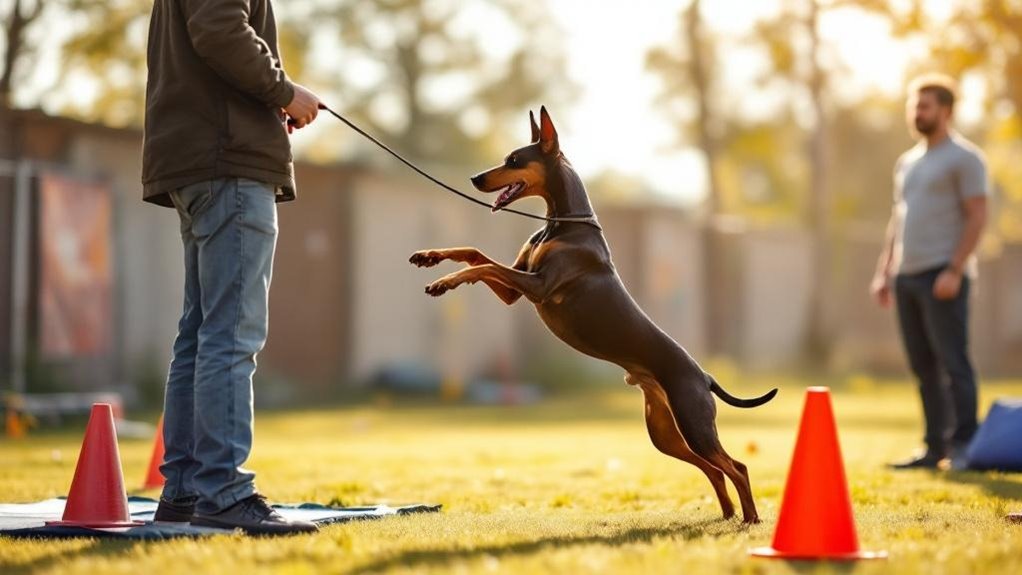
Your Doberman jumps on people because they’ve learned it gets attention—even scolding counts as a reward. To stop this, you must ignore jumping completely while teaching “sit” as an alternative behavior, then reward calmness instead. Consistency matters across your entire household, so everyone needs to follow the same rules. Managing triggers like doorbells and guests, plus ensuring adequate exercise, reduces jumping urges considerably. Understanding what drives your dog’s specific jumping pattern reveals the most effective approach for your situation.
- Key Takeaways
- Why Dobermans Jump: Understanding the Behavior
- How Attention Reinforces Jumping
- Understand Your Doberman’s Energy Triggers
- Check: Is Everyone at Home Following the Same Rules?
- Prevent Jumping Before It Starts: Management Strategies
- Create a Calm Environment for Training Success
- Teach the Sit Command as an Alternative Greeting
- Train Four Paws on the Floor Before Guests Arrive
- Use Leash Control During Greetings
- Ignore the Jump: Why Giving No Attention Works
- Reward Calm Behavior With Treats and Praise
- Prepare Your Guests for Proper Interaction
- Establish a Consistent Greeting Routine at the Door
- Practice Anti-Jumping Training in Multiple Environments
- Tire Out Your Doberman to Reduce Jumping Urges
- Prevent Jumping When Your Doberman Encounters Excitement
- Use Crates and Barriers as Temporary Tools
- Teach Your Doberman to Go to Their Place
- Why Your Doberman Still Jumps After Training: Common Mistakes
- Keep Your Doberman’s Good Behavior From Sliding Back
- Frequently Asked Questions
- Conclusion
Key Takeaways
- Ignore jumping completely—any attention, positive or negative, reinforces the behavior and must be eliminated.
- Teach and reward the sit command consistently as an alternative to jumping during greetings.
- Use physical barriers like leashes and gates to manage access to visitors and control situations.
- Exercise your Doberman regularly before training to reduce excess energy that triggers jumping behavior.
- Maintain consistency across all family members and prepare guests to ignore jumping and reward calmness.
Why Dobermans Jump: Understanding the Behavior
When your Doberman jumps on you or your guests, the behavior might seem like simple enthusiasm, but it’s actually a learned response that serves specific purposes in your dog’s mind. Your dog jumps because jumping has earned attention in the past, whether that attention was positive or negative, and dogs repeat actions that get rewarded with interaction.
New situations, visitors, or outdoor excitement can trigger increased jumping tendencies, as these environments elevate your dog’s arousal level. However, socialization greatly influences this behavior, since well-socialized dogs typically display better impulse control around people.
Understanding that jumping isn’t disobedience but rather a communication attempt helps you address it effectively through consistent training and structured reinforcement of alternative behaviors like sitting during greetings.
How Attention Reinforces Jumping
When you respond to your Doberman’s jumping with any form of attention—whether you’re pushing them away, speaking to them, or even making eye contact—you’re actually rewarding the behavior, since dogs don’t distinguish between positive and negative attention the way you do.
Your dog learns that jumping is an effective strategy to get what they want from you, and this connection strengthens every time you react, creating a cycle that becomes harder to break the longer it continues.
To interrupt this pattern, you’ll need to remove all attention during jumping and consistently redirect that attention only when your Doberman’s feet stay on the ground, which requires everyone who interacts with your dog to follow the same approach.
Why Dogs Repeat Jumping Behavior
Because your Doberman’s jumping results in attention—whether that attention is positive or negative—the behavior gets reinforced and becomes more likely to happen again.
When your dog jumps on people and receives acknowledgment, interaction, or even physical contact in response, that reaction serves as a reward, solidifying the behavior in their mind.
Even pushing your dog away provides the attention they’re seeking, making the jumping worthwhile from their perspective. Your visitors’ reactions, family members’ responses, and strangers’ engagement all contribute to this reinforcement cycle.
Each interaction teaches your Doberman that jumping is an effective strategy for gaining human contact. Understanding this pattern helps you recognize why consistency matters, since any attention—positive or negative—strengthens the unwanted behavior and makes it harder to eliminate.
Unintended Reward Signals
The jumping behavior you’re trying to eliminate persists largely because your Doberman’s interactions with people—you, your family, and visitors—deliver exactly what they’re after: attention and engagement.
Even negative attention, like pushing your dog away or scolding them, counts as unintended rewards that reinforce jumping. Your Doberman doesn’t distinguish between praise and reprimand; both provide the interaction they seek. When you engage with a jumping dog through any response, you’re fundamentally teaching them that jumping works.
To break this cycle, you must recognize that every interaction—positive or negative—strengthens the behavior. Consistency matters here: until your Doberman learns that jumping produces no rewards whatsoever, they’ll keep attempting it, hoping the next jump finally gets the attention they crave.
Breaking The Attention Cycle
Your Doberman’s jumping persists because you’re inadvertently caught in a cycle where every interaction—whether you’re petting, scolding, pushing away, or even making eye contact—registers as the attention they’re seeking.
To break the attention cycle, you must completely ignore your dog when jumping occurs, offering zero response of any kind. This means no talking, no touching, and no looking, since all these actions reinforce the behavior you want to eliminate.
Only when your Doberman’s four paws remain planted on the ground should you provide attention, praise, or treats. This consistent approach teaches your dog that jumping yields nothing while calm, grounded behavior produces the rewards they desire, effectively redirecting their greeting instinct.
Understand Your Doberman’s Energy Triggers
Why does your Doberman jump more in some situations than others? Understanding your Doberman’s energy triggers—the specific events that set off excitement and jumping—helps you manage behavior proactively.
Doorbells, arriving guests, and new environments often spark jumping because they activate your dog’s protective instincts and desire for social connection. Recognizing these patterns allows you to anticipate jumping before it happens rather than react after the fact.
Your Doberman likely jumps more when under-exercised, since excess energy demands an outlet, or when anxious about unfamiliar situations.
Check: Is Everyone at Home Following the Same Rules?
If your family members aren’t following the same rules about jumping, your Doberman will receive mixed signals that undermine your training efforts. The dog learns that jumping sometimes gets attention from certain people even when you’ve been ignoring it.
You’ll need to establish unified training protocols where everyone in your household agrees on which commands to use, like “sit” or “off,” and commits to ignoring jumping behavior consistently so your dog understands that the action never results in the attention it seeks.
Regular communication with family members about your Doberman’s progress and any adjustments to your approach will help maintain this consistency and reinforce the message that jumping doesn’t work.
Consistency Across All Family Members
One of the most common reasons training efforts fail is that different family members enforce different rules, which creates confusion for your Doberman and undermines your progress against jumping behavior. When one person allows jumping while another discourages it, your dog receives mixed signals about what’s acceptable, making consistency nearly impossible to achieve.
To strengthen your training, establish unified expectations across your household. Everyone should use identical commands like “sit” or “off,” ensuring your Doberman recognizes the same cues regardless of who’s giving instructions.
Schedule regular family discussions about training progress and expectations, allowing members to align their approaches and troubleshoot challenges together.
Practicing greetings consistently reinforces appropriate behavior, solidifying your dog’s understanding. This unified structure transforms training from fragmented efforts into a cohesive strategy that actually works.
Establishing Unified Training Protocols
Because your Doberman learns through repetition and pattern recognition, the rules she encounters must remain constant across every household member and every interaction, or her progress will stall.
When you say “sit” but your spouse says “down,” your dog receives conflicting signals that undermine training efforts, creating confusion rather than clarity.
You’ll establish unified training protocols by agreeing on specific commands, corrections, and rewards before training begins.
Schedule a family meeting to discuss which words you’ll use, how you’ll respond to jumping, and what treats or praise you’ll offer.
Document these decisions so everyone follows the same approach consistently.
This consistency transforms your household into a unified training environment where your Doberman understands expectations clearly, making learning faster and more reliable across all interactions.
Prevent Jumping Before It Starts: Management Strategies
Rather than waiting to correct jumping after it happens, you’ll find that preventing the behavior before it starts is far more effective and requires less effort overall. Management strategies work by controlling your Doberman’s environment, reducing opportunities for jumping to develop in the first place.
| Strategy | Action | Benefit |
|---|---|---|
| Physical barriers | Use baby gates or leashes | Limits access to visitors |
| Redirected focus | Cue “go to your place” | Channels excitement productively |
| Strategic rewards | Keep treats near entrances | Reinforces calm behavior |
| Required calm | Train sit before interactions | Establishes prerequisite for attention |
| Controlled atmosphere | Instruct guests to ignore dog | Reduces reinforcement of jumping |
You’ll restrict your dog’s access to situations where jumping occurs, keeping treats and toys nearby for distraction, and instructing visitors to ignore your Doberman until it sits calmly, creating structure that prevents unwanted behavior from taking root.
Create a Calm Environment for Training Success
While management strategies reduce jumping opportunities, your Doberman still needs a structured environment where it can actually learn to stay calm. This foundation makes all your training efforts far more effective.
Before each training session, establish a calm space by minimizing distractions and using soothing music or a quiet area to lower your dog’s excitement levels. Regular exercise beforehand dissipates excess energy, making it easier for your Doberman to focus on commands rather than act on impulses.
Use barriers or gates to restrict access to high-traffic areas during training, creating the controlled setting your dog needs to process new behaviors. This consistency in environment allows your Doberman to concentrate fully, strengthening the connection between calm behavior and positive reinforcement, which accelerates learning and builds lasting habits.
Teach the Sit Command as an Alternative Greeting
You’ll want to start with basic obedience by luring your Doberman into a sitting position with treats, then immediately rewarding the moment their rear touches the ground, which creates a clear association between the behavior and the reward.
Once your dog consistently sits on command in your home, you’ll gradually increase the distance and duration of the sit, practicing in different rooms and outdoor settings so they can perform reliably regardless of distractions or excitement levels.
Finally, you’ll involve family members and guests in the training process, having them withhold attention and petting until your Doberman sits first, which reinforces that sitting—not jumping—is the appropriate way to greet people.
Starting With Basic Obedience
Teaching your Doberman to sit on command establishes a clear, controlled alternative to jumping, giving your dog an appropriate way to greet people instead of launching toward them.
Start by practicing the sit command at a distance, rewarding your dog only when they comply with treats, then gradually increase difficulty as they master the behavior. If your Doberman stands up instead of sitting, retreat and repeat the command until they remain seated successfully.
Once your dog demonstrates consistent understanding, involve friends and family in training sessions to reinforce the sit command across different contexts and with various people.
Progressive Distance and Duration
Once your Doberman reliably sits on command in a controlled setting, the next step involves gradually increasing the challenge by bringing distance and real-world distractions into the equation, which teaches your dog that sitting remains the correct response even when greetings become more realistic and exciting.
Start by having your dog sit from several feet away, then slowly decrease that distance as you approach, rewarding each successful sit.
Next, introduce distractions by having friends or family members greet your Doberman while it maintains the sitting position, reinforcing calm behavior throughout the interaction.
Extend the duration gradually, rewarding your dog for staying seated longer during these practice sessions, building consistency that transfers to actual greetings.
Involving Family and Guests
While practicing sits with your Doberman in controlled settings builds a strong foundation, the real test comes when family members and guests enter your home, bringing unpredictable energy and excitement that can quickly undo your progress if everyone doesn’t follow the same approach.
You’ll need to brief all family members on the strategy before guests arrive. Explain that everyone must ignore jumping completely, making it unrewarding, and instead insist on a sit before offering attention or affection. This consistency matters tremendously because your dog will quickly learn which behaviors get results.
Use a leash during initial greetings to maintain control and reinforce sits with treats and praise. When your Doberman sits calmly, reward immediately so sitting becomes the preferred greeting method.
This unified approach prevents confusion and accelerates progress.
Train Four Paws on the Floor Before Guests Arrive
Before your guests arrive, you’ll need to establish a controlled environment where your Doberman can practice keeping all four paws on the floor, and tethering the leash to a stationary object is the foundation for this training.
This setup prevents jumping while you work on the desired behavior systematically.
Use treats strategically to reward your dog for remaining calm and grounded as guests approach, gradually extending the greeting duration as your Doberman improves.
Toss treats on the ground just before a guest reaches your dog, reinforcing the connection between staying grounded and positive outcomes.
Practice this routine consistently, only allowing greetings when your dog sits or maintains four paws on the floor.
As the behavior becomes habitual, gradually reduce treats while maintaining the structure that supports success.
Use Leash Control During Greetings
As your Doberman progresses with the foundation training, moving to leash control during actual greetings gives you the structure needed to manage jumping in real situations with visitors.
Leash control transforms greeting time into a controlled learning opportunity where you can reinforce calm behavior consistently. Here’s how to implement this strategy effectively:
- Keep your dog on a long leash during all guest interactions, allowing you to guide positioning while maintaining safe distance.
- Use gentle leash pops paired with the “off” command when jumping occurs, reinforcing the desired behavior immediately.
- Instruct guests to ignore your Doberman completely until it settles into a seated position.
- Practice greetings across different environments regularly, building your dog’s ability to stay calm regardless of location or visitor.
This reinforcement pattern teaches your dog that calm behavior, not jumping, earns attention and interaction with people.
Ignore the Jump: Why Giving No Attention Works
The leash control you’ve established gives you the foundation to teach your Doberman one of the most powerful lessons about jumping: that it doesn’t work.
When your dog jumps, you must ignore the jump completely—no talking, no eye contact, no physical contact of any kind. Dogs repeat behaviors that earn them rewards, and attention, whether positive or negative, counts as a reward. Scolding or pushing your dog away inadvertently reinforces the jumping because your Doberman receives the engagement it’s seeking.
Instead, practice consistent non-engagement, ensuring family members and guests do the same. This unified approach eliminates the mixed signals that confuse your dog about acceptable behavior.
Reinforcement of calm behavior with praise and treats creates a clear alternative, establishing the structure your Doberman needs to succeed.
Reward Calm Behavior With Treats and Praise
Now that you’ve established the foundation of ignoring jumping behavior, you’ll shift your focus to actively rewarding the calm behavior you want to see instead, which creates a powerful counterbalance to the attention-seeking jumping. This positive reinforcement strategy teaches your Doberman that staying grounded earns the rewards and attention they crave.
- Use a clicker or verbal cue paired with treats immediately after your dog sits or stays, creating a clear association between calm actions and rewards.
- Reward your dog consistently and promptly following the desired behavior, ensuring they understand exactly what earns praise.
- Gradually extend the duration and complexity of calm behaviors before rewarding, building a structured training foundation.
- Celebrate small progress moments to maintain positive engagement, showing your Doberman that calmness leads to attention.
This approach transforms the dynamic completely, making calm behavior more rewarding than jumping ever was.
Prepare Your Guests for Proper Interaction
Your training efforts at home won’t fully succeed unless your guests understand and follow the same approach, because inconsistent responses from visitors can quickly undo the progress you’ve established with your Doberman.
Before guests arrive, inform them that your dog needs to greet them calmly while sitting, and explain that ignoring jumping behavior prevents reinforcement.
Instruct visitors to approach slowly and quietly, using low voices and minimal movements to avoid overstimulating your dog.
Ask guests to wait until your Doberman sits before initiating interaction, which reinforces the desired calm greeting.
Teach them the “No Touch, No Talk, No Eye Contact” method until your dog demonstrates calm behavior, ensuring consistent structure that supports successful socialization and prevents your dog to jump.
Establish a Consistent Greeting Routine at the Door
You’ll want to start by preparing your environment and setting clear expectations before your dog ever reaches the door, which means deciding in advance whether you’ll use a leash, gate, or designated spot to manage your Doberman’s position during arrivals.
Once you’ve established your management setup, you can begin teaching the greeting routine itself by having your dog sit or place all four paws on the floor before any interaction happens, rewarding calm behavior immediately so your dog learns that settling down is what brings positive attention.
This consistency between your pre-arrival decisions and your actual doorway responses is what transforms occasional good behavior into a reliable routine, since your dog will start to predict that visitors mean an opportunity to earn rewards through calmness rather than excitement.
Pre-Arrival Preparation Steps
Three key elements—a designated space, controlled access through a leash, and a practiced command—form the foundation of a consistent greeting routine that discourages jumping before guests even arrive at your door.
Your pre-arrival preparation steps establish the structure your Doberman needs to remain calm during introductions.
You’ll want to implement these measures:
- Create a designated mat or bed where your dog stays until guests enter, containing their excitement in one location.
- Practice the “sit” command during training sessions until your Doberman responds reliably every time.
- Keep a leash nearby so you can maintain immediate control when the doorbell rings.
- Brief your guests beforehand to ignore your dog until it demonstrates calm behavior, reinforcing your training efforts.
This preparation transforms guest arrivals from chaotic events into predictable situations where your Doberman knows exactly what behavior you expect.
Doorway Behavior Management Techniques
Because your Doberman’s jumping behavior intensifies at the door—where excitement peaks and multiple stimuli converge—establishing a consistent greeting routine creates the structure needed to redirect that energy into calm, controlled behavior.
You’ll start by training your dog to sit before you open the door, which interrupts the impulse to jump. When your dog jumps, use a leash to maintain control and prevent interaction until all four paws touch the ground.
Inform guests in advance to ignore your dog until it settles, ensuring consistency across all greeting scenarios. Reward calm sitting with treats or praise, reinforcing the desired behavior through positive association.
This routine, practiced repeatedly, teaches your Doberman that sitting produces rewards while jumping eliminates attention.
Practice Anti-Jumping Training in Multiple Environments
While your Doberman may respond well to anti-jumping training in your home, that controlled environment doesn’t guarantee he’ll maintain calm behavior when encountering new settings, people, and distractions.
This is why practicing commands across multiple locations is essential for true consistency.
- Start in low-distraction environments where your dog can focus on commands without overwhelming stimuli.
- Gradually introduce busier areas like parks or streets to reinforce calm behavior around new people and activity.
- Use a long leash during practice sessions to maintain control and apply immediate corrections when jumping occurs.
- Incorporate diverse social situations with friends, family, and strangers who ignore your dog until he demonstrates calm behavior.
Monitor your Doberman’s responses across different environments, adjusting your techniques as needed to guarantee lasting progress in managing jumping behavior.
Tire Out Your Doberman to Reduce Jumping Urges
You’ll find that a tired Doberman jumps less often, since physical exercise like daily walks and runs burns off the excess energy that fuels jumping behavior.
Mental stimulation through puzzle toys, obedience training, and scent work exhausts your dog’s mind just as much as physical activity does, creating a calmer overall state.
Consistency in combining these exercise routines and structured activities guarantees your Doberman receives the balanced stimulation needed to manage impulses and reduce jumping urges over time.
Physical Exercise Requirements
One of the most effective ways to curb jumping behavior in Dobermans is to meet their substantial daily exercise needs, which typically require at least one to two hours of physical activity each day.
When you provide adequate physical exercise, you’re directly addressing the excess energy that fuels jumping behavior during interactions with people.
Consider these physical exercise options:
- Running or jogging alongside your Doberman to build endurance and burn significant energy
- Playing fetch in a secure area, which combines physical exertion with mental engagement
- Participating in agility training that challenges both body and mind simultaneously
- Taking structured daily walks at varied paces and environments to maintain consistency
Tired dogs naturally demonstrate calmer demeanor, making jumping less likely during greetings and social situations.
Mental Stimulation Activities
Because Dobermans possess keen intelligence and strong working drives, they require regular mental challenges just as much as physical exercise to stay calm and focused. When your dog lacks mental engagement, boredom builds and jumping behavior intensifies as a way to seek attention and stimulation.
Mental exercise directly addresses this pattern by occupying your Doberman’s mind, reducing excess energy that fuels jumping urges. Puzzle toys, obedience training, and scent work tap into their problem-solving abilities, while activities like hide-and-seek and trick training provide structured challenges that foster calmness.
| Activity Type | Duration | Frequency | Mental Benefit | Impact on Jumping |
|---|---|---|---|---|
| Puzzle toys | 15-20 min | Daily | Problem-solving skills | Reduces jumping |
| Obedience training | 10-15 min | 3-4x weekly | Focus and impulse control | Decreases jumping |
| Scent work | 20-30 min | 2-3x weekly | Concentration and engagement | Minimizes jumping |
| Agility basics | 15-25 min | 2x weekly | Reaction time and thinking | Calms jumping behavior |
| Hide-and-seek | 10-15 min | Daily | Mental engagement | Lowers jumping urges |
Rotating toys and introducing new challenges maintain consistent engagement, creating the calm demeanor you’re seeking.
Energy Management Strategies
When a Doberman’s energy levels remain unchecked, jumping becomes an inevitable outlet for their excitement and restlessness.
Implementing effective energy management strategies requires you to provide consistent physical and mental outlets that tire your dog, thereby reducing their jumping urges during social interactions.
- Schedule daily walks or runs to burn excess physical energy and calm their overall demeanor.
- Incorporate puzzle toys and obedience training sessions to tire them mentally and lower activity levels.
- Engage in interactive play like fetch or tug-of-war, channeling their energy productively.
- Arrange structured socialization with other dogs to release pent-up energy in controlled environments.
Prevent Jumping When Your Doberman Encounters Excitement
Your Doberman’s jumping becomes most challenging during moments of excitement, such as when guests arrive or when you’re about to take him for a walk, because these situations trigger his natural enthusiasm and desire for attention.
To stop jumping effectively, you’ll need to establish a controlled environment where your dog remains on a leash or in a confined space until he’s calm. Use management techniques like asking your dog to “go to your place” or positioning gates to limit access when visitors arrive, which minimizes jumping opportunities altogether.
Once he settles, reinforce calm behavior by rewarding him with treats or praise only when all four paws stay on the floor during greetings. This consistent approach teaches him that calmness, not jumping, earns your positive attention.
Use Crates and Barriers as Temporary Tools
Crates and barriers serve as structural management tools that reduce your Doberman’s jumping by controlling when and where he encounters exciting situations, making them especially valuable during the early stages of training.
These tools create physical boundaries that prevent unwanted jumping while keeping your dog secure and calm during high-excitement moments.
- Place your Doberman in a crate when guests arrive, allowing him to observe without direct access to people.
- Use baby gates to restrict entry to common areas, establishing a quiet zone away from greeting chaos.
- Combine crates and barriers during training sessions to minimize distractions and limit jumping opportunities.
- Gradually reintroduce your dog to guests using these tools, slowly increasing interaction as calm behavior improves.
Consistent application of crates and barriers, paired with positive reinforcement, creates the structure necessary for lasting behavior change.
Teach Your Doberman to Go to Their Place
Redirecting your Doberman’s impulse to jump requires teaching him an alternative behavior that’s incompatible with jumping, and designating a specific place like a mat or bed accomplishes this goal effectively.
Start by using positive reinforcement, rewarding your dog with treats and praise each time he successfully goes to his place on command. Practice consistently in your daily routines, gradually introducing distractions like arriving guests to strengthen the behavior across different contexts.
Increase the duration he stays in his place before rewarding, building patience and self-control over time. When visitors arrive, use barriers or leashes to guide him to go back to his designated spot, reinforcing the calm behavior you’re developing.
Why Your Doberman Still Jumps After Training: Common Mistakes
Even after you’ve invested time and effort into teaching your Doberman to go to his place, you might find that he’s still jumping when visitors arrive or when excitement builds. This frustration often stems from common training mistakes rather than a lack of ability on your dog’s part.
- Giving attention to jumping behavior – You inadvertently reinforce jumping by reacting to it, whether your response is positive or negative, since any attention rewards the behavior.
- Inconsistent rules across household members – Different people enforce different standards, confusing your Doberman about what’s actually acceptable.
- Skipping practice in distracting environments – Training only at home prevents your dog from generalizing his skills to real-world situations with visitors and excitement.
- Allowing occasional jumping in informal settings – Mixed signals undermine training progress and create confusion about when jumping is permitted.
Keep Your Doberman’s Good Behavior From Sliding Back
Because training progress can fade quickly without ongoing maintenance, you’ll need to actively reinforce your Doberman’s good behavior long after he’s mastered the basics. This means treating every interaction as an opportunity to either strengthen or weaken what you’ve taught him.
Consistency across your household prevents confusion, so everyone must enforce the same jumping rules without exception. When your dog keeps all four feet on the ground during greetings, reward that calmness immediately with attention and praise.
Monitor his behavior regularly for any regression signs, adjusting your techniques as needed. Structured routines during hellos—having guests ignore your dog until he sits—maintain the expectations you’ve established.
Without this ongoing reinforcement and structure, your Doberman will gradually revert to jumping, undoing months of progress.
Frequently Asked Questions
How to Stop a Doberman From Jumping on People?
You’ll teach your Doberman the “sit” command and reward calmness with treats. Use a leash during greetings, consistently ignore jumping, and reinforce all four paws staying on the floor.
What Is the 7 7 7 Rule for Dogs?
You’re basically running an emotional bank account with your dog—you’ll need seven positive interactions for every single negative one you dish out to keep their behavior balanced and thriving.
What Is Dancing Doberman Syndrome?
You’re dealing with Dancing Doberman Syndrome when your dog bounces on hind legs excitedly during greetings. You’ll notice this exuberant jumping stems from their natural breed temperament. You can manage it through consistent training and proper exercise routines.
How Do I Stop My Dog From Jumping on Me and People?
You’ll redirect your Doberman’s jumping by teaching “sit” and rewarding calm behavior consistently. Keep them leashed during interactions, have guests ignore jumping, and practice structured greetings regularly to reinforce desired behavior.
Conclusion
You’ve climbed the mountain by understanding your Doberman’s jumping stems from seeking attention, energy, or excitement. Now you’ll maintain that summit through consistent reinforcement, management strategies, and household unity. Your dog won’t regress if you continue rewarding calm behavior while preventing jumping opportunities, much like tending a garden requires ongoing care, not just initial planting. Stay vigilant with these practices, and you’ll enjoy a well-mannered companion.