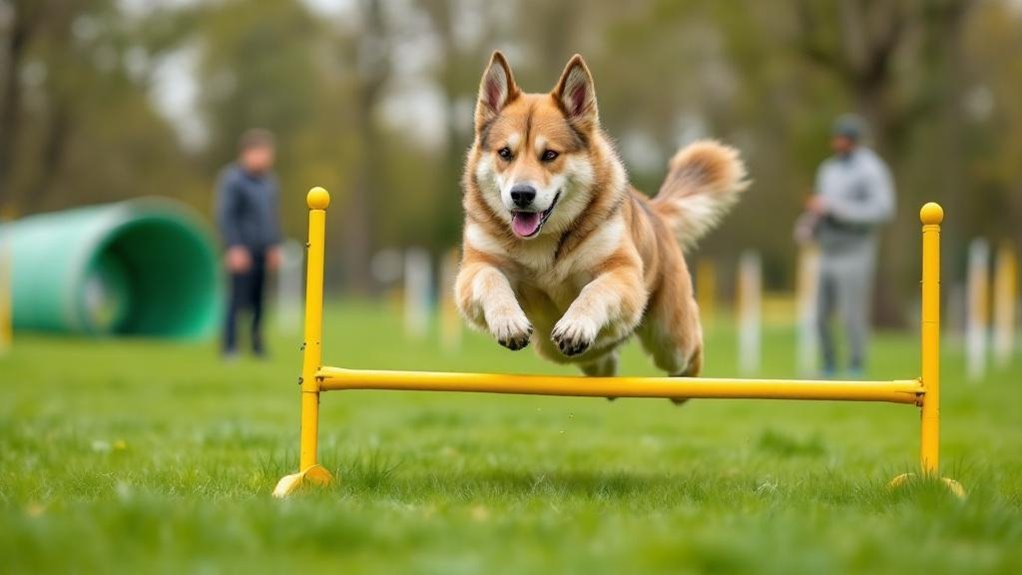
You can train your large breed dog for agility, but you’ll need to prioritize joint protection since their size creates extra stress on bones and ligaments. Start with low-impact conditioning using soft terrain, resistance bands, and swimming to build strength gradually. Make certain your dog is at least 15 months old with veterinary clearance, then progress through adjustable obstacles set at shoulder height or lower. Clear communication through verbal cues and hand signals guides your dog through courses safely. Understanding proper contact positions and core stability exercises prevents injury while building confidence for competition.
- Key Takeaways
- What Agility Actually Involves
- Decide If Agility Fits Your Large Breed
- Low-Impact Drills to Condition for Agility
- Find an AKC Agility Class Near You
- Set Up Home Training Equipment
- Understand Contact Positions and Why They Matter
- Teach the 4-Off Position to Prevent Joint Injury
- Use Nose Touch to Nail Clean Contacts
- Get Strong Enough to Handle Your Powerful Dog
- Strengthen Your Core for Better Control
- Prevent Injuries Before They Happen
- DIY Agility Courses for Your Backyard
- Teach Turn-Taking and Impulse Control
- Agility Training: Handling Pressure and Stress
- Prepare for Your First AKC Trial
- Fuel Your Large Dog for Agility Performance
- Frequently Asked Questions
- Conclusion
Key Takeaways
- Large breed dogs require adjustable jumps set at shoulder height or lower to protect vulnerable joints during agility training.
- Low-impact conditioning on soft surfaces like grass or sand builds foundational strength while minimizing joint stress and injury risk.
- Core stability and posterior chain exercises including glute bridges strengthen muscles necessary for balance and safe obstacle navigation.
- Ensure dogs are at least 15 months old with veterinary clearance before beginning structured agility training programs.
- The 4-off contact position keeps all four paws grounded, reducing injury risk compared to the 2-on 2-off position.
What Agility Actually Involves
When you enter the world of dog agility, you’re stepping into a structured sport where you and your dog work together to navigate an obstacle course as quickly and accurately as possible.
Dog agility is a structured sport where handler and dog navigate obstacle courses together, balancing speed with precision.
The agility course typically features 14 to 20 different obstacles, including tunnels, jumps, and weave poles, each designed to test your dog’s physical capability and responsiveness to your direction.
You’ll guide your dog through these challenges using both verbal cues and hand signals, which means clear communication becomes essential.
Success depends on balancing speed with precision, since knocking over jumps or missing weave poles results in penalties.
Your role involves reading the course layout beforehand, then directing your dog with confidence and consistency, reinforcing correct movements through the obstacles while maintaining an efficient pace throughout the entire run.
Decide If Agility Fits Your Large Breed
Before you commit to agility training with your large breed dog, you’ll need to honestly evaluate whether your dog’s personality and physical condition align with what the sport demands.
Assess your dog’s energy level first, since agility requires sustained enthusiasm for running and jumping. Your large dogs must also demonstrate the ability to focus amid distractions from other competing dogs, as this directly impacts their performance on courses.
Consider your dog’s age and health status, ensuring they’re at least 15 months old with veterinary clearance.
Evaluate your dog’s temperament for responsiveness to your commands, since strong communication forms the foundation of successful agility work.
These assessments guide your decision about whether agility represents a realistic and beneficial activity for your specific dog.
Low-Impact Drills to Condition for Agility
You’ll build foundation strength through low-impact drills like walking and gentle jogging on soft terrain, which develop your dog’s muscles and endurance without stressing the joints that large breeds rely on during agility work.
Progressive conditioning techniques—starting with simple exercises like weaving around cones, then advancing to swimming and tug-of-war with rope toys—allow you to increase your dog’s physical demands gradually while reinforcing commands that’ll matter during trials.
This structured approach creates the muscular base and mental readiness your dog needs before you introduce more demanding obstacles and movements.
Building Foundation Strength
Several foundational exercises form the backbone of agility conditioning for large breed dogs, and they’re designed to build the strength and stability your dog needs without stressing vulnerable joints.
You’ll want to establish a consistent fitness routine that prepares your large breed dogs for the physical demands of an obstacle course.
- Glute bridges and bodyweight squats develop core strength, providing the stability necessary for maneuvering agility equipment safely.
- Resistance band exercises enhance muscular conditioning while minimizing joint strain during building strength activities.
- Balance work, such as standing on one leg or using balance boards, fosters the coordination essential for obstacle course success.
Gradually increase exercise intensity and duration as your dog’s conditioning improves, reinforcing proper form through consistent practice and structure.
Progressive Conditioning Techniques
Now that your large breed dog’s foundation strength has improved through targeted exercises like glute bridges and resistance band work, you’re ready to introduce progressive conditioning techniques that build agility capacity while keeping joint stress low.
Walking on soft terrains like grass or sand engages your dog’s natural instincts for controlled movement while minimizing impact on joints. Start with low-height obstacles, focusing on technique rather than speed, so your dog learns proper form safely. Incorporate resistance bands into drills to build strength without excessive strain.
Consistency matters greatly here—combine these conditioning exercises with mobility routines that enhance flexibility and range of motion. This structured approach guarantees your large breed develops the endurance and muscular support necessary for successful agility performance.
Find an AKC Agility Class Near You
You can find structured AKC agility classes tailored to large breed dogs by visiting the American Kennel Club‘s official website, where a locator tool helps you identify clubs and classes based on your location.
Once you’ve identified options near you, you’ll discover that most classes meet weekly for about an hour, providing consistent training that develops your dog’s skills while building your handler foundation.
Joining an AKC club connects you with other dog enthusiasts who share your training goals, giving you access to personalized instructor guidance, networking opportunities, and a pathway toward competitive events if you choose to pursue them.
Getting Started With Classes
Finding a reputable agility class through an American Kennel Club club is one of the most practical ways to begin training your large breed dog, since these organizations offer introductory courses structured for different skill levels and taught by experienced instructors who can guide you through proper techniques for traversing obstacles safely.
Before you enroll, you’ll want to prepare by considering these essentials:
- Verify your dog’s age and fitness level, making sure he’s at least 15 months old and in good physical condition.
- Commit to weekly one-hour classes that provide consistent structure and foundational skill development.
- Plan to network with other handlers, gaining community support and shared learning experiences.
Since agility is a sport requiring proper form and conditioning, working with qualified instructors guarantees you and your dog develop safe habits from the start, building a strong foundation for future progress.
Building Your Training Community
Community and consistency form the backbone of successful agility training, and joining an AKC-affiliated agility class is one of the most effective ways to establish both.
You’ll find that structured classes meeting weekly for about an hour create the reinforcement your large breed dog needs to develop confidence with obstacles in a safe environment.
Beyond skill-building, you’re entering a network of fellow dog sports enthusiasts who share your goals and experiences. These connections foster friendships while providing practical support from handlers who understand the challenges you’re facing.
An AKC class also guarantees you’re learning proper techniques and competition rules alongside your dog’s physical development, which directly strengthens your performance potential.
Search your area’s AKC website to locate nearby classes and start building the community foundation your training requires.
Set Up Home Training Equipment
Creating a functional agility course at home doesn’t require expensive commercial equipment, since you can build effective obstacles using basic materials like PVC pipes, which you’ll arrange into jumps and weave poles according to standard agility specifications.
You’ll want to incorporate three essential elements into your setup:
Three essential elements create an effective home agility course: adjustable jumps, collapsible tunnels, and soft surfaces for injury prevention.
- Adjustable jumps set at shoulder height or lower to protect your large breed’s joints from excessive impact.
- Collapsible tunnels that build your dog’s confidence while developing speed through enclosed spaces.
- Soft surfaces like grass or carpet that cushion landings and reduce strain during training.
Practice for 15-20 minutes daily on your homemade course, maintaining consistency as your dog prepares for agility trials.
This structured approach develops muscle memory, reinforces obstacle skills, and keeps your dog engaged throughout the training process.
Understand Contact Positions and Why They Matter
Contact positions shape how your dog moves through obstacles, and understanding the differences between them—particularly the 4-off position, which keeps all four paws grounded as your dog descends and greatly reduces injury risk for larger breeds, versus the 2-on 2-off position, which carries greater risks of premature jumping and wasted runs—directly affects both safety and trial performance.
You’ll build consistency by teaching your dog to target a nose touch, a foundation skill that reinforces body control and strengthens the communication between you and your dog during contact work.
Starting with clean, controlled finishes over speed guarantees your dog develops the technique and confidence necessary for reliable execution, which ultimately translates to better scoring and fewer faults caused by improper contact zone exits.
The 4-Off Position Benefits
Keeping all four paws on the ground during contact obstacles—what we call the 4-off position—builds a foundation for safer, more controlled agility work with your large breed dog. This position offers several important advantages that directly improve both safety and performance:
- Reduces jumping and injury risk by encouraging consistent ground contact throughout the obstacle.
- Minimizes impact on forelegs during descent, protecting joints from unnecessary strain.
- Promotes balanced, efficient movement that prevents hopping into unstable positions.
You’ll notice that dogs using the 4-off position run contacts with greater control and precision. Teaching this position, often combined with a “down” command, reinforces stability and body awareness.
2-On 2-Off Position Risks
While the 4-off position builds a strong foundation for safe, controlled agility work, many trainers still encounter dogs working in the 2-on 2-off contact position, where the dog’s front paws leave the obstacle while the back paws remain in contact.
This 2-on 2-off position risks create several performance and physical challenges you’ll want to address. Dogs in this position often become unbalanced and distracted, which increases mistakes during runs. The impact on their forelegs upon descent can cause injury, since they’re bearing concentrated weight on fewer limbs.
Additionally, this position encourages hopping off the contact zone, wasting valuable time and disrupting rhythm. Head position and eye contact suffer too, impairing your dog’s focus on upcoming obstacles.
Recognizing these risks helps you redirect training toward more sustainable contact work.
Nose Touch Target Training
Redirecting your dog’s focus toward the contact zone itself, rather than simply racing through it, is where nose touch targeting becomes invaluable for building proper contact positions.
You’ll teach your dog to hit specific areas on obstacles by using clear commands like “go” paired with consistent positive reinforcement, which strengthens their motivation to execute the task correctly.
Here’s how nose touch targeting benefits your large breed dog:
- Lowers your dog’s head upon contact, reducing hard impacts and injury risk
- Promotes better balance and control during obstacle performance
- Facilitates smoother shifts to stable positions like the 4-off stance
Teach the 4-Off Position to Prevent Joint Injury
Because large breed dogs experience greater impact forces when descending obstacles, teaching them to keep all four paws on the ground at the end of an obstacle—known as the 4-off position—becomes essential for protecting their joints and ligaments.
This technique distributes weight evenly across all legs, reducing strain on the forelegs during descent. You’ll notice that the 4-off position prevents the balance issues that arise with the 2-on 2-off approach, particularly beneficial for larger dogs requiring stability.
To establish this consistently, teach your dog to lay down as part of the contact sequence, reinforcing the correct endpoint. Emphasize proper eye contact and head position throughout the descent, which contributes to overall stability.
This structured approach improves agility trial performance by prioritizing clean finishes over speed.
Use Nose Touch to Nail Clean Contacts
When you teach your dog to touch the contact obstacle with their nose, you’re encouraging a controlled head-down position that naturally slows their descent and reduces hard impacts on the target zone. This is especially important for large breeds prone to joint stress.
This technique works because it gives your dog a specific, achievable focus point rather than asking them to simply hit an area. The clarity of the task builds their confidence and commitment to executing the contact precisely.
You’ll solidify this behavior through consistent positive reinforcement each time your dog completes the nose touch correctly, creating a reliable pattern that translates into cleaner, safer contact performances during actual agility trials.
Why Nose Touch Works
How does a simple nose touch translate into cleaner, more controlled contact performances on agility obstacles? The answer lies in how this technique reshapes your dog’s physical approach and mental focus during training.
When you reinforce nose touches, you’re establishing a clear behavioral pattern that directly influences your dog’s temperament and body awareness.
Here’s why this method proves so effective:
- Nose touches naturally lower your dog’s head, improving balance and stability across contact zones.
- Repeated targeting reduces hard landings, preventing injuries from abrupt impacts on obstacles.
- Consistent reinforcement strengthens your dog’s ability to focus on specific contact areas.
Training The Contact Position
The foundation of clean contact performance rests on teaching your dog to commit fully to the contact zone with a deliberate nose touch, and this requires you to build a systematic training structure that rewards precision over speed.
Start by establishing a clear cue like “go” that signals your dog to target the contact obstacle with their nose, creating consistent communication during training the contact position. Use positive reinforcement immediately when your dog successfully hits the target, strengthening the connection between the action and reward.
Practice the “4-off” position regularly, ensuring all four paws remain grounded at the obstacle’s end, which reduces foreleg stress while improving balance.
This methodical approach builds confidence and accuracy, transforming your large breed dog’s contact performance into reliable, efficient runs that minimize injury risk.
Get Strong Enough to Handle Your Powerful Dog
Your body’s strength directly impacts your ability to safely manage a large breed dog during agility training, since you’ll need the muscle control and stability to guide, brace, and support your dog through demanding movements and unexpected shifts in direction.
Staying physically fit requires targeted work on key areas:
Staying physically fit requires targeted work on key areas: posterior chain strength, upper body resistance, and balance stability.
- Posterior chain strength—hamstrings, glutes, and core—prevents injury while controlling your dog’s power.
- Upper body resistance exercises, like half-kneeling rowing, enable effective management of larger dogs.
- Balance and stability work through glute bridges and squats maintains your position during course navigation.
Consistent strength training builds muscle memory, which reinforces your bracing ability during high-drive trials.
Include warm-ups and cool-downs in your routine to prepare your body and reduce injury risk, ensuring you’re ready for the physical demands ahead.
Strengthen Your Core for Better Control
While overall strength creates the foundation for managing your large breed dog, a strong core specifically gives you the stability and control needed when your dog shifts direction suddenly or pulls with full force during agility work.
Your core muscles act as your anchor point, allowing you to maintain balance during unpredictable movements on the course. Exercises like glute bridges and squats build both abdominal and back strength, creating a stable base for handling your dog effectively.
Adding resistance bands to your routine further enhances core stability and endurance. By developing muscle memory through consistent targeted exercises, you build the bracing ability necessary to guide your dog through complex sequences while reducing injury risk, ultimately improving your overall performance and communication on the agility course.
Prevent Injuries Before They Happen
Most large breed dogs can’t sustain intense agility work without proper preparation, since their size and weight place greater stress on joints, ligaments, and muscles than smaller breeds experience. You’ll need to prioritize injury prevention through deliberate planning and monitoring.
Large breed dogs require careful injury prevention and preparation before intense agility training due to joint and ligament stress.
- Warm up gradually before training, allowing muscles and joints to prepare for the work ahead.
- Watch for fatigue signs like slower responses or reluctance to jump, which signal you should end the session.
- Incorporate low-impact exercises such as swimming and gentle leash walks to build strength without excessive strain.
You can prevent injuries by starting with mobility routines that include cool-downs, maintaining consistency with your conditioning program, and adjusting intensity based on your dog’s physical condition.
This structured approach protects your dog while building the foundation needed for successful agility work.
DIY Agility Courses for Your Backyard
Building a backyard agility course doesn’t require expensive equipment or professional construction, since you can create effective obstacles from materials you likely already have at home. PVC pipes work well for jumps and tunnels, while weave poles made from vertical pipes spaced appropriately promote coordination.
Household items like planks function as balance beams, and hula hoops serve as jumping challenges. When designing DIY agility courses, keep jump heights lower than your dog’s shoulder height to prevent injury, especially for larger breeds.
Practice sessions of 15-20 minutes daily reinforce skills and strengthen your bond while providing necessary exercise. Consistency with your routine builds your dog’s confidence and improves their performance over time, making your backyard training both effective and sustainable.
Teach Turn-Taking and Impulse Control
Before your large breed dog can successfully navigate an agility course, they’ll need to master the foundation of patience and self-control that turn-taking provides. Your dog’s ability to wait for their turn directly impacts their performance on obstacles, preventing impulsive rushing that compromises technique and safety.
Build impulse control through these structured approaches:
- Use games like “Look At That” to redirect your dog’s focus away from distractions and toward the task at hand.
- Reward your dog’s willingness to wait between turns, reinforcing timing and patience during training sessions.
- Gradually increase task complexity to strengthen your dog’s ability to follow commands during actual agility runs.
Consistent practice develops your dog’s focus and self-discipline, which are critical for competitive success and safe performance.
Agility Training: Handling Pressure and Stress
As you work through agility training with your large breed dog, you’ll likely discover that managing your own stress and pressure is just as important as teaching your dog to stay calm on the course.
Handling pressure begins with recognizing that your tension directly affects your dog’s performance and behavior. Build resilience through consistent physical fitness practices, which strengthen both your body and mental composure during competitions.
Incorporate yoga and targeted stretches into your routine to reduce stress levels and maintain focus. Effective communication with your dog minimizes anxiety for both of you, creating stronger team dynamics.
When you practice these self-care habits regularly, you develop the muscle memory and conditioning necessary to stay composed when stakes feel high, ultimately enhancing your competitive success.
Prepare for Your First AKC Trial
Your dog’s eligibility forms the foundation for entering an AKC agility trial, so you’ll want to verify several requirements before registering. You’ll need to confirm:
- Your large breed dog is at least 15 months old and AKC registered
- Your dog maintains current vaccinations and a clean health status
- You’ve attended local AKC agility classes to understand trial rules
Building consistency in training helps you compete in Agility successfully. Focus on clean runs rather than speed to develop foundational skills, and familiarize your dog with all obstacles including hurdles, tunnels, and A-frames.
Mock trials at home simulate the competition environment, allowing your dog to adjust to the trial setting. This structured preparation reduces anxiety and builds confidence before your first official agility event.
Fuel Your Large Dog for Agility Performance
Fueling your large breed dog properly makes the difference between a sluggish performance and one where your dog maintains energy, focus, and physical resilience throughout training sessions and competitions.
You’ll want to provide high-quality protein, healthy fats, and essential vitamins and minerals that support your dog’s demanding energy needs.
Feed smaller, frequent meals to improve digestion and sustain consistent energy availability without fatigue.
Facilitate adequate hydration before, during, and after exercise, since large dogs dehydrate quickly during physical activity.
Incorporate glucosamine and omega fatty acids to support joint health and reduce inflammation.
After training, offer post-exercise nutrition combining protein and carbohydrates, which replenishes glycogen stores and promotes muscle repair.
This nutrition strategy directly reinforces your dog’s recovery and performance capacity.
Frequently Asked Questions
What Is the 7 7 7 Rule for Dogs?
You should give your dog at least 7 minutes of exercise daily for each month of their age. You’ll gradually increase activity as they mature, supporting healthy development and preventing obesity-related issues in large breeds.
How Do You Say “I Love You” in Dog Speak?
You’d tell your dog “I love you” by wagging an Instagram filter at them, then offering gentle ear scratches, soft vocalizations, and physical closeness. They’d reciprocate through tail wags, leaning against you, and bringing you their favorite toys.
At What Age Should a Dog Start Agility Training?
You can start basic agility training when your large breed dog reaches 9 to 12 months old. However, you’ll want to wait until they’re 18 to 24 months before doing high-impact activities to protect their joints.
What Is the 3-3-3 Rule for Dog Training?
Think of your dog’s adjustment like planting a tree—it needs time to root. The 3-3-3 rule means you’ll experience three shock days, three settling weeks, and three stabilizing months before your dog reveals its true personality.
Conclusion
You’ve built a foundation where your large dog transforms from a powerful force into a focused athlete, each hurdle you’ve cleared together becoming a stepping stone toward genuine partnership. Your consistency in training, combined with proper conditioning and structured reinforcement, releases your dog’s potential while protecting their joints and confidence. This journey requires patience and commitment, yet the rewards—a confident, obedient companion—extend far beyond the competition ring.