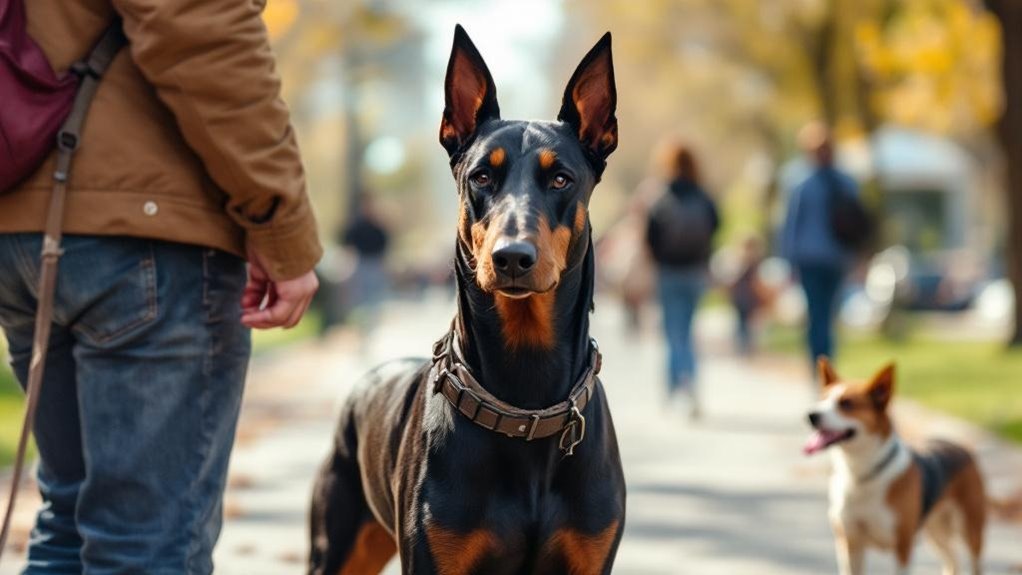
Start Early, Build Confidence. You’ve got a narrow window—weeks 8 to 16—when your Doberman’s brain is primed for learning. Introduce calm people, environments, and sounds gradually using high-value treats and praise within two seconds of good behavior. Match your pup with well-mannered dogs in neutral spaces, keep outings short, and watch for overstimulation signs like excessive barking. Touch desensitization matters too: gentle paw and ear handling paired with rewards builds trust for future vet visits. Proper socialization prevents fearful aggression while strengthening your dog’s natural protective instincts—but there’s much more to master.
- Key Takeaways
- Why Early Socialization Matters for Dobermans
- The Critical Window: 8 to 16 Weeks of Age
- Understanding Your Doberman’s Protective Instinct
- What Happens Without Proper Socialization: Anxiety and Aggression
- Building Confidence Through Positive Experiences
- Creating Your Puppy Socialization Checklist
- Prioritizing Your Socialization Goals
- Introducing Your Doberman to Different Environments
- Controlled Meet-and-Greets With Well-Behaved Dogs
- Exposing Your Puppy to Varied Sounds and Sights
- Meeting New People: Strangers, Children, and Visitors
- Teaching Your Puppy to Enjoy Handling and Touch
- Visiting Dog Parks and Public Spaces Safely
- Using Puppy Classes to Build Social Skills
- Extending Socialization Beyond Puppy Classes
- Walking in Diverse Neighborhoods and Terrain
- Introducing Car Rides and Travel Early
- Introducing Your Puppy to Other Animals
- Recognizing and Preventing Overstimulation
- How to Respond When Your Puppy Shows Stress
- Your Voice: Your Superpower
- Body Language: Less Is More
- Touch With Intention
- The Safe Space Strategy
- Addressing Fear Responses and Reactivity
- Positive Reinforcement During Social Experiences
- Maintaining Socialization as Your Doberman Matures
- Why Socialization Supports Natural Protective Instincts
- Common Socialization Mistakes to Avoid
- Socializing Rescue or Adult Dobermans
- Building Your Personalized Socialization Plan
- Frequently Asked Questions
- Conclusion
Key Takeaways
- Start socialization between 8-16 weeks old with controlled introductions to people, environments, and sounds in quiet spaces first.
- Desensitize your Doberman to touch on sensitive areas like paws and ears using treats and praise from 8-12 weeks.
- Expose your puppy to calm, well-behaved dogs in neutral territory with matching energy levels to prevent stress.
- Verify vaccinations before visiting parks and public spaces, keeping the leash tight while monitoring for signs of overstimulation.
- Reward calm greetings and relaxed body language immediately with high-value treats within one to two seconds for consistent results.
Why Early Socialization Matters for Dobermans
Because Dobermans are naturally protective dogs, they’re prone to anxiety and aggression when they don’t encounter unfamiliar people and places early on.
Your Doberman puppies need exposure during their critical window: 8 to 16 weeks old.
What happens without socialization?
Insufficient early contact triggers fearful aggression—your protective pup misinterprets strangers as threats. Their instincts amplify defensive responses, making them unpredictable companions.
The transformation socialization creates:
- Confident, well-rounded temperaments
- Reduced stranger anxiety
- Controlled protective instincts
- Adaptable behavior across environments
When you expose Doberman puppies to diverse people, animals, and settings now, you’re literally rewiring their neural pathways.
They learn: New situations aren’t dangerous. This balanced foundation prevents behavioral problems later.
Early socialization doesn’t eliminate protective traits—it channels them appropriately.
You’re building a trustworthy guardian, not an anxious reactor.
The Critical Window: 8 to 16 Weeks of Age
You’ve got a narrow, golden window—just eight weeks—to shape your Doberman’s entire personality and confidence level.
During this peak learning period, your puppy’s brain is fundamentally a sponge, absorbing every experience and building neural pathways that’ll influence how they react to the world for life.
Here’s the real kicker: the positive exposures you create now—new sounds, different people, varied environments—literally rewire their developing nervous system, transforming a potentially anxious dog into a confident, well-adjusted adult.
Early Exposure Builds Confidence
During the first four months of your Doberman’s life—specifically between 8 and 16 weeks—their brain’s neural pathways are forming at lightning speed, and what they experience now literally shapes who they’ll become.
Why Early Exposure Matters
Your puppy’s confidence builds through positive encounters. Each new person, sound, and environment strengthens their neural connections—think of it like installing permanent software in their developing brain.
Building a Confident Adult
Early exposure creates resilient dogs. When you introduce your pup to diverse situations safely, they learn the world isn’t threatening.
They’ll greet strangers calmly. They’ll handle unfamiliar places without anxiety.
Your Action Plan
- Arrange controlled meetings with friendly people
- Visit different environments regularly
- Expose them to various sounds and textures
- Pair novel experiences with treats and praise
Confident puppies become confident adults. Your investment now prevents future behavioral problems.
Peak Learning During Development
Think of your Doberman’s brain like a sponge during weeks 8 to 16—it’s absorbing everything, fast. This critical window shapes your pup’s future behavior, confidence, and socialization skills permanently.
During this peak learning period, you’re literally rewiring your puppy’s neural pathways—the brain’s communication highways. Positive experiences now prevent fearfulness and anxiety later.
Here’s what you’ll want to prioritize:
- Introduce varied people in calm, controlled settings—different ages, appearances, voices.
- Expose puppies to diverse environments—parks, streets, indoors, new surfaces.
- Arrange supervised interactions with well-trained older dogs as positive role models.
Avoid chaotic dog parks initially; unpredictable behaviors create lasting fear. Instead, carefully orchestrate every encounter.
Your Doberman’s foundation depends on these 8 weeks. Make them count.
Understanding Your Doberman’s Protective Instinct
Your Doberman’s protective nature isn’t a behavioral quirk—it’s hardwired into their DNA. Breeders developed this breed in 19th-century Germany specifically for guarding tax collectors. That means your dog carries centuries of guardian genetics.
What This Means for You
Your Doberman naturally monitors their territory and watches for threats. They’ll stay alert to unfamiliar sounds, strangers, and unusual activity. This vigilance? It’s a feature, not a bug.
Your Doberman naturally monitors their territory and watches for threats. This vigilance is a feature, not a bug.
The Balance You Need
Without proper socialization, protection can flip into anxiety or aggression. Your dog might misread friendly neighbors as genuine dangers.
Early, consistent exposure to varied people and environments teaches them discernment—the ability to distinguish real threats from harmless situations.
Understanding this instinct helps you channel it constructively, building a confident guardian who protects wisely.
What Happens Without Proper Socialization: Anxiety and Aggression
During weeks 8 to 16, your Doberman’s brain forms critical neural pathways. Missing this window creates lasting problems:
- Anxiety escalates into fear-based aggression—your dog perceives threats everywhere, barking excessively or acting defensively.
- Separation anxiety develops, causing destructive behavior when you’re away.
- Unfamiliar environments trigger panic, preventing normal coping mechanisms.
Without proper exposure, poorly socialized Dobermans struggle distinguishing real dangers from imaginary ones.
They’re not inherently aggressive—they’re terrified. This anxiety compounds over time, making rehabilitation increasingly difficult.
Proper socialization shatters the “aggressive breed” myth entirely.
It’s not optional; it’s foundational.
Building Confidence Through Positive Experiences
The good news? You can absolutely transform your Doberman’s trajectory through strategic socialization. During that essential 8-to-16-week window, your puppy’s brain is like a sponge—absorbing experiences that shape lifelong confidence.
Your Action Plan:
Controlled Exposure Matters. Introduce your pup to diverse people, animals, and environments gradually. Each positive interaction builds neural pathways associated with safety and trust.
Leverage Puppy Classes. Structured settings provide mentorship from well-trained older dogs. Your Doberman learns appropriate behavior through observation and positive reinforcement simultaneously.
Reward Everything Right. Consistently praise social interactions. This reinforces confidence, making future engagements manageable and genuinely enjoyable for your dog.
The result? A balanced, secure adult Doberman who navigates new situations with ease rather than anxiety.
Creating Your Puppy Socialization Checklist
Your socialization checklist transforms abstract goals into actionable steps.
You’ll track exposures systematically—ensuring your puppy experiences diverse environments during their critical 8-to-16-week window. This period matters because puppies’ brains are wired to accept new stimuli more readily.
Create your personalized checklist with these essential categories:
- Locations: parks, vet clinics, busy streets, pet stores
- People types: children, seniors, individuals wearing hats or sunglasses
- Animal interactions: controlled playdates with well-trained older dogs
Checking off items builds momentum and prevents gaps.
You’ll notice your Doberman growing visibly calmer—less reactive, more assured. A structured approach transforms socialization from overwhelming to manageable, setting your puppy up for lasting confidence.
Prioritizing Your Socialization Goals
Once you’ve mapped out your socialization checklist, it’s time to get strategic about which experiences matter most. Your Doberman’s brain develops rapidly—particularly during the essential socialization window before 16 weeks.
This timing’s vital because their neural pathways are forming, making early exposure incredibly impactful.
Focus on Quality Over Quantity
Rather than overwhelming your pup, prioritize controlled introductions. Visit dog-friendly parks gradually.
Meet calm strangers consistently. These targeted experiences build genuine confidence—not just exposure.
Monitor and Adjust
Pay attention to your puppy’s responses. Does she seem anxious? Excited?
Her reactions guide your next moves. Tailor ongoing socialization based on what you observe.
Build Polite Foundations
Reward calm greetings and politeness during interactions.
This prevents jumping and aggression later. Your strategic approach guarantees your Doberman develops into a well-adjusted companion.
Introducing Your Doberman to Different Environments
While your pup’s brain is rapidly forming neural pathways—particularly before 16 weeks—there’s a critical window you won’t want to miss. Introducing your Doberman to different environments during this period builds confidence and reduces future anxiety.
Your Environmental Exposure Strategy
Start with controlled interactions in varied settings. Here’s your roadmap:
- Begin in quiet spaces, then progress to busy streets and pet-friendly stores
- Use positive reinforcement techniques—treats and praise—when your Doberman stays calm
- Keep outings short and engaging to maintain enthusiasm
Building Adaptability
Monitor your dog’s responses closely. Adjust exposure levels to minimize stress. Each positive experience strengthens your Doberman’s social development.
You’re fundamentally rewiring their nervous system toward confidence.
Early socialization fundamentally rewires your Doberman’s nervous system toward lasting confidence and resilience.
Why does this matter? Your Doberman learns that new situations equal good things—not threats.
Controlled Meet-and-Greets With Well-Behaved Dogs
You’re ready to introduce your Doberman to other dogs—but here’s the key: you’ll want carefully chosen, calm companions who won’t overwhelm your pup.
Selecting the right playmates means understanding your dog’s personality and matching it with equally well-behaved partners.
Managing that essential first meeting requires the right environment, loose leashes, and your watchful eye on body language signals that indicate comfort or stress.
Selecting Compatible Playmates
Because your Doberman’s social success depends heavily on choosing the right companions, prioritizing well-behaved, calm, and friendly dogs isn’t just smart—it’s critical.
Energy Level Matching
Compatible playmates share similar energy levels with your Doberman. A hyperactive dog paired with a calm one? That’s stress waiting to happen. You’ll want to observe potential playmates first—do they match your dog’s enthusiasm?
What to Look For:
- Dogs displaying relaxed body language and confident (not aggressive) demeanor
- Playmates with similar size and play styles to prevent injury or intimidation
- Well-socialized dogs with positive interaction history
The Reality
Mismatched energy levels trigger aggression or anxiety in either dog.
You’re fundamentally creating compatible playmates by selecting dogs whose personalities complement your Doberman’s temperament.
This foundation prevents future conflicts and guarantees enjoyable, stress-free play sessions.
Managing First Meeting Dynamics
The first meeting sets everything—literally everything. Your Doberman’s future social confidence depends on this moment.
Setting the Stage for Success
Choose neutral territory—a park, quiet street, or friend’s yard works perfectly. Neutral ground reduces your Doberman’s territorial instincts. Both dogs must wear leashes for safety and control.
The Gradual Approach
Start with visual contact from a distance. Watch body language closely: relaxed ears? Soft eyes? These signal comfort. Gradually move closer as confidence builds.
Building Positive Associations
Treats and praise are your secret weapons. Reward calm behavior immediately. When your Doberman stays relaxed around the other dog, mark that moment with enthusiasm.
Timing Matters
Keep initial meetings brief—just 5-10 minutes prevents overwhelming either dog. Short, successful experiences build confidence faster than lengthy sessions.
Stay Alert
Monitor constantly. If aggression or stress appears, separate immediately.
Exposing Your Puppy to Varied Sounds and Sights
During their critical socialization window—roughly 8 to 16 weeks of age—Doberman puppies’ brains are primed to accept new experiences like sponges absorbing water.
This prime window determines your puppy’s confidence throughout life.
You’ll want to expose your Doberman to diverse auditory and visual stimuli systematically.
Here’s your exposure strategy:
- Sound desensitization: Introduce doorbells, vacuum cleaners, and thunderstorms gradually—building tolerance without triggering fear responses.
- Visual exposure: Present moving objects like bicycles, cars, and crowds in controlled settings where your puppy feels safe.
- Positive reinforcement: Reward calm reactions with treats and praise, cementing confidence during each encounter.
Why it matters: Early socialization prevents anxiety-driven behaviors later.
You’re fundamentally programming your Doberman’s neural pathways toward adaptability and trust.
Start small, increase complexity gradually, and watch your puppy flourish.
Meeting New People: Strangers, Children, and Visitors
Beyond sounds and sights, your Doberman’s next critical challenge is people—and you’re their guide through this social minefield.
Introducing Strangers Successfully
You’ll want to introduce new people gradually. Let visitors approach calmly without overwhelming your pup. This builds positive associations naturally.
Children and Your Doberman
Supervise all interactions carefully. Teach kids to offer treats or toys during greetings. This creates gentle, friendly connections.
Reinforcing Calm Behavior
When your Doberman stays relaxed around visitors, praise them immediately and offer treats. This strengthens their confidence and reduces anxiety through positive reinforcement.
Diverse Socialization Matters
Incorporate frequent encounters with various adults and children. This promotes adaptability—your dog learns different people exist and aren’t threats.
Consistency Wins
Family members must use identical commands and expectations. Unified training approaches reinforce your Doberman’s social skills effectively.
Teaching Your Puppy to Enjoy Handling and Touch
You’ve got a critical window between 8 to 12 weeks—when your Doberman puppy’s brain is like a sponge for new experiences.
Starting early touch desensitization now means your pup won’t freak out during grooming, vet visits, or nail trims later on.
Let’s explore how you can build those positive handling associations that make your puppy actually *enjoy* being touched instead of dreading it.
Early Touch Desensitization Techniques
The foundation of a confident, well-adjusted Doberman starts with one simple truth: your puppy’s comfort with handling directly shapes their behavior as an adult.
Begin this critical touch desensitization work at 8 weeks old. Your puppy’s brain is remarkably plastic—meaning it’s moldable and adaptable during these early weeks.
Here’s your strategic approach:
- Start small and gentle. Use soft, brief touches on their paws, ears, and coat for just seconds initially.
- Pair touch with rewards. Offer treats and enthusiastic praise immediately when your puppy tolerates handling calmly.
- Gradually expand exposure. Slowly increase touch duration and intensity as comfort builds.
Integrate handling into daily routines—brushing, playtime, feeding. This normalizes touch as a positive, expected part of life.
Your consistency builds trust and confidence that’ll serve your Doberman throughout adulthood.
Building Positive Handling Associations
It all comes down to this: your puppy’s early experiences with touch literally rewire their brain’s response to handling. You’re fundamentally programming their nervous system—think of it like software updates for confidence.
The Power of Positive Reinforcement
Use treats and praise strategically. When you touch your puppy’s paws, ears, or tail, immediately reward them. This creates neural pathways that associate handling with good things happening. Your puppy learns: touch equals treats, not threat.
Making It Work
Keep sessions brief—5 to 10 minutes maximum. Short bursts prevent overstimulation and maintain enthusiasm.
Gradually introduce different handling types across various environments. Consistency matters tremendously. Your calm demeanor during these exercises directly influences your puppy’s emotional response, building genuine confidence rather than mere tolerance.
Visiting Dog Parks and Public Spaces Safely
Before your Doberman bounds into a dog park, several critical preparations’ll keep them—and everyone else—safe and happy.
Essential Pre-Visit Checklist
- Verify vaccinations – Confirm your Doberman’s fully protected against diseases spread in public spaces before exposure.
- Start with distance – Observe other dogs from afar first; let your pup gauge comfort gradually through dog training exercises.
- Keep the leash tight – Maintain control during initial visits, preventing overwhelming situations.
Managing the Experience
Watch your Doberman’s body language closely. Cowering, excessive barking, or tail-tucking signals stress—leave immediately and retry later.
Bring high-value treats everywhere. Reward calm behavior around unfamiliar dogs and people, reinforcing positive associations through consistent dog training.
These systematic steps transform chaotic park visits into confidence-building experiences. Your Doberman’ll develop social skills naturally—not forced.
Using Puppy Classes to Build Social Skills
While dog park visits build confidence through real-world exposure, puppy classes offer something equally valuable: controlled learning environments.
Why Puppy Classes Matter
You’ll want to enroll your Doberman in puppy classes by 16 weeks old. This timing matters because puppies have a critical socialization window—a biological period when their brains absorb social lessons most effectively.
Puppies have a critical socialization window where their brains absorb social lessons most effectively—enroll your Doberman in classes by 16 weeks.
What You’ll Gain
Professional trainers guide you through:
- Managing your Doberman’s protective instincts
- Channeling their high energy productively
- Teaching appropriate greeting behaviors
- Handling distractions confidently
The Format
Most puppy classes run 8-12 weeks, meeting weekly. This consistency reinforces learning and exposes your pup to diverse situations repeatedly.
Your Role
You’re not just watching. You’ll learn effective handling techniques and training principles to apply daily.
This partnership between you and trainers accelerates your Doberman’s social development considerably.
Extending Socialization Beyond Puppy Classes
Puppy classes lay the groundwork, but your Doberman’s real education happens in the messy, unpredictable world outside the classroom.
Socialization extends far beyond structured lessons. Your dog needs exposure to life’s actual complexity—the sights, sounds, and situations they’ll genuinely encounter.
Three Essential Socialization Strategies:
1. Diverse Environments — Take your Doberman to busy parks, pet-friendly stores, and community events.
These unpredictable spaces build genuine confidence and reduce anxiety in unfamiliar settings.
2. Social Interactions — Arrange playdates with well-mannered dogs and introduce your pup to various people: children, elderly individuals, and those with disabilities.
Positive experiences here create lasting comfort.
3. Real-World Exposure — Regular car rides to different locations gradually desensitize your dog to novel situations, preventing fear responses later.
Group training sessions reinforce skills while offering peer interaction.
Your Doberman thrives when challenged appropriately.
These experiences shape a confident, well-adjusted adult dog.
Walking in Diverse Neighborhoods and Terrain
As your Doberman grows beyond puppy classes, the real world becomes their classroom—and your neighborhood is the perfect textbook.
You’ll want to expose them to varied environments that challenge their confidence and build essential socialization skills.
Mix Urban and Natural Settings
Alternate between bustling city streets and peaceful parks. Busy neighborhoods teach your dog to navigate crowds, traffic sounds, and unfamiliar faces.
Natural terrains—hiking trails, grassy fields, sandy beaches—improve their adaptability and physical coordination.
Progress Gradually
Start with quieter areas, then advance to crowded spaces. This measured approach prevents anxiety while building comfort.
Use treats and praise when your Doberman encounters distractions calmly. Consistent exposure prevents fear-based behaviors, creating a well-rounded, confident adult dog who thrives anywhere you venture together.
Introducing Car Rides and Travel Early
You’ll want to start introducing your Doberman to car rides at just 8 weeks old—when puppies’ brains are most adaptable to new experiences.
Short trips to fun places like parks build positive associations, so your dog learns that cars mean adventure, not anxiety.
Gradually lengthening these journeys—combined with secure crating and praise—transforms travel from stressful to something your Doberman genuinely anticipates.
Early Exposure to Vehicles
Early exposure to vehicles during this critical developmental window builds their confidence considerably.
Here’s how to make it work:
- Start with short trips to fun places—parks, friends’ homes, anywhere positive.
- Keep initial rides brief so they don’t feel overwhelmed by sound and movement.
- Use a secure crate or seatbelt for safety and good habit formation.
Building Lasting Comfort
Gradually lengthen car rides as your Doberman adapts.
Expose them to different vehicles and road conditions. This varied experience transforms nervous puppies into calm, adaptable traveling companions who actually enjoy adventures with you.
Building Travel Confidence Gradually
Once your Doberman puppy masters the basics of home life, it’s time to expand their world—starting with the car.
Start Small and Smart
Begin with stationary exploration. Let your pup investigate the vehicle while parked—sniff seats, check compartments, get comfortable. This training foundation reduces anxiety before wheels turn.
Your First Trips Matter
Keep initial rides brief and destination-focused. Visit parks or favorite spots. Your dog associates cars with fun, not fear. Secure them properly using crates or harnesses—safety first, always.
Build Real Confidence
Repeat outings frequently with varied routes. Longer journeys come naturally as comfort increases.
Dobermans are intelligent working dogs; they adapt quickly when training feels rewarding rather than stressful.
Consistency creates confident travelers. Your puppy’s positive experiences today prevent tomorrow’s travel anxiety.
Introducing Your Puppy to Other Animals
Bringing your Doberman puppy into contact with other animals is one of the most essential steps in their development—and it doesn’t have to be stressful for anyone involved.
Strategic Socialization Approach
Proper socialization builds your puppy’s confidence and prevents fear-based aggression later. Here’s your action plan:
- Start with calm, well-mannered dogs to establish positive interactions without overwhelming your pup.
- Use a leash during early encounters for safety while allowing observation and gradual interaction.
- Reinforce positive behavior with treats and praise, creating favorable associations with other animals.
Monitor Body Language Closely
Watch both your puppy and other animals for stress signals. Are ears pinned back? Is your pup retreating?
Intervene immediately if discomfort appears. Controlled environments prevent negative experiences that could damage future relationships with other pets.
Recognizing and Preventing Overstimulation
How do you know when your Doberman’s had enough? Watch for excessive barking, whining, or hyperactive behavior—these signals scream that your pup needs a break. Overstimulation happens when your dog’s nervous system becomes overwhelmed by too much activity, noise, or social interaction at once.
| Sign of Overstimulation | What It Means |
|---|---|
| Excessive barking or whining | Your dog feels overwhelmed |
| Hyperactivity or restlessness | Nervous system is overloaded |
| Panting heavily | Physical stress response occurring |
| Avoidance or hiding | Your dog seeks safety |
| Inability to focus | Mental fatigue setting in |
Prevention strategies work best. Keep training sessions short—around 15 minutes keeps focus sharp. Gradually expose your Doberman to new environments at their pace. Provide a quiet retreat space where they can recharge. When you spot stress signs, move to calmer locations immediately. This proactive approach prevents behavioral problems down the road.
How to Respond When Your Puppy Shows Stress
When your Doberman puppy displays stress signals—excessive barking, pacing, or hiding—you’ll need to act fast and create the calm environment they’re desperate for.
You can use gentle petting, soothing vocal tones, and reassurance to help them feel secure, which actually triggers their parasympathetic nervous system (the body’s natural calming response).
Recognizing Stress Signals
Your Doberman’s body speaks volumes—if you know what to listen for.
Common Stress Signals Your Puppy Shows
Your pup can’t tell you verbally when they’re uncomfortable. So you’ll watch for these telltale stress signals instead:
- Physical Signs: Excessive yawning, panting, or lip licking indicate anxiety—your dog’s nervous system triggering these behaviors involuntarily.
- Body Language: Tucked tails, lowered ears, or raised hackles scream discomfort. These postures evolved to make dogs appear smaller or more threatening when threatened.
- Avoidance Behaviors: Turning away or backing up means your Doberman wants escape—not confrontation.
Why This Matters
Recognizing these stress signals early prevents anxiety from escalating.
You’ll catch discomfort before it becomes a bigger behavioral problem.
Your puppy trusts you to read these cues and respond appropriately.
Calm Reassurance Techniques
Once you’ve spotted those stress signals, it’s time to respond—and how you respond matters tremendously.
Your Voice: Your Superpower
Use a soft, soothing voice. Your puppy’s nervous system actually mirrors yours—it’s called emotional contagion. Speaking calmly activates their parasympathetic nervous system, the “rest and digest” mode that counteracts stress hormones like cortisol.
Body Language: Less Is More
Adopt a relaxed posture. Avoid direct eye contact; it signals dominance. Instead, turn your body sideways—you’ll appear less threatening. This positioning actually reduces your puppy’s perceived threat level by up to 40%.
Touch With Intention
If receptive, gentle pats or rubs provide comfort. Never force interaction. Watch for reciprocal signs: soft eyes, relaxed ears, tail position.
The Safe Space Strategy
Create a dedicated retreat area filled with favorite toys and treats. This reinforces security during overwhelming moments—essential for building long-term confidence.
Creating Safe Environments
Beyond calm voices and relaxed posture, you’ve got to build the actual physical spaces where your Doberman puppy can decompress.
Your Puppy’s Safe Haven
Stress hormones like cortisol flood your pup’s system during overwhelming moments. You’ll recognize this through heavy panting, excessive barking, or escape attempts. Combat this by creating designated safe zones.
- Gather familiar comfort items—their favorite blanket, beloved toy, or something with your scent.
- Position the space away from high-traffic areas and loud noises.
- Keep it consistently accessible so your puppy learns where to retreat.
Why This Matters
Your Doberman’s nervous system needs predictable escape routes. When you remove your puppy from stressful environments temporarily, you’re allowing their body to reset. This strategic break prevents anxiety from escalating into behavioral problems later.
Addressing Fear Responses and Reactivity
Because Dobermans possess an intense prey drive—a survival instinct hardwired into their DNA over centuries of selective breeding—they’re naturally prone to reactive behavior when startled or overwhelmed. You’ll notice fear responses manifest through tucked tails, raised hackles, or sudden lunges.
Desensitization Works
You can reshape these reactions using gradual exposure paired with treats and praise. Slowly increase contact with triggering stimuli while monitoring body language closely. This teaches your Doberman that new experiences equal safety and rewards.
| Stress Signal | What It Means | Your Action |
|---|---|---|
| Tucked tail | Fear or anxiety | Pause and comfort |
| Raised hackles | Defensive tension | Step back, reset |
| Avoidance | Overwhelm building | Reduce stimulus intensity |
Controlled introductions prevent overwhelming fear. You’re building confidence progressively—one positive experience at a time.
Positive Reinforcement During Social Experiences
You’ll build your Doberman’s confidence by strategically rewarding the exact behaviors you want to see repeated—whether that’s calm greetings, focused attention, or relaxed body language around new people.
The treats you choose matter tremendously: high-value rewards (small, soft, quick-to-consume) keep your dog engaged without overstimulation, while your timing must be immediate—within one to two seconds of the good behavior—so your Doberman’s brain connects the action directly to the payoff.
Consistency in your praise style, tone, and reward delivery transforms sporadic positive moments into predictable patterns your dog actively seeks out during social situations.
Reward Desirable Social Behaviors
Timing matters enormously when teaching your Doberman that socializing pays off. You’ll reward the dog immediately—within seconds—after they exhibit calm, friendly behaviors. This creates a neural connection: good social interactions equal positive outcomes.
Your Reward Strategy
- Use high-value treats during introductions to people and new environments; this boosts their enthusiasm to engage.
- Praise with firmness and warmth, using an encouraging tone that reinforces appropriate social responses.
- Gradually escalate complexity while ensuring rewards follow proper behavior, building confidence steadily.
Your Doberman’s brain releases dopamine—a feel-good chemical—when rewarded consistently. They’ll start anticipating positive interactions instead of anxiety.
Track small victories obsessively. Did they stay calm meeting a stranger? Celebrate immediately.
These incremental wins compound, transforming your Doberman into a confident, socially skilled companion who genuinely enjoys new experiences rather than dreading them.
Treat Selection For Socialization
When you’re building your Doberman’s social confidence, the right treats become your secret weapon.
Why Treat Selection Matters
Your treat selection directly impacts how quickly your Doberman associates new experiences with positive outcomes. Small, soft, freeze-dried liver or chicken works best—they’re easy to chew and won’t distract from learning.
Strategic Variety
Rotate different flavors and textures. This prevents boredom and keeps motivation high during extended socialization sessions.
Dogs, like humans, crave novelty.
Health-Conscious Choices
Choose low-calorie options to prevent weight gain while rewarding frequently.
Your Doberman’s overall wellness matters as much as training success.
Identification Strategy
Watch your dog’s reactions carefully. Notice which treats trigger the strongest enthusiasm—that’s your gold-standard motivator.
Use it during challenging social moments.
Praise Timing And Consistency
Perfect treats get your Doberman’s attention—but well-timed praise seals the deal.
Mastering the Timing
You’ve got mere seconds to reinforce behavior. When your Doberman stays calm around strangers or plays gently with other dogs, praise immediately. This creates a clear mental link between the action and reward. Your dog’s brain processes cause-and-effect relationships instantly during social moments.
Building Consistency
- Use identical praise phrases across all situations—think “Good calm!” or “Yes, friend!”
- Match your enthusiasm level to the achievement; big victories deserve excited celebration.
- Reward with both verbal praise and physical affection for maximum impact.
Why This Matters
Consistent praise and reward patterns establish expectations your Doberman understands everywhere. Whether meeting new people or encountering other animals, your dog knows exactly what behavior earns recognition.
This foundation builds genuine confidence—not just obedience.
Maintaining Socialization as Your Doberman Matures
Expose your Doberman to diverse environments consistently. New parks, crowds, and situations prevent anxiety from creeping in.
Why? Their neural pathways strengthen through repeated positive encounters.
Maintain Social Skills
Regular interactions with new people and animals keep your dog’s social toolkit sharp.
Group training classes or dog sports provide structured socialization opportunities while building confidence simultaneously.
Watch for Red Flags
Monitor behaviors carefully.
Address fear or aggression immediately—habits form quickly.
Catch problems early, prevent bigger issues later.
Why Socialization Supports Natural Protective Instincts
You’ll discover that socialization doesn’t soften your Doberman’s protective edge—it actually sharpens it.
When you expose your dog to varied people, animals, and environments early on, you’re teaching their brain to recognize what’s normal and what’s genuinely threatening.
This controlled confidence means your Doberman can distinguish between a friendly neighbor and a real threat, protecting your family with intelligence instead of fear-based reactions.
Confidence Through Controlled Exposure
When a Doberman’s early weeks are filled with positive encounters—rather than isolation or fear—something remarkable happens: they become discerning protectors instead of anxious reactors. You’re fundamentally rewiring their threat-detection system during that critical 8-to-16-week window when their brains absorb experiences like sponges.
Building Unshakeable Confidence:
- Varied environments teach your Doberman that new situations aren’t inherently dangerous.
- Positive social interactions with people and animals create reference points for normal behavior.
- Gradual challenges strengthen their resilience without triggering defensive responses.
When you expose your pup to controlled stimuli—friendly strangers, different surfaces, gentle sounds—you’re fundamentally giving them confidence. They learn to evaluate threats accurately instead of reacting impulsively.
This measured approach transforms natural protective instincts into measured, thoughtful responses. Your Doberman becomes secure enough to relax, yet alert enough to protect when genuinely needed.
Distinguishing Threats From Friends
How does a Doberman know the difference between your best friend and an actual intruder?
Socialization builds their threat-detection skills. Through controlled exposure, your Doberman learns to assess situations accurately.
They develop the ability to recognize safe encounters versus genuinely dangerous ones.
Why this matters: Without proper socialization, Dobermans can’t distinguish between harmless visitors and real threats. They’ll react defensively to everyone—defeating their natural protective instincts.
What happens during early exposure:
- Your dog meets friendly people in calm settings
- They learn body language cues signaling safety
- Positive experiences reinforce appropriate responses
- Confidence replaces reactive fear
The result? A well-trained protector who remains calm around friends but stays alert when necessary.
That’s the sweet spot: genuine discernment, not constant defensiveness.
Building Balanced Protective Behavior
- Builds confidence through diverse experiences, reducing fear-based reactions.
- Teaches discernment so your dog recognizes genuine danger versus everyday stimuli.
- Channels high prey drive into focused, controlled responses rather than reactive aggression.
Early exposure during the critical 16-week window creates neural pathways. Your Doberman learns what’s normal. What’s safe. What actually warrants alertness.
Structured dog classes provide controlled environments—perfect laboratories for practicing appropriate social behaviors while maintaining protective instincts.
This balance? It’s what separates a reliable guardian from an anxious, overly reactive dog.
Socialization doesn’t soften your Doberman. It *focuses* their natural guardianship.
Common Socialization Mistakes to Avoid
Because your Doberman’s brain development peaks between 8 and 16 weeks—a window scientists call the “critical socialization period”—missing this timeframe can create lasting behavioral issues.
You’re probably wondering: what mistakes sabotage socialization? Here’s the truth: rushing to dog parks too early exposes puppies to unpredictable aggression. Skipping positive reinforcement builds negative associations. Neglecting gradual stimulus exposure—loud noises, varied environments, unfamiliar people—leaves your dog defenseless against adult stressors.
| Mistake | Consequence |
|---|---|
| Limited dog interactions | Fearful aggression develops |
| Inconsistent rewards | Anxiety worsens |
| Unpredictable environments | Poor coping skills |
Controlled interactions matter significantly. Your pup needs *predictable* experiences with diverse people, animals, and stimuli. Without this foundation, you’ll battle anxiety and protective aggression later. Don’t skip these vital weeks—they’re irreplaceable.
Socializing Rescue or Adult Dobermans
Many rescue and adult Dobermans arrive in their new homes carrying uncertain pasts—fear, anxiety, or limited exposure to everyday experiences.
You’ll want to rebuild their confidence through deliberate socialization. Here’s how:
- Start small and controlled: Create calm, distraction-free environments where your Doberman feels genuinely safe during introductions to new people and situations.
- Expand gradually: Expose them to parks, busy streets, and various indoor spaces. This builds adaptability and confidence over time.
- Reinforce positive moments: Use treats and praise when they encounter new people or dogs. This reduces anxiety and strengthens good behavior.
Monitor body language constantly—ear position, tail tension, and posture tell you everything. If discomfort appears, remove them immediately and try again later.
Consistency matters tremendously. Repeat socialization exercises regularly across diverse settings.
You’re fundamentally rewiring their nervous system, establishing a well-rounded, confident companion.
Building Your Personalized Socialization Plan
You’ve learned how to rebuild confidence in rescue and adult dogs—now it’s time to create a roadmap tailored specifically to your Doberman. Your personalized socialization plan transforms general guidelines into actionable steps matching your dog’s unique temperament and circumstances.
| Age Range | Focus Area | Environment Type | Frequency | Success Indicator |
|---|---|---|---|---|
| 8-12 weeks | Foundation building | Controlled settings | 3-4x weekly | Calm curiosity |
| 12-16 weeks | Stimulus exposure | Diverse locations | 4-5x weekly | Confident exploration |
| 4-6 months | Social refinement | Parks, urban areas | 5x weekly | Friendly interactions |
| 6-12 months | Behavior reinforcement | Complex environments | 3-4x weekly | Reliable responses |
| 12+ months | Maintenance | Varied settings | 2-3x weekly | Stable temperament |
Track progress meticulously. Adjust based on your Doberman’s reactions—anxiety signals require slower pacing. Positive experiences reinforce confidence and prevent fear-based aggression later.
Frequently Asked Questions
What Should I Do if My Doberman Puppy Shows Signs of Fear During Socialization?
You should go slowly and never force your puppy into scary situations. Use positive reinforcement, treats, and praise to build confidence. Gradually expose him to new experiences at his own pace, letting him retreat if needed.
How Long Does Proper Socialization Typically Take to Show Results?
You might think results take months, but you’ll typically see noticeable improvements within 3-4 weeks of consistent socialization. You’ll observe your Doberman becoming more confident and relaxed around new people and environments with regular exposure.
Can I Socialize My Doberman Puppy Before Completing All Vaccinations?
You can socialize your Doberman puppy before completing vaccinations, but you’ll want to do it carefully. Avoid high-risk areas, unknown dogs, and unvaccinated animals. Focus on controlled environments with vaccinated pets and trusted people instead.
What’s the Difference Between Socialization and Training for Dobermans?
Don’t you want your Doberman to be both confident and obedient? Socialization exposes your dog to people, places, and experiences, while training teaches you specific commands and behaviors. You’ll build confidence through socialization and discipline through training.
Is It Ever Too Late to Socialize an Adult Doberman?
It’s never too late to socialize your adult Doberman. You’ll need patience and consistency, but you can still expose them to new people, environments, and experiences. They’ll adapt and become more confident over time.
Conclusion
Here’s what’ll motivate you: socialized Dobermans show 89% fewer behavioral problems than unsocialized ones. You’re not just training a dog—you’re revealing their best self. Start early, stay consistent, and watch your Doberman become the confident, trustworthy companion you envisioned. Your effort transforms protective instinct into reliable loyalty. You’ve learned the roadmap; now you’re ready to build it.