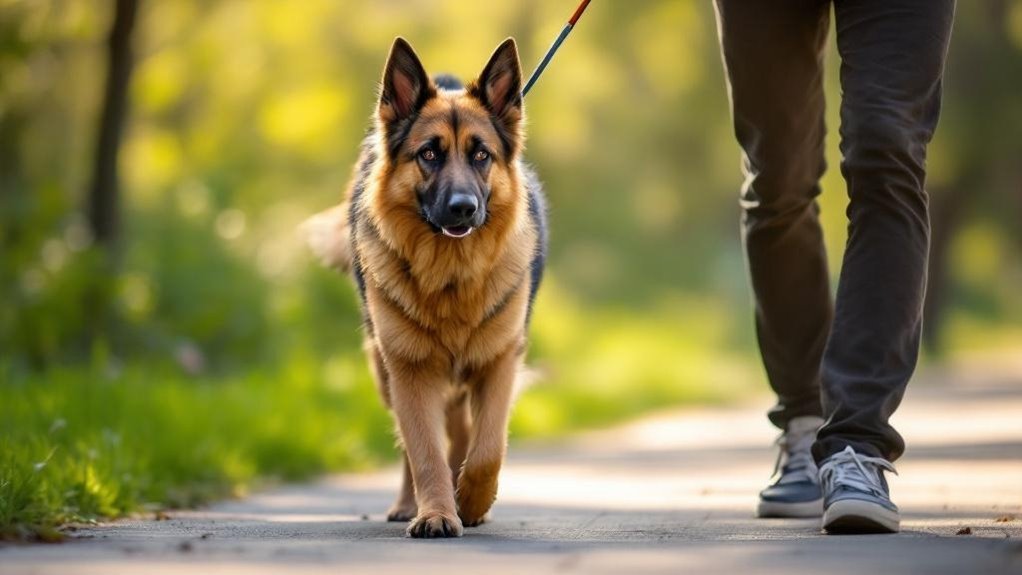
German Shepherds pull because of natural instincts, high energy, and inconsistent training rather than disobedience. You’ll reshape this behavior by using the right equipment like a six-foot leash and well-fitted harness, establishing a specific walking cue, and rewarding calm behavior immediately. Stop moving when pulling occurs so your dog learns that forward progress requires a loose leash. Consistent practice in low-distraction environments builds foundation skills, while structured techniques like direction changes keep their attention on you. Understanding the mechanics behind each training step transforms walks into reliable, controlled experiences.
- Key Takeaways
- Why German Shepherds Pull on the Leash
- Choose the Right Training Environment and Equipment
- Introduce the Collar and Leash Without Pressure
- Find Your Grip: Arm Position and Comfort
- Spot the Signs of Pulling
- Stop and Stand Still to Discourage Pulling
- Use Quick Tugs to Reset Attention
- Change Direction to Keep Your Dog Focused
- Praise Immediately When the Leash Goes Slack
- Select High-Value Treats and Toys for Motivation
- Practice “Let’s Walk” for Relaxed Outdoor Time
- Play “Catch Me If You Can” to Build Drive
- Use the Box Step to Build Side Position
- Establish a Calm Mindset Before Every Walk
- Transition From Games to Real-World Walking
- Handle Setbacks and Distracting Environments
- Prevent Regression When Changing Walking Routes
- Manage Reactivity Toward Strangers on Walks
- Create an Exercise Schedule to Reinforce Training
- Frequently Asked Questions
- Conclusion
Key Takeaways
- Start training in low-distraction environments with a six-foot leash and well-fitted collar or harness for control and comfort.
- Stop walking when your German Shepherd pulls; reward calm behavior to teach that loose leash enables forward movement.
- Use high-value treats and enthusiastic praise immediately after desired behavior to reinforce positive associations with leash walking.
- Change direction unpredictably during walks to maintain focus on you and keep training mentally stimulating for your dog.
- Establish a consistent daily exercise schedule with focused leash training sessions twice weekly to reinforce loose leash walking skills.
Why German Shepherds Pull on the Leash
Leash pulling in German Shepherds stems from a combination of natural instincts and training gaps that you’ll need to understand before addressing the behavior. Your dog’s high energy levels and strong prey drive make them eager to explore, which naturally translates into pulling on the leash during walks.
Additionally, reactive behavior toward strangers or unfamiliar animals can intensify this pulling, especially when your dog wants to investigate or respond to perceived threats. Inconsistent exercise and mental stimulation compound the problem, as unexercised dogs channel excess energy into leash pulling.
Improper leash training techniques, where you apply excessive tension or yanking, actually reinforce the pulling rather than correct it. Finally, excitement or anxiety may drive your dog’s leash behavior, requiring gradual desensitization and calmness training to address underlying emotional triggers effectively.
Choose the Right Training Environment and Equipment
Now that you understand why your German Shepherd pulls on the leash, you’re ready to set up the right conditions for training success, and this starts with your environment and equipment.
Start in controlled spaces where distractions stay minimal, allowing your dog to focus on you rather than external stimuli. As you implement these training tips, observe your dog’s body language for signs of stress or distraction.
Start with controlled environments to minimize distractions and help your German Shepherd focus on you during training.
Your equipment choices matter greatly:
- Use a six-foot leash that permits natural movement while maintaining control
- Select a well-fitted collar or harness designed for comfort and safety
- Incorporate toys and treats to reinforce positive associations
Gradually introduce new locations as your German Shepherd gains confidence.
When the leash goes slack consistently, you’ll know your dog understands the connection between loose walking and rewards, establishing the structure and consistency necessary for lasting training success.
Introduce the Collar and Leash Without Pressure
You’ll want to introduce the collar during positive experiences like mealtime and play, so your German Shepherd builds a calm association with wearing it rather than viewing it as a signal for restriction or stress.
Start with a short or old leash during these sessions, keeping things relaxed and gradually extending the leash length as your dog shows comfort with the setup, which prevents overwhelming them during this critical acclimation phase.
This gradual approach, paired with consistent positive reinforcement, establishes the foundation for successful loose leash walking by shifting your dog’s perspective from resistance to acceptance.
Building Positive Collar Associations
One of the most important steps in loose leash walking training is establishing that the collar and leash aren’t tools of restriction or punishment, but rather predictors of good things to come.
You’ll build positive associations by pairing the collar with rewarding experiences during dog training sessions.
Create these positive moments consistently:
- Put the collar on right before feeding time, so your German Shepherd connects it with mealtime satisfaction.
- Attach the leash during playtime with favorite toys, making it synonymous with fun and engagement.
- Reward calm behavior with treats immediately after putting on gear, reinforcing that wearing equipment brings immediate benefits.
This approach establishes a foundation where your dog views the collar as a signal for positive experiences rather than restraint, making loose leash walking training substantially more effective through proper reinforcement and structure.
Gradual Leash Acclimatization Process
With your German Shepherd now viewing the collar as a signal for positive experiences, you’re ready to introduce the leash itself without creating pressure or resistance.
During playtime, put on the leash while your dog remains engaged and happy, allowing them to move freely around your space. Let them drag the leash during these sessions so they become accustomed to the weight and sensation without associating it with control.
When your dog begins to pull on the leash, avoid yanking back; instead, simply maintain calm consistency by continuing forward at your own pace.
Only remove the leash once your dog settles into calm behavior, reinforcing that quiet acceptance brings relief. This structure prevents negative associations while building the foundation for future training success.
Find Your Grip: Arm Position and Comfort
Your arm position during loose leash walking forms the foundation for clear communication with your German Shepherd, and getting it right makes the entire training process more effective and sustainable.
When your dog pulls, your body mechanics determine whether you can respond with consistency and control.
Focus on these three key positioning elements:
- Keep your elbow bent and positioned close to your side, allowing you to manage tension from the end of the leash without strain.
- Maintain a neutral wrist position that prevents locking or tensing, enabling quick reactions to your dog’s movements.
- Hold the leash with a relaxed grip that signals calm attention to your German Shepherd.
This foundation prevents discomfort during extended walks while improving your ability to reward good behavior through slack management and clear reinforcement.
Spot the Signs of Pulling
When your German Shepherd suddenly lurches forward or maintains constant tension on the leash, you’re witnessing pulling behavior that stems from excitement, anxiety, or the dog’s natural instinct to explore—issues that intensify without adequate exercise. Recognizing these signs helps you intervene effectively and establish consistency in your training.
| Sign of Pulling | What You’ll Notice | What It Means |
|---|---|---|
| Tension on leash | Constant tightness | Dog’s focus is ahead, not on you |
| Leading ahead | Dog consistently in front | Pulling drives their movement |
| Frequent stops | Sniffing while moving forward | Dogs attention diverts during walks |
When you spot your German Shepherd pulls on the leash, step back immediately and redirect their behavior. This signals that pulling results in losing freedom, reinforcing loose leash walking through clear cause and effect.
Stop and Stand Still to Discourage Pulling
When your German Shepherd pulls on the leash, you’ll stop walking immediately, which creates a direct connection between the pulling behavior and the halt of forward movement, teaching your dog that tension doesn’t advance the adventure.
This strategy works because dogs learn through consistent patterns, and the repeated experience of stopping reinforces that a loose leash is the only path to continued exploration and enjoyment.
You’ll maintain a calm, relaxed posture during these pauses, signaling that patience and loose-leash walking are what earn rewards and progress, not force or urgency.
The Power Of Stillness
One of the most effective ways to stop pulling behavior in German Shepherds is to become completely still the moment your dog lunges forward on the leash. This technique works because your dog learns that pulling doesn’t achieve the desired outcome, and it helps the dog understand that forward movement only happens when the leash remains loose.
When you stand motionless, three things occur:
- Your dog realizes that pulling stops all progress toward their destination.
- Your dog refocuses attention on you rather than straining ahead.
- Your dog establishes eye contact as they check in with your position.
Consistency matters greatly here, as repeated application reinforces that calm walking earns praise and movement.
This structure teaches your dog to walk beside you naturally, transforming leash walks into predictable, manageable experiences.
Teaching Patience Through Pauses
Building on the principle that stillness interrupts pulling, you’ll now take that concept further by turning your stops into deliberate teaching moments that build your German Shepherd’s patience.
When your dog pulls, you stop immediately and remain completely still, avoiding any leash tension or resistance. This pause signals that pulling won’t move you forward, whether you’re walking past other dogs and cats or traversing busy streets.
Your dog learns that calm behavior is the only way to progress, much like how animal companions in multi-pet households learn boundaries through consistent structure.
Breaking The Pulling Cycle
The moment your German Shepherd leans into the leash and pulls forward, you’ll stop walking completely, creating an immediate consequence that interrupts the pulling pattern. This halt signals that pulling won’t achieve their goal of moving forward, establishing a clear cause-and-effect relationship your dog will recognize over time.
As you implement this technique, follow these key steps:
- Maintain a relaxed arm position and use calm voice cues to reinforce peaceful behavior.
- Stand still without speaking or moving until your dog stops pulling and returns to a loose leash.
- Reward them immediately with treats or praise to reinforce the desired behavior.
Consistency matters most here. Practice stopping repeatedly during walks, using gentle leash tugs to redirect attention back to you, allowing your dog to eventually understand that walking politely beside you produces the outcomes they want.
Use Quick Tugs to Reset Attention
Quick tugs on the leash work as gentle reminders that redirect your German Shepherd’s focus back to you when their attention drifts during walks, and this technique becomes especially effective when you pair it with the right timing and release. You’ll notice the best results occur when you tug briefly, then immediately release tension, signaling to your dog that the leash itself communicates rather than restrains. This distinction helps your German Shepherd understand that loose leash means freedom to explore safely.
| Element | Action | Outcome |
|---|---|---|
| Timing | Tug when attention lapses | Quick refocus |
| Release | Immediate tension drop | Understanding builds |
| Pairing | Add treats or praise | Behavior reinforces |
| Consistency | Regular application | Attention improves |
Integrating quick tugs into your routine establishes clear communication, teaching your dog that tension requires their awareness and cooperation during walks.
Change Direction to Keep Your Dog Focused
When you change direction unpredictably during your walk, you create a natural consequence that pulls your German Shepherd’s attention back to you, since they can’t predict where you’re heading and must stay tuned to your movements to keep pace.
This unpredictable route works because dogs are naturally drawn to follow what they can anticipate, so the moment you shift left or right without warning, they refocus on you as their guide rather than on whatever distraction caught their eye.
Unpredictable Route Changes
Because your German Shepherd’s attention naturally drifts during walks, incorporating unpredictable direction changes keeps their focus locked on you rather than allowing their mind to wander toward distractions like other dogs, squirrels, or passing pedestrians.
You’ll notice that frequent turns and sudden backtracking force your dog to monitor your movements closely, which naturally reduces leash pulling and creates better engagement.
Transform these direction changes into an interactive experience by:
- Making random turns without warning, prompting your dog to anticipate your next move
- Using verbal cues like “This way!” to reinforce communication and clarify expectations
- Gradually increasing unpredictability as your dog becomes more responsive and adaptable
This structure builds consistency while keeping walks mentally stimulating, encouraging your German Shepherd to remain attentive and enthusiastic to stay by your side throughout the journey.
Redirecting Attention Effectively
Through sudden directional shifts, you’ll capture your German Shepherd’s attention and redirect their focus back to you rather than allowing it to drift toward external distractions.
When your dog begins pulling or gazing elsewhere, execute an abrupt change in direction, which interrupts their attention pattern and requires them to refocus on your movements. Simultaneously, use the “Create Slack” technique by quickly straightening your arm to generate momentary tension in the leash, signaling urgency that demands their attention.
This combination of physical cues makes you, rather than environmental stimuli, the more interesting focal point.
Immediately praise your dog when they follow your direction change and maintain closeness, reinforcing this attentive behavior.
Praise Immediately When the Leash Goes Slack
One of the most effective ways to shape your German Shepherd’s loose leash walking is to praise him the moment his leash goes slack, since this immediate feedback creates a clear connection between the behavior you want and the reward he receives.
Timing matters greatly in dog training, and you’ll see better results when you reinforce the exact moment relaxation happens.
Timing is everything in dog training—reinforce the exact moment your German Shepherd relaxes for faster, better results.
Here’s what effective praise looks like:
- Verbal affirmation delivered instantly as the leash loosens, signaling approval
- High-value treats offered immediately to strengthen the association with calm walking
- Consistent repetition across multiple walks, building the habit through structured practice
Your German Shepherd learns faster when consequences follow behavior directly, making him understand that loose leash walking earns rewards, not pulling.
Select High-Value Treats and Toys for Motivation
You’ll find that selecting high-value treats and toys specific to your German Shepherd’s preferences creates the foundation for effective motivation during leash training, since dogs respond more reliably to rewards they genuinely want rather than generic alternatives.
Soft, aromatic treats like small pieces of cooked chicken or textured toys that squeak work particularly well because they capture attention quickly and can be consumed fast enough that training maintains its rhythm without interruption.
Pairing these rewards consistently with loose leash behavior builds strong positive associations, reinforcing the connection between walking calmly beside you and receiving something your dog finds genuinely rewarding.
Identifying Motivating Rewards
Motivation is the engine that drives your German Shepherd‘s willingness to stay focused during loose leash training, and the most effective motivators are high-value rewards that your dog finds genuinely exciting.
You’ll want to experiment with different options to discover what truly captures your dog’s attention, then use those rewards consistently throughout training sessions.
Consider these motivating reward options:
- Freeze-dried meats or small cheese pieces that your dog can consume quickly without losing focus.
- Peanut butter or soft treats that reward good behavior instantly on walks.
- Interactive toys with squeakers or treat-dispensing features that engage your dog’s mind.
Consistency matters greatly because your German Shepherd learns to connect specific actions with predictable rewards.
This strengthens the reinforcement cycle and improves leash behavior over time.
Pairing Treats With Training
The bridge between identifying what motivates your German Shepherd and actually using those rewards effectively lies in strategic pairing—connecting treats and toys with the precise moments when your dog demonstrates the behavior you’re reinforcing.
Timing matters greatly; you’ll deliver the reward immediately after your dog walks beside you without pulling, creating a clear connection between the action and the positive outcome. Use small, quick-consuming treats like chicken pieces or cheese to maintain training momentum without interruption.
Pair every reward with enthusiastic verbal praise, strengthening the association between loose leash walking and approval. Vary your rewards based on task difficulty—reserve higher-value treats for moments requiring sustained focus or extra effort.
This structured approach builds consistent reinforcement patterns that accelerate learning and solidify the desired behavior.
Practice “Let’s Walk” for Relaxed Outdoor Time
Once you’ve established basic loose leash walking foundations, introducing a specific cue like “Let’s walk!” creates a clear signal that initiates a relaxed and enjoyable outdoor experience while cueing your German Shepherd to settle into a calm position beside you.
This command works because it separates intentional walking time from other activities, establishing clear expectations for both you and your dog.
Start your practice in low-distraction environments where your dog can focus on the task:
- Choose quiet residential streets or empty parks to minimize competing stimuli
- Use consistent body language and tone each time you give the command
- Gradually introduce slightly busier areas as your dog demonstrates reliable responses
As your German Shepherd masters this cue in calm settings, you’ll build the foundation needed for more challenging environments, ensuring that loose leash walking becomes a reliable habit.
Play “Catch Me If You Can” to Build Drive
Building on the calm settling behavior you’ve developed with “Let’s walk,” you can now incorporate play-based exercises that strengthen your German Shepherd’s natural instinct to follow you closely.
The “Catch Me If You Can” game works by having you run a short distance away, triggering your dog’s chase drive and encouraging them to maintain proximity.
Running away triggers your dog’s chase drive, naturally encouraging them to stay close and maintain focus on your movements.
During play, incorporate sudden stops and directional changes to keep your dog attentive to your movements, which builds focus and responsiveness.
Reward successful engagement with treats or praise, reinforcing the connection between staying near you and positive outcomes.
This playful approach develops your dog’s drive while making training enjoyable, creating a foundation that flows seamlessly into structured loose leash walking skills.
Use the Box Step to Build Side Position
Now that you’ve built your German Shepherd’s drive to follow you through play, you can shift that enthusiasm into a structured positioning exercise using the Box Step method, which teaches your dog to maintain a consistent side position during walks. This technique reinforces close proximity and attention through deliberate lateral movements.
To implement the Box Step effectively:
- Face forward, then step sideways while prompting your dog to follow and stay at your side.
- Create box-shaped patterns by combining forward, lateral, and backward steps in sequence.
- Reward correct positioning with treats or toys each time your dog maintains the desired placement.
Practice this method across various environments so your German Shepherd generalizes the behavior and remains attentive regardless of location, building the foundation for reliable loose leash walking in all situations.
Establish a Calm Mindset Before Every Walk
Before you even clip the leash to your German Shepherd’s collar, you’ll want to take a few moments to calm your own mind through deliberate breathing or quiet reflection, because your dog will pick up on whatever energy you’re bringing to the walk.
Your shepherd responds to your emotional state, so a relaxed demeanor sets the foundation for focused loose leash walking.
Establish a brief pre-walk routine that signals calmness to your dog.
Practice short training sessions emphasizing composure, allowing your shepherd to understand what comes next. As your dog remains calm during leashing, offer treats or praise to reinforce this behavior, creating positive associations with preparation time.
Gradually introduce distractions around your dog during leashing so they become accustomed to stimulation while maintaining composure, strengthening their ability to stay focused despite environmental changes.
Transition From Games to Real-World Walking
The games you’ve been playing with your German Shepherd have built valuable foundations—attention, proximity, and responsiveness to your cues—but your dog now needs to transfer these skills into the structured environment of real-world walking.
Your German Shepherd’s foundation in attention and proximity must now transfer into the structured demands of real-world walking.
You’ll bridge this gap by gradually reducing play intensity while introducing clear change signals.
Start your progression deliberately:
- Use the verbal cue “Let’s walk!” to signal the shift from playtime to walking mode, establishing a consistent boundary between activities.
- Begin with short neighborhood routes in familiar, low-distraction settings where your dog can focus on maintaining calm proximity.
- Reward calm leash behavior with treats and praise, reinforcing the connection between structured walking and positive outcomes.
This gradual change prevents confusion, allowing your German Shepherd to understand expectations before encountering complex real-world environments.
Handle Setbacks and Distracting Environments
As your German Shepherd encounters new environments filled with competing stimuli—other dogs, unfamiliar sounds, interesting smells—you’ll likely notice that his loose leash skills falter, and this isn’t a failure of your training but rather a predictable challenge that requires you to adjust your approach rather than abandon it.
Start in low-distraction settings and gradually introduce more complex environments, allowing Jude to build confidence progressively. When distractions appear, use high-value treats or favorite toys to redirect his attention, reinforcing loose leash behavior through positive association.
Practice stopping and rewarding calm responses to distractions, which teaches him that external stimuli lead to rewarding pauses rather than pulling opportunities.
Employ the “penalty yards” game consistently, returning him to a starting point when pulling occurs, demonstrating that maintaining a loose leash enables forward progress.
Prevent Regression When Changing Walking Routes
Once your German Shepherd demonstrates reliable loose leash walking in familiar, controlled settings, introducing new routes presents a fresh challenge that can temporarily undo his progress if you’re not careful about how you approach the alteration. New environments trigger heightened alertness, which can cause previously trained behaviors to slip away. To prevent regression, you’ll need intentional planning and consistent reinforcement.
New environments can trigger heightened alertness in your German Shepherd, causing previously trained loose leash behaviors to slip away without intentional planning and consistent reinforcement.
Start by exploring each new route at a relaxed pace, allowing your dog to acclimate without structured demands.
Then implement these strategies:
- Practice loose leash techniques consistently across multiple new locations to help generalize the behavior.
- Use high-value treats and toys to maintain engagement during unfamiliar walks.
- Monitor your dog’s stress responses and adjust training intensity based on his comfort level.
This gradual approach keeps your dog confident and focused, preventing old pulling habits from resurfacing during changes.
Manage Reactivity Toward Strangers on Walks
Your German Shepherd’s reactivity toward strangers stems from fear, uncertainty, or lack of positive exposure.
So you’ll want to start distance-based desensitization by keeping your dog far enough away that they notice the stranger but don’t react, then gradually move closer as calm behavior improves.
You’ll countercondition this reactive response by pairing stranger encounters with high-value treats and toys, rewarding your dog’s focus on you and relaxed demeanor rather than fixating on the person approaching.
Throughout these encounters, you’ll maintain a loose leash and calm energy yourself, since tension in your movements and handling will signal to your dog that strangers are genuinely something to worry about.
Whereas your steady, controlled presence reinforces that these situations are manageable and routine.
Distance-Based Desensitization Practice
Distance-based desensitization is the foundation for helping your German Shepherd build tolerance around strangers, and it works by establishing a safe starting point where your dog can observe people without triggering reactive behavior like barking, lunging, or pulling.
You’ll create structured opportunities for your dog to acclimate gradually:
- Identify a distance where your dog remains calm and focused on you, not the stranger.
- Reward quiet behavior with treats or praise each time your dog chooses to ignore the person.
- Slowly decrease distance over multiple sessions as comfort increases, retreating if reactivity emerges.
Monitor your dog’s body language constantly—stiff posture, intense staring, or raised hackles signal you’ve moved too close.
Consistency matters greatly; practicing regularly in different environments helps your German Shepherd generalize this calm behavior, reducing reactivity across situations rather than just one location.
Counterconditioning Positive Stranger Associations
While distance-based desensitization helps your German Shepherd observe strangers calmly, counterconditioning takes the next step by actively reshaping what your dog feels when they see people approach, transforming neutral or negative reactions into positive ones through consistent pairing of strangers with good things.
You’ll reward your dog with high-value treats or enthusiastic praise the moment they notice someone, before they can react poorly, so they learn that strangers predict rewards rather than threats. This method works because repeated positive experiences gradually rewire your dog’s emotional response, making calm behavior feel natural and automatic.
Start this training at distances where your dog feels safe and confident, then slowly decrease space as their comfort grows, ensuring success at each stage before advancing further.
Leash Calmness During Encounters
When you’re walking your German Shepherd and a stranger approaches, the leash becomes your primary tool for managing what happens next, making it essential that you’ve established clear communication before reactivity takes over.
Your dog’s nervous energy or excitement needs redirection, not punishment, so you’ll want to use the “Stop” command when pulling or barking begins. This teaches your shepherd that reactive behavior actually halts the walk entirely, creating a natural consequence without force.
Employ these three strategies to build calm encounters:
- Reward composed behavior with treats before tension builds
- Increase distance from triggers when reactivity emerges
- Practice consistently, returning to greater distances if needed
Patience and steady reinforcement transform how your German Shepherd responds to strangers, establishing the calm demeanor that makes loose leash walking genuinely possible.
Create an Exercise Schedule to Reinforce Training
Consistency in your daily routine creates the foundation that loose leash walking skills need to stick, so you’ll want to establish a structured schedule that includes 20 to 30 minute leash walking sessions every day, paired with twice-weekly focused training sessions dedicated specifically to leash manners.
During these daily walks, you’ll practice in varied environments—quiet parks, busy streets, and unfamiliar locations—which helps Jude generalize loose leash behaviors across different settings rather than performing well only in familiar places.
Combining on-leash walking with off-leash play reduces excess energy that typically contributes to pulling, while mixing practice sessions with interactive games like “Catch Me If You Can!” maintains engagement and reinforces staying close to you naturally.
Frequently Asked Questions
How to Train Your Dog for Loose Leash Walking?
You’ll start with a six-foot leash, rewarding calm walking beside you with treats and praise. Use “Oops!” when your dog pulls, then practice in controlled environments before introducing real-world distractions gradually.
How Long Does It Take to Teach Loose Leash Walking?
You’ll typically see basic progress within a few sessions, though mastering loose leash walking consistently takes weeks or months. Daily 5-10 minute practice sessions with positive reinforcement accelerate your results markedly.
What Is the Hardest Command to Teach a Dog?
You’ll find that recall is typically the hardest command to teach your dog because they’re naturally drawn to explore and get distracted. It requires consistency, high-value rewards, and progressive practice in distracting environments.
What Is the 3 Second Rule for Dogs?
You’ve got three seconds to re-engage your dog’s attention after giving a command. If you don’t maintain focus within that timeframe, you’ll redirect them back to the task. It’s essential for reinforcing responsive behavior.
Conclusion
You’ve now built a solid foundation for loose leash walking, and your German Shepherd’s training is like a tree taking root—it’ll grow stronger with consistent care. Keep reinforcing what you’ve learned through regular practice, maintain your exercise schedule, and stay patient when setbacks occur. By applying these techniques consistently across different environments and situations, you’ll transform walks into controlled, enjoyable experiences for both you and your dog.