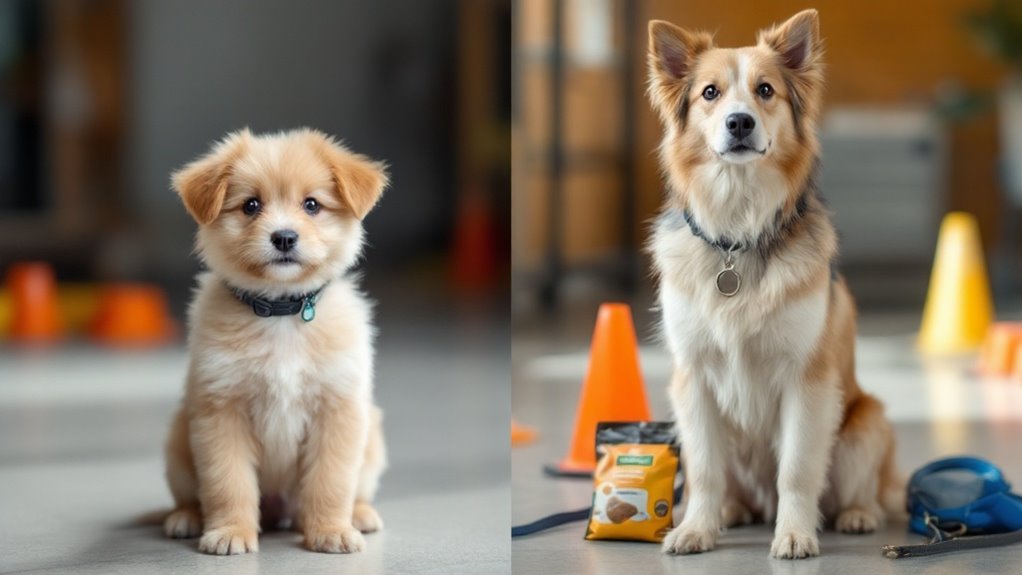
Your puppy’s rapid-fire treats and five-minute sessions worked because novelty and frequent rewards matched your pup’s developmental stage, but around 1–2 years, your dog’s attention span, motivation, and social maturity shift dramatically. Constant food rewards lose their pull as metabolism slows and teething fades, while boundary-testing and independence emerge. You’ll need shorter, more cognitively challenging sessions, variable reinforcement schedules, and rewards tied to play or activity access instead of treats. Understanding these biological changes helps you rebuild training methods that actually stick with your maturing dog.
- Key Takeaways
- Why Puppy Training Methods Stop Working as Your Dog Matures
- Understanding Developmental Stages: Juvenile to Adult
- Shortening Sessions, Increasing Mental Challenge
- Keep Training Fresh: Adding Novelty and Distractions
- Adapting Rewards as Your Dog’s Motivation Shifts
- Layering Skills for Lasting Reliability
- Managing Adolescent Regression: What to Expect and How to Respond
- Socialization Windows: Extending Beyond Eight Weeks
- Slowing the Learning Curve: Training Adult Dogs at Their Speed
- Strengthening Your Bond Through Consistent, Age-Appropriate Training
- Frequently Asked Questions
- Conclusion
Key Takeaways
- Shift from rapid-fire treats and five-minute sessions to focused 10-minute sessions with increased mental challenge and progressive difficulty.
- Expect boundary testing and selective listening between 6–18 months; view regression as biological phase requiring adjusted management, not failure.
- Transition food rewards to play, exploration, and social interaction as motivation decreases; use intermittent reinforcement schedules post-mastery.
- Layer training complexity through chained sequences and problem-solving games instead of rote repetition; break behaviors into smaller progressive steps.
- Rotate puzzle types every 3–7 days and introduce controlled distractions across varied locations to prevent habituation and generalize skills.
Why Puppy Training Methods Stop Working as Your Dog Matures
Watching your puppy master commands through rapid-fire treat rewards and five-minute training sessions can feel like a breakthrough, but those same methods often plateau or fail entirely as your dog matures.
Puppy training breakthroughs often plateau as your dog matures, requiring adjusted methods beyond rapid-fire treats and short sessions.
Your puppy’s brain operated in a narrow window where novelty, frequent rewards, and short bursts of focus worked because development and socialization demands aligned with that approach.
Adult dogs, however, experience shifts in attention span, motivation, and social maturity that render continuous food rewards and brief sessions less effective. Their metabolism slows, teething needs fade, and around one to two years, social maturity emerges, bringing selective behavior and rule-testing.
You’ll need to adjust treat size and frequency, extend session length, and introduce intermittent reinforcement schedules that build reliability rather than dependence on constant rewards.
Understanding Developmental Stages: Juvenile to Adult
As your puppy’s learning methods begin to plateau, understanding where your dog sits within the juvenile stage becomes the foundation for adjusting your approach.
Your dog’s developmental timeline depends on breed size: small breeds mature around 9–12 months, medium breeds 12–14 months, and large or giant breeds extend to 18–24 months.
During this juvenile period, lasting roughly 12 weeks to maturity, your new puppy develops secondary social relationships, tests household boundaries, and increasingly asserts independence.
Hormonal shifts trigger territorial behavior and rule-challenging, making consistency and structure essential.
Continue short, frequent training sessions—around 10 minutes several times daily—while gradually increasing difficulty.
Pair reinforcement with ongoing socialization and adequate exercise, preserving learning momentum as your dog progresses toward adult behavior patterns.
Shortening Sessions, Increasing Mental Challenge
As your dog matures, you’ll shift from longer, repetitive drills to shorter, focused sessions packed with mental challenge—moving from five to ten minutes with puppies down to two to five minute bursts for adults while you increase how often you train each day.
Rather than drilling the same cue over and over, you’ll replace that repetition with cognitive tasks like shaping new behaviors, sequencing multiple cues together, or problem-solving games that keep your dog’s brain engaged without stretching session time.
This combination of brief, intense practice and elevated difficulty maintains your dog’s focus and prevents the boredom that comes with rote repetition, so you’re building a sharper learner even when you’re spending less time in formal training.
Training Duration and Focus
Your adult dog’s training needs a structural shift that mirrors their cognitive maturation, and the most effective way to make that adjustment is to consolidate your sessions rather than simply reduce them.
Instead of multiple scattered 10–15 minute puppy sessions daily, shift to 2–3 concentrated 10-minute sessions as your dog matures, maintaining similar total training time while building focus and efficiency.
This consolidation allows deeper work on fewer behaviors, preventing the scattered attention that dilutes progress.
Your dog can now sustain concentration longer, so use these focused blocks to layer complexity—moving from simple repetitions to chained sequences like Wait plus Recall plus Sit.
This structure respects your dog’s developing attention span while maximizing each session’s impact through purposeful, progressive training.
Puzzle Games and Enrichment
Puzzle games shift dramatically once your dog moves into adulthood, because their brain can now handle sustained mental work without the scattered focus that defines puppyhood, yet they’ll still lose interest if sessions drag on too long or demands stay too simple.
You’ll shorten your puzzle session from the 5–10 minute bursts you used with your puppy to 10–15 minutes once or twice daily, matching your adult dog’s improved but still limited attention span.
Simultaneously, you’ll increase difficulty gradually over 3–6 weeks, moving from basic treat-dispensing toys like slow-feeder bowls to multi-step puzzles and scent-tracking tasks.
Rotate puzzle types every 3–7 days to prevent habituation, and always reward independent problem-solving with high-value treats to reinforce engagement and sustained effort.
Keep Training Fresh: Adding Novelty and Distractions
Dogs can get bored with the same training routine in the same location, which causes their responses to weaken or become tied too closely to one specific context rather than generalizing across different situations. To keep training fresh and build reliable responses, you’ll want to introduce new things strategically:
- Gradually add controlled distractions—low-level toys, family members walking by, or distant traffic noise—during short 5–10 minute sessions before increasing complexity
- Combine familiar cues into new sequences, such as Wait + Recall + Sit, so your dog generalizes skills and stays mentally engaged
- Change training locations weekly between your backyard, quiet streets, and park edges to make sure commands transfer across environments
- Vary reward types and schedules, using high-value treats for challenging distractions and switching to intermittent reinforcement as reliability improves
Keep sessions brief and frequent, ending on successful cues to maintain motivation.
Adapting Rewards as Your Dog’s Motivation Shifts
As your puppy matures into adulthood—timing that varies by breed size, from nine months in small breeds to two years in giants—their motivation for food rewards naturally decreases while their interest in play, exploration, and social interaction grows.
You’ll notice this shift as treats that once reliably prompted focus become less compelling, signaling that you need to gradually shift toward lower-value rewards and life-based reinforcements like brief walks, toy access, or praise over the course of a week or so.
This developmental change isn’t a training setback; it’s an opportunity to build a more sustainable system where your adult dog stays motivated by rewards that align with their mature preferences and your ongoing lifestyle together.
Motivation Changes Through Development
Your dog’s motivation for training doesn’t remain constant—it shifts predictably as your puppy matures into an adolescent and then into an adult, and recognizing these shifts allows you to adjust your rewards so training stays effective and engaging.
Understanding these developmental stages helps you maintain progress with your new dog.
- Puppies (up to 18 months) respond intensely to small, high-value food treats during brief training sessions, capitalizing on rapid learning and teething-driven reward sensitivity.
- Adolescents (6–18 months) increasingly prefer social rewards like play and access to activities over low-value food alone.
- Adult dogs thrive on intermittent, variable reinforcement schedules that build persistence while reducing treat dependency.
- Context matters—a well-exercised adult dog may need environmental management rather than reward adjustments to restore training drive.
Reassess your approach every few months to maintain consistency and engagement throughout your dog’s life.
Reward Preferences in Adulthood
Shifting your reward strategy as your dog matures isn’t optional—it’s essential to keeping training effective and sustainable over time.
As your adult dog’s food motivation decreases, you’ll need to identify what actually matters to them through brief preference tests, offering three to five options and noting which they consistently choose.
Many adult dogs shift toward toys, play, or environmental rewards rather than treats alone, so good training adapts to these natural preferences.
Once you’ve identified what works, use intermittent reinforcement schedules strategically, spacing out rewards unpredictably to maintain behavior without overfeeding.
This approach builds consistency and keeps your dog engaged long-term, transforming training from puppy-dependent treat-driven sessions into a sustainable system that reflects your dog’s evolving motivations and maturity.
Layering Skills for Lasting Reliability
Building lasting reliability requires you to layer skills strategically, starting with high-value foundation cues—Sit, Down, and Recall—in short 5–10 minute sessions repeated several times daily, then gradually adding duration, distance, and distractions over weeks to strengthen the dog’s responses. Use a clicker or clear marker to reinforce successive approximations, rewarding calm tolerance of nearby distractions first before advancing challenge levels.
- Keep your dog on leash or long line during skill-building to prevent mistakes
- Shift criteria when behavior reaches 80–90% reliability in low-distraction settings
- Add one new distraction or 30 seconds of time per session
- Advance only after consistent success in novel environments
Maintain intermittent reinforcement after mastery to prevent regression as your puppy matures into adulthood.
Managing Adolescent Regression: What to Expect and How to Respond
Between 6 and 18 months, your dog’s brain and body are changing rapidly due to hormonal shifts and social maturity, which often triggers boundary testing and a temporary push for independence that can make previously solid behaviors seem to disappear.
You’ll likely notice selective listening, increased willfulness, and the re-emergence of puppy behaviors like jumping or house-soiling, even though your dog isn’t actually forgetting what you’ve taught—they’re simply prioritizing their own choices over yours as confidence grows.
The key is recognizing this regression as a normal developmental phase rather than a failure in training, and responding by tightening structure, shortening training sessions to 5–10 minutes with immediate rewards, and maintaining consistent routines while you give your dog’s impulse control time to mature.
Boundary Testing and Independence
As your adolescent dog matures—typically between 12 weeks and 24 months, depending on breed size—you’ll likely notice a shift in their willingness to cooperate, a phenomenon known as boundary testing and increased independence that’s completely normal during social development.
This new selective attention doesn’t mean training failed; rather, your dog’s developing brain naturally seeks autonomy, requiring you to adapt your approach. Address this shift by:
- Keeping training sessions short (around 10 minutes) and frequent to sustain focus
- Reinforcing basic cues consistently while progressively raising performance standards
- Rewarding independence only when calm, reliable responses occur
- Implementing management tools like leashes indoors, crates, and gates to prevent unsupervised freedom
This controlled structure prevents bad habits from solidifying while your adolescent learns lasting boundaries.
Hormonal Changes and Behavior
During your dog’s adolescence—roughly between 6 and 18 months depending on breed size—surges in sex hormones can trigger a sudden shift in behavior that catches many owners off guard, even if their dog was previously obedient and reliable.
Your puppy might suddenly test boundaries, show increased independence, or regress in commands they’d mastered months earlier. Intact males and females often display territoriality, mounting, roaming, and heightened reactivity during hormonal peaks.
Rather than viewing this as disobedience, understand it’s a biological phase requiring adjusted management. Maintain consistent rules and short training sessions while using leash, crate, and gates to prevent mistakes.
Reward calm behaviors and increase mental and physical exercise to channel adolescent energy productively. Most dogs stabilize around 18–24 months as hormones settle.
Socialization Windows: Extending Beyond Eight Weeks
While the most critical socialization window closes around 12 weeks of age, your puppy’s capacity to learn from social experiences and form lasting impressions continues well into the juvenile period—roughly through 16 weeks and beyond—which means the eight-week mark when you bring your puppy home is really just the beginning of a longer process rather than the finish line.
Your puppy arrives with limited experience reading non-littermate signals, so you’ll need to structure progressive exposures over the next several months:
- Introduce calm adult dogs in controlled settings to teach bite inhibition and household rules
- Expose your puppy to varied people, sights, and sounds in manageable increments
- Remove your puppy immediately if fear or escalation appears, replacing negative episodes with gentler alternatives
- Maintain consistent positive reinforcement throughout juvenile months to convert puppy presence into reward predictions
Slowing the Learning Curve: Training Adult Dogs at Their Speed
Adult dogs typically learn more slowly than puppies because their brains have finished the rapid developmental period where new neural pathways form most readily, and because they may carry habits, fear responses, or learned patterns that require deliberate unlearning before new behaviors can take root.
You’ll see the most progress by keeping training sessions short—five to ten minutes—and practicing frequently to match their attention span and prevent fatigue.
Break new behaviors into small steps, rewarding each small improvement before raising your expectations.
Use high-value treats paired with a marker word or clicker to make rewards immediate and clear.
Start with familiar commands like Sit or Down before adding distractions, building consistency through daily practice that keeps adult dogs engaged and motivated.
Strengthening Your Bond Through Consistent, Age-Appropriate Training
Training remains one of the most powerful tools you have for deepening your connection with your adult dog, and the key to that deepening is consistency paired with challenges that match your dog’s stage of life.
You’ll build a stronger bond by progressively raising the difficulty of tasks as your dog’s skills improve, which keeps him mentally engaged and reinforces his trust in you.
Consider these progression steps:
- Start with simple sits and downs during early tolerance work with a new puppy
- Advance to longer stays and off-leash recalls as confidence grows
- Introduce novel tasks like scent work or tricks for mental stimulation
- Continue short, frequent sessions (10 minutes, 2–3 times daily) to maintain motivation
This structured approach transforms training into a shared language between you and your dog.
Frequently Asked Questions
What Is the 3-3-3 Rule With Puppies?
You’ll experience three phases when bringing your puppy home: the first 3 days of adjustment stress, the next 3 weeks of bonding and rule-testing, and the following 3 months of socialization and behavior shaping.
What Is the 7 7 7 Rule for Dogs?
You can apply the 7-7-7 rule to housetraining, socialization, and diet shifts. Your puppy holds its bladder roughly one hour per month of age, you’ll socialize during seven weeks, and you’ll establish adult manners over seven months.
What Is a Red Flag Behavior in Puppies?
You’ll want to watch for repeated biting that doesn’t respond to correction by 16 weeks, intense unexplained fears, resource guarding, uncontrollable hyperactivity preventing learning, or escalating predatory behavior toward pets or children.
What Is the 10 10 10 Rule for Puppies?
You’ll structure each training session into three 10-minute blocks: focused training, supervised play, and calm rest. You’ll repeat these cycles daily, adjusting frequency based on your puppy’s age and energy level.
Conclusion
You’ll find that your dog’s training evolution mirrors their physical growth, and this isn’t a failure of your methods but a natural progression requiring adjustment. By shifting from repetition-based learning to problem-solving challenges, you’re honoring their developing brain, not abandoning what worked before. Consistency across these shifts—maintaining structure while respecting their changing needs—strengthens your relationship and creates a capable adult dog who listens because you’ve remained a reliable guide.