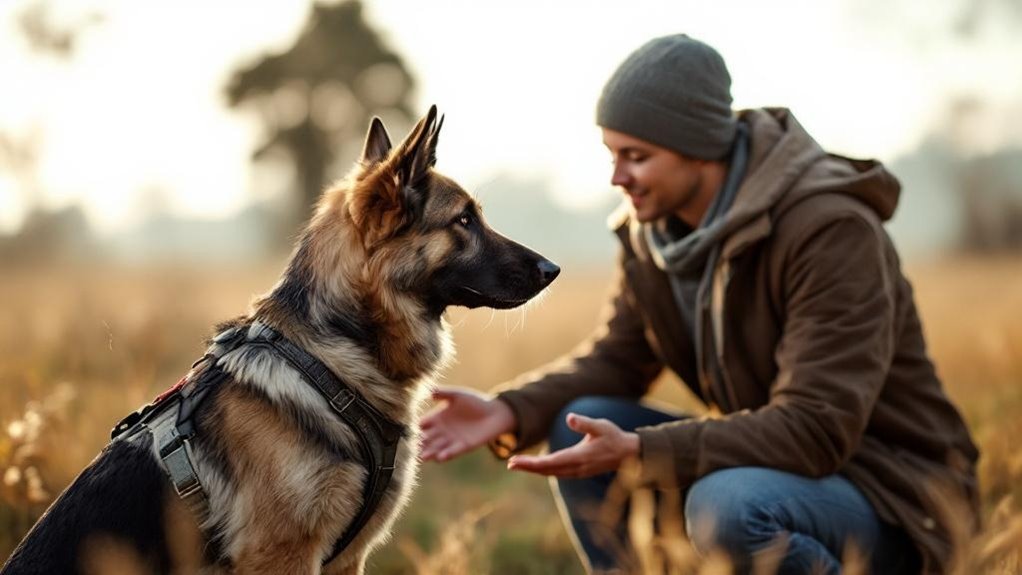
Training a rescue German Shepherd with trauma means recognizing that defensive behaviors, anxiety, and avoidance stem from past abuse, neglect, or overwhelming conditions—not stubbornness. You’ll need to identify specific triggers, establish predictable daily routines, and use consistent positive reinforcement to rebuild trust. Start with short training sessions in calm environments, reward desired behaviors immediately, and introduce new experiences slowly. Working with a trauma-informed trainer helps you develop a customized plan, while natural supplements like chamomile can support emotional healing. Understanding your dog’s individual needs and responding with patience creates the foundation for genuine progress.
- Key Takeaways
- What Causes Trauma Responses in Rescue German Shepherds?
- How to Identify Your Dog’s Behavioral Triggers
- Building a Safe, Predictable Home Environment
- Trust-Building Through Daily Routines
- Positive Reinforcement for Traumatized Dogs
- Music and Sound Therapy as a Calming Tool
- Basic Obedience Training for Rescue German Shepherds
- Moving From Basic Commands to Intermediate Training
- Natural Supplements That Support Emotional Healing
- Finding and Working With a Trauma-Informed Trainer
- How to Socialize an Anxious Rescue German Shepherd
- What to Do When Training Stalls or Regression Happens
- Frequently Asked Questions
- Conclusion
Key Takeaways
- Identify trauma triggers through consistent monitoring and documentation to develop personalized rehabilitation and training plans.
- Establish predictable daily routines with designated safe spaces to build trust and reduce anxiety-related behaviors.
- Use positive reinforcement with immediate rewards within seconds to teach desired behaviors and reinforce safety.
- Work with certified trauma-informed trainers experienced in positive reinforcement techniques for German Shepherds specifically.
- Combine training with natural supplements like chamomile or valerian root to support emotional healing and calm.
What Causes Trauma Responses in Rescue German Shepherds?
When rescue German Shepherds display aggressive, avoidant, or destructive behaviors, those reactions typically stem from specific experiences they’ve endured before finding safety, and understanding these origins is essential if you’re going to help them heal.
Past physical abuse, neglect, or abandonment create lasting trauma responses that your dog carries into their new home. Beyond direct harm, emotional neglect and poor socialization—meaning limited positive human contact during critical development periods—contribute markedly to anxiety and fear.
Physical abuse, neglect, and poor socialization create deep trauma responses that shape how rescue dogs interact with their new homes.
Even accidents or injuries from before rescue can trigger heightened stress. Shelters themselves intensify these reactions, as their overwhelming environments remind traumatized dogs of previous suffering.
Recognizing what caused your dog’s trauma responses enables you to design a personalized rehabilitation journey grounded in consistency and patience, addressing their specific emotional needs rather than applying generic training methods.
How to Identify Your Dog’s Behavioral Triggers
You’ll identify your dog’s behavioral triggers by watching how they respond to specific situations—sudden noises, unfamiliar people, or confined spaces—and noting which circumstances consistently produce stress or defensive reactions.
Keeping a record of these patterns across different environments helps you recognize what genuinely frightens your dog versus what’s simply unfamiliar, allowing you to distinguish between normal caution and trauma-based responses.
Once you’ve mapped these triggers, you can work with a trainer or veterinarian to develop a structured plan that gradually builds your dog’s confidence while avoiding unnecessary exposure to the situations that provoke the strongest reactions.
Recognizing Trauma Response Patterns
Several key behavioral shifts can reveal that your German Shepherd is responding to trauma, and learning to spot these patterns is essential for helping your dog feel safe and build trust.
Watch for avoidance behaviors, excessive barking, or destructive actions that signal anxiety, since these responses often stem from past negative experiences. Physical signs like cowering, trembling, or hiding indicate specific fear triggers you’ll need to identify.
Pay close attention to your dog’s reactions to stimuli such as loud noises or sudden movements, recognizing trauma response patterns by documenting these responses consistently across different settings.
This systematic observation helps you understand which situations provoke stress, allowing you to create a safer environment and develop appropriate training strategies that address your dog’s particular needs and anxieties.
Common Environmental Stress Factors
Beyond the immediate trauma responses your dog displays, understanding the environmental conditions that trigger those reactions is equally important for building a reliable training plan.
Loud noises, sudden movements, and chaotic surroundings commonly provoke unwanted behaviors in rescue German Shepherds, while isolation from humans or other animals can intensify anxiety and destructive actions. Routine changes, particularly shifts in feeding times or walking schedules, destabilize your dog’s sense of security and may trigger regression in training progress.
Identifying specific triggers—particular sounds, sights, or scents that provoke distress—allows you to develop targeted interventions. By systematically exposing your dog to positive experiences in controlled settings, you build consistency and reinforcement that gradually reshape their responses, establishing structure that replaces fear-based reactions with calmer, more predictable behavior patterns.
Building a Safe, Predictable Home Environment
Because rescue German Shepherds have often experienced unpredictability and upheaval in their past, establishing a stable home environment becomes one of the most powerful tools you can use to help them heal and adapt.
You create this safe, predictable home environment through consistent daily routines that include regular feeding times, walks, and play sessions, which help your dog understand what to expect and build trust with you.
Consistent daily routines of feeding, walks, and play build trust and help rescue German Shepherds understand what to expect.
Designate a quiet corner with comfortable bedding where your shepherd can retreat when overwhelmed, giving them control over their space and promoting emotional recovery.
Minimize exposure to loud noises and chaotic situations, as these triggers elevate stress and complicate adjustment.
This structure and consistency form the foundation upon which all other training and bonding efforts depend.
Trust-Building Through Daily Routines
When you establish a consistent daily routine with feeding, walking, and playtime at predictable times, your rescue German Shepherd learns to anticipate positive interactions and experiences less anxiety about what comes next.
By using calm, reassuring tones during these routine activities and offering praise or treats when your dog responds well, you’re creating a pattern that connects you with safety and support rather than uncertainty or fear.
Gradually introducing small changes to this structure—like varying your walking route slightly or adjusting playtime duration—helps your dog build confidence and adaptability without becoming overwhelmed by instability.
Consistency Establishes Emotional Security
A rescue German Shepherd’s nervous system has been disrupted by shelter life, uncertainty, and the stress of change, so establishing a predictable daily routine becomes one of your most powerful tools for rebuilding trust and reducing anxiety.
When you maintain consistency in feeding times, exercise schedules, and training sessions, your dog learns that her environment is safe and controllable, which allows her nervous system to settle and her mind to relax.
This predictability creates a stable framework where she can begin to feel secure again, and positive reinforcement during these routine interactions strengthens her confidence and deepens your bond.
Predictable Schedules Reduce Anxiety
Your rescue German Shepherd’s brain operates best within a framework of predictability, where she knows what to expect at each point in her day. Trauma disrupts this sense of safety, but you can rebuild it through predictable schedules that reduce stress and anxiety.
When you establish consistent times for daily activities, your dog’s nervous system learns to relax, as uncertainty no longer dominates her thinking. This structure works by:
- Feeding her at the same times daily, signaling reliable nourishment
- Scheduling walks when she anticipates movement and exploration
- Designating playtime that provides predictable mental stimulation
- Conducting training sessions at consistent intervals for reinforcement
These routines create emotional anchors that help her manage anxiety levels more effectively, strengthening your bond through shared predictability and trust.
Routine-Based Positive Reinforcement Methods
Building trust with your rescue German Shepherd requires pairing the predictable routines you’ve established with positive reinforcement that marks desired behaviors in the moment they occur. During routine-based training sessions lasting 5 to 10 minutes daily, you’ll deliver treats and praise immediately when your dog responds correctly, creating clear connections between actions and rewards. This consistency strengthens your bond while respecting your dog’s emotional capacity.
| Activity | Timing | Reinforcement |
|---|---|---|
| Feeding | Same time daily | Calm praise |
| Walking | Scheduled intervals | Treats for focus |
| Training | Short sessions | Immediate rewards |
Adjust your positive reinforcement approach based on your dog’s stress signals, ensuring the environment remains supportive and predictable throughout their rehabilitation journey.
Positive Reinforcement for Traumatized Dogs
Three core principles—immediacy, consistency, and clarity—form the foundation of positive reinforcement for traumatized dogs, and you’ll find that mastering these principles accelerates their recovery and rebuilds their trust in you.
When working with traumatized dogs, you’ll need to apply these strategies systematically:
- Reward desired behaviors within seconds, so your dog connects the action to the reward.
- Maintain identical responses to the same behaviors across all training sessions.
- Use clear, simple commands that your dog can reliably understand and follow.
- Keep sessions brief, between 5 to 15 minutes, preventing overwhelm and fatigue.
Positive reinforcement works because it teaches your dog that safety and good outcomes follow specific behaviors, gradually replacing fear responses with confidence and trust in your presence.
Music and Sound Therapy as a Calming Tool
While positive reinforcement teaches your rescue German Shepherd what behaviors earn rewards, music and sound therapy work differently—they create an environmental foundation that makes your dog’s nervous system more receptive to learning and healing in the first place. You’ll establish a calming environment by playing specific genres daily, ideally 30 minutes to 1 hour, since consistent exposure reduces anxiety comparable to behavioral training alone.
| Genre | Effect |
|---|---|
| Classical | Deep relaxation |
| Soft Rock | Gentle calming |
| Reggae | Stress reduction |
| Ambient | Sustained peace |
| Instrumental | Focused healing |
Music therapy works by resonating with canine hearing frequencies, lowering your dog’s stress response and strengthening your bond simultaneously. Tailor playlists to your individual dog’s preferences, observing which genres produce the most noticeable behavioral shifts, then maintain that routine consistently throughout rehabilitation.
Basic Obedience Training for Rescue German Shepherds
You’ll build trust with your rescue German Shepherd through consistent commands and daily 15-20 minute training sessions, which prevent overwhelming the dog while reinforcing what it’s learning.
Positive reinforcement techniques—treats, praise, and calm handling—motivate your dog to engage with obedience work and signal that you’re a reliable, safe handler, especially important for dogs with trauma backgrounds.
Creating a safe learning environment means starting in quiet spaces with minimal distractions, so your dog can focus on your instructions without triggering anxiety or defensive behaviors.
Building Trust Through Consistency
Because rescue German Shepherds often carry the weight of traumatic experiences, they need consistency in training commands and daily routines to feel secure in their new environment. This foundation of predictability helps reduce the anxiety that frequently accompanies their shift to a home.
Building trust requires you to establish reliable patterns that your dog can depend on, which directly influences their emotional recovery.
Implement these consistent practices:
- Use identical commands and hand signals every time you train
- Schedule training sessions at the same times daily
- Apply positive reinforcement immediately after desired behaviors
- Maintain the same rules and boundaries throughout your household
When you repeat these elements reliably, your dog learns what to expect, gradually understanding that their environment is safe and predictable, transforming their sense of security.
Positive Reinforcement Techniques Work
Positive reinforcement—rewarding your rescue German Shepherd immediately after they display a desired behavior—creates a direct connection between their actions and good outcomes, which accelerates learning and builds the trust that trauma-affected dogs desperately need.
When you consistently reward desired behaviors during training sessions, your dog learns what you expect and feels secure in their progress, which reduces anxiety and encourages engagement.
Use high-value treats like chicken or cheese to strengthen motivation, and keep training sessions brief, around 5-10 minutes, so your dog stays focused without becoming overwhelmed.
This structure prevents frustration while allowing your rescue dog to absorb cues more effectively. Positive reinforcement paired with a calm environment creates the stability your German Shepherd needs to heal and thrive.
Creating Safe Learning Environments
Three foundational elements—a calm physical space, consistent routines, and minimal distractions—work together to help your rescue German Shepherd learn basic obedience commands more effectively than training in chaotic or unpredictable settings.
A safe environment reduces anxiety and allows your dog to focus on learning rather than scanning for threats.
Establish these conditions:
- Choose a quiet room away from household noise and activity.
- Maintain the same training time each day to build predictability.
- Remove toys and other stimuli that compete for attention.
- Keep sessions short to prevent overstimulation.
Consistency paired with positive reinforcement creates trust.
When your German Shepherd knows what to expect and receives rewards for correct responses, they’ll gradually relax and become more receptive to your guidance during training.
Moving From Basic Commands to Intermediate Training
Once your rescue German Shepherd has mastered basic commands like sit, stay, and come, you’re ready to build on that foundation by introducing intermediate commands such as heel, place, and leave it, which require greater focus and impulse control.
Clear communication and consistency form the backbone of your training program, establishing expectations your dog can reliably follow. Use positive reinforcement—treats and praise—immediately after your dog demonstrates good behavior, which strengthens the desired response and deepens your bond.
Keep sessions brief, around five to ten minutes several times daily, maintaining engagement without overwhelming your dog. Gradually add gentle distractions during practice, helping your shepherd maintain focus amid real-world triggers.
This structured approach builds confidence while preventing frustration.
Natural Supplements That Support Emotional Healing
While training builds your rescue German Shepherd’s confidence through structured commands and positive reinforcement, you’ll also want to address the underlying anxiety and stress that often accompany dogs with traumatic histories.
Natural supplements can support emotional healing by easing these symptoms, allowing your dog to feel more secure during rehabilitation.
Consider these effective options:
- Chamomile reduces anxiety and promotes relaxation in recovering dogs
- Valerian root decreases stress-induced behaviors common in abused German Shepherds
- High-quality supplements from reputable brands guarantee safety and efficacy
- Balanced integration into your dog’s diet enhances calming effects without overwhelming their system
You’ll want to choose supplements carefully, since not all products deliver equal results.
When combined with consistent training, these natural solutions create an environment where your dog can process trauma more effectively and progress through rehabilitation with greater stability.
Finding and Working With a Trauma-Informed Trainer
Because rescue German Shepherds often carry invisible wounds from their past experiences, finding the right trainer becomes crucial to their recovery and your success together.
A trauma-informed trainer possesses certifications in positive reinforcement techniques and demonstrates proven experience handling trauma-related behaviors, which distinguishes them from standard trainers.
When you meet potential trainers, discuss your dog’s specific background, triggers, and behavioral patterns so they can develop a customized training plan that respects your dog’s emotional state.
Effective trauma-informed training introduces new experiences gradually, allowing your shepherd to build confidence at their own pace rather than through forced exposure.
Regular progress evaluations with your trainer confirm methods adjust as needed, reinforcing the trust and security your dog requires for genuine healing and behavioral improvement.
How to Socialize an Anxious Rescue German Shepherd
Socialization for an anxious rescue German Shepherd differs fundamentally from socialization for a confident dog, requiring patience and a deliberate pace that honors their emotional state rather than pushes them beyond their comfort. Your professional trainer can help you develop a structured plan that prevents overwhelming your dog during this sensitive process.
Follow these core strategies:
- Start with short, controlled interactions in quiet settings before progressing to busier environments.
- Use treats and praise to reinforce calm behavior during each socialization session.
- Monitor body language for stress signals like cowering or tail tucking, then step back accordingly.
- Consider introducing a calm, well-socialized dog to model appropriate social behavior.
This gradual approach works especially well for dogs with separation anxiety, building confidence through consistent, positive experiences that establish safety and trust over time.
What to Do When Training Stalls or Regression Happens
When your rescue German Shepherd’s progress plateaus or they slip backward into old behaviors, it’s typically a signal that something in your training approach needs adjustment rather than a sign of failure.
Training plateaus in rescue German Shepherds signal a need to adjust your approach, not failure.
Training stalls often occur when your methods don’t align with your dog’s trauma background and personality, so reassess your current strategy with honest evaluation.
Consistency matters tremendously; any shift in routine or reinforcement style creates confusion that triggers regression.
Create a calm, structured environment during sessions to minimize anxiety, which commonly causes setbacks in traumatized dogs.
If progress remains stuck, consult a veterinary behaviorist or professional trainer specializing in trauma-affected dogs who can identify specific obstacles and provide tailored solutions customized to your shepherd’s unique needs and recovery timeline.
Frequently Asked Questions
What Is the 3-3-3 Rule for Dog Training?
You’ll find the 3-3-3 rule describes your rescue dog’s adjustment timeline: three days to decompress, three weeks to settle in, and three months to reveal their true personality. It helps you understand what you’re experiencing.
Do Rescue Dogs Remember Their Trauma?
Yes, your rescue dog remembers trauma. They don’t recall specific details, but they’ve retained emotional associations with triggers that remind them of past distressing experiences, which influences their behavior and responses.
Are German Shepherds Good PTSD Dogs?
Yes, German Shepherds make excellent PTSD dogs. You’ll benefit from their intelligence, loyalty, and natural ability to sense emotional changes. They’re highly trainable for specific tasks like deep pressure therapy, helping you feel safer and more secure.
What Is the Most Common Cancer in German Shepherds?
You’re barking up the right tree learning about hemangiosarcoma, the most common cancer in German Shepherds. This malignant blood vessel tumor typically affects your dog’s spleen and heart, requiring early detection for better outcomes.
Conclusion
You’ve learned that trauma recovery isn’t linear, though research confirms consistency and patience genuinely accelerate healing. Your shepherd’s progress depends on you maintaining structure, recognizing triggers, and adjusting expectations when setbacks occur. You’ll succeed by combining positive reinforcement with professional guidance, understanding that emotional regulation develops gradually. Trust the process, stay committed to routines, and celebrate incremental improvements—you’re fundamentally reshaping your dog’s neural responses through repeated, safe experiences.