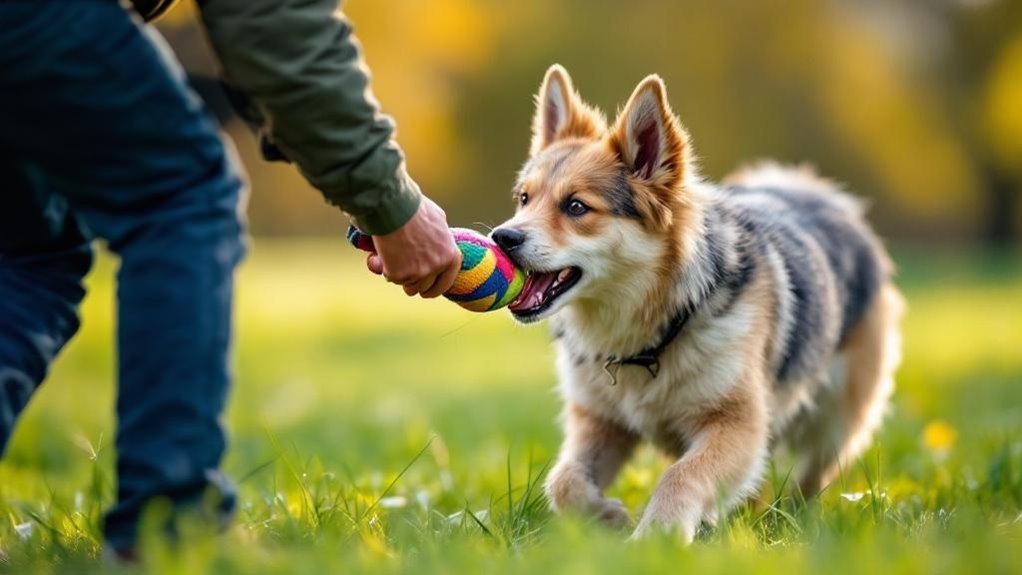
Working drive is your dog’s innate motivation to engage in focused, intense activities—especially strong in breeds like Malinois and German Shepherds. Without proper outlets and structure, this drive manifests as destructive behaviors: excessive barking, chewing, digging, and restlessness. You’ll manage it by matching activities to your dog’s breed instincts, scheduling consistent training sessions, and maintaining daily routines that balance engagement with decompression. Understanding arousal levels and recognizing when your dog’s reached capacity prevents overflow and keeps focus sharp. The key is intentional structure that channels drive productively rather than letting it build chaotically inside your home.
- Key Takeaways
- What Is Working Drive in Pet Dogs?
- When High Drive Becomes a Problem at Home
- Over-Arousal vs. Healthy Drive: Know the Difference
- The Arousal Bucket: Why Some Dogs Overflow Faster
- Six Signs Your Dog Needs Better Drive Management
- Impulse Control: The Foundation Everything Else Needs
- Match Activities to Your Dog’s Breed and Instincts
- Structured Games That Channel Drive Without Escalating
- Try the Aeroplane, Mouse Cage, and Orientation Games
- How Your Training Space Affects Drive Management
- Read Your Dog’s Signals: When to Pause, When to Play
- Marker Cues: Stop, Start, and Regulate Drive Intensity
- Master the “Go Play” and “Nuff” Cues
- Keep Sessions Short and Precision Work Last
- Daily Routines That Prevent Drive-Related Chaos
- Three Mistakes That Accidentally Reinforce High Drive
- Frequently Asked Questions
- Conclusion
Key Takeaways
- Match breed-specific activities to natural drives—scent work for hounds, retrieval for retrievers, structured tasks for working breeds.
- Establish consistent daily routines combining physical exercise, controlled training sessions, and quiet decompression periods to manage high drive effectively.
- Monitor arousal markers like excessive drooling and rapid breathing; pause activities when dogs show impulsive behaviors or stress signs.
- Keep training sessions between five to fifteen minutes, balancing task difficulty with appropriate arousal levels following the Yerkes-Dodson Law.
- Use structured games teaching orientation and disengagement to channel drive through focused, varied activities preventing destructive behaviors and frustration.
What Is Working Drive in Pet Dogs?
Working drive—the innate motivation that pushes certain dogs to engage in specific tasks or activities—exists because of selective breeding over generations.
Breeders intentionally developed certain breeds, like Malinois and Jack Russell terriers, to excel at herding, hunting, or protection work, embedding these drives deep into their genetics.
Selective breeding has embedded herding, hunting, and protection drives deep within certain breeds’ genetics over generations.
You’ll recognize working drive through focused intensity and enthusiastic responsiveness to tasks that align with their instincts. Dogs with high working drive demonstrate sustained concentration and zeal for activities requiring both mental and physical effort.
Understanding that your dog’s working drive stems from purposeful breeding helps you appreciate why they naturally gravitate toward certain behaviors.
Recognizing this foundation allows you to work with your dog’s nature rather than against it, establishing realistic expectations for training and activity management.
When High Drive Becomes a Problem at Home
While understanding your dog’s working drive helps you appreciate their natural instincts, that same intensity can create real challenges in a home environment, especially when their energy doesn’t find the right outlet. High drive dogs require consistent engagement, and without it, you’ll likely notice destructive patterns emerge.
The behaviors you’re seeing aren’t random misbehavior, they’re signals that your dog needs more purposeful activity:
- Excessive barking and vocalization indicating frustration
- Destructive chewing and digging targeting furniture or yard
- Attention-seeking actions that escalate when ignored
- Restlessness that prevents settling or relaxation
Recognizing these patterns matters because they differ from anxiety-driven responses.
You’ll need structured outlets—obedience training, agility work, scent activities—that channel this intensity productively, combined with clear boundaries that establish consistency between you and your dog.
Over-Arousal vs. Healthy Drive: Know the Difference
You’ll notice that healthy drive shows up as focused intensity and directed energy toward tasks, while over-arousal appears as erratic behavior, excessive drooling, dilated pupils, and an inability to respond to your cues.
High drive dogs often have smaller arousal buckets, meaning they hit their stress threshold faster than other dogs, and once that bucket overflows, you’ll see poor impulse control and difficulty learning.
Recognizing Arousal Overflow Signs
The difference between a dog working with healthy drive and one experiencing over-arousal often comes down to control—specifically, whether your dog can sustain focus or has crossed into excessive excitability that disrupts learning.
Your arousal levels indicator appears in several observable signs:
- Excessive drooling and dilated pupils during training sessions
- Inability to settle between exercises or follow directional cues
- Poor impulse control, including jumping, barking, or nipping
- Loss of responsiveness to familiar commands despite prior consistency
When you notice these markers, your dog’s arousal bucket has overflowed. This overflow prevents learning because your dog’s brain can’t process reinforcement effectively.
Understanding these signals helps you intervene early, adjusting training structure and adding calming breaks before over-arousal derails your progress entirely.
Optimal Drive State Training
Finding that sweet spot where your dog’s drive enhances learning rather than sabotages it requires understanding how arousal and performance connect. Your high-drive dog performs best within an ideal range, not at maximum intensity, because excessive arousal actually disrupts focus and responsiveness.
The Yerkes-Dodson Law explains this pattern: performance improves with arousal up to a point, then declines when your dog becomes hyperaroused. To train effectively, you’ll need to recognize when your dog’s arousal level matches the task difficulty.
Simple obedience requires lower arousal, while complex precision work demands moderate engagement. Structure your training sessions with appropriate breaks, environmental controls, and calming cues that keep your dog in that functional zone where learning happens most efficiently.
The Arousal Bucket: Why Some Dogs Overflow Faster
Because both positive and negative experiences fill a dog’s internal arousal system, understanding how this works helps you recognize why some dogs struggle with focus and impulse control while others remain calm. High-drive dogs typically have smaller arousal buckets, meaning they reach overflow faster than dogs with larger capacity. You’ll notice this pattern during training and daily activities.
High-drive dogs have smaller arousal buckets, reaching overflow faster than others, affecting their focus and impulse control.
Several factors contribute to how quickly a dog’s arousal levels spike:
- Genetic predisposition determines baseline bucket size and sensitivity
- Eustress from play and positive events extends recovery time
- Environmental stimuli accumulate throughout the day
- Lack of downtime prevents arousal from naturally decreasing
Recognizing these patterns allows you to monitor your dog’s state and incorporate calming activities before overflow occurs, keeping them within their ideal arousal range.
Six Signs Your Dog Needs Better Drive Management
Once you understand how your dog’s arousal bucket works, you can start spotting the specific behaviors that signal their drive isn’t being managed well. Excessive barking, digging, or destructiveness shows your dog is seeking an outlet for pent-up energy, while poor focus during training indicates their drive levels aren’t being channeled appropriately.
If your dog drags you on walks or behaves erratically in stimulating environments, their drive management needs attention. Watch for frustration signs like whining or lunging at distractions, which reveal unaddressed high drive issues affecting behavior.
Finally, intense fixation on toys or people without the ability to disengage suggests your dog requires better drive management techniques. Recognizing these patterns helps you address underlying energy and impulse control problems before they worsen.
Impulse Control: The Foundation Everything Else Needs
Self-regulation—your dog’s ability to pause before acting on instinct—determines whether drive management techniques will succeed or fail, since a dog without impulse control can’t access the skills you’re teaching during moments that matter most.
Without this foundation, your dog remains reactive rather than responsive, making every interaction harder to manage.
You’ll build impulse control through:
- Establishing neutral positions via Place training to create stable baselines for self-regulation
- Gradually activating drives through structured play while maintaining consistency in your cues
- Using marker cues like “LEAVE” to interrupt unwanted actions and reinforce better choices
- Implementing brief time-outs that allow your dog to decompress from heightened arousal
This systematic approach teaches your dog to manage arousal levels effectively, reducing over-excitement and stress responses during training and daily interactions.
Match Activities to Your Dog’s Breed and Instincts
Your dog’s breed history determines which activities will naturally engage their drive, making it far more effective to work with their instincts rather than against them. When you match activities to your dog’s breed, you tap into their natural motivations, creating engagement that reduces destructive behaviors and strengthens your bond.
| Breed Type | Natural Instinct | Ideal Activity |
|---|---|---|
| Scent Hounds | Tracking ability | Nosework and scent games |
| Retrievers | Object retrieval | Fetch and dock diving |
| Terriers | Prey drive | Lure racing and earthdog trials |
Working breeds like German Shepherds require structured tasks such as obedience trials and protection training. Home-based activities—trick training, treat-finding games—also channel your dog’s drive effectively. By understanding what motivates your individual dog, you create consistency in reinforcement and structure that satisfies their working nature.
Structured Games That Channel Drive Without Escalating
You can activate your dog’s drive through structured games that modulate arousal rather than escalate it, using controlled play as a tool for channeling energy into focused engagement with you.
Games like the Orientation Game or Disengagement Game teach your dog to shift attention deliberately and practice impulse control, which builds the neural pathways that support calm focus even when their drive is activated.
Controlled Play Activation Techniques
Controlled play activation techniques rely on structured games that tap into a dog’s working drive while maintaining focus on the handler and preventing the escalation that often leads to frustration or destructive behavior.
You’ll find that intentional, measured play sessions create the foundation for managing high-drive dogs effectively, allowing them to express their natural instincts within boundaries.
Consider these key techniques:
- Use marker cues during play to reinforce desired behaviors and sustain engagement without increasing excitement.
- Incorporate the Disengagement Game to teach your dog to shift between arousal states and calm down.
- Practice the Orientation Game to help your dog refocus on you amidst distractions.
- Keep sessions short and varied to channel drive while preventing frustration.
Consistency with these controlled play activation techniques builds your dog’s ability to work purposefully.
Drive Modulation Through Games
Structured games offer a powerful method for channeling a dog’s working drive by creating focused engagement that prevents the escalation into over-arousal and destructive behavior.
Games like the “Aeroplane” and “Mouse Cage” direct your dog’s natural instincts toward specific tasks, allowing you to manage the dog’s arousal levels while maintaining control.
The “Disengagement Game” teaches your dog to shift attention away from exciting stimuli back to you, building essential self-regulation skills.
By incorporating simple commands and rewarding calm responses, you reinforce impulse control through consistent practice.
Short training sessions work best, preventing overwhelm while keeping your dog focused.
Combining physical and mental challenges guarantees your dog remains engaged without escalating excitement, creating sustainable drive management that prevents behavioral problems stemming from unregulated energy.
Try the Aeroplane, Mouse Cage, and Orientation Games
When your dog struggles with impulse control or gets overstimulated during training, three specific games can help him learn to manage his arousal while staying focused on you.
Each game targets different aspects of drive management for a high drive dog, creating structured outlets that channel energy productively.
- Aeroplane Game promotes focus through controlled, consistent movements that stabilize arousal levels.
- Mouse Cage Game teaches disengagement from distractions by moving between visual markers.
- Orientation Game manages high arousal through rapid directional changes while maintaining handler engagement.
- Regular practice develops your dog’s ability to shift between arousal states effectively.
These games work because they provide consistency and structure, helping your dog understand that impulse control produces rewards.
Consistency and structure teach dogs that impulse control produces rewards, building lasting arousal management skills.
Practice them regularly to build lasting arousal management skills.
How Your Training Space Affects Drive Management
Your training space directly shapes your dog’s arousal level and ability to focus, since environmental triggers like noise, movement, and visual distractions pull their attention away from learning and intensify their drive.
When you configure your space strategically—using a designated mat, removing competing stimuli, and arranging equipment purposefully—you create conditions where your dog can settle into a calm state and channel their drive toward productive engagement rather than reactive behavior.
Consistency in this environment, including familiar sounds and scents, helps your dog feel secure enough to manage their impulses and respond to your guidance more reliably.
Environmental Triggers And Arousal
Because dogs’ arousal levels rise and fall in response to their surroundings, the training environment you choose becomes one of your most powerful tools for managing drive effectively.
Environmental triggers like unfamiliar sounds, new scents, or visual movement can quickly push your dog’s arousal beyond what you can control, especially if they already have a smaller arousal bucket.
To protect your dog’s focus and impulse control, you’ll want to:
- Start training in quiet, familiar spaces where your dog feels secure
- Introduce new environmental triggers gradually and in controlled doses
- Observe how specific sounds or smells affect your dog’s arousal state
- Return to consistent locations when you need to reset your dog’s drive level
Familiarity breeds confidence, allowing your dog to concentrate on learning rather than reacting.
Space Configuration For Control
The physical layout of your training space functions as a silent but powerful manager of your dog’s arousal level, shaping how easily they can focus or how quickly their excitement escalates. Your space configuration directly determines whether your dog remains composed or becomes overstimulated during sessions.
| Space Type | Best For | Effect on Drive |
|---|---|---|
| Confined area | Boundary training | Heightens focus and drive |
| Spacious environment | Impulse control | Promotes calmness |
| Designated zones | Multiple activities | Reduces confusion |
Strategic barriers and defined zones signal when your dog should concentrate intensely versus engage energetically. Minimizing distractions during precision work prevents arousal spikes that derail learning. You’ll optimize engagement by matching your environment to your dog’s current drive level, creating consistency that supports better behavior management throughout training.
Read Your Dog’s Signals: When to Pause, When to Play
How can you tell when your dog’s arousal level has crossed from engaged to overwhelmed?
You’ll recognize your dog’s arousal levels through specific physical markers that signal it’s time to pause or continue play. Watch for these indicators:
Recognize your dog’s arousal levels through specific physical markers to know when to pause or continue play.
- Excessive drooling, dilated pupils, and rapid breathing suggest mounting arousal.
- Difficulty maintaining focus during training indicates they’re losing control.
- Impulsive behavior like jumping or nipping shows they’ve exceeded their ideal zone.
- Slow recovery after play means they need decompression time before new tasks.
Use the LEAVE cue to interrupt escalating behavior and signal changes.
Shorter training sessions work better when your dog struggles with attention, allowing you to maintain consistency without overwhelming them.
Monitor recovery periods carefully, since even enjoyable activities create arousal that requires breaks before introducing fresh structure or reinforcement.
Marker Cues: Stop, Start, and Regulate Drive Intensity
Once you’ve learned to recognize your dog’s arousal signals, you’re ready to introduce marker cues that give your dog clear, consistent language for when to stop, start, or adjust their drive intensity during training and play.
Marker cues like “LEAVE” and “NUFF” interrupt unwanted behaviors and signal when to regulate excitement, while “Go play” safely activates drive under your control.
These cues work because they provide consistent communication, helping your dog understand exactly what you expect in high-stimulus environments.
By pairing marker cues with reinforcement and time-outs for decompression, you establish structure that promotes impulse control and emotional stability.
This combination creates a balanced framework where your dog learns to manage their own arousal effectively.
Master the “Go Play” and “Nuff” Cues
Two cues form the foundation of drive management: “Go Play” activates your dog’s energy in controlled ways, while “Nuff” signals when to stop and decompress. These cues work together to teach your dog that excitement has boundaries, preventing the over-arousal that leads to destructive behavior.
To master these cues, you’ll need to:
- Reinforce “Go Play” consistently during training sessions, rewarding your dog’s engagement with high-value treats or toys.
- Practice “Nuff” in low-distraction environments first, gradually increasing difficulty as your dog responds reliably.
- Use both cues daily to establish rhythm between active play and calm periods.
- Vary training locations to build responsiveness across different settings.
This structured approach develops your dog’s impulse control while maintaining their enthusiasm for appropriate activities.
Keep Sessions Short and Precision Work Last
Now that your dog understands when to activate and settle their energy through “Go Play” and “Nuff,” you’re ready to structure your training sessions so they can apply these skills consistently.
Keep your training sessions short—typically five to fifteen minutes—to prevent over-arousal and maintain focus, as extended sessions overwhelm dogs and reduce learning effectiveness.
Keep training sessions to five to fifteen minutes—extended sessions overwhelm dogs and reduce learning effectiveness.
Start with simpler, engaging tasks to stabilize arousal levels before progressing to precision work. Schedule precision exercises at the end of your session when your dog is neither frustrated nor fatigued, maximizing their ability to execute commands accurately.
Throughout training, monitor your dog’s responsiveness and adapt activities based on their arousal levels, ensuring sessions remain productive and enjoyable while building sustainable working drive management habits.
Daily Routines That Prevent Drive-Related Chaos
Because your dog’s behavior reflects what you’ve reinforced through daily patterns, establishing a structured routine becomes the foundation for managing drive consistently throughout the day. Your daily routines create predictability, which helps your dog shift between high-energy and calm states without spiraling into chaos.
- Schedule specific playtime windows where you channel drive through controlled activities like fetch or nosework.
- Incorporate training sessions that reinforce impulse control using consistent cues and commands.
- Build in quiet periods and designated relaxing spaces where your dog can decompress between stimulation.
- Plan physical exercise like long walks or agility training to burn excess energy before it becomes destructive.
This structure prevents over-arousal by giving your dog clear expectations about when to engage and when to rest, reducing unwanted behaviors driven by accumulated tension.
Three Mistakes That Accidentally Reinforce High Drive
Even when you’ve built a solid daily routine, the way you respond to your dog’s high drive in the moment can work against everything you’re trying to accomplish.
Three common mistakes undermine your dog training efforts considerably.
First, you reinforce jumping or barking by giving attention when your dog escalates these behaviors, teaching them that increased intensity gets results.
Second, you allow excessive play that spikes arousal, making focus impossible during training sessions.
Third, you neglect breed-specific outlets, leaving your dog bored and creating their own problematic stimulation.
Each mistake strengthens the behaviors you’re trying to reduce.
Instead, respond consistently by ignoring unwanted behaviors, providing structured activities that match your dog’s drive, and using calm, controlled interactions that reward restraint rather than excitement.
Frequently Asked Questions
What Is the 7 7 7 Rule for Dogs?
You should give your dog 7 minutes of activity, then 7 minutes of calm rest, repeating this cycle to manage their arousal levels. You’ll help them stay focused, reduce over-excitement, and build better impulse control throughout training.
What Is the 3-3-3 Rule for Dog Training?
You’re not building Rome in a day when you adopt a dog. The 3-3-3 Rule breaks your pet’s adjustment into three phases: three days of stress, three weeks of trust-building, then three months of full integration and stability.
What Is “I Love You” in Dog Language?
Your dog says “I love you” through wagging tails, soft eye contact, and relaxed body language. They’re telling you they trust you when they lick you, nudge you, or choose to stay close by your side.
What Is the 10 10 10 Rule for Dogs?
You’re hitting the jackpot when you balance your dog’s routine: ten minutes of exercise, ten minutes of mental stimulation, and ten minutes of training daily. This golden formula keeps your pup calm, focused, and well-adjusted.
Conclusion
You’ve now got the framework to help your dog find balance between enthusiasm and composure. By understanding how arousal builds, recognizing when your dog’s excitement gets the better of him, and practicing consistent management strategies, you’re creating the structure he needs. The real work happens in your daily routine—short sessions, precise timing, and thoughtful reinforcement patterns shape behavior over weeks. Stay patient with this process.