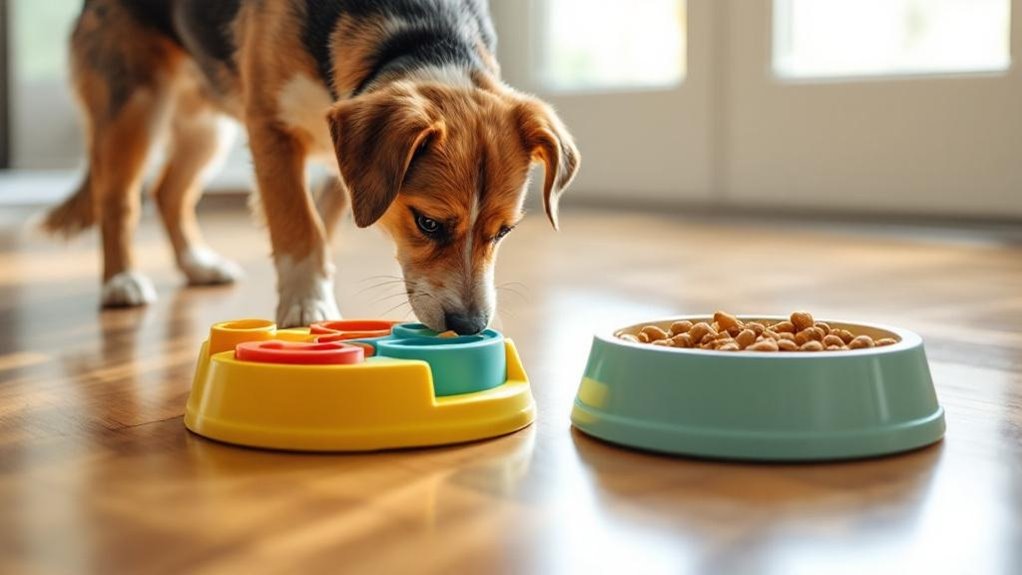
Puzzle feeders deliver the mental stimulation your smart dog needs beyond physical exercise, preventing boredom-related behaviors like destructive chewing and excessive barking. They slow down fast eaters, reducing gulping and digestive issues while building problem-solving skills. You’ll match difficulty to your dog’s current ability—starting simple, then progressing as confidence grows. Choose toys with secure, non-toxic materials and supervise playtime to guarantee safety. Track solving speed and rotate styles to maintain engagement. Understanding your dog’s specific needs reveals the perfect puzzle match.
- Key Takeaways
- Why Smart Dogs Need Mental Stimulation Beyond Exercise
- How Puzzle Feeders Slow Down Fast Eaters
- Picking the Right Difficulty for Your Dog
- Assessing Your Dog’s Puzzle-Solving Skills
- Removable Parts, Non-Toxic Materials, and Supervision Best Practices
- Product Comparison: Which Puzzle Feeder Matches Your Dog?
- West Paw Zogoflex Qwizl for Aggressive Chewers
- Outward Hound Hide N Slide for Intermediate Solvers
- Planet Dog Treat Dispensing Toy for Quiet Play
- Nina Ottosson Dog Casino for Advanced Puzzlers
- Best Alternatives: Snuffle Mats and Licking Mats
- Treat Balls and Rolling Dispensers for Active Dogs
- Budget Options Without Sacrificing Quality
- Premium Puzzle Feeders Worth the Investment
- Durable Rubber, Wood Composites, and BPA-Free Options
- Cleaning and Maintaining Your Puzzle Feeder
- Introducing Your Dog to a Puzzle Feeder: Step by Step
- What to Do When Your Dog Gets Stuck
- Keeping Dogs Engaged by Rotating Puzzle Toys
- Overfilling, Unsupervised Play, and Ignoring Wear Signs
- When It’s Time to Upgrade Your Dog’s Puzzle
- Pair Puzzle Feeders With Training for Stronger Bonds
- Quick Selection Checklist for Your Dog’s Perfect Match
- Frequently Asked Questions
- Conclusion
Key Takeaways
- Puzzle feeders provide essential mental stimulation for smart dogs, preventing boredom-related behavioral issues like destructive chewing and excessive barking.
- Select difficulty levels matching your dog’s skill; start simple, monitor frustration signs, and rotate styles to maintain engagement and prevent boredom.
- Top products include West Paw Zogoflex Qwizl for aggressive chewers, Nina Ottosson Dog Casino for advanced dogs, and Outward Hound Hide N Slide for beginners.
- Regular maintenance, inspections for damage, and supervision during playtime ensure safety while promoting consistent cognitive development and healthy eating patterns.
- Track puzzle-solving speed and document preferred types to gauge progress, upgrade difficulty when dogs solve rapidly, and strengthen training bonds through problem-solving accomplishments.
Why Smart Dogs Need Mental Stimulation Beyond Exercise
While physical exercise keeps your dog’s body fit, mental stimulation is what actually satisfies a smart dog’s brain. This distinction matters because intelligent dogs are naturally inclined to think, problem-solve, and work through challenges rather than simply burn off energy through running or playing fetch.
Without sufficient cognitive development opportunities, your smart dog becomes restless and develops behavioral problems like excessive barking or destructive chewing. Puzzle feeders provide the mental stimulation your intelligent dog craves by requiring active problem-solving during mealtime.
These interactive tools transform feeding from a passive activity into an engaging challenge that channels your dog’s natural instincts productively. By incorporating puzzle feeders into your dog’s routine, you’re addressing the root cause of boredom-related behaviors while promoting consistent mental engagement and satisfaction.
How Puzzle Feeders Slow Down Fast Eaters
Because puzzle feeders are designed with unique shapes and internal mechanisms that require dogs to manipulate parts to access food, they naturally extend mealtime and prevent the gulping behavior that leads to digestive problems.
Puzzle feeders use unique shapes and internal mechanisms to slow eating, preventing gulping and digestive problems naturally.
You’ll notice that fast eaters benefit greatly from this structured approach, as it transforms feeding into an engaging activity rather than a rushed consumption event.
Here’s how puzzle feeders slow down fast eaters:
- They create physical barriers that force dogs to work through maze-like passages, extending meals up to ten times longer than standard bowls
- They promote cognitive health by requiring problem-solving and mental engagement during eating
- They establish consistency in eating patterns, reducing vomiting, bloating, and negative habits over time
Picking the Right Difficulty for Your Dog
You’ll want to match each puzzle’s difficulty to your dog’s current skill level, starting with simpler toys that build confidence before moving toward more complex challenges.
If your dog shows signs of frustration—like giving up quickly or losing interest—you’re likely pushing too hard, so stepping back to an easier option keeps them engaged without causing stress.
Rotating between different puzzle styles and difficulty levels prevents boredom while reinforcing their problem-solving growth at a pace that works for their abilities.
Matching Challenge To Ability
The right puzzle toy difficulty makes all the difference in keeping your dog engaged and motivated, since toys that don’t match your dog’s current skill level can backfire in different ways.
You’ll find that matching challenge to ability requires observation and adjustment over time.
Consider these key strategies:
- Start with easier options like the Hide N Slide if your dog is new to puzzles, then progress systematically as their skills develop.
- Use toys with adjustable difficulty, such as the Casino Puzzle with lockable pegs, allowing you to increase complexity gradually.
- Monitor your dog’s solving speed and adjust accordingly, moving to harder puzzles when they finish too quickly.
Watch how your dog interacts with each toy. If they solve it rapidly, they’re ready for increased challenge.
Rotating puzzle toys while increasing difficulty levels keeps your dog entertained and mentally stimulated, preventing boredom while building confidence and problem-solving skills.
Preventing Boredom And Frustration
Finding the right difficulty level for your dog’s puzzle toys isn’t a one-time decision but an ongoing process that directly shapes whether they’ll stay engaged or lose interest altogether.
Too-easy puzzles breed boredom, while overly challenging ones create frustration and disengagement, so you’ll need to monitor your dog’s responses carefully. Start with beginner-level toys like the Outward Hound Hide N Slide, then progress gradually as your dog demonstrates mastery, allowing them to build confidence while maintaining engagement.
Rotating puzzle toys with varying difficulty levels prevents monotony and sustains enthusiasm for problem-solving. By observing how your dog interacts with each puzzle, you’ll develop a clear sense of their current skill level, enabling you to adjust difficulty accordingly and keep their mental stimulation consistent and rewarding.
Assessing Your Dog’s Puzzle-Solving Skills
You can assess your dog’s puzzle-solving ability by observing how quickly they work through simple toys, noting whether they solve them in minutes or struggle considerably, which tells you their starting skill level.
Watch for concrete problem-solving strategies like sniffing, pawing, and nudging to access treats, as these varied approaches show your dog understands the toy’s mechanics rather than just randomly interacting with it.
Once you’ve identified their speed and strategy preferences, you’ll know whether to start with basic puzzles to build confidence or move directly to moderately advanced ones that’ll keep their mind engaged without causing frustration.
Difficulty Level Selection
Matching a puzzle feeder to your dog’s current abilities is crucial for keeping them engaged without overwhelming them, and it starts with observing how they interact with toys and treats. You’ll notice patterns in their problem-solving approach, which guides your difficulty level selection for maximum engagement.
Consider these key factors when choosing:
- Start with beginner options like the Outward Hound Hide N Slide (level 2) if your dog shows limited puzzle experience, then progress gradually as their skills develop.
- Monitor solving speed; if your dog completes a toy quickly, upgrading to advanced designs like the Nina Ottosson Dog Casino guarantees continued mental challenge.
- Use toys with adjustable experience features, allowing you to modify complexity within a single feeder as your dog’s problem-solving abilities improve over time.
This structured approach maintains consistent reinforcement while preventing boredom through progressive difficulty increases.
Problem-Solving Speed Tests
How quickly your dog solves a puzzle reveals essential information about their current skill level and readiness for more complex challenges, which is why timing becomes one of your most practical assessment tools.
Start by recording how long it takes your dog to complete easy, medium, and advanced puzzles, comparing their speed across different formats like treat dispensing toys and sliding puzzles. This data shows you patterns in their problem-solving approach and identifies which puzzle types match their abilities.
Track engagement levels during each test; higher interest suggests they’ll maintain focus on challenging tasks.
Removable Parts, Non-Toxic Materials, and Supervision Best Practices
Because puzzle feeders go into your dog’s mouth and hands repeatedly, selecting toys with secure, non-removable parts is your first line of defense against choking hazards and intestinal blockages.
You’ll want to prioritize safety through these practical measures:
- Choose BPA-free plastics and durable rubber that withstand your dog’s chewing without breaking apart.
- Inspect toys regularly for cracks, loose pieces, or wear that could create hazards over time.
- Supervise playtime to monitor both engagement and any signs of material degradation.
Non-toxic materials guarantee that even aggressive chewers won’t suffer harm if they gnaw during problem-solving sessions.
Regular supervision allows you to catch potential issues early, while consistent inspection maintains the toy’s structural integrity.
This combination of careful selection, monitoring, and maintenance creates a safe environment for your dog’s cognitive development.
Product Comparison: Which Puzzle Feeder Matches Your Dog?
You’ll want to match your dog’s puzzle-solving experience with the right difficulty level, since beginners benefit from simpler designs like the Hide N Slide’s six compartments while experienced dogs thrive with moderate challenges like the Challenge Slider or advanced options like the Nina Ottosson Casino.
Durability and material quality directly affect how long your puzzle feeder lasts through repeated use, so you should consider whether your dog needs soft, plush options like the Hide-a-Squirrel or more robust, washable materials like those in the Paw5 Snuffle Mat.
Difficulty Level Matching
Matching your dog’s current abilities with the right puzzle feeder difficulty is crucial for maintaining engagement and preventing the frustration or boredom that comes from a poor fit. You’ll find that difficulty levels across puzzle feeders vary considerably, requiring careful evaluation of your dog’s experience with interactive play.
Consider these three key factors when selecting the appropriate challenge:
- Start with beginner options like the Outward Hound Hide N Slide at level two if your dog’s new to puzzle feeders.
- Progress to intermediate toys such as the Outward Hound Challenge Slider once your dog demonstrates consistent problem-solving skills.
- Advance to level three challenges like the Nina Ottosson Dog Casino for experienced puzzle solvers seeking greater complexity.
Adjusting difficulty levels as your dog’s skills develop guarantees continuous reinforcement and sustained engagement with puzzle feeders.
Material And Durability
When selecting a puzzle feeder, the material it’s made from plays a significant role in determining how long it’ll last and how well it’ll hold up to your dog’s individual chewing style. Durable plastic options like the Nina Ottosson series work well for moderate chewers, while heavy-duty rubber toys such as the KONG Classic provide superior reinforcement for aggressive chewers.
You’ll find that non-toxic, BPA-free components in feeders like the Outward Hound Hide N Slide guarantee safety during extended play sessions. For durability with environmental consistency, West Paw’s eco-friendly recycled materials deliver lasting structure without compromising performance.
Consider dishwasher-safe designs, such as the KONG Gyro, which simplify maintenance and hygiene, making upkeep straightforward and practical for your household.
West Paw Zogoflex Qwizl for Aggressive Chewers
For dogs that destroy toys within hours, the West Paw Zogoflex Qwizl offers a durable alternative built to withstand relentless chewing, thanks to its lightweight, spongy rubber construction that maintains its integrity even under intense jaw pressure.
This interactive dog toy features a cylinder shape that requires your dog to manipulate it strategically to retrieve hidden treats, promoting cognitive engagement and problem-solving skills for aggressive chewers.
You’ll appreciate these practical benefits:
- Dishwasher-safe cleaning and water-floating capability for versatile indoor and outdoor play
- Non-toxic USA manufacturing with recyclable materials supporting eco-conscious choices
- Minimal wear documented after extended use, ensuring long-term durability and consistency
The reinforcement structure of this puzzle feeder makes it a reliable investment for dogs that demand substantial durability without compromising interactive enrichment.
Outward Hound Hide N Slide for Intermediate Solvers
If your dog has mastered the basics of treat-retrieval toys but still needs appropriate challenge, the Outward Hound Hide N Slide offers a natural stepping stone beyond simple feeders, featuring six compartments with sliding lids and removable knobs that require deliberate manipulation without overwhelming your dog’s problem-solving ability.
| Feature | Benefit | Application |
|---|---|---|
| Level 2 Difficulty | Balanced challenge | Dogs progressing past beginner puzzles |
| Wood/Plastic Composite | Durability and safety | Withstands chewing; BPA, PVC, PhthalateFree |
| Six Compartments | Extended engagement | Prolongs mental stimulation during play |
| Easy Cleaning | Practical maintenance | Quick washup between uses |
| Secure Attachment | Choking prevention | Safe unsupervised puzzle solving |
This interactive toy encourages problem-solving while slowing fast eaters, promoting mental engagement and healthy feeding habits through consistent reinforcement and structured play.
Planet Dog Treat Dispensing Toy for Quiet Play
Dogs that’ve progressed beyond Level 2 puzzles often benefit from a different type of mental engagement, and the Planet Dog Treat Dispensing Toy delivers this through a simpler, quieter approach that complements structured puzzle play rather than replacing it.
You’ll find this toy offers distinct advantages for sustained interactive play:
- Its soft, quiet rubber-like material eliminates distracting noise during treat dispensing sessions.
- The hollow center accommodates kibble or treats, encouraging dogs to work persistently for food rewards.
- Its ergonomic design maintains engagement even when empty, extending mental stimulation opportunities.
The toy’s construction promotes consistent reinforcement of problem-solving behaviors without overwhelming your dog.
While the material attracts lint and requires hand cleaning rather than dishwasher maintenance, these minor considerations don’t diminish its value for providing mental stimulation during your dog’s daily routine.
Nina Ottosson Dog Casino for Advanced Puzzlers
When your dog masters the simpler mechanics of Level 2 puzzles, you’ll notice they’re ready for a more complex challenge that requires multiple problem-solving steps, and the Nina Ottosson Dog Casino delivers exactly that kind of advanced engagement through its combination of sliding and lifting mechanisms that demand real cognitive effort.
This advanced-level puzzle toy features lockable drawers you can adjust for varying difficulty, allowing you to customize the experience as your dog’s skills develop. The durable BPA-free plastic construction withstands repeated use, while the adjustable pieces promote problem-solving skills and prevent boredom.
You’ll appreciate the dishwasher-safe design for easy cleaning between sessions. By rotating the Casino into your dog’s routine, you establish consistent mental enrichment that enhances cognitive function and transforms mealtime into an engaging challenge.
Best Alternatives: Snuffle Mats and Licking Mats
While puzzle feeders like the Nina Ottosson Dog Casino excel at building problem-solving skills through mechanical challenges, snuffle mats and licking mats offer complementary enrichment strategies that work particularly well for active eaters or dogs who need a different type of mental engagement.
- Snuffle mats stimulate foraging instincts by hiding treats within fabric compartments, slowing down quick eaters while providing mental enrichment during mealtime.
- LickiMats allow you to spread various food textures like yogurt or peanut butter, which calms anxious dogs through comforting licking actions and promotes healthy eating habits.
- The PAW5 Wooly Snuffle Mat and LickiMat UFO—featuring suction cups and raised lips—prevent spills while maintaining consistency in your dog’s feeding routine.
These alternatives work together with traditional puzzle feeders to create structure, reinforcing positive behaviors and preventing boredom through varied engagement methods.
Treat Balls and Rolling Dispensers for Active Dogs
Three key benefits make treat balls and rolling dispensers ideal enrichment tools for dogs with high energy levels: they combine physical movement, mental problem-solving, and controlled feeding in one toy.
You’ll find these dispensers available in multiple sizes, from 2.75 inches to 4 inches, ensuring the right fit for your dog’s breed and strength. The large openings let your active dogs access treats inside without frustration, maintaining their engagement and motivation.
Many models function as puzzle bowls, encouraging your dog to manipulate the toy and solve how to release rewards, which sharpens cognitive abilities. You can also use these toys as slow feeders, extending mealtime and preventing rapid eating that causes digestive problems or weight gain, giving you a practical feeding solution.
Budget Options Without Sacrificing Quality
You don’t need to spend heavily on puzzle feeders to give your dog quality mental stimulation, since affordable options like the Outward Hound Hide N Slide and Bob-A-Lot Interactive Puzzle Toy deliver solid durability and engagement at lower price points.
These budget-friendly toys use simple, sturdy designs—adjustable compartments, maze patterns, and textured surfaces—that withstand regular use without breaking down quickly, which means you’re investing in consistency rather than paying premium prices for brand names.
Affordable Puzzle Toys Available
Because quality enrichment doesn’t require spending a fortune, several budget-friendly puzzle toys deliver real mental stimulation and engagement without compromising durability or effectiveness.
You’ll find affordable puzzle toys that challenge your dog’s problem-solving abilities while maintaining consistent performance through regular use.
Consider these accessible options:
- Outward Hound Hide N Slide – Around $15, this toy features engaging compartments where you can hide treats, encouraging your dog to work through multiple steps to access rewards.
- Nina Ottosson Dog Smart Beginner Puzzle Toy – Priced near $25, it provides multi-level challenges that build your dog’s confidence without overwhelming them with complexity.
- LickiMat Slomo Slow Feeder – Available for about $15, this slow feeder bowl combines affordability with calming effects through extended licking sessions.
These options deliver reinforcement and mental engagement without straining your budget.
Value Without Compromising Durability
When you’re shopping for puzzle feeders on a tighter budget, durability shouldn’t be the trade-off you make, because several affordable options combine sturdy materials with thoughtful design to withstand regular use and enthusiastic chewing.
The best dog puzzle toys in the budget-friendly category deliver engaging play through durable construction that resists wear and tear. Models like the Outward Hound Hide N Slide feature secure compartments built to last, while the West Paw Zogoflex Qwizl uses recyclable materials engineered for extended use by heavy chewers.
The Bob-A-Lot Interactive Puzzle Toy pairs sturdy construction with adjustable openings, letting you customize difficulty levels. The LickiMat Slow Feeder provides cost-effective durability with robust rubber construction.
These options prove you can find durable, engaging play without overspending.
Premium Puzzle Feeders Worth the Investment
Premium puzzle feeders represent a meaningful investment for owners of intelligent dogs, offering features and durability that distinguish them from basic feeding tools.
You’ll find that adjustable difficulty levels encourage prolonged engagement, allowing your dog to progress as their problem-solving skills develop. These premium options deliver consistent mental stimulation while slowing eating pace, which benefits digestive health and extends mealtimes into enriching experiences.
Consider these standout features:
- Customizable components that adapt to your dog’s advancing skill level and maintain challenge over time
- Durable construction with safety-focused materials like BPA-free plastics that withstand repeated use
- Multiple access points and sliding mechanisms requiring nose work and cognitive engagement
A quality slow feeder bowl combines maze design with adjustable openings, providing structure that reinforces healthy eating habits while delivering substantial value through long-term use.
Durable Rubber, Wood Composites, and BPA-Free Options
The materials you choose for your dog’s puzzle feeder greatly affect both its longevity and your dog’s safety during use. Durable rubber options like the West Paw Zogoflex Qwizl withstand heavy chewing while providing consistent playtime, whereas wood composites offer sturdy construction combined with mental engagement through treat compartments. BPA-free plastics guarantee your dog avoids harmful chemicals during interactive play.
| Material Type | Durability | Safety Features |
|---|---|---|
| Durable Rubber | Excellent | Non-toxic |
| Wood Composites | Strong | Eco-friendly |
| BPA-Free Plastics | Good | Chemical-safe |
| Non-Toxic Rubber | High | Easy to clean |
| Recyclable Materials | Moderate | Sustainable |
Durable materials prioritize both functionality and maintenance, simplifying your cleaning routine while reinforcing long-term value in your investment.
Cleaning and Maintaining Your Puzzle Feeder
Because puzzle feeders accumulate food particles and saliva during use, you’ll need to establish a regular cleaning routine to prevent bacterial growth and maintain your dog’s health. Consistent hygiene practices extend your toy’s lifespan and keep your dog safe from contamination.
Follow these cleaning and maintaining steps:
- Check your product manual to determine if your puzzle feeder is dishwasher safe, as many popular models like the Outward Hound Hide N Slide qualify for this convenient option.
- For non-dishwasher models, wash thoroughly with warm, soapy water to remove all food residues, ensuring complete sanitation without harsh chemicals that could damage the surface.
- Inspect regularly for wear, cracks, or loose pieces that pose choking hazards, replacing damaged components promptly.
Store your puzzle feeder in a dry location when not in use, preventing mold growth and preserving material integrity.
Introducing Your Dog to a Puzzle Feeder: Step by Step
You’ll want to start with an easier puzzle feeder like the Outward Hound Hide N Slide, which gives your dog a chance to understand the basic concept without becoming frustrated.
Then gradually move to more challenging toys as they develop proficiency and confidence. As your dog masters each level, you’re reinforcing their problem-solving skills and keeping their interest alive, so monitor their progress closely by watching how quickly they solve each puzzle and how engaged they remain during mealtime.
If you notice your dog losing interest or showing signs of frustration, scale back to a simpler puzzle rather than pushing forward, since consistency and appropriate challenge levels will determine whether they view puzzle feeding as rewarding rather than discouraging.
Start With Easy Difficulty
Starting your dog off with an easy puzzle feeder creates a foundation for success, since dogs who encounter manageable challenges tend to stay engaged rather than become frustrated or lose interest. The Outward Hound Hide N Slide offers simple food-hiding compartments perfect for beginners, allowing your dog to experience quick wins that build confidence.
To set up your dog for success, follow these steps:
- Choose a quiet space where your dog can focus without distractions or competing stimuli.
- Fill compartments with high-value treats your dog genuinely enjoys, ensuring strong motivation.
- Watch for signs of engagement and adjust if your dog seems overwhelmed.
Once your dog masters basic puzzles, you’ll gradually increase difficulty level by introducing toys with sliding tiles or adjustable compartments, building skills progressively through consistent practice and reinforcement.
Gradually Increase Challenge Levels
Once your dog’s mastered the basics and consistently solves simple puzzles without hesitation, it’s time to introduce medium-level toys like the Outward Hound Challenge Slider, which requires more complex problem-solving through sliding tiles and hidden compartments.
This progression keeps your dog mentally stimulated while building on skills developed with the Outward Hound Hide N Slide.
As you advance to medium-level toys, you’ll need to adjust the challenge based on your dog’s individual pace and learning style. Some dogs excel quickly with certain puzzle types, while others need more time.
Watch how your dog interacts with each toy, noting which mechanisms they understand fastest. Rotate between different styles and difficulties regularly, providing variety that maintains engagement without overwhelming them.
This structure guarantees consistent progress toward more demanding puzzles.
Monitor Progress And Adjust
Three key patterns emerge when you watch your dog interact with puzzle feeders: rapid problem-solving, persistent trial-and-error, and occasional frustration.
You’ll notice these behaviors signal whether your current challenge level matches your dog’s abilities, helping you determine when adjustments are necessary.
To monitor progress effectively, you should:
- Track how quickly your dog solves each puzzle, noting improvements in speed and technique over successive sessions.
- Observe body language for signs of frustration, such as excessive pawing or disinterest, which indicate the puzzle needs to be simpler.
- Document which puzzle types your dog prefers, allowing you to engage them with familiar formats while introducing new variations.
When you adjust the challenge level, you maintain your dog’s motivation and prevent boredom.
If your dog solves puzzles consistently within minutes, increase difficulty gradually. If frustration appears, step back to an easier version, reinforcing their confidence and structure around mealtime.
What to Do When Your Dog Gets Stuck
It’s not uncommon for dogs to hit a wall when working with puzzle feeders, especially when they’re first learning how the mechanisms work or when they’ve moved up to a more challenging toy.
When your dog gets stuck, gently guide them by pointing out correct actions or moving the puzzle with treats to demonstrate how mechanisms function. Remove treats temporarily to reduce frustration and encourage problem-solving exploration.
Gently guide stuck dogs by demonstrating correct actions, then temporarily remove treats to encourage independent problem-solving.
If your dog shows signs of stress, take breaks and return with fresh focus. Consider using a lower difficulty option to adjust the difficulty and build confidence before progressing.
Supervise playtime closely throughout sessions, remaining available to assist when needed. Provide lots of patience during this learning process, recognizing that consistency and structured guidance build their problem-solving skills effectively.
Keeping Dogs Engaged by Rotating Puzzle Toys
Because dogs naturally habituate to familiar objects, rotating your puzzle feeders prevents the mental stimulation from becoming routine and stale. You’ll maintain engagement by introducing variety into your dog’s feeding experiences, which keeps their problem-solving skills sharp and their interest high.
- Alternate between different puzzle toy types, such as treat-dispensing balls and snuffle mats, to provide fresh challenges that prevent monotony.
- Introduce puzzles at gradually increasing difficulty levels, allowing your dog to build confidence while continuing to develop cognitive abilities.
- Establish a rotation schedule where you store some toys away and bring others out regularly, creating novelty through consistent structure.
This approach prevents frustration by ensuring your dog encounters appropriate challenge levels throughout their learning progression, reinforcing their natural drive to solve problems and explore new solutions.
Overfilling, Unsupervised Play, and Ignoring Wear Signs
You’ll want to avoid overfilling your puzzle feeder, since packing in too many treats makes it harder for your dog to extract rewards, which can frustrate them and kill their motivation to engage with the toy.
Leaving your dog unsupervised with puzzle feeders also creates risks, as some dogs may chew or force apart removable components, potentially swallowing pieces that could cause choking or blockages.
Finally, you should inspect your puzzle toys regularly for cracks, missing parts, or other signs of wear, since damaged toys can injure your dog’s mouth or create choking hazards that turn an enrichment tool into a safety problem.
Risks Of Excessive Filling
While puzzle feeders offer valuable mental stimulation and controlled feeding, filling them beyond their design capacity creates several interconnected problems that undermine their purpose and safety.
When you overfill these toys, you compromise both their function and your dog’s experience.
- Frustrated dogs lose interest when treats become inaccessible, reducing the mental engagement you’re trying to provide.
- Obstructed mechanisms prevent the feeder from operating as designed, eliminating the challenge and reinforcement structure.
- Damaged feeders pose serious safety risks, including choking hazards and gastrointestinal blockages from ingested pieces.
Exceeding the manufacturer’s guidelines also triggers undesired feeding behaviors like scavenging and rapid consumption once the feeder empties.
Regular inspection for wear prevents these issues. Stick to recommended filling amounts, supervise play sessions, and maintain consistent toy condition to guarantee your dog benefits safely from puzzle feeders.
Importance Of Active Supervision
Most puzzle feeder problems stem from the gaps between purchase and practice—specifically, the moments when owners aren’t actively watching their dogs use these toys. Without active supervision, you can’t prevent your dog from overfilling the feeder, which leads to excessive eating and digestive upset.
Unsupervised play also creates risks: your dog might ingest toy parts or develop destructive behaviors out of frustration.
You’ll need consistent monitoring for wear signs, since damaged toys release harmful chemicals or become choking hazards.
Additionally, adjust the difficulty based on your dog’s ability, observing whether they show signs of frustration or disinterest. Engaging with your dog during playtime lets you identify these patterns early, reinforcing safe use while building your bond and ensuring the puzzle feeder remains both beneficial and secure.
Detecting Damage And Deterioration
Active supervision catches problems early, but your role doesn’t stop once playtime ends—it extends to inspecting the feeder itself for signs of wear that signal when replacement is necessary.
You’ll want to establish a consistent inspection routine to catch deterioration before it becomes dangerous.
- Check regularly for cracks, scratches, or worn edges that compromise the toy’s structure and may create sharp points or loose pieces.
- Avoid overfilling, which applies excessive force that accelerates wear and makes treat retrieval frustrating rather than engaging.
- Monitor your dog’s behavior—frustration or lost interest often indicates damage or diminished challenge.
Replace feeders showing clear deterioration, including fading colors or compromised structural integrity.
These signs tell you the toy no longer provides safe, effective enrichment and requires replacement to maintain your dog’s engagement and safety.
When It’s Time to Upgrade Your Dog’s Puzzle
How do you know when your dog’s puzzle feeder has stopped being a challenge? Watch for consistent, rapid solving—when your dog works through the puzzle in moments rather than minutes, you’ve spotted a clear signal to upgrade.
Similarly, observe whether boredom or frustration creeps into their feeding routine, as these behavioral shifts indicate the current puzzle no longer provides adequate stimulation.
Monitor your dog’s eating pace as well, since an effective puzzle feeder should slow consumption considerably. If your dog still gulps food quickly despite using the feeder, a more advanced option with greater complexity will better regulate their speed and engagement.
Consider exploring feeders with adjustable difficulty settings, which allow you to increase challenges progressively without purchasing multiple toys.
Rotating and upgrading puzzle feeders maintains your dog’s enthusiasm and prevents disengagement, ensuring the feeding experience remains rewarding and mentally stimulating over time.
Pair Puzzle Feeders With Training for Stronger Bonds
While you’re working to upgrade your dog’s puzzle feeder based on their solving speed, you’ll find that incorporating these tools into your training sessions creates a dual benefit: they reinforce commands and behaviors while simultaneously engaging your dog’s problem-solving skills. This combination strengthens your connection through shared accomplishment.
Training with puzzle feeders produces measurable results:
- Mental stimulation reduces anxiety and boredom by keeping your dog focused on productive tasks rather than destructive behaviors.
- Consistent puzzle feeder use during training sessions builds confidence as your dog successfully solves challenges and receives reinforcement.
- Rotating different puzzle designs maintains novelty, ensuring training stays engaging and deepens your bond through varied experiences.
You’ll notice that this structured approach to mental stimulation creates reliable patterns in your dog’s behavior, making training sessions more effective and your relationship more resilient.
Quick Selection Checklist for Your Dog’s Perfect Match
Finding the right puzzle feeder means matching the toy’s difficulty to your dog’s current skill level, since options span from simple designs like the Outward Hound Hide N Slide for beginners to complex challenges like the Nina Ottosson Dog Casino for experienced problem-solvers.
You’ll want to prioritize adjustable difficulty levels, which allow your dog puzzles to grow with your pet’s abilities and prevent frustration or boredom.
Verify that materials are durable and non-toxic, such as BPA-free plastics or safe rubber, to withstand regular use safely. Choose feeders promoting slow eating, as this reduces digestive issues considerably.
Finally, select toys that you can clean easily, ideally dishwasher-safe options, ensuring consistent hygiene throughout your dog’s feeding routine.
Frequently Asked Questions
Can Puzzle Feeders Help Reduce Anxiety and Destructive Behavior in Dogs?
Yes, puzzle feeders help reduce your dog’s anxiety and destructive behavior by engaging their mind during feeding time. You’ll keep them mentally stimulated, which decreases boredom-related stress and redirects their energy toward problem-solving instead of destructive habits.
How Often Should I Use Puzzle Feeders to Avoid Diminishing Their Novelty?
You’ll want to rotate puzzle feeders every few days or alternate them with regular feeding methods. This keeps your dog engaged and prevents habituation. You’re maintaining novelty by varying frequency and mixing feeding approaches strategically.
Are Puzzle Feeders Suitable for Puppies or Senior Dogs?
As the saying goes, “you can’t teach an old dog new tricks,” but you’re wrong—puppies and seniors benefit from puzzle feeders. You’ll find age-appropriate options that slow eating and mentally stimulate your dog safely.
What’s the Average Cost Range for Quality Puzzle Feeders?
You’ll find quality puzzle feeders ranging from $15 to $50, depending on complexity and durability. Budget-friendly options start around $15, while premium interactive feeders with multiple levels cost $30–$50. You’re investing in your dog’s mental stimulation.
Can Multiple Dogs Use the Same Puzzle Feeder Safely Together?
You might worry they’ll fight, but you can safely use one puzzle feeder with multiple dogs if you supervise them closely. You’ll want separate feeders for competitive eaters to prevent resource guarding and guarantee fair access.
Conclusion
You’ve now gathered the knowledge to guide your dog toward mental enrichment through puzzle feeders. By selecting an appropriately challenging device, supervising your dog’s engagement, and maintaining consistency with regular use, you’ll cultivate a more composed, intellectually stimulated companion. This approach, paired with training reinforcement, creates a structured foundation where your dog’s natural problem-solving abilities flourish, transforming mealtime into an opportunity for meaningful cognitive development and behavioral improvement.