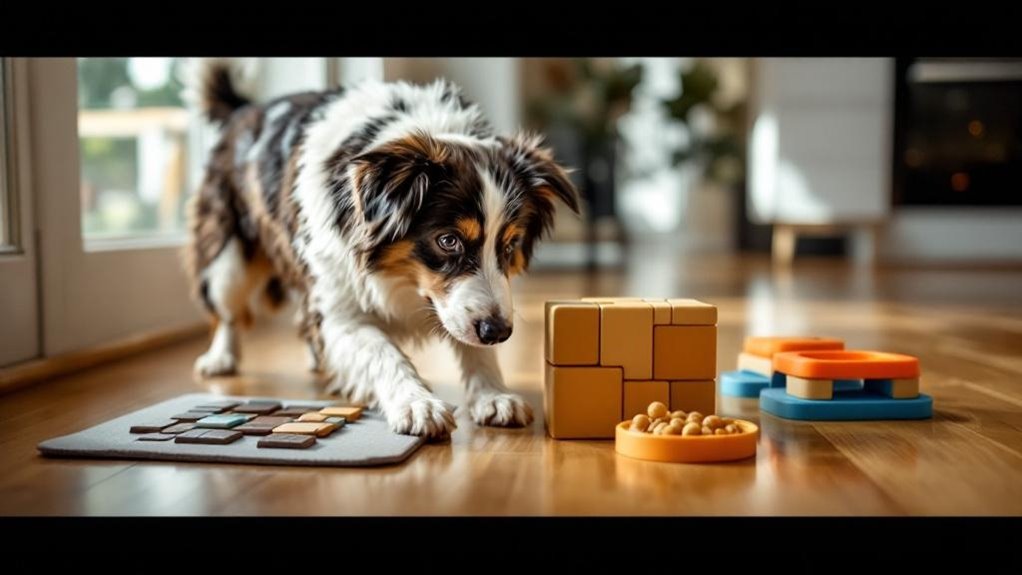
Your intelligent dog’s destructive behavior signals unmet mental needs, not character flaws. Puzzle toys redirect that energy through problem-solving, reducing anxiety and frustration while satisfying natural hunting instincts. Effective toys balance difficulty—avoiding extremes of being too easy or too hard—using quality materials and customizable options. Start with entry-level dispensers like the KONG Gyro to assess your dog’s skills, then progress to more demanding challenges as she demonstrates quick problem-solving. Understanding how to match difficulty levels to her abilities guarantees sustained engagement and behavioral improvement.
- Key Takeaways
- Smart Dogs Need Mental Challenges: Here’s Why
- How Puzzle Toys Stop Boredom and Destructive Behavior
- What Separates Great Puzzle Toys From Disappointing Ones
- Find Your Dog’s Challenge Level in 3 Minutes
- KONG Gyro: Best Entry-Level Treat Dispenser
- Play9 Roolo: Best for Unpredictable, Engaging Movement
- Start Here: Introducing Puzzle Toys Without Frustration
- Nina Ottosson Dog Casino: Best for Level 3 Challenge
- Kanoodle Puzzle Toy: Best for Problem Solvers
- K9 Connectables: Best Flexible, Customizable Puzzle
- Bob-A-Lot Interactive Puzzle: Adjustable Difficulty You Control
- Food Dispensing Toys That Keep Dogs Occupied for Hours
- Snuffle Mats: How to Trigger Your Dog’s Natural Foraging
- Lick Mats: Best for Calming and Extended Relaxation Play
- Chewing Toys That Double as Puzzle Challenges
- SodaPup Honey Pot: The Toughest Toy for Power Chewers
- Hide-a-Squirrel Plush Puzzle: Best Tactile Alternative
- Prevent Puzzle Toy Frustration: Quick-Start Guide
- Puzzle Toy Rotation: Keep Variety Fresh and Interesting
- Best Puzzle Toys Under $20: Maximum Value, Minimum Spend
- Where to Buy Puzzle Toys (And What to Expect)
- Signs Your Dog Is Ready to Level Up
- Common Puzzle Toy Mistakes and How to Avoid Them
- Frequently Asked Questions
- Conclusion
Key Takeaways
- Puzzle toys redirect mental energy away from destructive behaviors by engaging problem-solving skills and satisfying natural hunting instincts safely.
- Top recommendations include KONG Gyro for beginners, Nina Ottosson Dog Casino for intermediate, and SodaPup Honey Pot for power chewers.
- Effective puzzle toys balance difficulty levels, avoiding extremes of being too easy or too hard to maintain sustained engagement.
- Start with entry-level toys, then progress through Levels 2 and 3 as your dog demonstrates quick problem-solving and continued interest.
- Rotate puzzle toys regularly and monitor focus duration, problem-solving creativity, and enthusiasm to keep intelligent dogs mentally stimulated and satisfied.
Smart Dogs Need Mental Challenges: Here’s Why
Because intelligent dogs require ongoing stimulation to stay engaged, they’ll often develop destructive behaviors when bored—chewing furniture, excessive barking, or digging—behaviors that stem directly from a lack of mental activity rather than disobedience.
Your dog’s brain works much like yours, needing regular challenges to function efficiently and remain satisfied. Without adequate mental stimulation, intelligent dogs experience frustration that builds over time, pushing them toward problematic outlets for their energy and cognitive abilities.
Your dog’s brain needs regular challenges to stay satisfied. Without mental stimulation, frustration builds, leading to destructive behaviors.
When you provide consistent mental challenges through activities and toys, you redirect that natural drive constructively. This engagement reduces anxiety, strengthens focus, and creates a calmer household overall.
Understanding this connection helps you recognize that behavioral issues often signal unmet mental needs rather than character flaws, making mental stimulation an essential component of responsible dog ownership.
How Puzzle Toys Stop Boredom and Destructive Behavior
Now that you understand why intelligent dogs need mental stimulation, you can see how puzzle toys offer a direct solution to this challenge.
When you provide puzzle toys for dogs, you’re giving them structured activities that require problem-solving, which naturally redirects their mental energy away from destructive behaviors like chewing or digging.
Dogs experiencing boredom often develop anxiety and frustration, emotions that manifest through unwanted actions.
However, when you introduce these toys consistently, you engage your dog’s cognitive abilities and encourage independent play, reducing the likelihood of behavioral problems during your absence.
The mental engagement these toys provide creates a reinforcement cycle: your dog becomes more adept at thinking through challenges, experiences less anxiety, and exhibits fewer destructive habits as a result.
What Separates Great Puzzle Toys From Disappointing Ones
The difference between a puzzle toy that transforms your dog’s behavior and one that collects dust in the corner often comes down to whether it holds your dog’s interest over time.
Best puzzle toys balance difficulty carefully, offering enough challenge to keep your dog engaged without frustrating them into abandonment. Disappointing toys tend toward extremes, either solving too quickly or proving impossible, both outcomes leading to disinterest.
High-quality designs like those from Nina Ottosson use durable materials that withstand rough play, while customizable options such as K9 Connectables let you adjust difficulty as your dog improves.
The separation between exceptional and mediocre puzzle toys lies in their consistency, structure, and ability to provide ongoing mental stimulation through interactive play.
Find Your Dog’s Challenge Level in 3 Minutes
Once you’ve identified what makes a puzzle toy worthwhile, you’ll want to find the right difficulty level for your individual dog before investing in multiple options.
Start by observing how your dog interacts with basic toys, noting their problem-solving approach and persistence. Introduce entry-level dog puzzle toys like KONG Gyro or Play9 Roolo, then watch carefully for signs of engagement or frustration.
If your dog solves these quickly without losing interest, they’re ready for intermediate challenges like Nina Ottosson Dog Casino. The ideal puzzle keeps them mentally active without causing stress.
Pay attention to how long they stay focused and whether they return to the toy independently, which indicates appropriate difficulty and genuine engagement.
KONG Gyro: Best Entry-Level Treat Dispenser
If you’re looking for a puzzle toy that won’t overwhelm your dog with complexity, the KONG Gyro serves as an excellent starting point, combining treat dispensing with slow feeding in one durable package.
The toy’s transparent design lets your dog see treats inside the central sphere, creating visual motivation that encourages extended engagement. As your dog nudges and spins the Gyro, treats gradually dispense, rewarding persistence and problem-solving.
This structure makes it ideal for dogs new to interactive play, establishing consistency in reward-based learning without frustration. The plastic construction suits moderate chewers well, though aggressive chewers may require Kong alternatives offering greater durability.
Play9 Roolo: Best for Unpredictable, Engaging Movement
If you’ve got a dog that needs mental stimulation through unpredictable play, the Play9 Roolo delivers erratic movement that keeps your pet engaged as they work to retrieve treats, making it an excellent choice for problem-solving and cognitive development.
You’ll appreciate its dual function as a slow feeder, which helps regulate eating pace for dogs that consume food too quickly or show picky eating patterns, promoting healthier digestion and mealtime habits.
Since it’s designed exclusively for dry treats and food, you can maintain the toy easily and guarantee consistent performance without the complications that come with wet or sticky options.
Erratic Movement Engages Dogs
Dogs respond powerfully to unpredictable motion because their prey drive—the instinct to chase and capture moving objects—remains strong even in domesticated animals. The Play9 Roolo harnesses this natural behavior through its dynamic rolling pattern that keeps treats just out of reach.
This erratic movement creates consistent engagement by triggering your dog’s hunting instincts in a controlled, safe environment.
The toy’s unpredictable trajectory encourages sustained interaction and mental stimulation:
- Your dog experiences repeated moments of anticipation and discovery as the toy rolls unpredictably.
- The challenge of predicting movement patterns strengthens problem-solving skills through active play.
- Erratic motion maintains novelty, preventing habituation and keeping your dog interested longer.
- The reward structure—effort leading to treat access—reinforces positive behavioral patterns.
This design delivers reinforcement through structure, making the Play9 Roolo particularly effective for dogs needing consistent mental engagement and physical activity throughout their day.
Slow Feeding Functionality Options
Beyond its primary role as an engagement toy, the Play9 Roolo functions as an effective slow feeder because its design forces your dog to work for each treat or kibble piece rather than consuming food all at once, which can help prevent digestive issues and promote healthier eating habits. This slow feeding functionality offers multiple benefits for dogs with different eating patterns, particularly those who gulp their meals without proper chewing.
| Feeding Concern | Solution |
|---|---|
| Fast eaters | Controlled pace through rolling dispenser |
| Picky eaters | Interactive engagement increases interest |
| Mental stimulation | Problem-solving during meals |
| Digestive health | Reduced bloating from slower consumption |
| Treat reinforcement | Consistent reward structure |
You’ll notice your dog’s eating becomes more deliberate when using the Roolo, creating structure around mealtime while maintaining mental stimulation through active play.
Dry Treats And Food
When you’re looking for a treat-dispensing toy that’ll keep your dog mentally engaged through unpredictable movement patterns, the Play9 Roolo delivers consistent challenge by rolling erratically across floors and yards, mimicking the darting behavior of prey and triggering your dog’s natural hunting instincts.
You can fill this toy with your dog’s favorite dry treats and dog food, making it versatile for various dietary preferences. The erratic rolling motion encourages your dog to work harder for rewards, promoting active engagement and problem-solving behavior.
- Unpredictable movement sustains your dog’s focus longer than static toys
- Mental stimulation from tracking and chasing reduces destructive behaviors
- Natural prey-mimicking motion satisfies hunting instincts safely
- Adaptable to different dry treat sizes and dog food types
This structure reinforces positive reinforcement patterns while providing the consistency your intelligent dog needs for lasting engagement.
Start Here: Introducing Puzzle Toys Without Frustration
Introducing puzzle toys successfully requires you to understand that your dog’s first experience with these tools will shape their willingness to engage with them in the future, which is why starting with simpler designs matters far more than jumping straight to complex challenges. You’ll find that beginner puzzle toys like the KONG Gyro or Play9 Roolo provide manageable difficulty levels, allowing your dog to experience success without frustration.
| Puzzle Toy | Difficulty Level | Best For | Time Investment | Progression |
|---|---|---|---|---|
| KONG Gyro | Beginner | First introductions | 5-10 minutes | Foundation building |
| Play9 Roolo | Beginner | Gentle engagement | 10-15 minutes | Confidence development |
| Nina Ottosson | Intermediate | Skill advancement | 15-20 minutes | Problem-solving growth |
| Bob-A-Lot | Adjustable | Long-term development | Varies | Continuous challenge |
| Advanced puzzles | Expert | Experienced dogs | 20+ minutes | Mastery maintenance |
You’ll gradually increase difficulty as your dog develops skills, maintaining their interest through consistent, structured progression.
Nina Ottosson Dog Casino: Best for Level 3 Challenge
The Nina Ottosson Dog Casino represents a meaningful step up from beginner puzzles, requiring your dog to use multiple problem-solving techniques like sliding and opening compartments to retrieve treats.
The Nina Ottosson Dog Casino elevates puzzle play, demanding sliding and compartment-opening skills to unlock treats.
This Level 3 dog puzzle toy features adjustable lockable drawers, allowing you to increase difficulty as your dog’s skills develop, ensuring consistent mental engagement over time.
The durable plastic construction withstands repeated use, and you’ll appreciate that it’s dishwasher safe for convenient cleaning.
Your dog benefits from:
- Progressive difficulty that builds confidence through mastered challenges
- Enhanced cognitive stimulation that reduces destructive behaviors
- Independent problem-solving that strengthens focus and persistence
- Structured mental exercise that promotes overall well-being
You’ll notice your intelligent dog approaching these dog puzzles with increased determination and focus, developing patience alongside problem-solving abilities that translate to improved behavior throughout daily life.
Kanoodle Puzzle Toy: Best for Problem Solvers
If you’re looking for a toy that rewards your dog’s natural problem-solving instincts, the Kanoodle’s rotating lid mechanism and multiple treat pockets create engaging challenges that make your dog think through each step.
You’ll notice the toy’s brightly colored, uniquely shaped design captures visual attention while the one-step solution format makes it accessible for dogs new to puzzles, then naturally progresses in difficulty as your dog develops stronger solving skills.
This progressive structure means you can keep your intelligent dog mentally stimulated over time without needing to purchase entirely new toys, since the same puzzle toy grows more rewarding as your dog’s abilities advance.
Problem-Solving Features Design
For dogs that thrive on mental challenges, rotating puzzle lids create an ideal setup for strengthening cognitive abilities. The Kanoodle Puzzle Toy delivers this experience through a straightforward yet effective design that requires your dog to manipulate multiple compartments to access hidden treats or kibble.
The problem-solving features work by encouraging independent thinking through trial-and-error learning, where your dog discovers which lid movements unveil rewards.
- Your dog builds confidence as they successfully solve each compartment
- Rotating lids maintain novelty, preventing boredom during repeated play sessions
- Brightly colored, uniquely shaped lids trigger curiosity and sustained engagement
- Progressive difficulty allows your dog to advance their cognitive skills naturally
The durable construction guarantees consistency in reinforcement, supporting long-term mental development and enrichment for intelligent dogs seeking meaningful challenges.
Progressive Difficulty Customization
One of the Kanoodle Puzzle Toy’s standout features is its ability to adjust difficulty levels as your dog’s problem-solving skills improve, which you can customize by changing how you arrange the rotating lids or which compartments you fill with treats.
This progressive difficulty structure prevents your dog from losing interest once they’ve mastered initial challenges, ensuring consistent mental stimulation over time. You can start by leaving certain lids slightly loose, allowing your dog quicker access to rewards, then gradually tighten them as their confidence grows.
K9 Connectables: Best Flexible, Customizable Puzzle
Because dogs learn at different rates and possess varying levels of puzzle-solving experience, K9 Connectables stand out as a toy that adapts to your dog’s abilities rather than forcing them into a one-size-fits-all challenge.
You’ll appreciate how interchangeable components let you adjust difficulty levels, meaning your dog can start simple and progress as their skills develop. The durable construction withstands enthusiastic chewing, while the treat-filling option provides consistent reinforcement and extended engagement.
Why K9 Connectables work:
- Your dog manipulates components with paws and snout, building confidence through independent problem-solving
- Flexible design supports both novice and experienced puzzle solvers without frustration
- Customizable structure keeps your dog mentally stimulated across different play sessions
- Treat rewards reinforce successful puzzle completion and encourage repeated interaction
This approach guarantees your dog stays challenged appropriately while developing cognitive skills progressively.
Bob-A-Lot Interactive Puzzle: Adjustable Difficulty You Control
While the K9 Connectables excel at progressive customization through interchangeable parts, the Bob-A-Lot Interactive Puzzle takes a different approach by letting you adjust difficulty through openings you control directly on the toy itself.
You can modify the challenge level based on your dog’s developing skills, which maintains engagement without causing frustration. The puzzle’s heavy, sturdy base prevents tipping during play, allowing your dog to focus on solving rather than stabilizing the toy.
You’ll also appreciate its dual function as a slow feeder, promoting healthier eating patterns while delivering mental stimulation. Made from durable materials, it withstands aggressive chewing, ensuring consistent reinforcement of your dog’s problem-solving abilities across extended play sessions.
Food Dispensing Toys That Keep Dogs Occupied for Hours
Food dispensing toys work by releasing kibble or treats through openings as your dog manipulates them, which keeps your dog engaged for extended periods because they’re working toward a concrete reward rather than playing aimlessly. You’ll find various sizes available, including the Lil Snoop and Nooks Happiness, accommodating different breeds and energy levels.
Popular options like the Tricky Treat Ball and TetraFlex provide interactive play by dispensing food as the ball rolls, promoting both mental stimulation and physical exercise. These food dispensing toys double as slow feeders, helping regulate your dog’s eating speed and prevent health issues associated with rapid consumption.
Food dispensing toys like the Tricky Treat Ball combine mental stimulation, physical exercise, and slower eating habits for healthier dogs.
- Your dog receives consistent reinforcement through reward delivery
- Problem-solving skills develop through manipulation and persistence
- Physical activity increases during play sessions
- Anxiety decreases when dogs focus on extractive tasks
You can enhance difficulty by placing smaller puzzle toys inside for added challenge.
Snuffle Mats: How to Trigger Your Dog’s Natural Foraging
Snuffle mats tap into your dog’s natural instinct to search for food by scent, mimicking the foraging behavior they’d engage in if left to their own devices in the wild. You’ll notice your dog using their nose to work through fabric folds, engaging their brain while finding hidden treats, which reduces boredom and prevents destructive behaviors. These mats come in various designs suited to different skill levels.
| Feature | Benefit | Application |
|---|---|---|
| Machine washable | Easy hygiene maintenance | Clean after each use |
| Multiple sizes | Accommodates all breeds | Match mat to dog size |
| Varied difficulty | Adjustable challenge | Progress as skills improve |
Regular use of snuffle mats provides consistent mental stimulation, strengthening your dog’s problem-solving abilities while reinforcing positive engagement patterns.
Lick Mats: Best for Calming and Extended Relaxation Play
You can maximize engagement by freezing lick mats with dog-safe foods like peanut butter, yogurt, or broth, which slows down consumption and keeps your dog occupied for extended periods while providing mental stimulation through the challenge of working the food free.
The varied textures and surface designs across different lick mat styles—from ridged patterns to nubby surfaces—create different licking experiences that engage your dog’s natural foraging instincts and maintain novelty, preventing boredom over time.
Pairing a properly secured mat with these freezing techniques and surface variations gives you a reliable structure for calming play sessions during grooming, travel, or periods when your dog needs focused, solo activity.
Freezing for Extended Engagement
When you freeze a lick mat with treats or wet food spread across its surface, you’re fundamentally transforming a simple toy into an extended engagement tool that keeps your dog mentally occupied for greatly longer than an unfrozen version would.
The freezing process creates a challenge that requires sustained effort, slowing your dog’s consumption and providing consistent mental stimulation throughout the experience.
Benefits of freezing for extended engagement:
- Extends playtime greatly, offering hours of focused activity rather than minutes
- Provides a soothing effect that calms anxious dogs during grooming or stressful situations
- Slows feeding pace, promoting healthier eating habits and better digestion
- Reduces destructive behaviors by channeling your dog’s energy productively
You’ll notice your dog works gradually through the frozen layers, maintaining concentration and structure to their day while experiencing natural reinforcement from their effort.
Texture and Surface Variety
The different textures and patterns built into lick mats create varied resistance levels that engage your dog’s problem-solving abilities while they work to extract treats from the surface.
This texture variety means your dog encounters changing difficulty as they lick, which prevents boredom and maintains mental stimulation throughout the session. You can spread peanut butter or yogurt across these textured surfaces, and the ridges and grooves will hold the treat in place, requiring your dog to work strategically to access it.
Chewing Toys That Double as Puzzle Challenges
Combining chewing satisfaction with mental engagement, puzzle toys that hide treats inside offer your dog two forms of stimulation in one toy, addressing both their instinct to chew and their need for problem-solving activity.
Chewing toys that double as puzzle challenges work by requiring your dog to manipulate the toy in specific ways to access rewards, creating consistent reinforcement for problem-solving behavior.
Puzzle chewing toys reinforce problem-solving by requiring dogs to manipulate and interact with toys to access hidden rewards.
- The Pickle Pocket hides small treats inside, encouraging prolonged engagement through both chewing and extraction
- The Dog Toy Ball holds treats or peanut butter, demanding your dog figure out extraction techniques
- The Honey Pot from SodaPup provides extreme durability for powerful chewers while concealing treats
- The Green Treat Dispensing Chew Ball rewards play with food rewards, combining exercise with mental challenge
This structure builds your dog’s confidence while satisfying their natural drives.
SodaPup Honey Pot: The Toughest Toy for Power Chewers
Your dog’s powerful jaws require a toy that won’t splinter, crack, or fall apart within days, and that’s where the SodaPup Honey Pot excels as one of the most durable options available for aggressive chewers.
This dog toy features a wide opening that allows you to fill it with treats or peanut butter, keeping your dog engaged while working through the honeycomb design. The unique structure encourages problem-solving and mental stimulation, as your dog must manipulate the toy to access rewards.
Made from food-safe, non-toxic materials, the Honey Pot provides safe playtime without hazardous fragments. The honeycomb pattern creates natural resistance, so your dog expends energy productively while reinforcing healthy chewing behavior and sustained focus.
Hide-a-Squirrel Plush Puzzle: Best Tactile Alternative
While the SodaPup Honey Pot excels at withstanding aggressive chewing, not every dog needs a toy designed for power chewers, and some dogs respond better to a tactile puzzle that rewards their natural hunting instincts.
The Hide-a-Squirrel Plush Puzzle offers your dog a different kind of engagement through its plush tree trunk design, where you can hide treats or kibble inside pockets for your dog to discover and retrieve.
This puzzle toy works particularly well for intelligent dogs who enjoy problem-solving challenges:
- Fulfills your dog’s natural foraging and hunting behaviors
- Strengthens the bond between you and your dog during interactive play
- Provides mental stimulation that reduces boredom and destructive behaviors
- Available in multiple sizes to match your dog’s breed and skill level
Regular use builds consistency in your dog’s problem-solving abilities while reinforcing positive behaviors through rewarding structure.
Prevent Puzzle Toy Frustration: Quick-Start Guide
You’ll want to match each puzzle’s difficulty to your dog’s current skill level, starting with simpler toys that build confidence before advancing to complex challenges that keep them engaged without overwhelming them.
Pay attention to how your dog responds—signs of frustration like repeated pawing, abandonment, or whining tell you the puzzle’s too hard, while quickly losing interest suggests it’s too easy.
Adjust by modifying treat amounts, rotating toys to refresh novelty, and always supervising to catch frustration early so you can either simplify the task or guide your dog toward success.
Matching Difficulty To Ability
Selecting puzzle toys that match your dog’s current ability level is essential for keeping frustration at bay, because toys that are too simple lead to boredom while those that are too challenging can create stress and discouragement.
Start with Level 1 puzzles featuring one-step solutions, which build confidence and encourage problem-solving in beginners. Progress gradually to Level 2 and Level 3 options as your dog masters each stage, introducing multi-step challenges that maintain engagement for intelligent dogs.
- Adjustable difficulty levels adapt to your dog’s evolving skills
- Consistent progression prevents both boredom and overwhelming stress
- Monitoring behavior reveals when to advance toy complexity
- New challenges reinforce mental stimulation and problem-solving abilities
Track your dog’s interest and performance regularly, adjusting difficulty levels accordingly to guarantee ongoing enjoyment and a rewarding play experience.
Progressive Challenge Advancement
Progressive advancement prevents the common trap where dogs either lose interest in toys that’ve become too easy or shut down when faced with puzzles beyond their current abilities.
You’ll want to monitor your dog’s problem-solving speed closely, as this directly indicates when they’re ready to move forward.
Start by observing how quickly your dog solves each puzzle toy. When they complete it consistently without hesitation, that’s your signal to introduce slightly harder options.
Puzzle toys with adjustable difficulty levels, like the Nina Ottosson Dog Casino, allow you to increase complexity gradually without overwhelming them.
This measured progression builds confidence while maintaining engagement.
You’re creating a structure where success reinforces motivation, allowing your dog to develop stronger problem-solving skills systematically rather than through trial-and-error frustration.
Recognizing Signs Of Frustration
Even well-intentioned puzzle toy selections can backfire when the difficulty level doesn’t match your dog’s current abilities, and recognizing frustration early prevents negative associations with problem-solving play.
You’ll notice your dog displaying frustration through specific behaviors that signal the toy has become too challenging, indicating you should adjust your approach to keep your dog mentally engaged without overwhelming them.
Watch for these warning signs:
- Excessive barking or whining directed at the puzzle
- Repeated pawing at the toy with increasing intensity
- Quick loss of interest, followed by disengagement
- Body tension or stiff posture around the puzzle
Monitor your dog’s body language consistently throughout play sessions.
When you spot these signals, switch to simpler toys immediately, then gradually reintroduce difficulty at a slower pace, ensuring success reinforces their confidence in problem-solving activities.
Puzzle Toy Rotation: Keep Variety Fresh and Interesting
Your dog’s interest in puzzle toys naturally fades when they’ve mastered a toy’s challenge or seen it too many times, which is why rotating toys through active play and storage cycles keeps their mental engagement sharp and their problem-solving skills developing.
You can maintain freshness by introducing new puzzle toys every few weeks or switching out existing ones to encourage renewed interest in familiar challenges. Keeping a variety of difficulty levels available allows you to adjust engagement based on your dog’s current mood and energy level, ensuring consistent stimulation without overwhelming them.
Store some puzzle toys away temporarily, then reintroduce them later; this strategy makes familiar toys feel novel again.
Building a diverse collection from brands like Nina Ottosson and SodaPup provides varying stimulation types, from treat-dispensing to interactive feeding solutions, supporting ongoing mental development.
Best Puzzle Toys Under $20: Maximum Value, Minimum Spend
Building a collection of varied puzzle toys doesn’t require a significant investment, since many high-quality options cost less than $20 and deliver the mental engagement your dog needs to stay sharp.
You’ll find durable, effective toys that stimulate problem-solving without straining your budget.
- The KONG Gyro ($16.99) spins to release treats, rewarding your dog’s interactive play and persistence.
- The Treat Tumble Interactive Puzzle ($4.00) offers marked-down pricing for affordable mental stimulation with kibble or treats.
- The Puppy Smart Interactive Treat Puzzle ($8.50) suits beginners, encouraging straightforward problem-solving with dry treats.
- The Snuffle Palz Pig ($7.50) channels natural foraging instincts while keeping costs minimal.
These affordable options provide consistent reinforcement and structure, allowing you to rotate toys regularly without financial strain while maintaining your dog’s cognitive engagement.
Where to Buy Puzzle Toys (And What to Expect)
Where can you find puzzle toys that’ll work for your dog without the hassle of searching multiple retailers? Chewy stands out as your primary option, offering exceptional customer service, fast shipping, and competitive pricing that rivals Amazon.
New customers receive a $20 eGift Card on purchases of $49 or more, which effectively reduces your initial investment while you explore different puzzle toys. The platform stocks a diverse selection suited for various dog sizes and skill levels, ensuring you’ll find options that match your dog’s abilities and learning pace.
If you’re shopping internationally, localized Amazon links provide convenient access to similar puzzle toys. Beyond transactions, Chewy emphasizes community support through personalized cards and donations to help pets in need, allowing you to contribute meaningfully alongside your purchase.
Signs Your Dog Is Ready to Level Up
You’ll notice your dog is ready to advance when they’re completing their current puzzles quickly and with obvious ease, which means their brain’s craving more demanding challenges to stay engaged.
If you’re seeing signs of boredom—like disinterest in toys that once captivated them or a tendency to give up without much effort—that’s your signal that the difficulty level you’re currently offering isn’t meeting their mental needs.
The key is watching for that sweet spot where your dog shows persistence and enthusiasm for problem-solving but can solve existing puzzles too fast, indicating it’s time to introduce a higher level of complexity to maintain their interest and mental stimulation.
Completing Puzzles With Ease
Once your dog consistently retrieves treats from basic puzzle toys like the KONG Gyro and Play9 Roolo, it’s worth considering whether they’re ready to step up to more demanding options.
When your dog solves puzzles without frustration or losing interest, they’re demonstrating the cognitive capacity for increased difficulty. You’ll notice they enthusiastically attempt multi-step puzzles like the Nina Ottosson Dog Casino, which signals readiness for complexity.
Dogs exhibiting problem-solving skills—trying different approaches and using their noses strategically—show they’re prepared for higher-level puzzle toys requiring strategic thinking.
- Your dog completes basic puzzles consistently without hesitation
- They maintain focus and enthusiasm throughout problem-solving attempts
- They demonstrate varied approaches to accessing treats
- They show genuine excitement when encountering new puzzle toys
Gradual introduction to adjustable puzzle toys helps you gauge their capacity without overwhelming them.
Seeking Increased Mental Challenge
As your dog masters basic puzzle toys with consistent success, they’ll naturally begin to show signs that they’re ready for greater challenges, and recognizing these signals guarantees you’re providing appropriate mental stimulation at the right time.
Watch for decreased engagement with current toys, rapid problem-solving, or persistent boredom during play sessions. Your dog might solve puzzles too quickly or lose interest entirely, indicating they need more complexity.
Advanced problem-solvers who manipulate toys to extract treats demonstrate the capacity for intricate puzzles. Dogs displaying curiosity and tenacity when exploring new toys show readiness for demanding interactive toys.
Observing your dog complete multi-step puzzles successfully suggests they’re prepared to tackle even more sophisticated challenges. These observations help you maintain their mental engagement consistently.
Displaying Boredom With Current Toys
One of the most reliable indicators that your dog has outgrown their current puzzle toys is a noticeable drop in engagement during play sessions, where they’ve moved from enthusiastically working through challenges to showing indifference or mild interest.
When your dog consistently ignores toys they once loved or simply paws at them without sustained effort, you’re witnessing a clear signal that their cognitive needs have expanded beyond what these toys provide.
Watch for these behavioral patterns that reveal readiness for more demanding puzzle toys:
- Excessive chewing on furniture or household items as they seek alternative mental stimulation
- Restlessness and vocalization indicating frustration with under-stimulating activities
- Destructive digging or other behaviors that suggest pent-up mental energy
- Decreased problem-solving attempts with previously engaging toys
Regularly rotating and upgrading to more complex puzzle toys maintains consistency in their enrichment, preventing boredom and reinforcing a structured play environment that supports their evolving intelligence.
Common Puzzle Toy Mistakes and How to Avoid Them
Why do so many dogs lose interest in puzzle toys after just a few sessions? You’re likely making one of several common mistakes that undermine engagement and skill development. Selecting a puzzle toy that’s too easy causes boredom, while jumping to overly complex options discourages your dog entirely.
Start with simpler puzzles and gradually progress to more challenging ones, building confidence through manageable steps. You’ll also want to rotate puzzles regularly to maintain novelty and motivation, avoiding the trap of repetitive play.
Always supervise your dog during puzzle sessions to prevent choking hazards from loose pieces. Finally, clean puzzle toys according to manufacturer instructions, preventing bacteria buildup that can pose health risks. Consistency in these practices reinforces your dog’s problem-solving abilities effectively.
Frequently Asked Questions
How Often Should I Rotate Puzzle Toys to Maintain My Dog’s Interest and Engagement?
You should rotate your dog’s puzzle toys every one to two weeks to keep them mentally stimulated and prevent boredom. Switching them regularly maintains novelty and engagement while allowing your pup to rediscover forgotten favorites.
Are Puzzle Toys Safe for Dogs With Sensitive Teeth or Dental Issues?
Like protecting a fragile treasure, you’ll want to choose soft rubber or silicone puzzle toys for your dog’s sensitive teeth. You’ll avoid hard plastic or rope-based options that strain dental work and gums.
Can Puzzle Toys Help With Separation Anxiety When I Leave My Dog Alone?
Yes, puzzle toys can help reduce your dog’s separation anxiety. You’ll keep your pup mentally engaged and distracted while you’re gone, which lessens destructive behaviors and anxiety symptoms greatly.
What’s the Difference Between Puzzle Toys and Regular Treat-Dispensing Toys for Dogs?
You’ll find that puzzle toys require active problem-solving to access treats, while regular treat-dispensing toys simply dispense rewards for basic interaction. Puzzle toys engage your dog’s mind more deeply, offering greater mental stimulation and challenge.
How Do I Clean and Maintain Puzzle Toys to Ensure Hygiene and Longevity?
You’ll clean puzzle toys by hand-washing them in warm soapy water, scrubbing crevices thoroughly, and air-drying completely. You should sanitize them weekly, inspect for damage regularly, and store them in a dry location to prevent mold growth and deterioration.
Conclusion
You’ve now discovered that puzzle toys aren’t just playthings—they’re investments in your dog’s mental well-being. By selecting the right challenge level and rotating toys consistently, you’ll notice your pup becomes more content and less inclined toward creative home redecorating. Start with entry-level options, observe your dog’s problem-solving style, and gradually introduce more complex puzzles. This structured approach keeps your intelligent companion engaged and fulfilled.