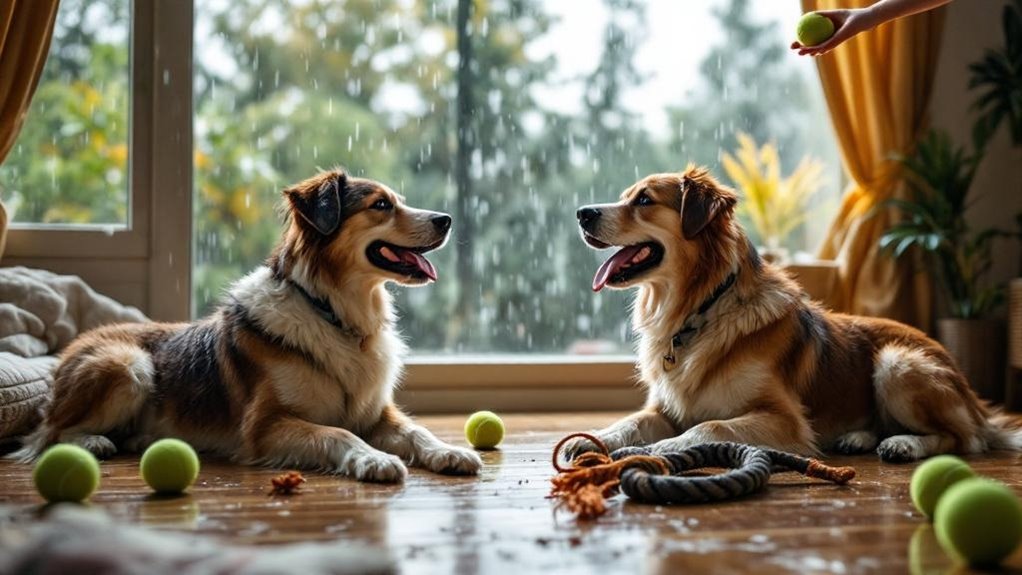
When rain traps your large dog indoors, you’ll need deliberate strategy combining physical and mental challenges to prevent destructive restlessness. Indoor fetch in hallways, stair climbing, and obstacle courses burn physical energy, while hide-and-seek, scavenger hunts, and puzzle toys engage problem-solving abilities. Rotate between high-intensity activities and calmer games, scheduling specific days for each type to maintain balance. Watch for fatigue signs like heavy panting and decreased interest, providing hydration breaks as needed. Consistency and structure transform rainy days into productive opportunities for growth.
- Key Takeaways
- Indoor Fetch Games in Hallways and Stairwells
- Build an Indoor Obstacle Course in 15 Minutes
- Hide and Seek: Teaching the “Find It” Command
- Rainy Day Treat Scavenger Hunts
- DIY Puzzle Toys From Household Trash
- Nose Work Games: Shell Game and Hand Pick
- Sniffing Mats and Foraging Activities for Mental Fatigue
- Kong Stuffing: Frozen Treats for Extended Chewing
- Cardboard Box Enrichment: Cheap and Destructible
- Tug of War: Rules for Safe Play With Large Breeds
- Bully Sticks, Raw Bones, and Yak Chews for Extended Chewing
- Training Sessions That Double as Mental Exercise
- Stair Climbing: Building Strength Without Outdoor Space
- Puzzle Toys for Large Dogs: Easy to Advanced Levels
- “Go and Come” Game for Recall Practice
- Teach New Tricks on Rainy Days for Mental Engagement
- Mental Stimulation Without Movement: Sensory Activities
- Bubble Popping: Low-Energy Play for Tired Pups
- Low-Energy Alternative: When Active Play Isn’t Enough
- Reading Your Dog’s Fatigue: When to Stop Playing
- Create a Weekly Rainy Day Activity Plan
- Quick-Reference Guide: 5-Minute Activities
- How to Tell When Your Dog Is Tired Enough
- Troubleshooting: When Your Dog Won’t Engage
- Rotating Toys to Prevent Boredom
- Measuring Long-Term Progress and Adjusting Your Routine
- Frequently Asked Questions
- Conclusion
Key Takeaways
- Use hallways and stairwells for controlled indoor fetch games with soft, lightweight toys to safely tire large dogs.
- Build simple indoor obstacle courses using household items like chairs, broomsticks, and cushions within 15 minutes.
- Hide treats throughout the house and use “find it” commands to engage natural scent-tracking instincts mentally.
- Create DIY puzzle toys from cardboard boxes and egg cartons with hidden treats for problem-solving challenges.
- Establish a structured schedule alternating between high-intensity activities like stair sprints and calm mental games like sniffing mats.
Indoor Fetch Games in Hallways and Stairwells
Indoor fetch games in hallways and stairwells offer large dogs a controlled environment where they can run, retrieve, and burn energy without needing a yard or outdoor space.
You’ll find that these indoor games provide an excellent solution for exercising your dog on days when outdoor activities aren’t feasible. Use soft, lightweight toys like plush or squeaky options to prevent damage to your home’s surfaces.
Indoor fetch games provide an excellent solution for exercising your dog on days when outdoor activities aren’t feasible.
You can increase the challenge by tossing toys down stairs, which adds intensity while allowing brief exercise bursts. Supervise your dog closely during stairwell play to guarantee safe ascending and descending.
Vary the distance and speed of your throws to keep your dog engaged and mentally stimulated, adjusting intensity based on your dog’s fitness level and energy needs.
Build an Indoor Obstacle Course in 15 Minutes
You can construct a functional obstacle course using common household items like chairs, broomsticks, and cushions, which means you don’t need special equipment or extensive setup time.
Start with straightforward obstacles such as a low broomstick propped on books for jumping, then gradually introduce more challenging elements like weaving patterns or crawling spaces as your large dog builds confidence and understanding.
Safety matters greatly with bigger dogs, so you’ll want to make sure obstacles are stable and appropriately sized, space them with enough room for your dog’s length and stride, and always supervise the activity to prevent injuries or collisions.
Household Items Work Best
Creating an effective obstacle course doesn’t require expensive equipment or special materials, since everyday household items like pillows, chairs, and broomsticks can provide all the structure and challenge your large dog needs to build agility and problem-solving skills.
You’ll find that common household objects work exceptionally well for indoor dog activities because they’re adjustable, safe, and already available. Consider these options:
- Pillows arranged in lines for jumping practice
- Chairs positioned to create weaving patterns
- Step stools or low furniture for climbing challenges
These items let you modify the obstacle course based on your dog’s current abilities, ensuring appropriate difficulty levels.
Start with simple tasks like jumping over pillows, then gradually increase complexity as your dog gains confidence and strength, making the experience both progressive and rewarding throughout the training process.
Start Simple, Build Complexity
Because your large dog’s success depends on building confidence gradually, the best approach is to start with straightforward obstacles and then layer in additional challenges as they master each element.
Begin with a simple broomstick jump positioned at an appropriate height to assess your dog’s ability and willingness, which establishes a foundation for more complex activities. Once your dog navigates this initial obstacle consistently, introduce tunnels using cushions or boxes to enhance agility and exploration skills.
Next, create weaving courses by arranging chairs or furniture in lines that challenge coordination and focus. As your dog demonstrates competence, increase difficulty by adding new variations and combining multiple obstacles.
Throughout these obstacle courses, offer rewards and positive reinforcement after successful attempts, which builds both skill and motivation for continued participation in these indoor activities.
Safety Considerations For Large Dogs
Several critical safety measures will guarantee that your large dog can navigate an indoor obstacle course without injury, and these protections are especially important because larger dogs generate more force and momentum during movement. Your safety considerations directly impact how effectively your dog receives physical stimulation while remaining protected.
- Use sturdy equipment like heavy-duty chairs or brooms that withstand your dog’s weight and vigorous movement without collapsing.
- Remove sharp edges, small objects, and choking hazards from the entire setup area.
- Install non-slip mats on slippery floors to reduce slips and falls during high-energy navigation.
Create wide spaces between obstacles so your large dog won’t feel trapped or anxious.
Regularly inspect your course for stability, adjusting components as needed to maintain a safe, secure environment that supports consistent physical activity.
Hide and Seek: Teaching the “Find It” Command
You’ll want to start your dog’s training with treats placed directly on the floor in front of them while you say “find it,” which creates a straightforward association between the command and the action of locating food.
As your dog becomes reliable with this basic version, you can gradually increase the difficulty by tossing treats in different directions or hiding them in less obvious spots around your room, which builds their confidence and problem-solving ability.
This progression from simple to challenging locations keeps the activity engaging while reinforcing their understanding of the command through consistent practice and reward.
Starting With Simple Hiding Spots
Hide and seek games built on the “find it” command form one of the most effective ways to keep large dogs mentally engaged indoors, since they’re tapping into the natural hunting instincts that drive their sense of smell and problem-solving abilities.
You’ll start by showing your dog a treat and letting them watch you place it in an obvious location, which builds positive association with the command. Before hiding treats around the house, use a “sit” or “stay” command to keep your dog stationary until you’ve finished.
Your first hiding spots should remain easy to find:
- Treats on the floor near furniture
- Treats partially hidden under blankets
- Treats in open doorways
This straightforward approach establishes consistency and builds your dog’s confidence before progressing to challenging locations.
Advancing To Challenging Locations
Once your dog’s confidence builds with simple hiding spots, you’re ready to increase the difficulty by placing treats in locations that require more searching effort, such as under furniture, behind doors, or inside partially closed cabinets. This progression develops your dog’s problem-solving abilities and provides mental enrichment through scent games that engage their natural instincts.
| Hiding Location | Difficulty Level | Search Time | Mental Challenge | Reinforcement Method |
|---|---|---|---|---|
| Under couch cushions | Moderate | 2-3 minutes | High | Verbal praise + treat |
| Behind closed doors | Challenging | 3-5 minutes | Very high | Excited celebration |
| Inside cabinets | Advanced | 5+ minutes | Extreme | Extra rewards |
| Under rugs | Moderate-high | 2-4 minutes | High | Consistent praise |
| Behind curtains | Challenging | 3-6 minutes | Very high | Multiple treats |
Use sit-stay commands before releasing your dog, reinforcing impulse control while you hide treats strategically throughout your space.
Rainy Day Treat Scavenger Hunts
When rain keeps your large dog confined indoors, a treat scavenger hunt transforms idle time into mental stimulation that taps into their natural searching instincts. You’ll want to start by hiding treats in easily accessible locations around your home to build your dog’s confidence before gradually increasing the difficulty.
Structure your hunts strategically:
- Hide high-value treats like cheese or hot dogs under cushions and behind doors to maintain motivation and engagement.
- Use the command “find it” consistently to reinforce focus and teach your dog to rely on their sense of smell.
- Celebrate discoveries with enthusiastic praise, which strengthens positive associations and encourages future participation.
As your dog becomes more adept, place treats in progressively challenging spots throughout your home, creating variety and sustained mental engagement during rainy days when outdoor exercise isn’t possible.
DIY Puzzle Toys From Household Trash
You can build on the mental engagement from scavenger hunts by creating puzzle toys from materials you’ve already got around your house, which costs nothing and gives your large dog a different kind of problem-solving challenge.
Cardboard boxes folded with treats inside encourage your dog to tear them apart, while plastic bottles with hidden treats require manipulation and chewing to access rewards.
Empty paper towel rolls sealed at both ends offer another option, as do egg cartons with treats concealed inside.
These DIY puzzle toys engage your dog’s natural foraging instincts, providing mental stimulation that keeps them occupied during indoor days.
Nose Work Games: Shell Game and Hand Pick
Building on the foraging instincts you’ve already engaged through puzzle toys, nose work games like the Shell Game and Which Hand? take your dog’s scent detection abilities further by combining problem-solving with active decision-making.
These nose work games provide substantial mental exercise while keeping your large dog occupied on rainy days.
Nose work games deliver substantial mental exercise, keeping your large dog engaged and occupied during rainy days.
To implement these activities:
- Hide a treat under one of three cups, encouraging your dog to identify the correct cup through scent detection.
- Conceal a treat in one closed fist and let your dog sniff and select the correct hand.
- Gradually increase difficulty by adding more cups or hands as your dog demonstrates proficiency.
Both games strengthen your bond through interactive play and positive reinforcement.
Varying treat types and challenge levels maintains consistency in engagement, preventing boredom and destructive behaviors while building your dog’s confidence and decision-making skills.
Sniffing Mats and Foraging Activities for Mental Fatigue
You can create a DIY snuffle mat using a towel or blanket by tying knots throughout the fabric, then hiding treats within the folds to encourage your dog to search and sniff.
Starting with easier difficulty levels—where treats are partially visible—and gradually increasing the challenge by burying them deeper or using multiple mats teaches your dog persistence while building problem-solving skills.
This scent work mentally tires your dog more effectively than physical exercise alone, since the focused searching and sniffing activate different brain regions, leaving your dog satisfied and calm after just 15 to 20 minutes of engagement.
DIY Snuffle Mat Creation
When your large dog needs mental stimulation without requiring a trip outside, a snuffle mat offers an accessible solution that engages their natural foraging instincts while keeping them occupied indoors.
You’ll create this enrichment tool by combining a rubber mat base with fleece strips, which you can layer or knot through the mat’s surface to form a textured hiding space for treats.
Building your snuffle mat involves three straightforward steps:
- Gather a non-slip rubber mat, fleece fabric strips, and small treats or kibble
- Knot or weave fleece through the mat’s holes to create varied density levels
- Hide treats throughout the strips, adjusting difficulty based on your dog’s experience
This mental stimulation activity tires your dog noticeably within 15-30 minutes, reducing anxiety and destructive behaviors while providing consistent indoor engagement, particularly during weather that limits outdoor play.
Foraging Game Difficulty Levels
As your dog’s sniffing skills develop through regular mat practice, you’ll want to adjust the challenge level to maintain their engagement and continue building mental fatigue. Foraging mats come in various difficulty levels, ranging from basic designs with easy-to-find pockets to complex versions requiring advanced techniques.
Start with simpler mats, then progress to more challenging options as your dog demonstrates consistent problem-solving abilities. You can further intensify the experience by hiding treats deeper within the mat or in less accessible areas, forcing your dog to use greater effort and persistence.
Incorporating different scents and textures alongside these graduated challenges stimulates their olfactory senses more effectively, encouraging sustained searching behavior. This structured approach to difficulty progression guarantees your dog remains mentally engaged while developing stronger scent-tracking abilities and focus.
Mental Fatigue Through Scent Work
Mental fatigue through scent work operates on a straightforward principle: when your large dog engages their natural foraging instincts to search for hidden treats, their brain works intensively in ways that physical exercise alone can’t replicate. This leads to genuine tiredness that calms hyperactive behavior and reduces boredom.
You can create mental fatigue through these scent work methods:
- Hide treats throughout your home, requiring your dog to search systematically and problem-solve.
- Use sniffing mats made from fabric scraps where your dog roots through layers to discover food.
- Play “find it” games that strengthen scent-tracking skills while providing calming enrichment.
This mental fatigue proves especially valuable on rainy days when outdoor activities aren’t possible.
Regular scent work participation creates consistent cognitive stimulation, making your large dog mentally tired enough to rest contentedly indoors.
Kong Stuffing: Frozen Treats for Extended Chewing
Kong stuffing with frozen treats offers a practical solution for keeping large dogs mentally stimulated and physically engaged during indoor time, since the challenge of extracting frozen contents can hold their attention for extended periods.
You can prepare these frozen treats by combining dog-safe ingredients like peanut butter, yogurt, or mashed bananas, then freezing the mixture for several hours until solid. This extended chewing activity promotes healthy habits while alleviating boredom and anxiety, particularly beneficial during rainy days when outdoor exercise isn’t possible.
Rotating different ingredient combinations and varying difficulty levels maintains your dog’s motivation and interest over time. Since large dogs possess strong jaws, Kong toys withstand their chewing power effectively, making them ideal vehicles for delivering mental stimulation and behavioral reinforcement through structured, rewarding activities.
Cardboard Box Enrichment: Cheap and Destructible
You can transform simple cardboard boxes into engaging puzzle toys by creating openings of various sizes, stuffing them with treats or toys, and letting your dog work through the problem-solving challenge of accessing the rewards inside.
Start with larger openings and fewer layers to build your dog’s confidence, then gradually increase the difficulty by reducing opening sizes or adding multiple boxes nested together, which reinforces their problem-solving skills through consistent, progressive challenge.
This approach gives you a sustainable enrichment method that costs nothing, keeps your large dog mentally stimulated during indoor time, and can be recycled once your dog has finished destroying it.
Making DIY Puzzle Toys
One of the simplest and most rewarding enrichment activities for large dogs involves transforming ordinary cardboard boxes into puzzle toys that encourage natural foraging behaviors, and it’s a method that costs virtually nothing while providing substantial mental stimulation.
You can create varying difficulty levels through these approaches:
- Place treats inside a sealed box, allowing your dog to tear it apart.
- Fold the box partially or create strategic openings for added challenge.
- Nest multiple boxes together to extend engagement time.
The texture and sound of cardboard stimulate your dog’s senses, making the activity inherently satisfying. Since you’re utilizing discarded materials, this enrichment option remains environmentally responsible.
Supervision remains essential during playtime to prevent cardboard ingestion, and you should always select untreated boxes to guarantee your dog’s safety throughout the activity.
Stuffing Boxes With Treats
While basic cardboard boxes already provide satisfying sensory experiences through tearing and destruction, filling them with treats creates a powerful incentive structure that transforms simple play into focused problem-solving. This variation is one of the most effective enrichment methods for large dogs.
You can shake treats inside the box to amplify your dog’s excitement and direct their attention toward retrieving the hidden rewards. By varying box designs—folding flaps, multiple openings, or compartments—you establish different difficulty levels that challenge your dog’s cognitive abilities and maintain engagement over time.
This approach offers economic benefits since you’re repurposing recyclable materials already available at home. However, supervision remains essential during play to prevent your dog from ingesting cardboard pieces, so select appropriately sized boxes and monitor their interaction carefully throughout the activity.
Adjusting Difficulty Levels Progressively
As your dog develops confidence and skill with basic cardboard box enrichment, gradually increasing the challenge keeps their mind engaged and prevents boredom from setting in. This progressive approach works both mentally and physically, because your dog must problem-solve while exerting more effort to reach rewards.
Consider these adjustment strategies:
- Fold box flaps partially closed, requiring your dog to manipulate them with their nose or paws
- Layer multiple cardboard boxes together, creating compartments that demand sustained engagement
- Vary box shapes and sizes, which changes how your dog approaches each puzzle
This structure reinforces consistency in their play routine while building their problem-solving abilities.
Tug of War: Rules for Safe Play With Large Breeds
Because large dogs possess considerable jaw strength and size, tug of war requires deliberate structure and clear boundaries to remain safe and enjoyable for both you and your dog.
You’ll want to invest in a durable tug toy appropriately sized for large breeds, ensuring it can withstand their strength without breaking during play.
A durable, appropriately sized tug toy for large breeds withstands their strength during play without breaking.
Establish clear commands for starting, stopping, and releasing the toy, maintaining control throughout sessions.
Practice a reliable drop command regularly, reinforcing it with treats to encourage compliance.
Monitor your dog’s body language closely for signs of overstimulation or aggression, intervening immediately if play becomes too intense.
Keep sessions short and focused to provide physical and mental engagement while preventing excessive excitement that leads to unwanted behavior.
Bully Sticks, Raw Bones, and Yak Chews for Extended Chewing
You’ll want to match each chew option to your dog’s size and chewing intensity, since bully sticks work well for moderate chewers, raw bones suit dogs with strong jaws, and yak chews provide durability for aggressive chewers who need long-lasting engagement.
Supervise your dog closely during chewing sessions to watch for broken pieces that could become choking hazards, and remove any chew that’s been worn down to a size smaller than your dog’s mouth.
Choosing The Right Chew
Several types of chews can satisfy your large dog’s natural urge to chew while keeping them engaged indoors, each offering different benefits based on your dog’s needs and chewing style.
Consider these three options:
- Bully sticks – high-protein, low-fat chews that’re easily digestible and perfect for most dogs.
- Raw bones – large marrow bones provide nutrition and extended chewing sessions, though they require supervision.
- Yak chews – long-lasting, hard alternatives lower in fat and higher in protein, ideal for dogs with allergies.
Match the chew’s toughness to your dog’s chewing strength, selecting harder options for powerful chewers and softer varieties for gentler ones.
Always monitor your dog during chewing to prevent choking hazards, and replace worn chews promptly to maintain safety and engagement.
Safety And Supervision Guidelines
Now that you’ve selected the right chew for your dog’s needs, managing how and when your dog uses these chews becomes the next priority, since even the best-chosen options can pose risks without proper oversight.
You must monitor your dog consistently during chewing sessions, watching for signs of splintering, choking, or aggressive consumption that could lead to digestive blockages.
Limit chewing time to approximately 30 minutes per session to prevent gastrointestinal upset and jaw fatigue, establishing a structured routine that maintains consistency with your dog’s daily activities.
Safety depends on your active presence and attention; never leave your large dog unattended with bully sticks, raw bones, or yak chews.
This reinforcement of supervised chewing protects your dog from serious health complications while allowing them to enjoy the benefits these chews provide.
Training Sessions That Double as Mental Exercise
Because large dogs have considerable energy and intelligence, training sessions offer an ideal way to channel both their physical capacity and their need for cognitive engagement indoors.
Large dogs possess considerable energy and intelligence that training sessions effectively channel for indoor cognitive engagement.
You’ll find that structured training provides mental exercise while building focus and discipline during rainy days when outdoor activity isn’t possible.
Here’s how to maximize training sessions:
- Keep sessions brief—around 5 to 10 minutes—to maintain enthusiasm and prevent boredom from diminishing your dog’s interest in learning.
- Use high-value treats as rewards, which encourages motivation and reinforces positive behavior for improved learning outcomes.
- Mix variations of known commands by adding spins or jumps, building your dog’s confidence and agility simultaneously.
Incorporating puzzle toys during training further challenges your dog’s problem-solving abilities while they respond to commands, creating a thorough mental workout that exhausts their mind effectively.
Stair Climbing: Building Strength Without Outdoor Space
When your large dog’s energy levels exceed what a quick indoor walk can satisfy, stair climbing offers a practical solution that builds muscle strength and cardiovascular fitness without requiring outdoor space.
This exercise engages multiple muscle groups during each ascent and descent, effectively burning excess energy while keeping your dog mentally and physically stimulated indoors.
Start with short stair climbing sessions to prevent fatigue, then gradually increase repetitions to enhance endurance and strength. Supervise your dog throughout the exercise, as larger breeds may experience joint issues or slip on stairs.
You can reinforce this exercise by incorporating commands like ‘sit’ or ‘stay’ between repetitions, combining physical activity with mental engagement for thorough training benefits.
Puzzle Toys for Large Dogs: Easy to Advanced Levels
While stair climbing builds your large dog’s physical strength, puzzle toys address the mental side of exercise by encouraging problem-solving and sustained focus indoors.
These toys combine mental and physical engagement, keeping your dog occupied during rainy days when outdoor play isn’t possible.
Start with easier designs, then progress to advanced levels as your dog develops skills:
- Beginner puzzles feature simple compartments where your dog slides or lifts pieces to access treats.
- Intermediate toys require multiple steps, combining sliding and rotating actions for increased challenge.
- Advanced puzzles demand sequential problem-solving, rewarding persistence and strategic thinking.
Rotating puzzle toys prevents boredom while maintaining consistency in your dog’s routine.
Insert high-value treats or kibble to reinforce engagement, ensuring your large dog stays mentally stimulated and satisfied throughout the day.
“Go and Come” Game for Recall Practice
Strengthening your large dog’s recall skills requires a structured approach that combines physical activity with positive reinforcement, and the “Go and Come” game does exactly that by turning practice into an engaging indoor exercise.
You toss a high-value treat away from you, call your dog back enthusiastically, and reward them when they return, which reinforces their go find and recall abilities simultaneously.
Start in a distraction-free area and gradually increase the tossing distance to challenge your dog’s response. This repetitive process burns excess energy while strengthening your bond through consistent positive reinforcement.
Teach New Tricks on Rainy Days for Mental Engagement
Because rainy days confine your large dog indoors, teaching new tricks becomes an excellent way to channel their energy into mental work that’s just as exhausting as physical exercise. When you teach your dog new tricks, you’re providing the mental stimulation large breeds need to stay calm and content.
Focus on these manageable strategies:
- Keep training sessions short, around 5-10 minutes, to maintain your dog’s attention and prevent frustration.
- Teach commands like “spin,” “roll over,” or “leave it” using high-value treats as positive reinforcement.
- Rotate training locations throughout your home to keep the environment fresh and exciting.
Consistency matters here. Short, focused sessions work better than long, draining ones, allowing your dog to learn effectively while building obedience skills you’ll use daily.
Mental Stimulation Without Movement: Sensory Activities
Mental engagement doesn’t always require your dog to run laps or burn calories through physical activity, and you’ll find that sensory-based games offer a powerful alternative that taps into their natural instincts while keeping them mentally sharp indoors. You can stimulate their mind through smell, touch, and sound without demanding physical exertion, which proves especially valuable on rainy days when outdoor exercise becomes impractical.
| Activity | How It Works | Mental Benefits |
|---|---|---|
| Scent Games | Hide treats in household items | Enhances focus and concentration |
| Puzzle Toys | Dogs work to extract treats | Develops problem-solving skills |
| Foraging Mats | Dogs dig through textures for rewards | Stimulates sensory perception |
You’ll notice your dog remains engaged for extended periods as they explore these activities, which reduces restlessness while building cognitive strength through consistent reinforcement and structured engagement.
Bubble Popping: Low-Energy Play for Tired Pups
When your large dog needs engagement without the physical demands of running or jumping, bubble popping offers a surprisingly effective activity that combines low-intensity movement with sensory stimulation and mental focus. You can use pet-safe, non-toxic bubbles, including flavored varieties that spark your dog’s curiosity and keep them interested longer.
Consider these key benefits of low-energy play:
- Improves coordination and reflexes as your dog chases and pops floating bubbles
- Provides mental stimulation for dogs with lower energy levels or those recovering from injury
- Strengthens your bond through relaxed, positive interactions in a calm setting
Bubble popping sessions require minimal preparation and space, making them ideal for rainy days when outdoor activities aren’t possible.
You’ll notice your dog stays engaged while expending controlled energy, maintaining consistency in their activity routine without overexertion or stress.
Low-Energy Alternative: When Active Play Isn’t Enough
Even though bubble popping and similar gentle activities offer valuable mental engagement, your large dog needs additional low-energy options that’ll sustain their interest throughout the day, particularly during times when vigorous exercise isn’t possible or appropriate.
Puzzle toys and long-lasting chews like yak chews or bully sticks provide extended entertainment without physical strain, allowing your dog to remain engaged indoors.
Scent games, where your dog uses their nose to locate hidden treats, deliver powerful mental stimulation through problem-solving.
Gentle training sessions invigorating commands or teaching new tricks combine mental engagement with minimal exertion.
Hide and seek with treats encourages your dog’s problem-solving skills in a calm manner.
These indoor activities work together, creating structure and reinforcement that prevent boredom and destructive behavior while respecting your dog’s physical limitations.
Reading Your Dog’s Fatigue: When to Stop Playing
Your large dog’s ability to enjoy indoor activities depends on your awareness of their physical limits, since even the most engaging puzzle toys or gentle training sessions can push them toward exhaustion if you’re not paying attention to their signals.
Indoor activities for large dogs require constant awareness of physical limits to prevent exhaustion and injury.
You’ll notice fatigue through several observable behaviors:
- Physical signs like heavy panting, lethargy, or slowed movements that indicate declining energy
- Body language such as drooping tails, avoiding eye contact, or decreased interest in play activities
- Increased frequency of rest breaks, suggesting your dog needs extended recovery time
Monitor hydration carefully, as tired dogs often ignore water bowls despite needing fluids.
Offer water breaks consistently throughout play sessions to prevent dehydration.
Large dogs benefit from shorter, frequent activity bursts rather than prolonged exertion, so structure your indoor play accordingly and prioritize consistency in recognizing when your dog genuinely needs rest.
Create a Weekly Rainy Day Activity Plan
You’ll keep your large dog engaged and balanced by rotating different activity types throughout the week, alternating between mental challenges like puzzle toys and scent games with physical activities such as DIY obstacle courses and interactive play.
This structure prevents boredom while ensuring you’re addressing both the cognitive and physical needs that large dogs require to stay content indoors.
Schedule Rotating Activity Types
Creating a structured weekly schedule with rotating activity types prevents boredom and keeps your large dog’s mind and body engaged, even when weather confines you indoors.
You’ll notice that alternating between high-energy and calm activities maintains balance while preventing exhaustion or frustration.
- Designate specific days for high-intensity indoor activity, such as stair sprints, fetch games, or obstacle courses that burn energy quickly.
- Schedule training sessions on separate days, keeping them short and focused on teaching new tricks or revisiting old commands with consistent reinforcement.
- Plan quieter periods for puzzle toys, scent games, and gentle play that encourage problem-solving without demanding vigorous physical exertion.
This rotation creates structure that your dog anticipates, reducing destructive behavior.
Balance Mental And Physical
While a single type of activity might seem efficient, combining mental and physical challenges actually works better for large dogs because it prevents the restlessness that comes from addressing only one need.
You’ll burn energy more effectively when you pair physical exercise with mental engagement, creating a balanced approach that satisfies your dog’s complete needs.
Structure your week by rotating different activity types.
Monday might feature an obstacle course using furniture, while Wednesday focuses on scent games hiding treats throughout your home.
Incorporate training sessions for new tricks on Tuesday and Thursday, then dedicate Friday to puzzle toys and interactive feeders.
Weekend playtime—tug-of-war or indoor fetch—combines both challenges. This structured consistency reinforces mental stimulation while preventing boredom, ensuring your large dog remains calm and satisfied on rainy days.
Quick-Reference Guide: 5-Minute Activities
When your schedule’s tight but your large dog’s energy isn’t, five-minute activities offer an efficient way to provide mental and physical stimulation without requiring elaborate setup or extended time commitment.
Five-minute activities provide efficient mental and physical stimulation for energetic large dogs without elaborate setup or time commitment.
This quick-reference guide presents games for dogs that fit seamlessly into busy days, delivering consistent engagement through structured play.
- Treat Scavenger Hunt encourages nose work and problem-solving as your dog locates hidden goodies throughout your home.
- Quick Toy Retrieval reinforces natural instincts while burning energy through simple tossing exercises.
- Rapid Training Refresh stimulates your dog’s mind by practicing commands or introducing new tricks.
These activities work because they combine physical exertion with mental engagement, preventing boredom while maintaining your dog’s fitness.
Consistency matters greatly, so rotating these games prevents monotony and keeps your large dog mentally sharp during indoor days.
How to Tell When Your Dog Is Tired Enough
You’ll notice your dog displaying physical signs of fatigue like heavy panting, slower movements, yawning, and stretching, which indicate their energy stores are depleting.
Behaviorally, you can observe that they’re ignoring toys and treats, showing less responsiveness to commands, and seeking out quiet spaces to rest, all of which signal readiness for downtime.
Recognizing these combined indicators—both physical and behavioral—helps you establish consistent activity patterns that match your large dog’s actual capacity, preventing overexertion and supporting their recovery.
Physical Signs Of Fatigue
Because large dogs require significant physical and mental exertion to stay healthy, recognizing when they’ve had enough activity is essential to preventing exhaustion and injury.
A tired dog displays several physical indicators that you shouldn’t ignore, signaling it’s time to stop and allow recovery.
Watch for these key signs:
- Reduced energy levels, including lying down, sluggish movement, and lack of interest in play
- Heavy panting or increased drooling, which commonly occur after physically active sessions
- Changes in posture, such as slumping or resting their head on their paws
When your large dog seeks out quiet areas like favorite beds or corners, they’re communicating their need for rest.
Decreased enthusiasm for activities indicates they’ve reached their limit, making it the right moment to provide recovery time and prevent overexertion.
Behavioral Indicators Of Tiredness
Several behavioral changes‘ll signal that your large dog has reached an appropriate level of fatigue and needs rest, and recognizing these markers helps you avoid pushing them past their physical limits.
When keeping your dog engaged in great physical exercise, watch for decreased interest in toys and treats, which indicates they’ve expended sufficient energy.
Your dog may seek out a quiet place to lie down, demonstrating their body’s readiness for recovery.
Additionally, you’ll notice persistent eye rubbing or heavy eyelids as clear signals of tiredness.
A relaxed laying position, whether side lying or belly up, confirms they’re comfortable and sleepy.
Recognizing these behavioral indicators allows you to establish consistent rest periods, reinforcing a healthy structure of activity and recovery throughout your day together.
Troubleshooting: When Your Dog Won’t Engage
What’s keeping your dog from engaging with the activities you’ve set up? Low engagement often signals that your dog needs different stimulation or that fatigue is setting in.
- Introduce novel toys or treats to spark curiosity and reignite interest in play.
- Observe body language for stress signals or boredom that indicates activity adjustments are needed.
- Break sessions into shorter, frequent segments to maintain mental stimulation and prevent fatigue.
Incorporate varied textures and scents into puzzles to encourage focused participation.
Use positive reinforcement through verbal praise and treats to build enthusiasm, creating consistency in how your dog responds to indoor activities.
If your dog still won’t engage, the activity structure itself may need revision, requiring you to match the challenge level more closely to your dog’s current interest and energy state.
Rotating Toys to Prevent Boredom
Your large dog’s interest in the same toys will naturally fade over time, especially when those playthings remain constantly available. This predictability is precisely what makes rotation such an effective strategy for maintaining engagement indoors.
By rotating toys every few days, you keep your dog mentally stimulated and prevent the boredom that often leads to destructive behavior. When you store toys away temporarily, they gain novelty value upon reintroduction, reigniting your dog’s interest through the simple effect of time and absence.
Varying toy types—squeaky, plush, and puzzle options—further enhances this approach by addressing different play preferences and cognitive challenges. This structured consistency reinforces exploration and problem-solving skills, offering your large dog varied enrichment experiences that sustain long-term engagement during indoor time.
Measuring Long-Term Progress and Adjusting Your Routine
As your large dog settles into a consistent routine of indoor activities, tracking their behavior becomes essential for understanding what’s working and what needs adjustment.
Measuring long-term progress requires systematic observation and documentation over weeks and months, not days.
Regularly track your dog’s behavior by:
- Logging activity preferences and enthusiasm levels in a simple checklist, noting which games generate sustained interest versus declining engagement.
- Conducting bi-weekly weight and fitness assessments to verify indoor activities promote healthy exercise without causing boredom or lethargy.
- Recording milestone achievements like mastered tricks or improved obstacle course times to identify genuine progress patterns.
Celebrate these milestones to reinforce positive behavior and motivate continued participation.
When you notice patterns—particular activities your dog favors or performance improvements—gradually increase complexity accordingly.
This systematic approach guarantees your indoor routine evolves with your dog’s changing needs, maintaining both mental stimulation and physical challenge throughout their life.
Frequently Asked Questions
What to Do With a Bored Dog on a Rainy Day?
You can engage your bored dog indoors by playing fetch with soft toys, hiding treats around the house, setting up a mini agility course, using puzzle feeders, and playing scent games to stimulate their mind and body.
What Is the 7 7 7 Rule for Dogs?
You’ll want to give your furry friend seven minutes of walking, seven minutes of playtime, and seven minutes of mental stimulation daily. This balanced approach keeps your dog calm, content, and prevents behavioral issues effectively.
What Is the 3 3 3 Rule for Dogs Moving?
You’ll experience three phases when moving your dog: three days to decompress, three weeks to settle in, and three months to fully adjust. Your dog’s stress behaviors gradually fade as you provide consistent support throughout this change.
What Is the 10-10-10 Rule for Dogs?
You’ll apply the 10-10-10 rule by dedicating ten minutes each to training, structured play, and physical exercise daily. You’re balancing your dog’s mental stimulation, emotional engagement, and physical fitness to promote overall well-being.
Conclusion
You’ve learned that keeping your large dog mentally and physically stimulated indoors requires consistency, variety, and careful observation of fatigue levels. A two-year-old Golden Retriever named Max, initially destructive on rainy days, transformed within weeks when his owner rotated puzzle toys, established daily hide-and-seek sessions, and tracked his engagement patterns. By rotating activities and measuring progress, you’ll develop a personalized routine that works for your dog’s unique needs and energy level.