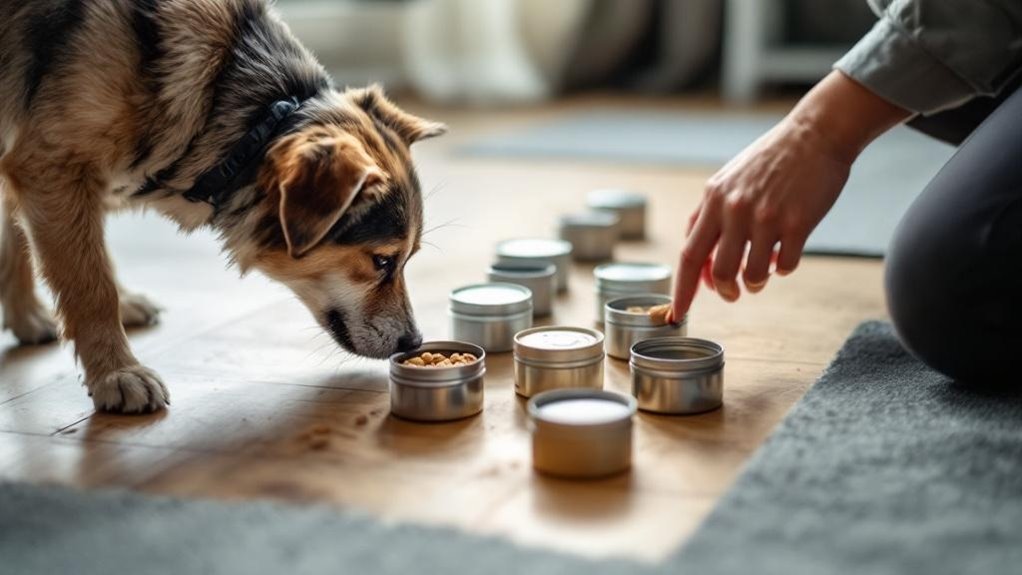
Your dog’s nose contains 300 million scent receptors, making smell their primary way to engage with the world. Scent games activate this powerful olfactory system, reducing anxiety and destructive behaviors while building focus and confidence. Start with budget-friendly setups like muffin tin puzzles or cup games using treats you already have. These games work because they tap into your dog’s natural instincts and provide the mental stimulation their brains crave. Understanding how to structure these sessions and progress difficulty levels transforms both training outcomes and your bond with your dog.
- Key Takeaways
- Why Dogs Have Such Powerful Noses
- How Scent Games Boost Your Dog’s Mental Health
- Your Scent Game Starter Kit (Everything Costs Less Than $20)
- Start Here: The Muffin Tin Puzzle
- The Cup Game: Teach Scent Selection in Minutes
- Box Search: Build Independent Tracking
- The Hot Sock: Introduction to Scent Detection
- Food or Sock: Guide Your Dog to Prefer Scent
- Hot or Cold: Distinguish Scented From Unscented
- Three’s Company: Add Complexity With Multiple Hides
- To Infinity and Beyond: Hide in Tougher Spots
- Scent Games for Puppies: Start as Early as 8 Weeks
- Nose Work for Senior Dogs: Mental Sharpness at Any Age
- Turn Every Walk Into a Scent Training Session
- Scent Enrichment: Transform Your Dog’s Living Space
- Avoiding Choking Hazards and Overexertion
- How Much Nose Work Is Too Much?
- Why Dogs Disengage and How to Rebuild Drive
- Birch Oil: Your First Official Scent Work Odor
- Know the Difference: Backyard Games vs. Trial Scent Work
- Simulate Trial Conditions at Home
- How to Know Your Dog Is Ready for Competition
- Making Scent Work Fun for Both Dog and Handler
- Frequently Asked Questions
- Conclusion
Key Takeaways
- Dogs have 300 million scent receptors, making scent games powerful mental enrichment that reduces anxiety and prevents destructive behaviors.
- Start with budget-friendly DIY games like muffin tin puzzles and box searches using highly scented treats and common household items.
- Begin scent training around 8 weeks old, leveraging puppies’ natural curiosity through interactive play for positive behavioral development.
- Keep initial sessions short at 10-15 minutes, rotating activities to maintain engagement while monitoring for signs of fatigue.
- Use a scent-infused sock paired with treats to teach investigative skills, rewarding immediate interest to build confidence and positive associations.
Why Dogs Have Such Powerful Noses
Your dog’s nose isn’t just a cute feature—it’s a sensory powerhouse that fundamentally shapes how she experiences the world. Your dog’s sense of smell operates at a level you can’t fully imagine, being 10,000 to 100,000 times more sensitive than yours.
She possesses roughly 300 million scent receptors compared to your 5-6 million, which means she detects odors you’ll never notice. Her brain dedicates approximately 40 times more space to processing smells than yours does, allowing her to categorize and remember countless scents with precision.
This advanced olfactory system enables your dog to explore her surroundings primarily through scent, making smell essential for her mental engagement and emotional well-being. Understanding this capability helps you appreciate why scent work games provide such meaningful enrichment for her.
How Scent Games Boost Your Dog’s Mental Health
You’ll find that scent games deliver mental stimulation by engaging your dog’s powerful olfactory brain—which is 40 times larger than yours—and keeping their focus directed toward a meaningful task rather than destructive behaviors.
When your dog successfully locates a hidden scent, they experience a sense of accomplishment that reduces anxiety and builds confidence, creating a positive emotional cycle that counteracts boredom and stress.
Emotional Well-Being Enhancement
Because dogs rely so heavily on their sense of smell to understand their world, engaging them in scent work games taps directly into their most natural and instinctive abilities, which in turn creates a cascade of positive emotional responses. When you introduce mental stimulation through scent games, you’re providing your dog with rewarding experiences that build confidence and resilience.
| Benefit | Result | Timeline |
|---|---|---|
| Stress reduction | Calmer behavior | Immediate |
| Increased optimism | Greater enthusiasm | Weekly |
| Stronger handler bond | Enhanced trust | Ongoing |
Regular nose work sessions give your dog an outlet for natural instincts while simultaneously reducing frustration levels. You’ll notice improved emotional stability as your dog develops stronger coping skills, making them more adaptable to daily challenges and better equipped to handle new situations.
Mental Stimulation and Enrichment
When you engage your dog in scent work games, you’re activating one of the most powerful tools in their cognitive toolkit—their olfactory system, which contains an olfactory bulb roughly 40 times larger than a human’s.
This mental stimulation strengthens problem-solving abilities and builds confidence, particularly in dogs struggling with behavioral challenges.
Regular scent activities provide essential enrichment that prevents boredom and destructive behaviors stemming from under-stimulation.
Here’s what consistent scent work accomplishes:
- Enhances focus and concentration during independent work
- Builds perseverance when facing challenging searches
- Creates mental structure through routine engagement
- Develops problem-solving strategies and resilience
- Reduces anxiety-related behaviors through productive activity
Stress Relief Through Engagement
Dogs that regularly participate in scent work experience a measurable reduction in stress and anxiety, since these activities channel their natural instincts into productive, focused engagement.
When you introduce scent games, you’re providing mental stimulation that occupies your dog’s attention, shifting their focus from worry-inducing situations toward purposeful problem-solving. This redirection works because scent work taps into deeply ingrained behaviors, creating a sense of accomplishment and control.
As your dog engages in nose work activities, their brain releases positive neurochemicals that counteract stress responses. The consistency of regular scent sessions builds confidence and reinforcement, helping your dog develop resilience.
Over time, this structured engagement reduces boredom, lowers cortisol levels, and establishes a calming routine that supports emotional stability and overall well-being.
Your Scent Game Starter Kit (Everything Costs Less Than $20)
You can gather everything you need for scent games using budget-friendly items you likely have at home or can purchase for under $20, including a muffin tin, tennis balls, cardboard boxes, socks, and cups.
Your DIY setup requires no special equipment—just arrange these household items strategically to create hiding spots and search areas that engage your dog’s natural sniffing abilities.
Budget-Friendly Essential Items
Starting your scent work journey doesn’t require expensive equipment or a hefty budget, since most of what you’ll need either costs nothing or can be purchased for under twenty dollars total.
You can gather essential items from around your home, creating an effective training setup without financial strain.
Here’s what you’ll need to begin:
- Cardboard boxes sourced for free from local stores or recycling centers
- Muffin tins or empty plastic cups repurposed from your kitchen
- Highly scented dog treats under $20 for motivation and reinforcement
- Cotton swabs paired with birch essential oil for scent introduction
- Common household items already in your possession
This budget-friendly approach means you’re not investing heavily upfront, yet you’re still providing meaningful mental stimulation.
Your dog develops tracking skills through consistency and structure, using smelly dog treats as positive reinforcement during each training session.
DIY Setup Instructions
Now that you understand what materials work best for scent training, it’s time to assemble your actual games, because the real learning happens when your dog starts investigating and searching.
Start with the Muffin Tin Puzzle by placing tennis balls in each cup, then hiding treats underneath them. Your dog learns to lift each ball to find the reward, strengthening their scent detection skills through repetition and reinforcement.
Next, create your Box Search game by arranging empty cardboard boxes and hiding treats inside various compartments.
Space them apart so your dog must move between locations to find each hidden item. Begin with obvious placements, then gradually increase difficulty by placing boxes closer together or using multiple scent sources.
This progression builds consistency in your dog’s searching behavior while maintaining engagement.
Start Here: The Muffin Tin Puzzle
The Muffin Tin Puzzle is one of the simplest scent work games you can set up at home, requiring only an empty muffin tin, 12 tennis balls, and some highly scented dog treats.
The Muffin Tin Puzzle is a simple scent work game requiring only a muffin tin, tennis balls, and dog treats.
You’ll place treats in select holes, then cover each one with a tennis ball. Your dog must move the balls to discover the hidden rewards, which encourages nose work and problem-solving skills.
This game develops your dog’s natural scenting abilities through exploration and reinforcement:
- Builds confidence in using their nose during play
- Strengthens mental stimulation and focus
- Requires minimal setup and materials
- Works for dogs of all ages
- Allows easy difficulty adjustments
Varying treat locations keeps the puzzle fresh, preventing boredom while maintaining consistency in your dog’s training routine and engagement.
The Cup Game: Teach Scent Selection in Minutes
Once your dog has mastered the Muffin Tin Puzzle, you’re ready to introduce scent selection through the Cup Game, which uses just three simple cups to teach your dog to identify and choose the correct scent.
Start by placing a treat under one cup while your dog watches, allowing them to associate the scent with positive outcomes. Gradually increase difficulty by introducing additional cups and varying their positions, altering from one cup to two and then three to enhance problem-solving skills.
You can customize the game by using distinct scents under each cup, making it an excellent exercise for teaching scent discrimination to beginners.
Reward your dog upon correctly identifying the cup, building confidence and encouraging continuous participation in scent work activities.
Box Search: Build Independent Tracking
Building on your dog’s progress with scent selection, you can now introduce the Box Search game, which encourages your dog to explore and locate treats independently while strengthening their natural sniffing instinct.
Set up the Box Search by arranging several empty boxes in your training area, then hide treats in one or more boxes while your dog waits in another room. When your dog enters and finds a treat, you’ll provide quick praise and lure them away promptly to maintain engagement. This structure prevents frustration while reinforcing their search behavior.
Key elements for success:
- Hide treats before each session begins
- Praise immediately when your dog finds a treat
- Rearrange boxes between sessions for novelty
- Vary treat locations to sustain challenge
- Suitable for all ages and experience levels
Consistency in setup and reinforcement builds independent tracking skills effectively.
The Hot Sock: Introduction to Scent Detection
Another effective way to introduce scent detection is through the Hot Sock game, which uses a familiar scent—your own—as the foundation for building your dog’s investigative skills.
You’ll place treats in a bowl, then encourage your dog to maintain focus while you present a sock infused with your scent. When your dog investigates the sock, reward them immediately with treats nearby, creating positive associations with scent detection.
This dog training method works because familiar scents motivate engagement without overwhelming your dog. As your dog develops consistency and confidence, you can increase difficulty by relocating the sock to different areas or introducing additional scented items for differentiation.
This progressive approach establishes essential foundations for advanced nose work activities.
Food or Sock: Guide Your Dog to Prefer Scent
You’ll set up the game by placing the handler’s scent-soaked sock about 18 inches from a treat bowl, creating a clear choice that teaches your dog to prioritize scent over the immediate appeal of food.
Your reward consistency matters greatly here—you’ll reinforce the correct decision by offering treats beside the sock each time your dog chooses it, which strengthens the association between scent detection and positive outcomes.
As your dog learns this pattern, you can increase difficulty by covering the treat bowl with your hand while showing treats in the other, a setup that sharpens focus and builds stronger decision-making skills through structured repetition.
Setup and Positioning
The foundation of scent work training rests on creating a clear choice between two competing options: a treat bowl and a scent-infused sock positioned about 18 inches apart, which gives your dog a distinct visual and olfactory comparison to work with.
This setup establishes the structure your dog needs to train your dog effectively.
To begin, follow these positioning guidelines:
- Place the treat bowl and ‘hot sock’ at an 18-inch distance
- Cover the treat bowl with your hand to redirect focus
- Allow your dog to sniff and investigate the scented sock freely
- Position yourself to observe your dog’s responses clearly
- Rearrange both items in subsequent training sessions
Changing locations maintains consistency while building adaptability, ensuring your dog learns to identify scent regardless of environmental variables.
Reward Consistency Strategy
Building your dog’s preference for scent over food requires consistency in how and when you deliver rewards, creating a clear pattern that strengthens the connection between sniffing the sock and receiving treats.
You’ll reward your dog only when they engage with the sock, never when they approach the treat bowl, establishing reward consistency as the foundation of their learning. This structured approach teaches your dog that investigating the scent source produces positive outcomes, while ignoring it doesn’t.
When your dog finds the hot sock consistently, deliver treats immediately, reinforcing the behavior through repetition and timing.
Maintain this pattern across multiple training sessions, varying locations and sock positions while keeping your reward delivery predictable, so your dog understands exactly what behavior earns reinforcement.
Hot or Cold: Distinguish Scented From Unscented
Once your dog grasps basic scent recognition, the “Hot or Cold” game offers a straightforward way to sharpen their ability to distinguish between scented and unscented objects.
You’ll place a scent-laden sock alongside an unscented one, leveraging your dog’s extraordinary olfactory abilities—their sense of smell reaches 10,000 to 100,000 times more acute than yours.
This exercise builds problem-solving skills through targeted reinforcement:
- Encourage sniffing to activate their natural search instincts
- Reward successful identification of the “hot sock”
- Use sit-stay commands to establish structure
- Toss treats to stimulate engagement
- Practice in varying locations to deepen discrimination
Gradually increase difficulty, rotating scents and adjusting distances.
Consistency in rewards strengthens the connection between finding the scented object and positive outcomes, preparing your dog for more complex nose work activities ahead.
Three’s Company: Add Complexity With Multiple Hides
After your dog masters the two-sock challenge, introducing three objects—one scented and two unscented—pushes their discrimination skills forward while maintaining the foundational structure they’ve already learned. This progression requires your dog to find the hot sock among distractions, strengthening their ability to isolate specific scents from multiple options.
Swap the positions of all three socks regularly, preventing your dog from relying on location memory rather than scent detection. Consistent rewards reinforce their success, building confidence in their natural abilities.
As your dog demonstrates reliability, gradually add more socks to increase difficulty and maintain engagement. This layered approach develops critical thinking skills while deepening your bond through teamwork and positive reinforcement, establishing a foundation for more advanced scent work activities.
To Infinity and Beyond: Hide in Tougher Spots
Once your dog reliably finds the sock in obvious spots, you’re ready to gradually increase the difficulty by hiding it under chairs, behind furniture, or in other places that require extra effort and focus.
This progressive approach builds your dog’s confidence and problem-solving skills because they’ve already experienced success, so they understand the game’s basic structure and can handle new challenges.
Start with moderately difficult locations before moving to complex ones, offering treats and praise as reinforcement whenever your dog succeeds, which keeps their motivation strong and their scent work abilities sharp.
Progressive Difficulty Increases
As your dog’s confidence grows and they’re consistently finding scents in simple locations, you’re ready to introduce progressive difficulty increases that’ll challenge their problem-solving abilities and keep them engaged in the search process.
You can change the location and environment systematically, building complexity as your dog demonstrates mastery at each level.
Consider these strategic progression steps:
- Hide scents under furniture or behind objects to develop investigation skills
- Place treats in areas requiring navigation around obstacles for independent searching
- Shift outdoors using natural features like trees and bushes
- Increase distance between you and the hiding spot
- Combine multiple hiding locations in single sessions
Maintain consistency with rewards when your dog finds the treat, reinforcing their success and motivation.
This structured approach guarantees steady advancement without overwhelming your dog, establishing lasting scent work proficiency.
Exploring Challenging Hide Locations
When your dog’s successfully mastered finding treats in obvious spots, you’re ready to shift them toward more complex hiding locations that’ll genuinely challenge their problem-solving abilities and deepen their scent detection skills. Start by placing items under chairs, inside boxes, or behind furniture where your dog to find requires more searching effort. Rotate hiding spots consistently to prevent memorization, which keeps engagement high and maintains novelty. Change the scent occasionally by using different treats or objects, reinforcing their detection abilities across varied scenarios. Balance difficulty with success—if your dog struggles, simplify the task temporarily before gradually advancing again. This structured approach builds confidence while developing the persistence and focus necessary for real-world scent work applications.
| Hide Location Type | Difficulty Level | Search Time | Engagement Factor | Skill Development |
|---|---|---|---|---|
| Under chairs | Moderate | 2-3 minutes | Medium | Problem-solving |
| Inside boxes | Challenging | 3-5 minutes | High | Persistence |
| Behind furniture | Advanced | 5+ minutes | High | Strategic thinking |
| Elevated surfaces | Complex | Varied | Very high | Adaptability |
| Outdoor spaces | Expert | Extended | Maximum | Real-world readiness |
Building Confidence Through Practice
Your dog’s confidence grows through consistent practice with gradually tougher hiding spots, which builds their problem-solving abilities and strengthens their trust in their own nose.
Regular practice reinforces your dog’s learning across different environments and scenarios. When you establish a structured routine, your dog develops familiarity with the scent work process, making each session more predictable and manageable. This consistency matters because it allows your dog to focus on the task rather than uncertainty.
Build confidence by:
- Practicing in varied locations indoors and outdoors
- Rewarding successful finds immediately with treats or praise
- Gradually increasing hiding spot difficulty over weeks
- Repeating successful scenarios before introducing new challenges
- Maintaining a calm, encouraging tone throughout sessions
As your dog masters easier hides, they’re developing the neural pathways and motivation needed for complex detection work.
Your patience and reinforcement create the foundation for reliable scent detection skills.
Scent Games for Puppies: Start as Early as 8 Weeks
Puppies possess a remarkably keen sense of smell and natural curiosity that makes them ideal candidates for scent work games starting around 8 weeks of age. Introducing these activities early taps into their instinctive desire to explore and investigate their environment.
You can start with simple games like the Muffin Tin Puzzle, where you hide treats under tennis balls in an empty muffin tin, encouraging your puppy to problem-solve through exploration. This scent work builds mental enrichment and reduces boredom while teaching your puppy that using their nose is essential to play.
Early engagement boosts confidence and independence, fostering positive behavioral development as your puppy learns to locate hidden items. These collaborative activities strengthen your bond while promoting learning through consistency and reinforcement.
Nose Work for Senior Dogs: Mental Sharpness at Any Age
As your dog enters their senior years, their physical abilities may slow down, but their nose remains as powerful as ever, making scent work an ideal activity for maintaining cognitive function and preventing age-related mental decline.
You’ll notice how this change in routine can energize their mind while respecting their body’s limitations.
Nose work provides multiple benefits for aging dogs:
- Strengthens mental sharpness through consistent problem-solving challenges
- Boosts confidence and encourages independent thinking
- Reduces anxiety-related behaviors and boredom
- Deepens your bond through cooperative, low-impact play
- Adapts safely to their individual physical capabilities
You can tailor scent games to match your senior dog’s pace, using shorter sessions and easier hiding spots.
This structured approach maintains their cognitive engagement while protecting their joints and energy levels, ensuring they experience success and satisfaction.
Turn Every Walk Into a Scent Training Session
Every walk you take with your dog presents an opportunity to build scent work skills, since dogs naturally investigate their environment through smell and respond well when you structure those investigations into intentional training sessions.
You’ll strengthen these abilities by varying your routes frequently, which exposes your dog to new and interesting smells that stimulate curiosity and engagement.
During walks, pause periodically and ask your dog to find hidden treats so your dog learns to actively search rather than passively stroll.
When your dog sniffs and investigates scents, praise and reward that behavior immediately to reinforce focus.
You can also use specific scent cues by letting your dog sniff particular items, developing their abilities through consistency and structured practice that deepens your connection together.
Scent Enrichment: Transform Your Dog’s Living Space
While your walks give your dog structured opportunities to search for hidden treats and follow specific scent cues, your dog’s living space offers a different kind of learning environment where scent enrichment can happen continuously throughout the day.
Transform your home into an interactive scent playground by:
- Filling cardboard boxes with varied scents to encourage natural sniffing instincts
- Rotating scented toys regularly to maintain novelty and mental engagement
- Changing bedding frequently to introduce fresh odors throughout living areas
- Using everyday items like plush toys infused with different scents
- Introducing new odors consistently to prevent boredom-related behaviors
Your dog’s noses work best when consistently exposed to environmental variety, which builds their problem-solving skills and reduces stress through independent exploration, creating a structured reinforcement system within your home.
Avoiding Choking Hazards and Overexertion
Safety during scent work games requires your attention and deliberate choices about treats and session length, since your dog’s enthusiasm for searching can override their natural caution about what they consume or how hard they’re working.
You’ll prevent choking hazards by selecting treats appropriately sized for your dog’s breed and avoiding hard items that break into smaller pieces, while supervising every session closely.
Your dog needs consistent monitoring for overexertion signs like heavy panting or reluctance to participate, which indicate you should reduce activity intensity.
Watch for heavy panting and reluctance to participate—signs your dog needs reduced activity intensity during scent work games.
Limit sessions to 10-15 minutes, particularly for older dogs or those with health conditions.
Rotate through different activities to maintain engagement while providing adequate rest, preventing your dog from getting frustrated or physically exhausted.
How Much Nose Work Is Too Much?
How can you tell when your dog’s had enough? Watch for signs that you’ve pushed too hard into the room, where enthusiasm fades and focus drops away. How much nose work is too much? The answer depends on your dog’s age, experience, and temperament, but you shouldn’t exceed 10 minutes for beginners.
Monitor these indicators:
- Yawning or glazed expressions
- Decreased interest in treats or toys
- Wandering away from activities
- Repetitive sniffing without engagement
- Restlessness or stress signals
Keep sessions short and consistent, gradually increasing complexity only when your dog demonstrates sustained focus.
Implement breaks between activities to prevent burnout, allowing your dog to recharge mentally and physically. This structure reinforces learning while maintaining their enthusiasm for scent work, ensuring they stay engaged without becoming overwhelmed or fatigued.
Why Dogs Disengage and How to Rebuild Drive
When your dog loses focus during scent work, it’s rarely a sign of laziness or stubbornness; instead, disengagement signals that something in the training environment or approach isn’t working for them. Overwhelming settings, insufficient motivation, or low confidence commonly trigger this disconnection from tasks.
Dog disengagement during scent work signals environmental or training issues, not laziness or stubbornness.
You’ll notice your dog wandering away, ignoring cues, or showing minimal interest in searches.
To rebuild drive, shift your strategy by introducing high-value rewards that genuinely excite your dog and incorporating engaging games that restore enthusiasm.
Gradually increase task difficulty as confidence grows, ensuring success at each level. Frequent breaks during sessions allow your dog to mentally reset, returning refreshed and focused.
Consistent positive reinforcement for small wins strengthens their engagement, creating a sustainable foundation for sustained scent work participation.
Birch Oil: Your First Official Scent Work Odor
Now that you’ve rebuilt your dog’s engagement through rewarding games and gradual progression, you’re ready to introduce birch oil, the official scent used in AKC Scent Work trials and the ideal starting point for formal odor training.
Birch oil works because:
- Dogs detect it easily due to their powerful olfactory capabilities
- It’s the primary odor recognized in AKC trials
- The distinct smell promotes consistent learning and association
- Dogs quickly link the scent with positive outcomes
- It establishes a foundation for advanced odor detection
Start by placing a cotton swab in a glass jar to contain the scent. Reward your dog for showing interest, placing a treat under one jar when they investigate.
Through consistent exposure and reinforcement, your dog learns to actively search for birch oil, transforming casual curiosity into reliable scent work behavior.
Know the Difference: Backyard Games vs. Trial Scent Work
You’ll notice that backyard games let your dog explore scents freely and casually, while trial scent work demands precision, speed, and consistent responses under specific conditions.
Your training goals shift depending on which path you’re following: backyard games build foundational enthusiasm and sniffing skills through informal play, whereas trial preparation requires structure, focus on accuracy, and the ability to handle distractions and pressure.
Understanding this distinction helps you choose the right approach for your dog’s current stage and decide whether you’re aiming for casual enrichment or competitive readiness.
Casual Play Versus Competition
As your dog develops basic scenting skills, you’ll find that the environment and expectations you create during training fundamentally shape how they approach scent work tasks.
Casual play and competition serve different purposes in building your dog’s confidence and abilities. In casual play, you prioritize enjoyment and exploration, allowing your dog to work at their own pace without time pressure or strict protocols.
Competition, however, introduces structure, precision, and accountability through formal trial conditions. Understanding these distinctions helps you train effectively across both contexts:
- Casual play builds foundational skills through relaxed, playful engagement
- Competition develops speed, accuracy, and focus under pressure
- Your dog learns different behavioral expectations in each setting
- Consistent reinforcement prevents confusion between casual and trial environments
- Shifting gradually between contexts strengthens overall scent detection abilities
This approach guarantees your dog remains motivated while developing the discipline necessary for formal trials.
Training Goals And Objectives
Understanding what you’re trying to accomplish with scent work determines how you’ll structure your training, and backyard games and trial scent work serve distinctly different purposes that shape both your methods and your dog’s performance. Your training goals guide which search techniques you’ll emphasize and how you’ll reinforce your dog’s progress.
| Aspect | Backyard Games | Trial Scent Work |
|---|---|---|
| Primary Goal | Enhance natural sniffing ability through casual play | Demonstrate precision and specific search techniques under pressure |
| Search Techniques | Informal, exploratory approaches | Structured, formalized methods |
| Performance Measure | Informal praise and treats | Formal scoring system |
| Environment | Relaxed, familiar home settings | Controlled, competitive conditions |
Backyard games build confidence and problem-solving skills in low-pressure settings, while trial scent work prepares your dog for effective searching within timed conditions and specific layouts, requiring consistency and structured reinforcement.
Simulate Trial Conditions at Home
Preparing your dog for actual competition requires building familiarity with the pressure and unpredictability they’ll encounter in a trial, which means practicing at home under conditions that mirror what they’ll face in the field.
Competition preparation demands recreating trial pressure and unpredictability through structured home practice that mirrors field conditions.
You’ll strengthen your dog to search independently by recreating trial scenarios through structured practice:
- Use scent boxes with varying placements to build problem-solving skills
- Incorporate the City Name Search game to maintain handler engagement
- Suspend hides on clotheslines, creating elevated challenges
- Limit visibility using glow sticks in dark areas, emphasizing olfactory cues
- Progress from simple setups to multi-hide scenarios gradually
These scent work classes and practice methods develop consistency and reinforcement, teaching your dog to rely on their nose under pressure.
Building this structure at home prepares them effectively for competition demands.
How to Know Your Dog Is Ready for Competition
Several key indicators will tell you whether your dog’s ready to step into the competition ring, and you’ll want to observe these signs consistently across multiple practice sessions before making that commitment.
Your dog gets motivated by scent work when he demonstrates independent problem-solving during searches, showing sustained focus and perseverance without constant guidance. A confident, enthusiastic demeanor signals readiness, while reliable execution of basic commands like sit, stay, and come guarantees you’ll maintain control during events.
Before entering formal competitions, enroll your dog in work classes where he can build foundational skills and structure. Participation in mock trials reveals how your dog adapts under trial-like pressure, helping you gauge whether he’s genuinely prepared for the competitive environment ahead.
Making Scent Work Fun for Both Dog and Handler
You’ll build positive associations with scent work by treating training sessions as collaborative play rather than rigid exercises, which keeps both you and your dog engaged and enthusiastic to return to the activity.
When you reward your dog’s discoveries together—celebrating finds with enthusiasm, treats, and interactive toys—you’re reinforcing that searching is enjoyable, not obligatory, and you’re strengthening your bond through shared success.
This approach transforms trial preparation from pressure-focused competition into a rewarding experience where your dog’s natural instincts and your guidance work in harmony.
Building Positive Play Associations
When you pair scent work with rewards that your dog genuinely enjoys—whether that’s high-value treats, favorite toys, or enthusiastic praise—you’re creating a strong connection between the search itself and positive emotions. This means your dog will naturally want to engage in the activity more often.
To build these associations effectively:
- Put a treat in your hand and let your dog find it during early searches
- Praise and let your dog know immediately when they succeed
- Rotate between different rewards to maintain interest and enthusiasm
- Change locations regularly so the dog stays engaged with new environments
- Keep sessions brief to prevent fatigue and sustain positive feelings
This reinforcement structure teaches your dog that searching brings joy, building enthusiasm that carries forward into every training session.
Rewarding Discovery Together
The most effective scent work sessions transform the activity into genuine play rather than one-sided training, where your dog’s success becomes your shared victory and both of you feel the satisfaction of discovery. Rewarding discovery together strengthens your bond through collaborative achievement, making scent work something you both anticipate.
| Reward Type | Timing | Effectiveness |
|---|---|---|
| Treats | Immediately after success | High—creates strong association |
| Praise | During and after | High—reinforces enthusiasm |
| Play | Following completion | Moderate—varies by dog |
| Combination | Throughout session | Highest—maintains engagement |
Positive reinforcement works by connecting your dog’s sniffing efforts directly to pleasant outcomes, whether treats, verbal encouragement, or playtime. When you consistently reward successful scent identification, your dog develops confidence and genuine excitement about future searches, viewing the activity as mutually enjoyable rather than obligatory.
Frequently Asked Questions
What if My Dog Shows No Interest in Scent Games Initially?
You should start with stronger scents like liver or chicken. Make the game more rewarding by pairing scent discovery with high-value treats. You’ll build enthusiasm gradually through positive associations and patience.
Can Scent Work Help With Anxiety or Behavioral Issues in Dogs?
Yes, scent work helps calm your dog’s anxiety by engaging their natural instincts and redirecting nervous energy. You’ll notice improved focus and confidence as your dog works through scent games, reducing stress-related behaviors effectively.
How Do I Know if My Dog Is Stressed During Training?
You’ll notice stress signals like panting, yawning, lip licking, or pulling away. Your dog might refuse treats or lose interest in searching. You’re observing tension in their body or ears pinned back—these indicate you should take a break.
Is Scent Work Suitable for Dogs With Health Conditions?
Like a ship steering through calm waters, you’ll find scent work can suit dogs with health conditions. You should consult your vet first, though—it’s low-impact and adaptable to your dog’s physical limitations and energy levels.
What’s the Difference Between Recreational and Competitive Scent Work?
You’ll find recreational scent work’s more relaxed and fun-focused, while competitive scent work follows strict rules and judges evaluate your dog’s performance. Competitive events require certifications and titles, whereas recreational play doesn’t.
Conclusion
You’ve planted seeds in your dog’s mind through scent work, and they’re sprouting into focus and confidence. Your consistent practice builds a bridge between instinct and training, where your dog learns to channel natural abilities into purposeful work. As you move forward with games and competition, you’re not just teaching tricks—you’re revealing your dog’s potential and strengthening the partnership you’ve cultivated together.