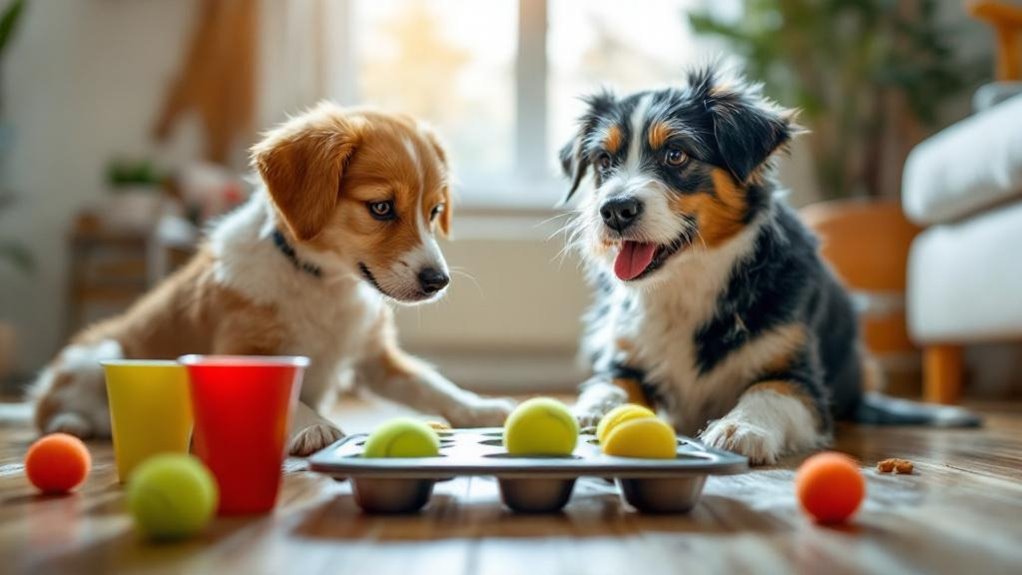
Your dog’s daily walks provide physical exercise but don’t satisfy their cognitive needs, which leads to boredom and destructive behavior. Brain games redirect their problem-solving drive toward puzzles instead of furniture, while reducing anxiety through focused mental engagement. Simple DIY options like muffin tin games, cardboard boxes, and towel roll puzzles require minimal prep and deliver real results. Just 10-15 minutes daily, rotated weekly, builds a stable companion while strengthening your bond through shared activities—though the most effective approach involves understanding which games work best for your dog’s age and learning style.
- Key Takeaways
- Why Your Dog Needs More Than Just a Walk
- How Brain Games Reduce Destructive Behavior and Anxiety
- Beginner Puzzles: Your Starting Point
- The Muffin Tin & Tennis Ball Puzzle
- The Cardboard Roll Destruction Game
- Paper Towel Tubes Filled With Soft Treats
- Intermediate Challenges: Stepping Up the Difficulty
- Frozen Treats: Slow-Release Mental Engagement
- The DIY Snuffle Mat With Fabric Strips
- Treats in a Bottle: Rolling and Problem-Solving
- Advanced Brain Games: For the Experienced Player
- Scent-Based Hide and Seek: Building Tracking Skills
- Scavenger Hunts Around Your Home
- The Shoebox Hide and Seek Game
- Puzzle Difficulty: Matching Games to Your Dog’s Level
- Choosing Treats: What Actually Keeps Dogs Engaged
- Safety First: Supervision Essentials
- Adapting Brain Games for Senior Dogs and Limited Mobility
- Your Dog Conquered It Already? Here’s What to Do
- How Often Should You Rotate Brain Games?
- Five-Minute Brain Games: No Prep Required
- Mental Stimulation Should Complement, Not Replace, Daily Walks
- Frequently Asked Questions
- Conclusion
Key Takeaways
- The Muffin Tin Game uses a muffin tin and tennis balls to create engaging cognitive interaction with minimal preparation.
- Cardboard boxes filled with crumpled paper encourage natural scavenging instincts and provide affordable DIY puzzle opportunities.
- The Towel Roll Puzzle engages a dog’s nose by hiding treats within a rolled towel for problem-solving.
- Mental stimulation for just 10-15 minutes daily prevents boredom and reduces destructive behaviors significantly.
- Rotate brain games every one to two weeks based on your dog’s puzzle completion speed and engagement level.
Why Your Dog Needs More Than Just a Walk
While a daily walk provides essential physical exercise, your dog actually needs mental stimulation to achieve true overall health and contentment.
Physical activity alone doesn’t address your dog’s cognitive needs, leaving room for boredom and destructive behaviors to develop. Mental stimulation through brain games engages your dog’s problem-solving abilities and creates the balance necessary for genuine well-being.
High-energy breeds especially benefit from this cognitive challenge, as do senior dogs whose mobility limitations make extended walks difficult.
By incorporating brain games into your routine, you provide an alternative form of exercise that tires your dog as effectively as longer physical activity. This combination reduces anxiety, strengthens behavior, and creates a more stable companion.
Starting with just 10 to 15 minutes daily establishes consistency and demonstrates how manageable mental enrichment can be.
How Brain Games Reduce Destructive Behavior and Anxiety
Because dogs need mental outlets just as much as physical ones, boredom becomes a primary trigger for destructive behaviors like excessive chewing, digging, and barking. Your dog’s natural instincts demand engagement, and without proper mental exercise, your pet redirects that energy into problematic habits.
Brain games address this by:
- Redirecting your dog’s problem-solving drive toward puzzle toys instead of furniture
- Lowering anxiety by focusing their attention on tasks rather than environmental stressors
- Reducing destructive patterns through consistent mental challenges that tire them as effectively as long walks
Just 10 to 15 minutes of daily mental stimulation can shift your dog’s behavior markedly.
Just 10 to 15 minutes of daily mental stimulation can create a marked shift in your dog’s behavior and overall well-being.
When you provide appropriate cognitive challenges, you’re not simply preventing bad habits—you’re building a calmer, more secure pet while strengthening your bond through shared activities.
Beginner Puzzles: Your Starting Point
Now that you understand how mental stimulation prevents destructive behavior, you’re ready to introduce your dog to actual brain games—and the best place to start is with beginner puzzles that require minimal preparation yet deliver real cognitive engagement.
The Muffin Tin Game, for example, uses a standard muffin tin with tennis balls placed in each cup, hiding treats underneath for your dog to remove and discover. Similarly, a cardboard box filled with crumpled paper and hidden treats encourages natural scavenging instincts while keeping your dog occupied.
The Towel Roll Puzzle involves rolling treats inside a towel, allowing your dog to use their nose to unravel it. These puzzles work because they combine physical activity with problem-solving, maintaining your dog’s focus and building confidence through achievable tasks and consistent reinforcement.
The Muffin Tin & Tennis Ball Puzzle
The Muffin Tin & Tennis Ball Puzzle stands out as one of the most effective beginner brain games because it combines simplicity with genuine cognitive challenge, using only items you likely already have at home.
You’ll need just two minutes to prepare this puzzle, making it accessible for any dog owner. Here’s what makes this puzzle effective:
Just two minutes of prep time makes this puzzle accessible for any dog owner looking to boost their pup’s mental engagement.
- High-value treats placed in muffin tin cups motivate your dog to engage actively.
- Tennis balls covering the cups require your dog to use problem-solving skills and physical effort.
- Scent tracking reinforcement strengthens your dog’s natural abilities while providing mental stimulation.
You can adapt this puzzle easily for smaller dogs by using a mini muffin tin and smaller balls.
For added difficulty, bait only a few cups while covering all of them, requiring your dog to distinguish which cups contain treats through scent alone.
The Cardboard Roll Destruction Game
You’ll appreciate how the cardboard roll destruction game offers straightforward setup—requiring only a toilet paper roll and treats—while still delivering meaningful mental engagement that keeps your dog occupied for several minutes.
The difficulty scales naturally as you progress from simply folding the ends inward to sealing them with peanut butter or adding multiple layers of paper, allowing you to match the challenge level to your dog’s current problem-solving abilities.
This type of enrichment strengthens your dog’s cognitive skills through active destruction and retrieval, reinforcing the kind of focused, purposeful behavior that tired dogs are less likely to direct toward destructive household habits.
Simple Setup and Materials
One of the most budget-friendly brain games you can create uses materials you probably already have at home: empty toilet paper rolls or paper towel tubes, which become engaging puzzle toys when filled with treats.
Setting up this cardboard game requires minimal effort:
- Insert small treats or kibble inside the hollow tube.
- Fold both ends inward to create a challenge your dog must solve.
- Optional: seal the ends with peanut butter or cream cheese for increased difficulty.
This straightforward approach provides mental stimulation without expense.
The cardboard becomes a destructible puzzle that encourages natural problem-solving behaviors, while the treats serve as reinforcement for your dog’s efforts.
You’ll find this game particularly effective for dogs needing consistent enrichment, offering both structure and reward in one simple package.
Progressive Difficulty Levels
As your dog masters the basic cardboard roll puzzle, you can gradually increase the challenge to keep their mind engaged and prevent boredom from setting in. Brain games help develop problem-solving abilities, and increasing the difficulty guarantees continued mental stimulation over time.
| Difficulty Level | Method | Duration |
|---|---|---|
| Beginner | Loosely folded ends with visible treats | 5-10 minutes |
| Intermediate | Tightly folded ends with peanut butter seal | 10-20 minutes |
| Advanced | Frozen rolls with multiple treat layers | 20-30 minutes |
To increase the difficulty, you can freeze filled rolls, add peanut butter to seal the ends more securely, or layer treats deeper inside the tube. This progression maintains engagement while building your dog’s problem-solving skills through consistent, structured reinforcement of their natural chewing instincts.
Mental Stimulation Benefits
Since dogs have a natural drive to chew and tear apart materials, the cardboard roll destruction game channels that instinct into a constructive activity that strengthens their problem-solving abilities while keeping them mentally engaged.
This mental exercise prevents boredom-related behaviors while building cognitive skills through active participation.
You’ll notice several key benefits when you implement this game:
- Stress relief through destructive play that provides a healthy outlet for anxiety
- Enhanced problem-solving as your dog figures out how to access hidden treats
- Sustained mental engagement that reduces unwanted behaviors throughout the day
A Dog Trainer will confirm that consistent mental stimulation supports overall behavioral development.
Paper Towel Tubes Filled With Soft Treats
You can choose soft treats like peanut butter or cream cheese that’ll stick to the cardboard and keep your dog engaged longer.
You’ll want to start with both ends open before progressing to folding them closed once your dog understands the game. As you increase the difficulty by securing the tube’s ends, your dog will need to use both paws and mouth to tear through the cardboard and access the treats inside, which builds problem-solving skills while providing physical activity.
Since cardboard ingestion poses a risk, you’ll need to supervise the entire play session and consider freezing the filled tubes to slow your dog’s progress, extend the challenge, and reduce the chance they’ll consume pieces of the tube.
Soft Treat Selection Guide
When you’re filling paper towel tubes with soft treats to create a licking challenge for your dog, the consistency and flavor of what you choose will directly affect how long your dog stays engaged with the activity.
You’ll want to select treats that offer proper structure and reinforcement for problem-solving:
- Peanut butter provides excellent stickiness, keeping your dog occupied longer as they work through the challenge.
- Cream cheese offers a smoother texture that encourages sustained licking and mental engagement.
- Wet dog food or broth-based treats create variety while maintaining the right consistency.
Rotating between these options prevents boredom and maintains your dog’s interest over time.
The thickness matters too—thicker spreads create longer-lasting challenges than runny options.
Match your selections to your dog’s preferences and chewing style for ideal results.
Folding And Difficulty Progression
The cardboard tube itself becomes your primary tool for controlling how challenging this puzzle will be for your dog. When you fold both ends inward, you create a folding structure that requires your dog to use their paws and teeth strategically, which increases the difficulty progression markedly.
Start with loose folds for beginners, then tighten them as your dog develops problem-solving skills, ensuring consistent reinforcement of their abilities. You can advance further by using tape to seal the ends, which demands greater effort and extends engagement time.
Freezing the filled tube before presenting it adds another layer of challenge, as the hardened treat resists immediate access. This structured approach to difficulty progression keeps your dog mentally stimulated while matching their developing capabilities.
Supervision And Safety Considerations
Since cardboard tubes can break apart during play, keeping a close watch on your dog’s interaction with this puzzle is crucial to prevent accidental ingestion of cardboard pieces that might cause choking or intestinal blockage.
Your supervision and safety considerations should focus on these key areas:
- Monitor your dog’s engagement level and intervene if excitement escalates to dangerous chewing patterns.
- Confirm tube ends are securely folded or sealed to minimize tearing and cardboard exposure.
- Use only non-toxic, pet-safe fillings like peanut butter or cream cheese that won’t harm your dog.
Match the tube size and treat softness to your dog’s size, as smaller dogs need thinner tubes and softer options.
Watch for signs of excessive excitement or difficulty accessing treats, adjusting the challenge accordingly to maintain both enjoyment and safety.
Intermediate Challenges: Stepping Up the Difficulty
Once your dog has mastered basic brain games, you’re ready to introduce intermediate challenges that require greater problem-solving and persistence, building on the foundation you’ve already established.
Scent games like the Advanced Hide and Seek develop your dog’s natural tracking abilities, where you create aromatic trails using treats placed in increasingly difficult locations throughout your home.
Advanced Hide and Seek games harness your dog’s natural tracking instincts through strategically placed aromatic trails and treats.
Cardboard boxes offer versatile puzzle opportunities, from simple folded boxes containing high-value treats to complex treasure hunts where you bury rewards under crumpled paper or nest boxes inside one another.
A DIY Snuffle Mat made from fabric strips on a rubber sink mat encourages foraging behavior, while Stuffed & Frozen Hooves provide extended engagement through chewing and licking.
Rotate these activities regularly to maintain novelty and prevent boredom while strengthening your dog’s cognitive abilities.
Frozen Treats: Slow-Release Mental Engagement
You can create frozen puzzle toys by layering dog-safe ingredients like treats, broth, or peanut butter in silicone molds or ice cube trays, which slows your dog’s consumption and extends their engagement with the puzzle.
The freezing process naturally prolongs how long your dog works to access the rewards hidden within the ice, providing sustained mental stimulation that keeps their mind active as they lick and manipulate the frozen toy.
You’ll find this approach particularly useful during hot weather or for teething puppies, since the cold soothes their discomfort while the extended engagement reduces boredom and destructive behavior.
Frozen Puzzle Toy Options
Frozen puzzle toys provide a powerful way to engage your dog’s mind while they work through a rewarding challenge, and they’re remarkably simple to create at home using basic supplies like ice cube trays or silicone molds.
You can build multiple difficulty levels by layering treats inside the ice, which extends engagement time and provides hydration benefits. Consider these practical options:
- Fill trays with water and treats, freezing in stages to create distinct layers.
- Mix low-sodium broth with kibble for added flavor and nutritional reinforcement.
- Embed different textures by alternating wet and dry ingredients throughout the freezing process.
This structure keeps your dog mentally active while working through the ice gradually, making frozen puzzle toys especially valuable for teething puppies and hot weather relief.
Always verify that every ingredient you use remains safe for canine consumption.
Extended Engagement Through Freezing
While the basic frozen puzzle toy creates immediate mental stimulation, extending the challenge through layered freezing techniques offers your dog a sustained reward system that works at a slower pace, keeping them engaged for considerably longer periods.
You can create these frozen treats by layering low-sodium broth, pureed fruits, and kibble in a container, freezing each layer before adding the next one. This structure forces your dog to work through multiple textures and flavors gradually, providing mental exercise that builds consistency and reinforcement over time.
The slow-release design means your dog remains occupied longer than with standard frozen toys, and the extended licking and chewing naturally cleans their teeth and gums while delivering steady mental engagement throughout the process.
The DIY Snuffle Mat With Fabric Strips
One of the simplest yet most effective brain games you can create at home is a snuffle mat, which combines a basic rubber sink mat with fabric strips to form a foraging puzzle that engages your dog’s natural hunting instincts.
You’ll tie fabric strips—fleece works well—into the mat’s holes, creating pockets where you hide treats. Your dog will use their nose to search through the fabric, mimicking natural foraging behaviors.
To customize difficulty:
- Vary fabric density for different challenge levels
- Adjust treat quantity based on your dog’s skill
- Change fabric types to alter texture complexity
This activity suits all dog sizes and promotes slower eating, mental stimulation, and bonding.
The snuffle mat reduces boredom effectively while encouraging your dog to engage their senses actively and thoughtfully.
Treats in a Bottle: Rolling and Problem-Solving
Another effective DIY brain game involves filling an empty plastic bottle with treats and drilling holes through the sides, which requires your dog to roll and manipulate the bottle to release the rewards.
You’ll want to start with larger holes so your dog experiences early success, then gradually decrease hole sizes as your dog masters the mechanics of these games for dogs. This approach builds confidence while maintaining engagement.
The rolling action stimulates both mental and physical activity, keeping your dog occupied during indoor time.
You can increase difficulty by creating versions without holes, forcing treats to fall through an opening instead, or hanging multiple bottles for paw interaction.
Always supervise play closely, checking for sharp edges or choking hazards that could harm your dog.
Advanced Brain Games: For the Experienced Player
Once your dog has mastered the basic mechanics of rolling bottles and simple hide-and-seek games, you’re ready to introduce challenges that require sustained focus, problem-solving across multiple steps, and deeper engagement with their natural instincts.
These advanced puzzle toys and treat puzzles build upon foundational skills while demanding greater cognitive effort.
Advanced puzzle toys build on foundational skills while demanding greater cognitive effort from your dog.
- Frozen Treat Puzzles slow down consumption and extend engagement time, requiring your dog to work through ice barriers to access rewards.
- Shell Games progressively increase difficulty by adding cups and shuffling patterns, strengthening memory and tracking abilities.
- Nested Box Puzzles combine multiple layers of problem-solving, where your dog must open successive containers to retrieve treats.
These challenges maintain consistency through structured reinforcement, preventing boredom while deepening your dog’s capacity for complex thinking and independent problem resolution.
Scent-Based Hide and Seek: Building Tracking Skills
How can you tap into your dog’s most powerful sense to create a game that’s both mentally stimulating and deeply satisfying? Scent-based hide and seek builds tracking skills by encouraging your dog to use natural sniffing instincts, which strengthens problem-solving abilities and focus.
Start with treats in visible locations, then gradually increase difficulty by concealing them in harder-to-find spots or using multiple containers. Adding holes or slits initially helps your dog detect scents before learning thorough searching techniques. This progression creates consistent reinforcement of tracking behavior.
| Difficulty Level | Container Type | Treatment Duration |
|---|---|---|
| Beginner | Open bowl | 5 minutes |
| Intermediate | Closed box with slits | 10 minutes |
| Advanced | Multiple sealed containers | 15 minutes |
Regular practice reduces boredom and anxiety while building confidence through exploration and mastery.
Scavenger Hunts Around Your Home
While scent-based hide and seek focuses on tracking skills through concentrated searching, scavenger hunts expand that foundation by spreading the challenge across multiple locations and rewarding your dog’s ability to work through larger spaces. You’ll strategically place treats throughout your home, gradually increasing difficulty as your dog develops confidence and problem-solving skills.
Start your scavenger hunts by following these steps:
Begin with visible treats on low surfaces, then progress to hidden spots, and expand across multiple rooms for increasing challenge.
- Begin with visible treat placements on the floor and low surfaces
- Progress to hidden spots between furniture, behind items, and at varying heights
- Expand into multiple rooms or outdoor areas for increased stimulation
This approach builds mental engagement while reducing boredom-related behaviors. The treats reinforce successful searching, while the expanding challenge maintains your dog’s interest over time, creating consistent mental exercise that strengthens your bond through collaborative play.
The Shoebox Hide and Seek Game
You’ll start the Shoebox Hide and Seek game by placing treats in one or a few boxes, then letting your dog use their natural scavenging instincts to find them through sniffing and exploration.
As your dog masters this initial challenge, you can create holes in the box tops to make detection easier at first, then gradually remove treats from more boxes or seal the boxes completely to increase the cognitive demand and keep your dog engaged.
This progression builds your dog’s scent detection skills systematically, reinforcing their problem-solving abilities while you control the difficulty level based on their success and confidence.
Getting Started With Shoeboxes
One of the simplest ways to introduce your dog to mental enrichment games is through the Shoebox Hide and Seek Game, which transforms ordinary cardboard boxes into a scavenging puzzle that taps into their natural instincts to search and explore.
You’ll need just a few household items to begin:
- Empty shoeboxes from your closet or storage
- Small treats or kibble for baiting select boxes
- A designated play area free from distractions
Start by placing several shoeboxes on the floor, hiding treats inside just a few of them.
Your dog will use their nose to investigate each box, discovering which ones contain rewards. This initial setup builds confidence and establishes the game’s basic structure.
As your dog becomes comfortable with finding treats, you’ll gradually increase difficulty by adding more boxes and reducing hole sizes, deepening their cognitive engagement over time.
Progressive Difficulty Levels
As your dog masters the basic version of the Shoebox Hide and Seek Game, you’re ready to introduce progressive difficulty levels that’ll keep their mind engaged and prevent boredom from setting in.
Start by hiding treats in fewer boxes, which requires your dog’s natural investigative abilities to work harder when searching, helping them find the hidden rewards more deliberately.
Next, nest multiple shoeboxes within each other, creating layers that demand increased problem-solving effort. Your dog must open or manipulate outer boxes to access inner containers, strengthening their cognitive skills through structured challenge.
This gradual progression maintains consistency in gameplay while introducing new elements that stimulate mental development. Monitor your dog’s confidence and adjust difficulty based on their success rate, ensuring the game remains rewarding rather than frustrating.
Enhancing Scent Detection Skills
Your dog’s nose contains roughly 300 million olfactory receptors, which means scent detection is their most powerful sense and their natural advantage in this game. Building on this ability transforms the Shoebox Hide and Seek Game into a targeted skill-development activity rather than simple entertainment.
You’ll strengthen your dog’s sense of smell through strategic progression:
- Create initial holes in box tops, allowing your dog’s scent detection to work efficiently while building confidence.
- Remove holes gradually, requiring deeper nasal engagement and sustained focus on the task.
- Vary treat placement patterns, preventing predictability and sharpening your dog’s discrimination skills.
Consistency matters here because repeated practice reinforces neural pathways related to olfactory processing.
Rotating box positions maintains novelty while structure guarantees your dog develops reliable searching strategies. This systematic approach transforms instinctive sniffing into refined ability.
Puzzle Difficulty: Matching Games to Your Dog’s Level
Finding the right puzzle difficulty for your dog isn’t about guessing—it’s about observing their responses and adjusting gradually so they stay motivated rather than frustrated.
Start with beginner games like the Muffin Tin Game, hiding treats under cups your dog easily flips over, then progress to intermediate challenges as confidence builds.
When your dog excels with basic tasks, introduce variations by using heavier obstacles, larger items, or more complex hiding spots that require sustained effort.
Tailor all puzzles to your dog’s physical size and ability, ensuring small breeds use mini tins while larger dogs work with sturdier materials.
Monitor engagement closely, and if you notice frustration or disinterest, scale back difficulty to rebuild confidence.
Use high-value treats or toys as reinforcement to encourage tackling increasingly complex challenges.
Choosing Treats: What Actually Keeps Dogs Engaged
When you want to keep your dog genuinely motivated during puzzle games, the treats you choose matter far more than you might think, since standard kibble simply won’t create the same level of engagement as high-value options like freeze-dried meats, soft chews, or xylitol-free peanut butter.
Consider these three strategies for selecting treats:
- Choose aromatic options that stimulate your dog’s natural sniffing instincts, making them more enthusiastic to solve puzzles.
- Use bite-sized pieces that deliver quick rewards, maintaining motivation throughout play sessions.
- Rotate textures between crunchy and soft treats to provide varied sensory experiences.
This rotation prevents boredom while reinforcing consistent engagement during puzzle games.
The structure you create through treat selection directly influences how often your dog’ll participate willingly, establishing a pattern of enthusiastic participation that strengthens their problem-solving skills over time.
Safety First: Supervision Essentials
The most critical step you’ll take when introducing DIY brain games is staying present and attentive throughout each play session, since small parts, loose materials, and unexpected swallowing hazards can pose genuine risks to your dog’s health.
You’ll supervise every interaction, watching for signs that your dog’s frustration or anxiety is escalating, which indicates you need to simplify the challenge. Monitor your dog’s behavior closely, as difficulty adjustments prevent stress and maintain engagement.
Additionally, inspect all DIY items regularly for wear, cracks, or loose components that could break free during play. Replace damaged materials immediately to keep your environment consistently safe.
This structured approach to supervision guarantees your dog enjoys brain games without unnecessary danger, making playtime both mentally stimulating and secure.
Adapting Brain Games for Senior Dogs and Limited Mobility
You’ll want to focus on low-impact puzzle options that don’t require your senior dog to jump, stretch, or manipulate objects with much force, such as scent games performed while lying down or puzzles with larger openings that accommodate decreased agility.
Comfortable play positioning matters greatly, so you should set up activities at your dog’s level—perhaps on a mat or bed—and use softer, lighter materials like plush toys or simple containers that won’t strain their joints or tire them quickly.
Shortened mental sessions work better for older dogs, since you can maintain engagement and motivation through verbal encouragement and praise while monitoring their response carefully and adjusting difficulty by hiding treats in fewer locations or simplifying the game if you notice frustration or fatigue.
Low-Impact Puzzle Options
Senior dogs and those with limited mobility benefit greatly from puzzle games that stimulate their minds without requiring excessive physical exertion. Several low-impact options can deliver meaningful mental engagement while keeping their bodies comfortable. You can implement these accessible choices:
- Towel Roll Puzzle – Unroll soft towels to find hidden treats, requiring minimal physical strain while maintaining cognitive engagement.
- Muffin Tin Game – Use a mini muffin tin with smaller treats, allowing your dog to access rewards easily without overextending themselves.
- Frozen Treat Puzzle – Offer a cool, invigorating challenge that your dog enjoys through licking and chewing, demanding no navigational effort.
These games accommodate mobility limitations while preserving your senior dog’s mental sharpness, creating structure and reinforcement that keeps their minds active throughout the day.
Comfortable Play Positioning
While the puzzle games we’ve discussed engage your dog’s mind effectively, how you set up the physical environment matters just as much as the activities themselves, especially when your dog has mobility concerns or is managing the effects of aging.
You’ll want to position all activities at ground level, eliminating the need for your dog to jump, climb, or strain their joints during play.
Soft materials like plush blankets and padded mats create a supportive surface that reduces physical stress while keeping your dog comfortable throughout the session. This setup allows your dog to participate fully without discomfort, making the experience enjoyable rather than exhausting.
Shortened Mental Sessions
Because aging dogs and those with mobility limitations tire more quickly than their younger counterparts, keeping brain game sessions brief—around 5 to 10 minutes—allows them to stay engaged without becoming overwhelmed or physically exhausted.
You’ll notice your dog maintains better focus and enthusiasm when sessions match their energy levels and physical capabilities.
Structure your practice around these principles:
- Choose accessible puzzles like the towel roll puzzle or muffin tin game that require minimal movement yet deliver mental stimulation.
- Maintain consistency by incorporating brief sessions into your daily routine, which reinforces learning without causing fatigue.
- Gradually increase difficulty as your dog builds confidence, ensuring appropriate challenge levels for their cognitive abilities.
This approach prevents cognitive decline while respecting your dog’s physical limitations, ultimately enhancing their quality of life through manageable, regular mental engagement.
Your Dog Conquered It Already? Here’s What to Do
When your dog masters a brain game quickly, it’s actually a sign that you’ve successfully built their problem-solving skills, which means it’s time to raise the bar. Increase the mental exercise by hiding treats in fewer containers or adding more complex obstacles throughout their environment.
You can layer multiple puzzles together, combining games like muffin tins and towel rolls to deepen the challenge and engagement. Rotate different brain games regularly to prevent boredom, since dogs lose interest when activities become predictable.
Change puzzle locations frequently, moving them between rooms and outdoor spaces to encourage exploration and scent work. These adjustments maintain consistent mental stimulation while keeping your dog motivated and curious.
How Often Should You Rotate Brain Games?
You’ll want to rotate your dog’s brain games weekly or every few days, depending on how quickly they master each puzzle. Consistency in introducing new challenges prevents boredom and keeps their mind engaged rather than letting them coast through familiar activities.
Watch your dog’s engagement levels closely—if they’re solving games too easily, losing interest, or seeming disinterested during play sessions, that’s your signal to switch to a different activity or increase the difficulty.
Create a simple rotating schedule with themed days, such as scent games on Monday, interactive puzzles on Wednesday, and complex problem-solving games on Friday, so you’ll maintain structure and guarantee your dog experiences diverse mental stimulation throughout each week.
Weekly Rotation Schedule Guidelines
To keep your dog’s mind sharp and engaged, rotating brain games every one to two weeks strikes the right balance between novelty and mastery. This frequency prevents boredom while allowing your dog time to develop competence with each game before moving forward.
Consider these guidelines for your weekly rotation schedule:
- Watch how quickly your dog solves each puzzle; faster completion times suggest shorter rotation periods.
- Mix difficulty levels throughout your schedule, alternating challenging games with easier ones based on your dog’s energy.
- Observe your dog’s engagement consistently, adjusting the rotation timeline as their preferences and mental exercise needs evolve.
Preventing Mental Stimulation Boredom
Since your dog’s brain adapts quickly to familiar puzzles, rotating games every few days to a week keeps mental stimulation effective and prevents the disengagement that comes with predictability. When you introduce new challenges weekly, you’re promoting cognitive growth and problem-solving skills that keep your dog’s mind sharp and engaged.
Regularly changing activities caters to your dog’s evolving preferences and abilities, enhancing their overall enjoyment and preventing mental exercise from becoming stale.
Balance this rotation by mixing familiar puzzles with new games, which reduces frustration while encouraging exploration. You’ll find that varying difficulty levels aligns with your dog’s fluctuating energy and mental needs, ensuring ideal engagement.
This structure of consistency and novelty prevents boredom while reinforcing your dog’s natural desire for mental challenges and discovery.
Tracking Engagement and Interest Levels
Observing how your dog responds to each puzzle or game reveals whether they’re genuinely engaged or losing interest, and this observation becomes your guide for deciding when to rotate activities.
You’ll notice patterns in your dog’s enthusiasm by tracking engagement through their problem-solving approach and energy levels during mental exercise.
Consider these indicators:
- Your dog completes puzzles quickly and seeks more challenges
- They show decreased motivation or ignore familiar games entirely
- Their behavior becomes restless or they wander away mid-activity
Every dog has different needs, so adjust rotation frequency based on individual preferences. Some thrive on daily changes while others prefer consistency with familiar games.
Monitor their responses regularly, rotating weekly or adjusting as needed to maintain ideal mental stimulation and prevent behavioral issues.
Five-Minute Brain Games: No Prep Required
When you’re short on time but want to keep your dog mentally engaged, five-minute brain games offer an efficient solution that requires nothing more than items you already have at home. These quick activities provide valuable mental exercise and dog training without demanding advance preparation, making them ideal for busy schedules. You can rotate through different games to maintain variety and sustain your dog’s interest over time.
| Game | Setup Time | Materials |
|---|---|---|
| Shell Game | Under 1 minute | Three cups, one treat |
| Towel Roll Puzzle | 2 minutes | Towel, treats |
| Find It Game | Immediate | Treats only |
Each game uses household items you already possess, eliminating excuses for skipping mental stimulation. Consistency with these quick exercises strengthens your dog’s problem-solving abilities and reinforces the structure of regular brain engagement.
Mental Stimulation Should Complement, Not Replace, Daily Walks
Brain games and physical exercise serve different but equally important purposes in your dog’s daily routine, and combining them creates a more complete approach to their overall health and happiness.
While walks provide cardiovascular benefits and outdoor stimulation, mental exercise targets your dog’s cognitive abilities through problem-solving and focus activities.
You’ll find that integrating both creates better outcomes:
- Physical exercise burns energy through movement and muscle engagement.
- Mental exercise tires your dog’s brain through concentration and decision-making.
- Combined activities address different aspects of your dog’s well-being.
Ten to fifteen minutes of brain games can match a longer walk’s effectiveness, especially for high-energy breeds.
However, you shouldn’t replace daily walks entirely with puzzle games, since your dog needs the varied sensory experiences and physical conditioning that outdoor time provides.
Structure your routine with both components for maximal results.
Frequently Asked Questions
Can I Make My Own Brain Games for Dogs?
Yes, you can easily create engaging brain games using household items like muffin tins, towels, and cardboard boxes. You’ll enhance your dog’s problem-solving skills while reducing boredom and anxiety with simple DIY puzzles.
How Do I Stimulate My Dog’s Brain at Home?
You’ll reveal your dog’s inner Einstein by creating puzzles with tennis balls and treats, hiding goodies in cardboard boxes, freezing toy-shaped snacks, and playing scent-tracking games using everyday household items.
How Do Dogs Say “I Love You”?
Your dog says “I love you” through wagging tails, soft eyes, leaning against you, gentle whining, nuzzling, licking, and bringing you their favorite toys. They’re also showing affection when they follow your commands and engage enthusiastically in playtime with you.
What Are Some Easy Brain Games for Dogs?
You can try the Muffin Tin Game, hide treats under cups in the Shell Game, roll treats in a towel, freeze treats in ice, or let your dog dig through a cardboard box filled with paper.
Conclusion
You’ve now got the tools to build your dog’s mental fitness routine, and you’ll notice the difference like flipping a switch in their behavior. Start with one simple puzzle, observe how your dog responds, then gradually add variety and difficulty. Consistency matters here—rotating games weekly keeps their brain engaged without boring them. Pair these brain games with regular walks, and you’re setting up a structure that addresses both their physical and mental needs.