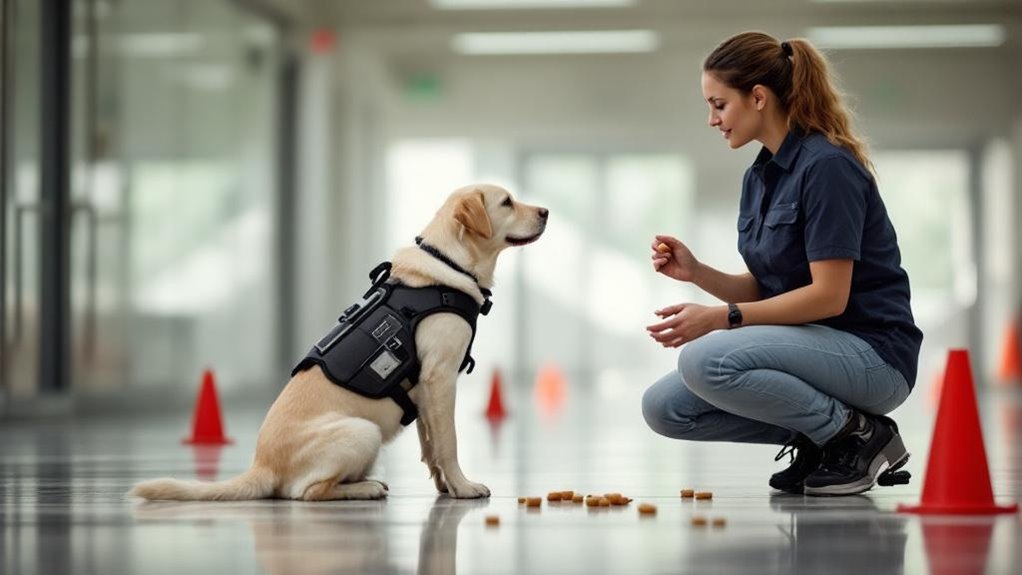
Foundation training teaches your service dog the core skills they’ll need: focus, impulse control, and emotional stability. You’ll build these through consistent positive reinforcement, starting with loose leash walking, eye contact, and the leave-it command. Early socialization within the first 16 weeks exposes your dog to diverse environments, sounds, and surfaces, reducing anxiety and strengthening your partnership. Short, focused training sessions with treats and clicker marking create reliable behavioral patterns that form the foundation for advanced tasks.
- Key Takeaways
- What Makes a Service Dog Different From Other Assistance Animals?
- Why Foundation Training for Service Dogs Sets Success
- Should You Train Your Own Service Dog or Hire a Professional?
- The Critical Role of Socialization in Early Development
- House Training as Your First Foundation Skill
- Teaching Impulse Control: A Foundation Training Essential
- Nose Touch: The Versatile Alert Behavior
- Chin Rest: Creating Calm and Stability
- Front Paws on Platform: Teaching Support Tasks
- Loose Leash Walking: The Service Dog Training Skill That Matters Most
- Settle and Relax: The Underrated Skill Every Service Dog Needs
- Why Where Your Dog Puts Its Paws Matters
- Teaching Your Dog to Navigate Distractions Gradually
- Why Consistency Matters More Than Intensity
- Using Treats and Praise to Shape Service Dog Behaviors
- Moving From Practice to Real-World Service Tasks
- When Your Dog Won’t Respond to Commands: Troubleshooting Common Problems
- Is Your Dog Ready for Public Access? A Real Readiness Checklist
- The Two-Question Rule: Knowing When Your Dog Meets ADA Standards
- Professional Training vs. Owner Training: What Drop-Out Rates Tell You
- Service Dog Training Timelines: What to Expect at Each Stage
- How to Keep Service Dog Skills Sharp After Training Ends
- Bonding Techniques That Strengthen Handler-Dog Teamwork
- Frequently Asked Questions
- Conclusion
Key Takeaways
- Foundation training develops essential skills including focus, impulse control, loose leash walking, eye contact, and the leave-it command.
- Early socialization within the first 16 weeks exposes dogs to diverse environments, sounds, surfaces, and social situations for adaptability.
- Positive reinforcement techniques using treats, praise, and clicker training mark desired behaviors and build emotional resilience effectively.
- Consistency in training methods reduces confusion, builds reliable behavioral patterns, and develops emotional stability for public access work.
- Short, focused training sessions with gradual distraction introduction progressively increase task focus and handler-dog partnership strength.
What Makes a Service Dog Different From Other Assistance Animals?
While you might hear terms like “service dog,” “therapy dog,” and “emotional support animal” used interchangeably, these animals actually serve very different purposes and operate under different legal frameworks.
Service dogs in training undergo rigorous, task-specific instruction to perform critical functions directly related to their handler’s disability, whether that’s alerting to seizures, retrieving items, or providing mobility assistance.
Therapy dogs and emotional support animals, by contrast, offer general comfort without specialized training requirements.
Under the ADA, only service dogs qualify for public access rights, accompanying handlers into restaurants, stores, and other establishments.
Therapy dogs and ESAs lack these legal protections, requiring permission from individual businesses.
Understanding these distinctions helps you recognize legitimate service animals and appreciate the specialized work involved in their development.
Why Foundation Training for Service Dogs Sets Success
Before a service dog can perform complex tasks like detecting medical emergencies or providing mobility assistance, it must master fundamental skills that form the backbone of all advanced training.
Foundation training equips your dog with essential abilities—focus, impulse control, and socialization—that directly enable real-world effectiveness.
Foundation training builds focus, impulse control, and socialization—the essential abilities that enable real-world service dog effectiveness.
You’ll develop behaviors like loose leash walking, eye contact, and the leave-it command, which prepare your dog for public settings and complex distractions.
Through positive reinforcement during foundation training, you build your dog’s emotional resilience and confidence alongside your own partnership.
These foundational skills develop the cognitive flexibility your dog needs to adapt to various environments.
When you establish this strong groundwork early, you create the structure necessary for specialized service tasks, ensuring your dog progresses smoothly into advanced training.
Should You Train Your Own Service Dog or Hire a Professional?
You’ll face a significant financial decision when choosing between owner-training and professional programs, since you can save thousands of dollars by training your own dog.
Whereas professional trainers often charge over $25,000 for extensive service dog development.
Professional organizations bring structured curricula, experienced guidance, and higher success rates—approximately 70% of dogs fail training due to behavioral issues—which means you’re paying partly for their expertise in identifying and managing dogs unlikely to succeed.
Your choice depends on your available time, training knowledge, and comfort level with foundational skills and socialization, as either path requires you to maintain consistency and structure throughout your dog’s development.
Owner-Training Cost Considerations
When deciding between training your own service dog and hiring a professional organization, the financial difference becomes immediately apparent, with owner-training typically costing a fraction of what professional programs demand.
You’ll find that your primary expenses involve:
- Training materials and instructional resources
- Basic supplies like leashes, treats, and markers
- Veterinary care and vaccinations
- Time investment in developing your skills
Professional programs often exceed $25,000, creating barriers for families who need service dogs.
Owner-training removes this financial obstacle, though it requires your sustained commitment and dedication. You must honestly assess whether you possess the necessary knowledge of canine behavior, the ability to invest considerable hours, and the discipline to maintain consistency throughout the training process.
This realistic self-evaluation determines your success.
Professional Organization Benefits
While owner-training offers a clear financial advantage, professional organizations bring a different kind of value that addresses the core challenge of service dog development: most candidates don’t make it through the process.
You’ll find that approximately 70% of service dog candidates fail due to behavioral challenges, a statistic that underscores why professional organization benefits matter. Experienced trainers provide tailored guidance that meets your specific disability needs while ensuring reliable, safe task performance. They follow established curricula and structured approaches, reducing the two-year timeline and $25,000+ costs associated with self-training without expertise.
Beyond initial training, professional organizations offer ongoing support that adapts as your needs evolve, strengthening your handler-dog bond and maintaining effectiveness throughout your service dog’s working life.
The Critical Role of Socialization in Early Development
You’ll want to expose your service dog puppy to diverse environments, people, and stimuli within the first 16 weeks, since early experiences directly shape how calmly and confidently they’ll respond to public settings later.
This environmental exposure builds the adaptability and focus your dog needs for public access work, and without it, behavioral challenges often emerge that can derail training entirely.
Start with systematic outings to busy areas, varied social interactions, and different sounds and textures, establishing a foundation that supports all the advanced training to come.
Environmental Exposure And Adaptation
The foundation of a reliable service dog rests on early socialization, which is the systematic introduction of puppies to diverse environments, sounds, surfaces, and social situations during their most formative weeks.
You’ll establish essential skills through environmental exposure that directly impact your dog’s future performance and stability.
By 16 weeks of age, your puppy should encounter:
- Different surfaces like grass, concrete, and tile to build physical confidence
- Various sounds including traffic, machinery, and crowds to reduce noise sensitivity
- Multiple social interactions with people and other animals in controlled settings
- Novel environments such as stores, parks, and public spaces to foster adaptability
Consistent environmental exposure during this critical developmental phase creates resilience, reduces anxiety-related behavioral issues, and strengthens your handler-dog partnership.
Without this structured reinforcement, your service dog faces significant risks of dropout during advanced training.
Building Confidence Through Experience
As your service dog candidate encounters new people, animals, sounds, and environments during their early months, you’re actively building the emotional foundation that’ll determine their success in advanced training and working life.
Early socialization experiences shape how your dog responds to unfamiliar situations later, reducing reactivity and fostering calm behavior when unexpected events occur. You’ll notice that consistent, positive exposure to varied stimuli reinforces confidence and adaptability, allowing your dog to remain focused despite distractions.
This structured approach strengthens the handler-dog bond through trust and effective communication. Without adequate socialization during these critical developmental periods, your candidate faces increased risk of behavioral challenges that prevent graduation, as statistics show approximately 70% of undertrained dogs don’t complete their programs.
Foundation For Public Access
Public access readiness begins long before your service dog candidate enters a crowded store or busy street, because the groundwork you’re laying now through deliberate socialization directly determines whether they’ll remain calm and focused when distractions intensify later.
Your foundation training requires strategic exposure across multiple contexts:
- Introduce varied environments early, exposing puppies to different sounds, surfaces, and settings before 16 weeks to build genuine confidence rather than forced tolerance.
- Facilitate meaningful interactions with diverse people, animals, and situations so your dog develops adaptability instead of anxiety when encountering unfamiliar stimuli.
- Gradually increase distractions during training sessions, teaching your service dog to maintain task focus amid busy surroundings.
- Establish consistent reinforcement patterns that strengthen the handler-dog partnership, creating reliable teamwork essential for public settings.
This systematic approach guarantees your dog performs reliably when it matters most.
House Training as Your First Foundation Skill
Every service dog’s training journey begins with house training, which establishes the fundamental habits and hygiene practices that’ll shape your dog’s reliability in public settings and professional roles.
You’ll develop consistency through frequent outdoor trips, especially during the critical window before 16 weeks of age when puppies absorb lessons most effectively.
Watch for behavioral signals—sniffing, circling, restlessness—that indicate your dog needs to eliminate, then immediately guide them outside to designated areas.
Reward successful outdoor bathroom breaks with praise and treats, creating positive associations between elimination and rewards.
This reinforcement technique builds reliable habits quickly, establishing the structure your service dog needs for later public access work and professional responsibilities.
Teaching Impulse Control: A Foundation Training Essential
Impulse control—the ability to pause before acting—forms the backbone of service dog training, distinguishing dogs who can focus reliably on their handlers from those who chase distractions or respond to environmental triggers.
You’ll build this foundation by teaching your dog to ask for things rather than demand them, starting with simple behaviors like sitting before receiving treats or attention.
Teaching your dog to ask for things rather than demand them builds the foundation for reliable impulse control and focus.
Core impulse control skills include:
- Teaching “wait” to delay action until you give permission
- Using “leave it” to prevent your dog from pursuing distractions
- Rewarding calm behavior consistently through positive reinforcement
- Gradually introducing distractions during training sessions
This structured approach guarantees your dog develops genuine self-control, making impulse control sustainable through real-world situations where service work demands unwavering focus.
Nose Touch: The Versatile Alert Behavior
You’ll build a strong alert foundation by teaching your dog that a nose touch signals attentiveness and readiness to work, which creates the behavioral groundwork for more complex tasks.
Once your dog’s nose touch becomes reliable through consistent reinforcement, you can transfer this foundational behavior to practical applications like pressing buttons, opening drawers, or alerting you to specific situations by touching your leg or other designated areas.
This progression from basic alert to task-specific action demonstrates how a single trained behavior, when reinforced consistently, becomes a versatile tool that adapts to your individual needs and expands your dog’s service capabilities.
Building Alert Foundation
One of the most practical foundation behaviors you can teach a service dog is the nose touch, a simple yet adaptable skill that serves as the building block for numerous alert tasks and functional behaviors.
When you’re training service dogs, you’ll discover that this foundational technique creates consistent communication between you and your dog, establishing clear patterns they can reliably perform under various conditions.
The nose touch develops essential alert capabilities through:
- Prompting handler attention when your dog needs to signal specific needs or concerns
- Transitioning to leg alerts by gradually moving your target hand to your leg during consistent reinforcement
- Operating mechanical objects like pushing cabinet doors, drawers, and buttons for practical assistance
- Building confidence and trust in both handler and dog through early success experiences
This structured foundation strengthens your working relationship while enabling more complex task development.
Transferring To Task Applications
Several practical service tasks can develop directly from the nose touch foundation you’ve already established, since the behavior’s core mechanics—a deliberate nose contact initiated by your dog—translate naturally into meaningful alerts and assistance functions.
During task training, you’ll guide your dog’s nose to specific targets, transforming the basic touch into functional behaviors like pushing elevator buttons or opening cabinet doors. This progression requires consistent reinforcement across different environments, ensuring your dog reliably performs under real-world conditions.
You might also adapt the nose touch into leg alerts during anxious moments, where your dog touches your leg to signal awareness. Each application builds on the same foundation, strengthening both your dog’s capability and your confidence in their support abilities.
Chin Rest: Creating Calm and Stability
When a service dog rests its chin on a handler’s lap or foot, it’s creating a physical connection that calms both the dog and the person it serves. This simple behavior is one of the most versatile tools in service dog training.
The chin rest foundation supports multiple applications:
- Deep pressure therapy: The dog’s weight and position deliver grounding sensations that reduce anxiety during stressful moments
- Object stabilization: Prevents chewing while holding items for retrieval, ensuring handlers receive objects intact
- Comfort signaling: Teaches your dog to communicate support and readiness across various environments
- Complex task development: Provides structure for teaching specialized responses like anxiety interruption
Front Paws on Platform: Teaching Support Tasks
You’ll build a foundation for support tasks by teaching your dog to place their front paws on a platform, which creates the precise positioning they’ll need for balance assistance and complex sequences later.
This targeted behavior helps your dog develop body awareness and learn to hold steady positions, making it easier to introduce adaptive equipment and progress toward more demanding support work.
Precise Positioning For Tasks
Teaching your service dog to place their front paws on a platform creates the foundation for effective support tasks, whether you need assistance after a fall, stability during mobility challenges, or a physical barrier during anxiety episodes.
Your dog, trained to perform with precision, develops spatial awareness through consistent platform work. This training strengthens the specific skills you’ll rely on during real-world situations:
- Precise paw placement that allows you to lean safely without slipping
- Body positioning that maximizes your dog’s leverage and stability
- Muscle memory reinforced through repetition and positive reinforcement
- Confidence built gradually, establishing trust between you and your dog
Regular practice creates the structure your dog needs to respond automatically, transforming a simple platform into the launching point for more advanced mobility assistance and protection tasks.
Balance And Support Training
Building on the spatial awareness your dog’s developed through platform work, you’re now ready to transform that foundation into active support for your own stability and mobility.
Your dog learns to position their front paws on the platform while you lean into them, creating a stable point you can rely on after falls or during moments of weakness. This balance and support work develops their ability to brace against your weight, reinforcing proper body mechanics and leg placement.
Through consistent reinforcement and repetition, your dog understands the structure of the task: paws stay positioned, body remains steady, and focus stays on you.
This foundation enables more complex assistance behaviors later, building confidence in both you and your dog as you navigate different environments together.
Complex Behavior Foundation Building
The front paws on platform behavior serves as a bridge between basic obedience and the specialized support tasks your service dog will eventually perform. This is because it teaches your dog not just where to position their body, but how to maintain that position while bearing your weight and responding to your movement.
Through consistent service dog training, you’re establishing foundational skills that enable more advanced assistance work.
- Body awareness develops as your dog learns spatial relationships and weight distribution on the platform.
- Confidence builds naturally through repeated success, making complex sequences feel manageable.
- Precise positioning becomes automatic, essential for blocking behavior and crowd protection during anxiety episodes.
- Teamwork strengthens because your dog understands how their body supports yours.
This structure creates consistency in your dog’s responses, allowing you to layer increasingly demanding tasks onto this reliable foundation.
Loose Leash Walking: The Service Dog Training Skill That Matters Most
Loose leash walking stands as one of the most critical skills you’ll teach your service dog, because it establishes the foundation for reliable public behavior and strengthens the working relationship between handler and animal.
Your dog can be trained to match your pace and direction through positive reinforcement techniques that make learning enjoyable for both of you. Rather than allowing pulling or constant sniffing, you’ll guide your dog to focus on you while traversing various environments.
Consistent practice in different settings—parks, busy streets, indoor spaces—ensures your dog remains attentive despite distractions. This foundational skill reduces potential chaos in public settings and enables effective teamwork, preparing your service dog for more complex tasks requiring sustained attention and cooperation with your specific needs.
Settle and Relax: The Underrated Skill Every Service Dog Needs
While loose leash walking teaches your service dog to move with purpose and attention, the ability to settle and relax in stationary positions completes the picture of controlled public behavior.
You’ll find that mastering this skill transforms how your dog responds to demanding environments.
When you teach your dog to settle and relax, you’re building emotional stability that extends far beyond training sessions.
Consider these essential elements:
- Gradual exposure to distracting environments strengthens your dog’s resilience and confidence
- Consistent reinforcement of calm behavior establishes reliable patterns you can depend on
- Multiple positions like down-stay or mat work provide structure and variety
- Regular practice improves impulse control and deepens your working partnership
This foundation directly supports your service dog’s effectiveness in public settings while reducing anxiety for both of you.
Why Where Your Dog Puts Its Paws Matters
You’ll find that precise paw placement forms the foundation of your service dog’s practical abilities, from stabilizing you during balance work to operating buttons for elevators and light switches. This means your dog must develop strong body awareness and understand spatial positioning in various environments.
When you establish consistent, accurate paw placement through structured training and reinforcement, you’re building your dog’s confidence while simultaneously creating the teamwork and trust necessary for real-world tasks. Whether your dog’s shielding you from distractions in public settings or executing complex movements around obstacles, this attention to where your dog positions its paws isn’t about perfection—it’s about creating reliable, safe assistance that your dog can execute reliably whether you’re in a crowded space or maneuvering a familiar room.
Body Awareness And Positioning
When a service dog places its paws with intention rather than chance, it gains the ability to support its handler with precision and safety in ways that random positioning simply can’t achieve.
You’ll develop your dog’s body awareness through deliberate practice and consistent reinforcement of specific placements.
Consider these key positioning applications:
- Balance assistance on stairs, where precise paw placement prevents handler falls
- Blocking techniques, positioning the dog between handler and obstacles or crowds
- Fall support, enabling the dog to stabilize during loss of balance
- Mobility tasks, using targeted paw placement to navigate around furniture and hazards
You’re building neural pathways through repetition, teaching your dog to understand spatial relationships between its body, your body, and the environment.
This foundation transforms random movements into reliable, purposeful actions that directly enhance your safety and independence during everyday tasks.
Paw Placement For Tasks
The spatial awareness you’ve built through body positioning practice now becomes the foundation for teaching your dog exactly where to place its paws during specific tasks, because the difference between a paw landing six inches to the left versus right can mean the success or failure of stability work, door opening, or blocking maneuvers.
| Task Type | Paw Placement Priority |
|---|---|
| Stability assistance | Positioned perpendicular to handler’s body |
| Door operation | Placed on door frame or handle location |
| Obstacle navigation | Aligned with safe pathway markers |
| Blocking behavior | Angled to shield handler effectively |
Your reinforcement strategy must reward precise paw placement consistently, establishing the muscle memory your dog needs for reliable performance across varying environments and situations.
Precise Movement In Public
Several factors converge when your service dog operates in crowded or unfamiliar public spaces, and precise paw placement becomes the mechanism that prevents problems before they start.
Your dog’s precise movement establishes clear boundaries, reduces reactive behavior, and maintains focus on handler support tasks.
To develop this foundation, you’ll work on:
- Target training where your dog learns to place paws on designated platforms, building body awareness essential for public navigation
- Distance control that prevents your dog from crowding handlers or creating hazards near other people
- Directional placement reinforcing where front paws belong during balance assistance and stair navigation
- Environmental consistency across different settings, ensuring your dog responds reliably regardless of distractions or unfamiliar spaces
This structured approach creates predictable patterns your dog can execute reliably, transforming public outings into controlled, safe interactions.
Teaching Your Dog to Navigate Distractions Gradually
As your dog masters basic obedience commands in quiet settings, you’ll need to systematically introduce distractions to build their ability to focus amid real-world chaos, and the key to success lies in starting small and increasing difficulty gradually. You’ll start in controlled environments with minimal distractions, then progressively add complexity as your dog demonstrates consistent focus.
| Training Stage | Distraction Type | Duration |
|---|---|---|
| Beginning | Mild sounds, one person | 5-10 minutes |
| Intermediate | Multiple people, moving objects | 10-15 minutes |
| Advanced | Heavy traffic, loud noises, unfamiliar environments | 15-20 minutes |
Use high-value rewards to reinforce attention during successful distraction navigation. Practice across multiple locations to encourage generalization. Monitor stress levels closely, taking breaks when needed to prevent overwhelm and maintain positive associations with training.
Why Consistency Matters More Than Intensity
You’ll find that consistent training methods build reliable behavioral patterns far more effectively than sporadic, intense sessions, since your service dog’s brain reinforces actions through repeated, predictable practice rather than occasional high-pressure training.
When you maintain the same cues, commands, and reinforcement strategies across every session and handler, you’re creating a clear communication system that allows your dog to respond accurately even in distracting public environments, which directly supports a sustainable long-term partnership where your dog can confidently perform complex tasks.
This steady approach also reduces the confusion and anxiety that inconsistency causes, helping your dog develop the emotional resilience needed to assist you reliably for years to come.
Building Reliable Behavioral Patterns
The foundation of a reliable service dog lies not in intense, sporadic training sessions but in the steady, repeated practice of commands and behaviors across similar contexts, which trains the dog’s brain to recognize patterns and respond predictably even under stress.
Building reliable behavioral patterns requires you to understand how consistency shapes your dog’s neural pathways:
- Frequency matters more than duration, so you’ll conduct shorter training sessions multiple times daily rather than one lengthy session.
- Repetition in similar environments helps your dog generalize skills, enabling performance in real situations.
- Positive reinforcement applied consistently creates clear associations between desired behaviors and rewards through clicker training.
- Confidence develops through predictability, reducing your dog’s anxiety during task execution.
This structured approach guarantees your service dog responds reliably when you need it most.
Sustainable Long-Term Handler Partnership
Once you’ve built those reliable behavioral patterns through repetition and reinforcement, you’ll discover that maintaining your service dog’s performance over months and years depends far more on steady, predictable training than on occasional intensive work.
This consistency also strengthens the partnership itself by creating mutual understanding between you and your dog. Regular sessions reinforce foundational skills that directly support your handler’s disability accommodations, while sporadic intense training creates confusion about expectations.
Your service dog learns to trust your commands and cues when you apply them uniformly across different environments, which builds emotional resilience and reduces anxiety.
Using Treats and Praise to Shape Service Dog Behaviors
Treats and praise form the foundation of effective service dog training because they create positive associations that encourage your dog to repeat desired behaviors.
When you pair them consistently together, you strengthen both the dog’s motivation and your bond as a handler.
To shape complex behaviors effectively, you’ll want to implement these key strategies:
- Use clicker training to mark desired behaviors with precision, then immediately follow with treats to clarify what you’re rewarding
- Practice gradual shaping through successive approximations, rewarding small steps toward the final behavior to build your dog’s confidence
- Keep training sessions short and focused, maintaining engagement through consistent treats and praise that sustain your dog’s enthusiasm
- Pair verbal praise with treats during every session, reinforcing the positive association that strengthens your service dog’s learning and your partnership
Moving From Practice to Real-World Service Tasks
How do you know when your service dog is truly ready to leave the training environment and perform reliably in the unpredictable real world?
You’ll assess their emotional resilience, teamwork with you, and consistent task performance under stress, which demonstrates they’ve mastered foundational training thoroughly.
Assess your dog’s emotional resilience, teamwork ability, and consistent task performance under stress to confirm foundational training mastery.
Begin altering gradually by reinforcing loose leash walking and focus in distracting environments, since these skills anchor all real-world performance.
Expose your dog to varied scenarios progressively—crowded spaces, different surfaces, unexpected sounds—allowing them to generalize learned behaviors effectively.
Simulate actual service tasks like retrieving dropped items or maneuvering around obstacles, building their confidence before genuine situations arise.
Regular high-distraction practice solidifies their reliability and guarantees they maintain performance consistency when pressure increases, establishing them as dependable assistance animals.
When Your Dog Won’t Respond to Commands: Troubleshooting Common Problems
Even when you’ve invested considerable time in training, your service dog may suddenly seem to ignore commands you’ve practiced repeatedly. This frustration often signals that something in the training process needs adjustment rather than indicating a fundamental failure.
Consider these common causes:
- Environmental distractions – Your trained dog may struggle in new settings with excessive stimuli, so return to quieter, familiar spaces before progressing to busier locations.
- Physical or emotional state – Fatigue, stress, or discomfort considerably affects your dog’s willingness to respond, making assessment of their well-being essential before sessions.
- Inconsistent cues – Varying your commands or hand signals confuses your dog, so use identical cues every time to reinforce learning.
- Inadequate reinforcement – Delayed or inconsistent rewards weaken the connection between behavior and positive outcomes.
Systematic troubleshooting restores responsiveness effectively.
Is Your Dog Ready for Public Access? A Real Readiness Checklist
Before your service dog ventures into public spaces, you’ll want to verify that they’ve developed the foundational skills and composure necessary to perform reliably when distractions multiply and stakes rise.
Start by evaluating their focus in varied environments, testing whether they maintain attention despite noise, crowds, and competing stimuli. Evaluate their command responses—sit, stay, and heel should be automatic and consistent, not occasional.
A service dog’s focus must remain steady amid noise and crowds, with commands like sit, stay, and heel executed automatically and consistently.
Observe their task performance under pressure, ensuring reliability isn’t dependent on ideal conditions. Check their manners too; excessive barking or jumping undermines public access effectiveness.
Finally, gauge their emotional stability in social situations, confirming they remain calm rather than anxious or reactive. This readiness checklist establishes whether your dog possesses the foundational composure required for successful public access work.
The Two-Question Rule: Knowing When Your Dog Meets ADA Standards
Once your dog has mastered the public access readiness checklist, you’ll want to understand the legal framework that defines what qualifies as a legitimate service animal under the Americans with Disabilities Act (ADA).
The ADA establishes a clear standard through two specific questions you can ask to determine legitimacy:
- Is the dog required because of a disability?
- What tasks has the dog been trained to perform?
These questions focus on function rather than appearance or documentation. Your dog must perform tasks directly related to the handler’s disability, distinguishing service animals from emotional support or therapy dogs.
Understanding this framework guarantees your training meets legal standards, maintaining consistency with ADA requirements and protecting public access rights through legitimate qualification rather than assumption or unofficial credentials.
Professional Training vs. Owner Training: What Drop-Out Rates Tell You
Now that you understand the legal requirements your dog must meet, you’ll face a major decision about how to get there: working with a professional training organization or taking on the training yourself. The statistics reveal important patterns: professional training programs maintain higher success rates through rigorous assessments and structured protocols, while approximately 70% of candidates still drop out due to behavioral challenges. Owner training offers cost savings and personalized bonding, yet introduces greater failure risk without proper expertise.
| Factor | Professional Training | Owner Training |
|---|---|---|
| Success Rate | Higher with structure | Variable, expertise-dependent |
| Cost | Exceeds $25,000 | Noticeably lower |
| Emotional Bond | More impersonal | Enhanced through personal connection |
Your choice depends on balancing financial resources, available time, training knowledge, and your dog’s individual temperament and consistency needs.
Service Dog Training Timelines: What to Expect at Each Stage
The journey from puppy to working service dog spans roughly two to three years, with each stage building on the previous one to develop the skills and reliability your dog will need. Understanding service dog training timelines helps you maintain realistic expectations and recognize when your dog’s progressing appropriately.
Each phase requires specific focus:
- 8 to 16 weeks: Socialization and basic obedience establish foundation impulses, house training, and command responses.
- 12 to 18 months: Foundation skills develop through nose targeting, loose leash walking, and practicing behaviors across different environments.
- 1 to 2 years: Public access training guarantees your dog responds correctly in real-world settings alongside you.
- 18 months onward: Task-specific training begins only when your dog’s mature enough to prevent burnout and maintain focus.
Ongoing maintenance training continues throughout your dog’s service life, reinforcing learned skills and introducing new tasks as your needs evolve.
How to Keep Service Dog Skills Sharp After Training Ends
Completing formal service dog training marks an important milestone, yet your dog’s working life has really just begun. Maintaining those hard-earned skills requires the same commitment you invested during training.
You’ll train a service dog continuously by scheduling consistent practice sessions that focus on public access behaviors and specific task performance, preventing skill degradation over time.
Vary your practice environments regularly, introducing high-distraction locations where your dog learns to generalize training to real-world situations. Gradually add new challenges to guarantee adaptability, while incorporating play and positive reinforcement to maintain enthusiasm.
Consider enrolling in refresher courses or workshops that provide structured opportunities to practice and refine skills together, strengthening your bond while keeping essential abilities sharp and reliable.
Bonding Techniques That Strengthen Handler-Dog Teamwork
While your service dog’s technical skills form the foundation of their work, the strength of your bond with them determines how reliably they’ll perform those skills when it matters most.
Effective bonding techniques create the trust and communication necessary for seamless teamwork in real-world situations.
Build your connection through these practical approaches:
- Early socialization and shared activities help your dog become attuned to your cues, fostering companionship that translates into responsive performance.
- Consistent positive reinforcement, such as clicker training, strengthens your communication loop and reinforces desired behaviors reliably.
- Calm, positive interactions like gentle petting and verbal praise encourage emotional resilience and your dog’s desire to please you.
- Practicing foundational skills in varied environments allows you both to adapt and grow together, reinforcing cooperation in public settings.
This foundation guarantees your dog remains focused and capable when you need them most.
Frequently Asked Questions
What Is the 3-3-3 Rule for Dog Training?
You’ll experience the 3-3-3 Rule across three phases: first three days involve stress and exploration, next three weeks show gradual settling, and final three months establish your dog’s true personality and routine behaviors.
What Is the 7 7 7 Rule for Dogs?
You’ll expose your puppy to seven different environments, meet seven new people, and introduce seven new sounds within their first seven weeks. This critical socialization builds confidence and reduces fearfulness in adult dogs.
Does Lupus Qualify for a Service Dog?
Yes, you can qualify for a service dog with lupus if your condition noticeably impairs your ability to perform major life activities. You’ll need medical documentation and must demonstrate specific tasks the dog would perform for your needs.
What Is “I Love You” in Dog Language?
Your dog says “I love you” through soft eye contact, tail wags, nuzzling, and leaning against you. They’re following you closely, bringing you toys, and seeking your physical affection constantly.
Conclusion
You’ve built your service dog’s foundation through systematic training, consistent reinforcement, and strong bonding—you’re now standing on solid ground. Your commitment to ongoing practice keeps those skills from fading, much like maintaining a well-traveled path prevents it from becoming overgrown. Continue this dedication, adjusting techniques as your dog matures, and you’ll sustain the reliable partnership that makes service work possible.