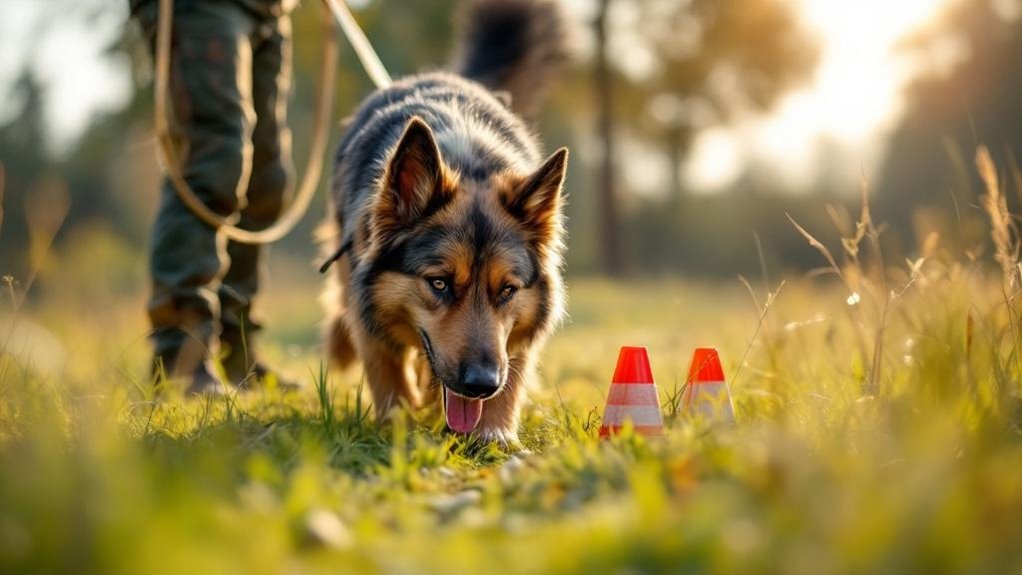
Your German Shepherd’s 225 million scent receptors and natural herding instincts make them exceptional candidates for tracking and trailing work. Tracking follows ground disturbances on specific surfaces, while trailing emphasizes airborne scent with greater decision-making freedom. Start with structured foundation training on soft surfaces like grass and soil, then gradually introduce varied terrains and real-world distractions. Consistent reinforcement, proper harness fit, and thorough scent preparation prevent common mistakes. Understanding how weather, humidity, and surface types affect scent behavior will help you build reliable skills across environments.
- Key Takeaways
- Distinguish Tracking From Trailing
- Why Shepherds Excel at Scent Work
- What Your Shepherd Already Knows (And How to Use It)
- Build Your Training Foundation
- Assess Your Dog’s Readiness
- Harness, Lead, and Articles: Choosing What Works
- Hard Surface Tracking: Transitioning Beyond Grass
- How Scent Behaves Across Surfaces and Weather
- Master Urban Distractions
- Contamination and Competition: City Tracking Fundamentals
- Read Your Dog’s Pace and Signals
- Five Mistakes That Derail Tracking Progress
- Lay Trails With Purpose: Progressive Complexity
- Article Training for Tracking Dogs
- SAR Training Fundamentals
- Sport Tracking vs. Real-World Rescue Work
- Conditioning: Preventing Injury in High-Drive Dogs
- Monitor Gait and Detect Pain Early
- Progress From Wilderness to Urban Environments
- Refine Technique for Advanced Teams
- Certification: AKC Standards and SAR Requirements
- Keep Skills Sharp Year-Round
- Frequently Asked Questions
- Conclusion
Key Takeaways
- German Shepherds possess 225 million scent receptors, making them naturally suited for tracking and trailing work with exceptional olfactory sensitivity.
- Begin tracking training on hard surfaces, gradually progressing to grass, soil, and mulch to build confidence and reliable skills across varied terrain.
- Use a 20-40 foot lead and snug-fitting harness to provide control and flexibility while allowing unrestricted movement during training exercises.
- Introduce real-world distractions gradually after mastering focused tracking, starting with environmental noise before introducing closer, more challenging distractions.
- Thoroughly prepare and scent-mark articles before training to avoid confusion; inadequate scent preparation is a common mistake that undermines dog performance.
Distinguish Tracking From Trailing
Foundation matters when you’re training a shepherd in scent work, and understanding the difference between tracking and trailing gives you that foundation.
Tracking involves following ground disturbances and scent left on a specific surface, requiring your dog to stay focused on an established path, while trailing emphasizes airborne scent, allowing your shepherd greater freedom to make real-time decisions.
Tracking follows ground scent on established paths, while trailing uses airborne scent, giving your shepherd greater freedom and real-time decision-making ability.
You’ll notice that tracking typically works best on soft surfaces like dirt, which retain scent effectively, whereas trailing adapts to various terrains.
Tracking demands structured guidance and reinforcement along defined routes, making it the foundational practice before advancing to trailing.
As your shepherd masters tracking’s consistency and framework, you’ll build the decision-making skills necessary for trailing’s more dynamic, adaptive demands in search and rescue scenarios.
Why Shepherds Excel at Scent Work
German Shepherds excel at scent work because you’re working with a breed whose olfactory system operates at roughly 40 times the sensitivity of yours, giving them a neurological advantage that no amount of training can replicate.
Their natural tracking instinct, combined with intelligence and trainability, allows you to channel these abilities into complex commands and focused behavior that translates directly to search and rescue operations and other real-world applications.
You’ll find they adapt effectively across different terrain types—whether urban streets or rural landscapes—because their versatile nature and consistent work ethic enable them to maintain concentration despite environmental distractions.
Natural Scent Detection Abilities
Because they’re equipped with up to 225 million scent receptors—roughly forty-five times more than humans possess—Shepherds have a neurological advantage that fundamentally shapes their ability to detect and distinguish complex odors in ways you can’t experience yourself.
This biological foundation makes them naturally suited for tracking and trailing work.
Your dog’s exceptional olfactory system operates through three key mechanisms:
- Detection capability: Shepherds identify scents in challenging environments, including urban settings with competing distractions
- Differentiation skills: Their receptors allow them to separate individual odor components within complex mixtures
- Soft surface sensitivity: They excel at following scent trails on grass, earth, and other permeable surfaces where odor particles linger
This innate ability provides the foundation upon which you’ll build consistent training and reinforcement structures.
Breed Instinct and Drive
While your Shepherd’s scent detection abilities give them the raw neurological capacity for tracking work, their breed instincts and natural drive transform that capacity into genuine motivation to search and pursue. German Shepherds were originally bred to herd livestock, meaning they’re hardwired to follow moving targets and control their movements, instincts that translate directly into tracking and trailing tasks. Their high energy levels and strong work drive fuel sustained engagement during scent work sessions. Your dog follows natural impulses when pursuing a scent trail, yet the handler must channel these instincts through structured training. This combination of herding heritage, intense focus, and desire to work makes your Shepherd exceptionally suited for scent detection roles.
| Instinct | Application |
|---|---|
| Herding drive | Following scent trails |
| High energy | Sustained tracking work |
| Natural focus | Scent concentration |
| Work motivation | Training engagement |
| Movement tracking | Trailing pursuit |
Adaptability Across Terrain Types
Your Shepherd’s ability to track successfully across multiple terrain types—from grassy fields to concrete streets to woodland areas—stems from three interconnected strengths: an extraordinarily sensitive nose capable of detecting scents 40 to 100 times more acutely than yours, the intelligence and trainability to adjust their search strategy based on environmental conditions, and the natural athleticism to shift fluidly between the explosive speed needed on open ground and the controlled pace required when maneuvering urban environments where scent particles scatter unpredictably.
Building this adaptability takes consistent effort over two weeks of targeted exposure:
- Practice on hard surface terrain regularly, allowing your dog to learn how scent behaves differently on pavement
- Alternate between soft and challenging ground to reinforce problem-solving skills
- Return to familiar locations to build confidence before introducing new environments
This structured reinforcement strengthens your Shepherd’s versatility, ensuring they perform reliably regardless of terrain challenges.
What Your Shepherd Already Knows (And How to Use It)
Several natural abilities already exist within your shepherd that you can build on to create an effective tracking dog, and understanding what these abilities are will help you train more efficiently.
Your shepherd possesses an innate sense of smell that you can leverage through Surface Tracking exercises, starting with scent articles they’re already familiar with to strengthen their confidence and focus.
Their high energy levels and strong work drive make them naturally suited for Tactical Tracking tasks requiring sustained effort across different terrains.
Since your shepherd learns through both visual cues and scent, you’ll find that combining clear commands with consistent training methodologies builds effectively on their existing knowledge.
This combination of natural instincts and structured reinforcement creates a foundation for successful trailing work.
Build Your Training Foundation
Your shepherd’s natural scent drive—that instinctive pull to follow and investigate odors—forms the foundation you’ll build on, so you’ll want to understand how your dog processes scent before you start formal training.
Progressive surface conditioning, which means you’ll start on hard surfaces like pavement or concrete before moving to grass, dirt, and complex urban environments, helps your dog develop reliable tracking skills in manageable stages while building confidence.
This structured approach, combined with consistent reinforcement and clear communication between you and your dog, creates the stability your shepherd needs to advance through more demanding tracking scenarios.
Understanding Canine Scent Drive
Understanding canine scent drive—that natural instinct for dogs to search for and follow scents—forms the foundation for all tracking and trailing work you’ll do with your Shepherd.
Recognizing how this drive works in your individual dog will shape every training decision you make moving forward.
Your Shepherd’s scent drive operates through several key mechanisms:
- Natural variation: Each dog possesses different scent drive intensity; some dogs display stronger motivation to track ground scents, while others excel at trailing airborne odors.
- Environmental responsiveness: Your dog’s ability to focus on scents depends heavily on distractions, weather conditions, and surface types you introduce during training.
- Progressive development: Building scent drive requires consistent exposure to varied environments, which strengthens your dog’s concentration and adaptability.
Observing your Shepherd’s individual responses guides your training structure forward.
Progressive Surface Conditioning
Once you’ve identified your Shepherd’s scent drive strengths and weaknesses, you’ll build on that foundation by systematically exposing your dog to different surfaces that’ll challenge and strengthen their tracking abilities.
Start with hard surfaces like concrete and asphalt, where scent disperses quickly, then gradually shift to grass, soil, and mulch as your dog’s scent detection capabilities improve. This progressive surface conditioning develops consistency in tracking performance across varied terrain.
Adjust training distances based on your dog’s responsiveness, and establish clear protocols with trail layers to maintain distinct scent trails.
Introduce controlled distractions and contamination factors during sessions, which helps your dog maintain focus despite environmental challenges and builds the adaptive skills necessary for real-world tracking scenarios.
Assess Your Dog’s Readiness
How can you tell if your dog’s ready to begin tracking and trailing training, and what should you look for during the assessment phase?
You’ll observe your shepherd’s natural instinct to follow scents, which forms the foundation for tracking success. Consider these key indicators:
- Natural drive: Your dog demonstrates consistent interest in ground scents and follows trails without constant prompting during two hours of exposure.
- Focus capacity: Your dog maintains concentration on the scent task, resisting distractions while learning to find two specific targets.
- Temperament stability: Your shepherd remains calm and controlled, allowing you to bring your dog back reliably using basic commands.
Age matters too—some dogs show readiness by eleven or twelve months, while others develop more gradually.
Assess your dog across varied surfaces, from grass to pavement, gauging adaptability and sustained engagement.
This preliminary evaluation determines whether your shepherd possesses the consistency and drive necessary for formal training progression.
Harness, Lead, and Articles: Choosing What Works
You’ll need to select equipment that supports your dog’s tracking performance, starting with a harness that fits snugly without restricting movement, since an uncomfortable harness can interfere with your dog’s ability to focus on scent work.
A 20-40 foot lead gives you adequate control while allowing your dog enough space to navigate turns and terrain variations that you’ll encounter during training and testing.
Your scent articles—typically a leather item, a cloth item, and two pre-scented pieces for advanced work—must be thoroughly scented before training begins, as proper preparation directly affects your dog’s success in identifying and retrieving articles during actual tracking exercises.
Harness Fit And Comfort
Selecting the right harness for tracking and trailing work requires balancing snugness with comfort, since an ill-fitting harness can restrict your dog’s movement, cause chafing during extended sessions, and even lead to long-term mechanical issues that affect how they perform.
You’ll need to check and adjust the fit regularly as your shepherd grows or their muscle develops.
Consider these key points when evaluating harness fit:
- The harness sits snugly without pinching, allowing two fingers of space between the material and your dog’s skin.
- Movement remains unrestricted during street crossings and trail work, enabling natural gait and scent detection.
- Your dog can come back reliably without the harness creating pressure points or discomfort.
Consistent adjustments prevent complications and maintain your shepherd’s tracking performance throughout training.
Lead Length And Control
Once your shepherd’s harness fits properly and supports comfortable movement, the lead becomes your primary tool for managing the dog’s range while they work the scent.
Getting this right directly affects both the dog’s ability to problem-solve and your capacity to guide them safely through tracking exercises. A lead length of 20 to 40 feet gives your dog enough space to engage with the scent trail independently while you maintain control from behind. This allows them to move laterally and backtrack when needed without feeling constrained.
Shorter leads restrict their natural tracking movements and limit their ability to follow the track’s direction, while excessively long leads make it difficult for you to intervene quickly if distractions arise or the dog drifts off course.
Article Selection And Scenting
The articles your dog learns to track form the foundation of their scenting work, and the materials you choose directly influence how well they can identify and follow a specific human scent in the field.
You’ll want to include a variety of textures that teach your dog to recognize scent across different surfaces, building consistency in their search patterns.
Select articles strategically:
- One leather article and one cloth article allow your dog to differentiate scents based on material and source.
- Two pre-scented articles enhance tracking capabilities by reinforcing the target scent through repetition.
- Thoroughly scent bandanas and gloves before test day to guarantee your dog can effectively track the intended trail.
This structured approach develops your dog’s ability to work methodically, regardless of what they encounter in actual tracking scenarios.
Hard Surface Tracking: Transitioning Beyond Grass
Moving your shepherd from grass and dirt tracking to hard surfaces requires you to understand how scent behaves differently on concrete, asphalt, and pavement. On hard surfaces, scent doesn’t pool in footstep impressions as it does on soil, so your dog must shift from following depressions to identifying actual scent particles instead.
This demands stronger scent discrimination skills, since productive odor sources matter more than visual ground disturbance. Start by laying short tracks with clear scent markers, gradually increasing complexity as your shepherd demonstrates reliability.
Introduce varied urban environments systematically, building adaptability through controlled exposure rather than overwhelming your dog. Maintain consistent protocols with your track layer to preserve scent integrity, ensuring your shepherd learns from reliable, repeatable conditions that reinforce correct behavior.
How Scent Behaves Across Surfaces and Weather
You’ll find that scent behaves differently depending on where your dog tracks, since soft surfaces like grass and dirt trap and hold scent particles much longer than hard surfaces such as concrete, which allow scent to dissipate quickly.
Weather plays an equally important role in determining how your dog will work, as humidity enhances scent dispersal, wind scatters it unpredictably, and temperature shifts affect how long the trail remains detectable—cooler conditions preserve scent while heat speeds evaporation.
Understanding these surface and weather patterns helps you set realistic expectations for your shepherd’s performance and adjust your training approach based on the environmental conditions you’re working in.
Surface Type Impact On Scent
Several factors determine how effectively your shepherd will track a scent trail, and surface type ranks among the most influential, since different materials retain, disperse, or conceal odor molecules in distinct ways.
Softer surfaces like grass and dirt hold scent molecules more effectively, creating consistent trails your dog can follow reliably. Hard surfaces such as concrete and asphalt present challenges because they cause scent to scatter rather than settle, making the trail fragmented and harder to detect.
Consider these surface variations:
- Grass and soil: Retain odors well, ideal for building tracking foundation
- Asphalt and concrete: Disperse scent rapidly, requiring heightened dog focus
- Mixed terrain: Combines retention and dispersal, demanding adaptability
Understanding these differences helps you select appropriate training locations and adjust your expectations accordingly, building your shepherd’s proficiency across varied conditions.
Weather Conditions And Scent Dispersal
While surface type creates the foundation for your shepherd’s tracking ability, weather conditions determine how effectively scent travels across those surfaces and reaches your dog’s nose.
Humidity enhances scent retention, making tracking easier, while wind disperses odor particles and complicates your dog’s work. Rain washes away trails initially, yet moisture afterward temporarily increases airborne scent particles, creating better detection windows.
Temperature considerably impacts performance: above 80°F, scents rise and disperse rapidly, whereas cooler conditions keep scent close to the ground where your shepherd tracks effectively.
Fog and high humidity alter how your dog perceives scent, requiring you to adjust your training approach.
Plan sessions during ideal conditions—cool, calm mornings with moderate humidity—to build consistency and reinforcement in your dog’s foundation skills.
Environmental Factors Affecting Scent Behavior
Because scent doesn’t behave the same way on every surface or in every condition, understanding how environmental factors shape scent dispersal directly impacts your shepherd’s tracking success.
You’ll find that soft surfaces like dirt and grass retain scent far better than hard concrete or asphalt, giving your dog clearer trails to follow.
Temperature and humidity work together to influence how scent particles move:
- Cooler air keeps scent molecules closer to the ground, making tracks easier for your shepherd to detect
- High humidity strengthens scent intensity, while high winds scatter particles rapidly and complicate tracking
- Light rain can enhance scent by dampening soil, though heavy rainfall washes trails away entirely
Master Urban Distractions
Urban tracking requires your shepherd to shift from the natural focus they’d use in open fields to a more disciplined, controlled approach that filters out constant sensory interference from traffic, building scents, and pedestrian movement.
You’ll introduce distractions gradually through tiered training, starting with low-level noise and scent disruption before advancing to busier environments. This structure builds your dog’s confidence and adaptability without overwhelming their tracking instincts.
Begin with varied terrains and conditions early on, establishing a foundation that prepares them for complexity. Your shepherd learns through self-discovery during structured activities, developing their own strategies for managing competing scents and sounds.
Maintain clear communication and guidance throughout, reinforcing focus with consistency. This methodical approach transforms urban challenges into manageable obstacles your dog can navigate successfully.
Contamination and Competition: City Tracking Fundamentals
Three primary obstacles—scent contamination, competing environmental signals, and pace adjustment—distinguish city tracking from the open-field work your shepherd’s already mastered, and understanding each one’ll help you navigate the shift successfully.
Urban scents layer unpredictably, mixing exhaust, food, and pedestrian traffic that obscure the original track. Your dog must learn to filter noise and focus on the target scent despite these distractions.
Urban scents layer unpredictably, mixing exhaust, food, and pedestrian traffic that obscure the original track. Your dog must learn to filter noise and focus on the target scent.
Build this capacity through structured progression:
- Introduce contaminated areas gradually, moving from quieter streets to busier intersections
- Practice pace control, requiring your shepherd to slow down and investigate methodically rather than rush
- Reinforce consistency by rewarding careful scent discrimination in increasingly complex environments
This foundation transforms your shepherd from a speed tracker into a methodical problem-solver equipped for reliable city work.
Read Your Dog’s Pace and Signals
Your shepherd’s body language tells you whether they’re tracking effectively or struggling with the contamination and distractions you’ve been building their tolerance for, and learning to read these signals helps you adjust your approach in real time.
A lowered head with periodic pauses suggests your dog needs encouragement or a pace change to refocus on the scent trail.
Watch their tail carefully: active movement signals motivation and engagement, while a tucked tail indicates discomfort or confidence issues.
Notice when your shepherd shifts between rapid and slow movements, as these changes show you when they’re processing scent efficiently versus feeling overwhelmed.
Consistent training across varied terrains builds your dog’s ability to self-regulate their pace, strengthening the communication foundation you need for reliable tracking work.
Five Mistakes That Derail Tracking Progress
Even experienced handlers can inadvertently undermine their shepherd’s tracking development by making common mistakes that compound over time, and recognizing these patterns early helps you correct course before they become entrenched habits.
Early recognition of tracking mistakes prevents them from becoming entrenched habits in your shepherd’s development.
- Inadequate scent preparation confuses dogs when articles lack proper exposure, preventing them from recognizing and following tracks effectively. So invest time in thorough pre-scenting techniques.
- Rushing certification leaves foundational gaps, as individual readiness varies. Premature advancement creates performance issues later when complexity increases.
- Limited environmental exposure reduces adaptability, particularly in urban settings where distractions challenge focus and tracking success.
Neglecting harness comfort causes gait problems and diminishes willingness to work, while unstructured training frustrates dogs as complexity increases without progressive scaffolding.
Address these systematically through patience, consistency, and graduated challenges.
Lay Trails With Purpose: Progressive Complexity
You’ll want to start your dog’s tracking foundation on hard surfaces like pavement and packed earth, where scent pools are more predictable and distractions are easier to manage before you layer in real-world complexity.
Once your Shepherd demonstrates consistent focus and reliable scent detection on these controlled trails, you can gradually introduce variable terrain, competing odors, and environmental obstacles that mirror the conditions they’d encounter in practical scenarios.
This progression prevents frustration and builds the confidence and problem-solving skills your dog needs to handle increasingly difficult tracking situations.
Starting With Hard Surfaces
Since hard surfaces like concrete and asphalt offer distinct scent concentration patterns, they’re ideal for introducing tracking work because they help your dog recognize and focus on the tracklayer’s footsteps rather than getting distracted by diffuse ground scent.
You’ll establish a foundation of understanding that translates effectively to softer surfaces later.
Begin with these practical steps:
- Start short and clear: Lay brief, marked trails so your dog quickly grasps the connection between following scent and success.
- Use consistent protocols: Establish reliable trail-laying techniques that help your dog distinguish between different scent signals.
- Adjust intervals carefully: Monitor your dog’s behavior and performance, adapting training frequency to prevent frustration or overwhelm.
This structured approach builds your dog’s confidence and problem-solving skills systematically, preparing them for increasingly complex tracking challenges ahead.
Building Distraction Challenges
Once your dog has mastered focused tracking on hard surfaces with minimal distractions, you’re ready to layer in real-world complexity that’ll test their adaptability and problem-solving skills.
Introduce distractions systematically, starting with environmental noise like wind or distant traffic, then progressing to closer elements such as other animals or people near the trail. Each new distraction builds on previous successes, allowing your dog to self-discover effective strategies rather than relying solely on your guidance.
Monitor their responses carefully, adjusting pace and intensity based on their confidence level. This tiered approach develops resilience and focus under pressure, ensuring your shepherd can track reliably in unpredictable conditions they’ll encounter during actual work.
Article Training for Tracking Dogs
Article training forms the foundation of a tracking dog’s ability to search for and identify specific scents, and it requires handlers to introduce their dogs to various scent articles—such as leather, cloth, bandanas, and gloves—so the dog learns to recognize and locate these items along a tracking trail.
You’ll want to focus on three essential preparation steps:
- Pre-scent all articles thoroughly before test day, ensuring your dog can identify them reliably.
- Include required articles at specific points along the track, following official guidelines like TDX requirements.
- Position a final article, typically a glove, at the trail’s end to mark successful completion.
Missing any required articles results in disqualification, so meticulous preparation matters. Judges evaluate your dog’s ability to follow scent and locate each article, making consistency and structure critical to your overall success and qualification.
SAR Training Fundamentals
You’ll build your shepherd’s SAR capabilities by starting with scent detection fundamentals, where you introduce your dog to target odors in controlled settings.
Then gradually increase complexity as their confidence grows. To develop the search endurance your dog needs for real rescue operations, you’re establishing consistent training sessions that progressively extend in duration and difficulty, combining varied terrain and environmental distractions so your dog learns to maintain focus under pressure.
Handler communication techniques form the foundation of this work, requiring you to learn clear signals, body language, and verbal cues that allow your dog to understand what you’re asking while you remain attentive to their behavioral responses that indicate they’ve detected a scent.
Scent Detection Fundamentals
The foundation of search and rescue training rests on understanding how your shepherd’s nose works and what it can accomplish, since dogs possess approximately 300 million olfactory receptors compared to the roughly 6 million humans have. This gives them the biological capacity to detect and differentiate scents that’d be completely imperceptible to us.
Your dog’s natural ability to discriminate between various scents becomes the cornerstone of effective SAR work, requiring you to build systematic structure around this innate skill.
To develop scent detection fundamentals, you’ll follow these essential steps:
- Introduce scent articles like leather and cloth to establish positive associations with detection work
- Begin training on natural surfaces before progressing to controlled urban environments
- Expose your shepherd to varying distractions consistently, reinforcing focus despite environmental challenges
This progression guarantees your dog develops reliable performance across diverse search and rescue scenarios.
Building Search Endurance
Once your shepherd’s scent detection fundamentals are solid, building search endurance becomes the next critical phase, since a dog that can identify scents for only a few minutes won’t perform effectively during real search and rescue operations that often demand sustained effort across extended timeframes.
Start with shorter tracks lasting five to ten minutes, then gradually extend sessions toward fifteen to twenty minutes of active searching as your foundation strengthens. Introduce varied surfaces—pavement, grass, dirt—so your dog adapts to different tracking conditions.
Layer in realistic distractions like urban noise and competing scents to sharpen focus under pressure. Throughout this progression, monitor your shepherd’s physical condition closely, watching for signs of fatigue or strain, and allow adequate recovery between sessions to prevent injury and maintain consistent performance.
Handler Communication Techniques
Building a reliable partnership with your shepherd depends on establishing clear, consistent communication that bridges the gap between your intentions and your dog’s actions.
Even the most skilled tracker will struggle without understanding what you’re asking.
Your communication toolkit includes:
- Verbal and non-verbal cues that remain consistent across all training sessions, reinforcing specific behaviors your dog associates with particular commands.
- Active listening to body language, which reveals your dog’s confidence level and signals when you need to adjust your tracking approach.
- Timely rewards and positive reinforcement that motivate your dog and strengthen the connection between commands and desired responses.
Regularly practicing these techniques builds the reliable associations your shepherd needs to maintain focus during dynamic search scenarios, transforming instruction into intuitive partnership.
Sport Tracking vs. Real-World Rescue Work
Sport tracking and real-world rescue work demand different skills from your shepherd, even though both rely on the dog’s natural scenting ability.
In competition tracking, your dog follows a predetermined course with specific articles at set distances, where precision and rule compliance matter most. Rescue work, however, requires your shepherd to adjust to unpredictable terrain, changing weather, and unknown scent conditions while locating missing persons efficiently.
Competition provides structure and consistency through pre-plotted routes and controlled aging periods, allowing you to reinforce specific behaviors predictably.
Rescue scenarios eliminate this predictability, demanding that your dog problem-solve independently when distractions intensify and scent disruptions occur.
Shifting your shepherd to real-world applications means exposing them to varied environments, urban settings, and dynamic challenges that sport training alone can’t replicate adequately.
Conditioning: Preventing Injury in High-Drive Dogs
Your shepherd’s natural drive to follow a scent can work against their physical well-being if you don’t manage their conditioning carefully, especially once they progress from controlled sport scenarios to demanding rescue work across varied terrain.
Building strength gradually prevents injury while your dog adapts to increasing intensity and duration.
Focus on these key areas:
- Monitor physical stress points regularly, checking shoulders, wrists, and pad integrity to catch soreness before it becomes chronic damage
- Fit harnesses properly and maintain nail length to guarantee correct movement patterns and reduce strain on joints
- Introduce terrain variety early through structured training, allowing your shepherd’s body to adjust to different surfaces systematically
This measured approach builds endurance without compromising long-term performance.
Monitor Gait and Detect Pain Early
Early detection of pain in your shepherd depends on understanding what normal movement looks like, then catching the subtle shifts that signal discomfort or strain. You’ll notice irregular wear patterns on nails during monthly checks, which reveal underlying gait problems before they worsen. Watch for foot dragging or reluctance to fully stretch legs, signs that fatigue or inappropriate surfaces are causing distress.
| Sign | Cause | Action |
|---|---|---|
| Uneven movement | Pain or harness issues | Adjust equipment, observe carefully |
| Irregular nail wear | Gait problems | Schedule vet consultation |
| Foot dragging | Fatigue or surface strain | Reduce intensity, change terrain |
High-drive dogs commonly overexert themselves during training, so you’ll need to incorporate pain management proactively. If you detect noticeable changes in movement or consistent signs of discomfort, contact your veterinarian promptly to address underlying health issues and maintain peak training performance.
Progress From Wilderness to Urban Environments
Once your shepherd has built solid tracking fundamentals and you’ve established a baseline for normal movement patterns, you’ll want to gradually expand training beyond wilderness settings into urban environments where real-world tracking demands complexity. This progression guarantees your dog doesn’t become overwhelmed by sudden environmental changes that disrupt focus and consistency.
Start by introducing controlled urban elements systematically:
- Begin on softer surfaces like park paths before moving to concrete and asphalt, which retain scent differently and require adjusted technique.
- Manage distractions gradually, exposing your dog to traffic noise, varied scents, and crowded areas in measured doses that build confidence without causing anxiety.
- Control pace and speed, teaching your shepherd to regulate excitement in faster-paced scenarios where quick reflexes might override careful scent work.
This structured approach reinforces tracking reliability across all conditions.
Refine Technique for Advanced Teams
At this stage, your shepherd’s foundational skills have matured enough to handle the demands of tactical tracking in law enforcement and search operations, where success depends on precision under pressure and the ability to adapt quickly to unpredictable conditions.
You’ll now deepen your handler-dog partnership through in-depth analysis of your techniques, identifying subtle patterns in how your dog responds to different urban trailing scenarios.
Deepen your handler-dog partnership by analyzing techniques and identifying subtle response patterns across diverse urban trailing scenarios.
Regular assessments reveal which skills need refinement and where consistency falters.
Focus on problem-solving exercises that mirror real-world complexity, incorporating variable environments and weather conditions.
This advanced work maximizes synergy between you and your dog, ensuring both remain effective and ready for certification.
Your commitment to technical refinement directly translates to operational readiness.
Certification: AKC Standards and SAR Requirements
After you’ve refined your team’s advanced skills through consistent problem-solving and variable training conditions, the next logical step is pursuing formal certification that validates your dog’s tracking ability and readiness for real-world operations.
You’ll encounter two main certification pathways, each with distinct requirements:
- AKC Tracking levels progress from TD (440-500 yards, 3-5 turns, aged 30 minutes to 2 hours) through TDX (800-1000 yards, 5-7 turns, aged 3-5 hours), establishing standardized benchmarks for competitive tracking.
- SAR certification combines TD and TDX skills, emphasizing practical applications across varied environments including urban settings where real rescues occur.
- Performance evaluation prioritizes effective task completion and adherence to organizational standards, ensuring your dog meets established criteria.
Both paths demand consistency, structured training, and precise execution under evaluation conditions.
Keep Skills Sharp Year-Round
Certification validates your dog’s abilities, but maintaining those skills demands year-round commitment through consistent practice in varied environments and conditions.
You’ll strengthen tracking abilities by rotating between rural and urban settings, which expose your dog to different distractions and surfaces throughout seasons. Introduce challenging elements like changing weather and new scents to build focus and consistency.
Rotating between rural and urban environments strengthens tracking abilities by exposing dogs to varied distractions, surfaces, and seasonal conditions.
Monthly training sessions or workshops keep you and your dog updated on current techniques, reinforcing what you’ve learned. Diversify training materials—leather, cloth, and other articles—so your dog identifies various scents effectively.
Regular feedback from experienced trainers helps you spot improvement areas and guarantees both handler and dog maintain sharp skills. This structure prevents skill degradation and sustains performance reliability.
Frequently Asked Questions
At What Age Should I Begin Tracking and Trailing Training With My Shepherd?
You should begin tracking and trailing training with your shepherd between 6 to 12 months old. Start with basic scent work exercises, then gradually progress to more complex trails as your dog matures and develops stronger focus and stamina.
How Long Does It Typically Take for a Shepherd to Become Proficient at Tracking?
You’ll typically need six to twelve months of consistent training before your shepherd becomes proficient at tracking. However, you’ll see noticeable progress within the first few weeks if you’re training regularly and using proper techniques.
What Is the Cost of Professional Tracking Training Versus Self-Training My Dog?
You’ll spend $1,000–$3,000 for professional tracking training, while self-training costs you minimal fees but requires significant time investment. You’ll need patience, consistency, and proper equipment to successfully train your shepherd yourself.
Can Older Shepherds Learn Tracking, or Is Early Training Essential for Success?
You can teach older shepherds to track, though you’ll achieve better results starting younger. Your dog’s motivation and health matter more than age. You’ll need patience, consistent training, and proper conditioning for success.
How Do I Know if My Shepherd Has a Natural Aptitude for Scent Work?
You can’t teach an old dog new tricks, but you can spot natural talent. Watch if your shepherd’s nose drops to ground scents during walks. They’ll show intense focus, frequent sniffing, and enthusiasm when tracking unfamiliar odors.
Conclusion
You’ve now built a shepherd trained to track and trail with precision, yet your work isn’t finished—it’s merely transformed. Consistency in practice, reinforcement of foundational skills, and regular environmental challenges keep your dog’s abilities sharp and reliable. Whether you pursue AKC certification or search-and-rescue work, you’ll find that dedication to structured training creates a partner whose scent-work capabilities grow stronger with every season.