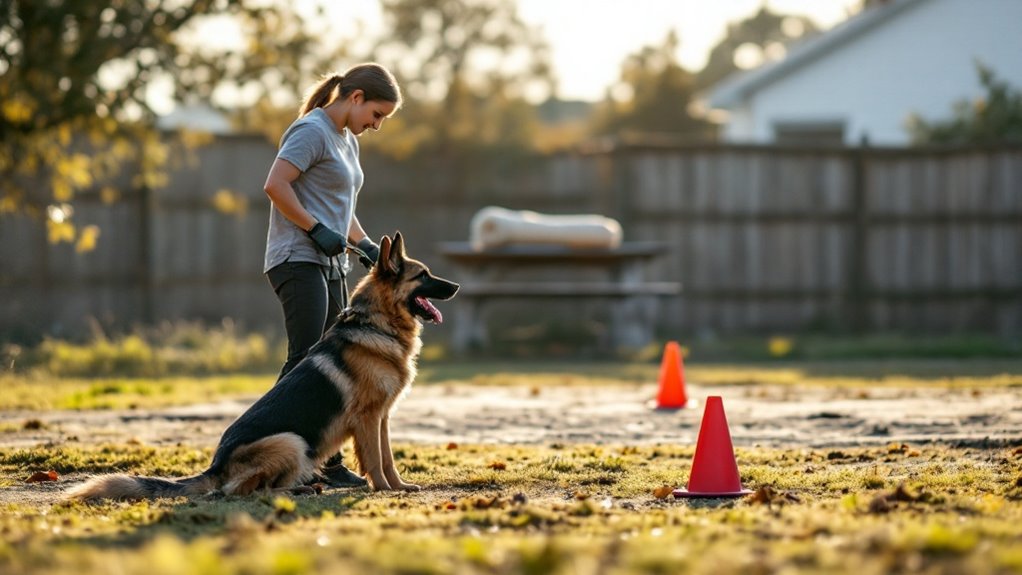
You’ll build safe protection training on obedience first, not shortcuts. Start with reliable sit, stay, and recall at 90% accuracy in calm settings, then gradually introduce mild stressors like distant sounds and strangers. Watch for stress signals—lip-licking, yawning, stiffening—that tell you when to pause progression. Use positive reinforcement, never force or intimidation. Make sure every household member uses identical commands, hand signals, and release cues to prevent confusion and unpredictable reactions. Hire a certified protection trainer for temperament evaluation and handler education. Consistency transforms reactive impulses into controlled, predictable skills.
- Key Takeaways
- Safe Protection Training Starts With Basic Obedience
- Spot Stress Signals: A Safety Essential for Protection Dogs
- Gradual Exposure Over Shock Training
- Build Reliable Recall Through Positive Reinforcement, Not Force
- Hire a Certified Trainer Before You Begin
- Family Consistency Keeps Protection Training Safe
- Frequently Asked Questions
- Conclusion
Key Takeaways
- Establish 90% obedience reliability in calm settings before introducing any protection behaviors or threat stimuli.
- Use long-lines and gradual exposure to low-intensity threats, advancing only after three to five calm repetitions.
- Standardize identical commands, hand signals, and tone across all household handlers to prevent confusion and false positives.
- Monitor stress indicators like lip-licking, yawning, and whale eye appearing before escalation to pause progression safely.
- Hire a certified protection dog trainer for temperament evaluation, handler education, and verified safety protocols throughout training.
Safe Protection Training Starts With Basic Obedience
Before you introduce any protection behaviors, you’ll need to establish rock-solid obedience—the foundation that makes everything else safe and controllable. Research shows reward-based methods increase obedience in stressful environments by approximately 86%, which directly improves safety during high-arousal scenarios where your dog must respond instantly.
Train sit, stay, recall, and heel under increasing distraction and stress so commands remain reliable in real-world situations. Your goal is consistent off-leash recall and reliable break-off even when sudden threats appear. This isn’t about perfection in your living room; it’s about your dog responding correctly when everything feels chaotic.
Only after this advanced obedience foundation should you consider bite/release-on-command training. Handler education matters equally—you’ll need to read canine body language, maintain consistent leadership, and practice daily. Your control and decision-making are the primary safety factors throughout protection training.
Spot Stress Signals: A Safety Essential for Protection Dogs
During protection training, your dog will regularly display stress signals—and you’ll need to recognize them before they escalate into unsafe behavior. Watch for subtle early warnings like increased lip-licking, yawning, and whale eye, which often appear 5–30 seconds before more serious reactions occur. Monitor physiological signs including elevated panting, drooling, fast breathing, and dilated pupils, as these indicate rising arousal levels.
Pay close attention to body language changes—stiffening, tail tucking, or sudden freezing—since these shifts signal your dog is evaluating threat. Use a stress-score checklist to quantify what you observe, rating from relaxed to severe escape intent. By logging context around each incident and tracking patterns, you’ll identify triggers and distance thresholds, allowing you to adjust training pace and prevent escalation toward reactive behavior.
Gradual Exposure Over Shock Training
You’ll build your dog’s confidence most effectively through gradual exposure, where you introduce realistic stimuli at low intensity and increase the challenge only as your dog stays calm and responsive, rather than relying on shock or aversive methods that can trigger fear or aggression.
This incremental approach works because your dog’s brain learns to associate each new situation—whether it’s a stranger at distance, sudden noises, or movement changes—with safety and reward, creating a genuine protective response instead of a reactive one born from stress.
Building Confidence Through Incremental Steps
Building confidence in your dog’s ability to handle new situations relies on a structured approach that introduces challenges gradually rather than all at once, which allows your dog’s nervous system to adapt without becoming overwhelmed. Start with obedience training at 90% reliability in calm settings, then layer in mild stressors like distant sounds or strangers, increasing intensity by only 10–20% per session. Short, frequent 5–10 minute sessions work better than extended corrections, building stable responses through repetition.
| Training Phase | Stressor Type | Duration | Success Indicator | Next Step |
|---|---|---|---|---|
| Foundation | None | 5–10 min | Sit/stay reliable | Introduce mild noise |
| Graduated Exposure | Distant sounds | 5–10 min | Calm posture | Increase proximity |
| Reinforcement | Stranger approach | 5–10 min | Focused attention | Add unpredictability |
| Controlled Bite | Handler-directed | 5–10 min | Responsive obedience | Extend duration |
| Advancement | Combined stressors | 10–15 min | Confidence evident | Real-world application |
Monitor body language constantly—whale eye, stiffening, lip lifting, or excessive yawning signals discomfort, requiring immediate regression to maintain confidence.
Environmental Desensitization And Repetition
Once your dog demonstrates reliable obedience in controlled settings, you’re ready to move into real-world environments where distractions and unpredictability naturally occur, and this shift requires a different strategy than what works indoors. Gradual exposure means starting in low-intensity locations—quiet parks or empty parking lots—before progressing to crowded spaces like busy streets or airports, advancing only when your dog succeeds consistently.
Short frequent sessions of five to fifteen minutes, repeated daily, build tolerance without overwhelming your dog’s nervous system. Each session should replicate the same environmental elements: identical sounds, sights, and your handler cues, reinforcing predictability. Combine this desensitization work with foundational obedience, maintaining a one-to-three ratio favoring obedience over drive work initially. This structure guarantees your dog makes decisions from your signals, not reactive arousal, creating genuine confidence rather than forced compliance.
Stress Responses Versus Conditioning Methods
When your dog encounters a stressor—whether it’s a loud noise, a crowd, or an unfamiliar environment—their body releases cortisol and adrenaline, triggering the classic fight-flight-freeze response that you’ll recognize through signs like rapid panting, whale eye, or a tucked tail.
Gradual exposure paired with reward-based markers produces measurably better outcomes than shock-based methods. By introducing low-intensity threat cues while your dog remains calm and rewarding composed responses, you’re reshaping their neurological pattern rather than overwhelming it.
This approach maintains command compliance up to 86% more effectively in high-arousal situations than aversive training. Start below moderate arousal levels, pause when stress indicators appear, and increment only after three to five calm repetitions, allowing your dog’s nervous system to genuinely adapt instead of merely enduring repeated provocation.
Build Reliable Recall Through Positive Reinforcement, Not Force
Reliable recall—the ability to call your dog back consistently, even in distracting situations—rests on one fundamental principle: your dog must learn that returning to you is always rewarding, never punishing or uncertain.
Reward-based methods create this association far more effectively than force or punishment, which can make your dog hesitant or avoidant.
Start in low-distraction environments using high-value treats or toys, marking the moment your dog turns toward you to build positive connection.
Use a long-line during early off-leash practice to prevent chasing while capturing successes safely.
Consistently reinforce recalls with enthusiasm and rewards, never calling your dog to end playtime or for something unpleasant.
Track progress through short, frequent sessions until you achieve 70–80% reliability before allowing unsupervised freedom.
Hire a Certified Trainer Before You Begin
Building reliable recall lays the foundation for safe pet ownership, yet protection training introduces a fundamentally different skill set that requires professional guidance you can’t safely develop on your own.
You’ll need to hire a certified protection dog trainer with verifiable credentials, K-9 sport experience, and strong references.
Before advancing your dog, the trainer should conduct a temperament and drive evaluation to assess confidence, impulse control, and reliable recall—not all dogs qualify for this work.
Make certain handler education is included, so you understand release protocols and management techniques outside formal sessions.
Verify the trainer maintains safety measures and equipment standards, including certified decoys, proper bite suits, and e-collar training protocols.
This structured approach protects both you and your dog throughout the training process.
Family Consistency Keeps Protection Training Safe
Your dog’s protective responses depend on consistent cues from everyone in your household—when you use different commands, hand signals, or release words than other family members do, you’ll create confusion that leads to unreliable behavior or false positives during critical moments.
You’ll need to establish unified protocols across all handlers, defining identical words and body language for protection work, so your dog learns exactly when to engage and when to stand down, rather than guessing based on mixed signals.
Clear boundaries and scheduled “work time” versus “off time” routines, combined with everyone’s accountability to these standards, transform protection training from a reactive habit into a controlled skill your dog can reliably perform on command.
Unified Commands Across Handlers
Every member of your household who interacts with a protection-trained dog must use identical verbal commands, hand signals, and tone, because dogs don’t generalize well across different handlers—what works perfectly when you say “sit” might confuse the dog when another family member uses a slightly different pitch or gesture. Unified commands prevent accidental activation and dangerous miscommunication during high-stress situations.
| Command | Correct Delivery |
|---|---|
| “Sit” | Firm, calm tone with downward hand motion |
| “Stay” | Extended hand, steady voice, no movement |
| “Engage” | Sharp, confident tone with forward gesture |
| “Emergency-release cue” | One-word command or whistle, practiced weekly |
Establish an emergency-release cue that every handler knows and practices regularly. Rotate handlers through monthly scenario drills so your dog responds consistently to different people, and maintain consistent body language across all interactions to strengthen reliable obedience.
Consistent Boundaries and Structure
While unified commands guarantee your dog responds to different handlers, consistent boundaries and structure within your home create the foundation that makes those commands reliable in the first place.
Your dog’s behavior improves dramatically when every family member enforces the same rules, reducing confusion that triggers defensive reactions during personal protection scenarios.
- Establish daily rules like no furniture access and greetings only when seated
- Use short, regular 10–15 minute training sessions to reinforce obedience under increasing distractions
- Separate work time from down time using clear triggers like a leash or specific cue words
- Require ongoing supervision through leash, fence, or crate during the training phase
- Follow identical handling protocols so inconsistent signals don’t increase stress and reactive responses
This structured approach guarantees your dog distinguishes when protection behaviors are appropriate and when relaxation is expected, building self-control alongside capability.
Family Leadership and Accountability
Accountability across your household isn’t just about obedience—it’s the difference between a reliably controlled dog and one who can’t predict which handler will enforce which rules, creating confusion that undermines protection dog training and increases dangerous mistakes.
When you train your dog without unified family leadership, mixed signals teach him to question commands, hesitate, or worse, react unpredictably during real threats.
Establish a written daily routine that every member follows identically: same exercise times, same feeding schedule, same command language.
Document who’s authorized to handle protection work, and rotate supervised practice sessions so the dog responds equally to each trained handler.
This consistency prevents the dog from testing boundaries with different family members, keeping his drive manageable and his responses predictable when protection matters most.
Frequently Asked Questions
What Is the 7 7 7 Rule for Dogs?
You’ll wait 7 seconds for your dog to settle after disturbance, observe 7 minutes of consistent calm behavior before increasing interaction, and reassess after 7 hours or days for lasting behavioral change.
What Is the 3-3-3 Rule for Dog Training?
You structure training into three 3-minute focused sessions with 3-minute breaks between them. This approach maximizes your dog’s concentration, improves skill retention, and prevents burnout while you monitor stress signals effectively.
Can You Train Your Own Dog for Protection?
You can cultivate basic obedience and impulse control at home, but bite work demands professional guidance. You’ll need certified decoys, proper equipment, and expert instruction to safely and legally train your dog for true protection.
What Are the Different Types of Protection Dog Training?
You’ll find five main types: obedience-based protection emphasizing reward training, handler-protection focusing on command-driven defense, patrol/guard work for perimeter deterrence, controlled bite training with certified decoys, and scenario-based desensitization for real-world reliability.
Conclusion
You’ve now laid the foundation for safe protection training by building obedience, recognizing stress signals, and establishing consistent recall. Like a well-constructed bridge requiring solid supports at every point, your dog’s training depends on all these elements working together. Moving forward, you’ll maintain this structure through regular practice, professional guidance, and unwavering family consistency, ensuring your dog’s protective instincts remain controlled and reliable.