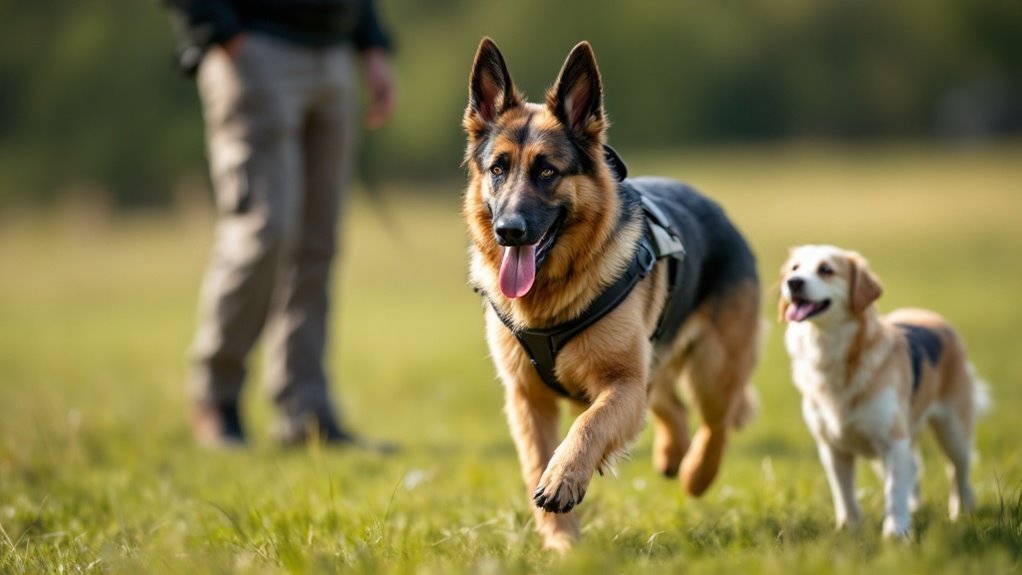
You can train your German Shepherd to protect your family by building on absolute obedience, clear leadership, and legal awareness first. Start with foundation commands—sit, stay, recall, heel—practiced daily across distracting environments, then progress to perimeter awareness and controlled alert barking with certified trainers. Protection work requires consistent reinforcement, 60–90 minutes of daily exercise split across sessions, and documented credentials to manage liability. The difference between a reliable guardian and an unpredictable risk lies in your structure and commitment to ongoing maintenance.
- Key Takeaways
- Why German Shepherds Excel at Family Protection
- Is Your Dog Ready? Temperament and Suitability Checklist
- Legal and Liability Basics Before You Begin
- When to Hire a Certified Professional Trainer
- Foundation Obedience: The Non-Negotiable First Step
- Socialization That Builds Discernment, Not Fear
- Alert Barking: Teaching Speak and Quiet Commands
- Territorial Boundaries: Training Your Dog’s Perimeter
- Schutzhund-Based Protection Training for German Shepherds
- Why Protection Dogs Don’t Obey Attack Commands
- Off-Leash Control When It Matters Most
- Building a Weekly Training Schedule Your Family Can Maintain
- Lifelong Protection: Ongoing Reinforcement and Adaptation
- Frequently Asked Questions
- Conclusion
Key Takeaways
- German Shepherds excel at family protection due to intelligence, trainability, natural instincts, and appropriate size without excessive sluggishness.
- Foundation obedience, consistent leadership, and positive reinforcement must precede any protection training to ensure reliable, predictable responses.
- Hire certified professional trainers with SchH titles or PPD experience for real-world scenario conditioning and family-compatible threat discrimination.
- Teach “Speak” and “Quiet” commands separately to create deliberate vocal control, rewarding barks only when seated and calm.
- Verify insurance coverage, consult attorneys on state-specific laws, and maintain professional training documentation to manage liability risks effectively.
Why German Shepherds Excel at Family Protection
German Shepherds bring together the specific qualities that make them reliable family protectors: intelligence that allows them to learn complex commands, trainability that lets handlers shape their protective behavior with consistency, and natural instincts that don’t require artificial encouragement.
You’ll find that a well-trained German Shepherd combines territorial awareness with the ability to distinguish between normal activity and genuine threats, enabling early detection and deterrence of intruders. Their physical presence—typically 65–95 pounds with a two-foot shoulder height—provides strong visual deterrence without the sluggishness of heavier breeds.
Unlike some protection dogs, German Shepherds bond with multiple family members and tolerate children’s unpredictable behavior, allowing them to switch seamlessly between affectionate companion and focused protector. This balance makes German Shepherd personal protection practical for active households.
Is Your Dog Ready? Temperament and Suitability Checklist
Before you enroll your dog in protection training, you’ll need to honestly assess whether your dog’s temperament and current skill level support this specialized work. An intelligent dog with natural protective instincts can excel, but only if you’ve established the right foundation.
Evaluate your dog using these criteria:
- Temperament stability—your dog shows curiosity without excessive fear or unprovoked aggression
- Physical maturity—your dog is at least 12 months old and healthy
- Reliable basic obedience—your dog responds consistently to sit, stay, come, and heel around distractions and strangers
- Socialization history—your dog distinguishes normal people from threats and doesn’t fear-bite
Avoid training dogs with extreme shyness, chronic anxiety, or unprovoked aggression, as these traits create unsafe, unmanageable outcomes.
Legal and Liability Basics Before You Begin
While protection training can provide legitimate security benefits, it also creates legal and financial exposure that you’ll need to understand and manage before you begin.
You’re civilly liable if your dog injures someone, so verify your homeowner’s or renter’s insurance covers dog-bite and liability claims. Consider an umbrella policy for additional protection.
Consult both a reputable certified professional trainer and an attorney to create a risk-management plan addressing your state’s specific laws.
Training a dog to bite can expose you to criminal penalties in some jurisdictions, so understand local regulations around dangerous-dog designations.
Maintain clear documentation of professional training credentials and certification records to demonstrate due diligence if an incident occurs.
Effective control—secure fencing, leash compliance, and supervised interactions—reduces negligence claims and protects your family legally.
When to Hire a Certified Professional Trainer
Now that you’ve addressed the legal framework and liability exposure, selecting the right trainer becomes your next practical decision—one that directly affects both your dog’s success and your family’s safety.
You’ll want to hire a certified professional when specific conditions align:
- Your dog demonstrates consistent obedience, stable temperament, and physical maturity (light work at ~6 months, intensive training after 12 months)
- You need real-world scenario conditioning for home invasion, burglary deterrence, or boundary guarding
- Your dog shows uncontrolled reactivity, chronic fear-biting, or indiscriminate aggression requiring immediate intervention
- You want family-compatible protection training that differentiates household members from genuine threats
Licensed trainers with documented SchH titles or PPD program experience provide structured progression, specialized equipment guidance, and owner leadership coaching that protects both your investment and household integrity.
Foundation Obedience: The Non-Negotiable First Step
You’ll establish your dog’s foundation obedience through consistent daily practice—short 10–15 minute sessions where you use treats, praise, and play to reinforce core commands like sit, stay, come, and heel across different environments.
Your own leadership matters as much as the training methods you choose; confident, steady body language and predictable rules teach your German Shepherd that you’re dependable and in control, which prevents the unpredictable aggression that can develop when dogs lack clear structure.
This combination of positive reinforcement and your consistent presence creates the cooperative relationship you’ll need before any protection work can be safe or reliable.
Building Owner Leadership Foundation
Before a German Shepherd can reliably respond to protection commands or safely escalate into advanced training, the dog must first master foundational obedience—and this mastery depends entirely on you establishing yourself as a consistent, calm leader.
Your shepherd won’t respect unclear signals or contradictory rules, so you’ll need to implement these practices:
- Use identical cues and timing across all family members to prevent mixed messages that weaken your leader status
- Apply positive reinforcement through treats, praise, and play to build reliable obedience and strengthen your bond
- Maintain calm, confident body language with steady eye contact and a clear voice during obedience training
- Practice consistently in distracting environments before advancing to protection work
This foundation guarantees your dog responds predictably when it matters most.
Positive Reinforcement Methods Work
Foundation obedience—the reliable performance of sit, stay, come, and heel—must be established before protection training begins, and positive reinforcement is the most effective method for building this critical foundation.
You’ll use treats, praise, and play to motivate your German Shepherd, creating a strong bond that makes obedience genuinely rewarding rather than forced.
German Shepherds retain commands longer when you deliver rewards consistently and immediately after correct behavior, reinforcing the connection between action and outcome.
Daily 10–15 minute sessions prevent mental fatigue while keeping their working drive sharp.
This consistent structure matters because trained protection dogs must respond reliably in complex situations, and that reliability stems from foundational obedience built through positive association rather than correction alone.
Socialization That Builds Discernment, Not Fear
A German Shepherd’s ability to distinguish between normal activity and genuine threats depends entirely on early, deliberate exposure to varied people, animals, sounds, and environments, because puppies who’ve encountered many safe stimuli learn to respond with calm curiosity rather than fear or indiscriminate alarm.
You’ll build this discernment through structured positive-reinforcement sessions, using treats and praise to reward calm behavior during controlled encounters.
Create a foundation by:
- Exposing your puppy to 10–15 minute sessions in diverse settings—parks, busy streets, unfamiliar yards
- Introducing people with different appearances acting as casual visitors or mock intruders
- Rewarding neutral, friendly interactions with familiar people consistently
- Pairing alert behaviors with immediate handler cues that reinforce quiet, settled responses
This approach teaches your German Shepherd to notify without escalating, building a confident protector rather than an anxious or reactive dog.
Alert Barking: Teaching Speak and Quiet Commands
You’ll teach your German Shepherd to bark on command by capitalizing on natural alerting triggers like a knock at the door or a stranger’s approach, then immediately marking and rewarding that first bark so your dog learns to vocalize deliberately rather than randomly.
Once Speak is solid, you’ll train Quiet as a separate skill by rewarding your dog for holding silence for progressively longer periods, pairing the cue with treats the instant barking stops, which gives you two distinct tools instead of one unpredictable behavior.
Combining both commands with Sit creates the structure and control you need, allowing you to reward alert barking only when your dog remains seated and quiet only when remaining calm, which prevents the nuisance barking that erodes your dog’s reliability as a protection asset.
Teaching The Speak Command
Because alert barking is one of the most natural protective behaviors a German Shepherd possesses, teaching the “Speak” command channels this instinct into a reliable, controlled response that distinguishes between appropriate alerting and excessive noise. You’ll start by creating situations that naturally trigger barking, then immediately mark and reward the behavior to establish clear associations.
Your training sequence involves:
- Prompting barks through knocking, doorbell sounds, or stranger approaches
- Marking the first clear bark with a clicker or verbal marker
- Rewarding immediately with high-value treats to strengthen the connection
- Pairing the verbal cue “Speak” with consistent hand signals
As your trained German Shepherd becomes reliable, introduce distractions and new locations, ensuring the Speak command works consistently across real-world scenarios. This foundation supports introducing “Quiet” during subsequent training sessions.
Mastering The Quiet Command
Teaching the “Quiet” command transforms your German Shepherd’s alert barking into a controlled, on-demand skill by establishing a reliable off-switch that guarantees excessive nuisance barking while preserving the dog’s protective deterrent value. Once your dog barks reliably on the “Speak” cue, you’ll introduce “Quiet” by holding a treat near their nose to encourage silence, then rewarding within one to two seconds when they stop vocalizing. Add the verbal cue immediately after the pause, creating a strong association between the word and the behavior.
| Training Stage | Duration | Method | Goal |
|---|---|---|---|
| Initial Introduction | 5–7 days | Treat luring during barking | Dog stops on cue |
| Consistency Building | 2–3 weeks | Practice across locations | Reliable response everywhere |
| Protection Program Integration | Ongoing | Real-scenario practice | Controlled alerting behavior |
This structured approach within your Protection Program guarantees your German Shepherd barks defensively when needed, then stops immediately on command, creating balanced household protection.
Controlling Excessive Barking Behavior
Most German Shepherds bark excessively because they’ve learned that vocalizing gets them attention, entertainment, or relief from boredom, rather than because they’re naturally prone to noise, so the key to controlling unwanted barking is teaching your dog to distinguish between appropriate alert barking and attention-seeking or anxiety-driven vocalizing through a two-part command structure that gives you precise control.
To protect your household while managing excessive vocalization, implement these strategies:
- Teach “Speak” by rewarding the first clear alert bark during staged intruder drills, linking barking with positive outcomes
- Pair “Quiet” immediately after, rewarding 2–3 seconds of silence and gradually extending the interval
- Require your dog to sit while barking, reinforcing controlled alerting rather than hyperactive vocalizing
- Never reward attention-seeking barks; wait for calm behavior before interaction
Consistent reinforcement and regular exercise reduce unnecessary vocalization dramatically.
Territorial Boundaries: Training Your Dog’s Perimeter
Establishing clear territorial boundaries teaches your German Shepherd exactly where your property ends and the wider world begins, which creates a foundation for reliable protection behavior that stays within legal and ethical limits. Walk your dog on-leash around the entire perimeter daily, observing where he naturally alerts or hesitates, then reinforce these markers through consistent practice. Use staged approaches by unfamiliar people at different perimeter points—front gate, back fence, driveway—rewarding alerting behavior followed by a firm Quiet command and high-value praise.
| Training Element | Duration | Frequency | Location |
|---|---|---|---|
| Perimeter walks | 15–20 minutes | Daily | Property boundary |
| “Stay” command practice | 10–30 seconds, building to minutes | 3–4 times weekly | Corners, gates |
| Staged visitor approaches | 5–10 minutes | Weekly | Multiple perimeter points |
| Recall drills | 5–10 minutes | Daily | Perimeter edge |
Practice “stay” and “place” commands at specific corners and gates for gradually increasing durations. Map your legal property limits beforehand, ensuring all territorial boundaries training occurs within authorized territory, preventing liability from territorial aggression beyond your lot.
Schutzhund-Based Protection Training for German Shepherds
Once your German Shepherd reliably respects territorial boundaries and responds to your commands at the perimeter, you can build on that foundation by introducing structured protection work through Schutzhund-based training, which takes your dog’s natural alerting behavior and channels it into disciplined, controlled responses to genuine threats.
This specialized approach progresses systematically through four key phases:
- Foundation obedience reinforcement guarantees your dog maintains focus and reliability under stress
- Scenario-based exercises introduce simulated threats like home invasions and perimeter breaches
- Controlled apprehension drills using specialized equipment teach precise bite work and instant release on command
- Real-world application testing validates your dog’s ability to distinguish actual danger from routine situations
Schutzhund-based protection training demands experienced, licensed trainers and consistent weekly reinforcement to maintain reliability and prevent inappropriate aggression responses
Why Protection Dogs Don’t Obey Attack Commands
A common misconception about trained protection dogs is that they’ll bite on command whenever an owner gives an aggressive cue, but responsible protection training deliberately avoids this outcome because indiscriminate attack commands create serious legal liability, increase the risk of inappropriate aggression toward innocent people, and undermine the controlled, context-aware responses that make a protection dog reliable rather than dangerous.
Proper training instead emphasizes controlled engagement through release and obedience under stress, teaching your dog to respond only to handler cues and recognized threats.
Trainers condition dogs to disengage on command, ensuring they won’t bite merely because you issued an aggressive directive. This structure prevents fear-based or impulsive reactions that emerge from premature aversive training, building a protection dog that distinguishes between genuine threats and everyday situations.
Off-Leash Control When It Matters Most
You can’t expect your German Shepherd to respond reliably off-leash during a real threat if you haven’t built that obedience foundation through consistent weekly training in progressively distracting environments starting around six months old.
Your dog needs to understand that your leadership—established through predictable rules, clear command authority, and emergency stop cues practiced under stress—overrides the impulse to chase, bite, or fixate on a perceived danger.
Without this structured reinforcement and proven off-leash control in controlled settings first, you’re depending on luck rather than training when your dog faces the uncontrolled variables of a genuine protection scenario.
Building Reliable Off-Leash Obedience
Shifting your German Shepherd to reliable off-leash obedience represents a critical milestone in protection training, yet it’s a step that demands genuine prerequisite mastery before you attempt it.
Your dog must demonstrate consistent performance of core commands—sit, stay, recall, and heel—across high-distraction environments while leashed, typically requiring 6–12 months of dedicated work with German Shepherds.
To build this foundation effectively:
- Progress through long-line drills, extending 20–50 feet while rewarding immediate returns with high-value treats or play.
- Train emergency recall and “recall & sit” with intense reinforcement and randomized practice to override instinctive responses.
- Practice weekly in distracting settings like busy parks and parking lots with decoy people and animals.
- Maintain consistent one-word commands and confident body language to establish predictable handler leadership.
This structured approach prevents regression and minimizes safety risks during protection work.
Real-World Protection Response Scenarios
When your German Shepherd has mastered reliable on-leash obedience across distracting environments, you’re ready to shift that control into real-world protection scenarios where the dog must respond decisively off-leash while remaining under your command.
German Shepherd protection dogs require exposure to varied, unpredictable situations that test their decision-making under pressure. You’ll progress from controlled training exercises to multi-threat drills involving masked actors, vehicle approaches, and boundary challenges. This structured exposure, rooted in Schutzhund principles, teaches your dog to assess threats, bark on cue, and disengage immediately upon command, maintaining off-leash reliability in genuine situations.
| Scenario Type | Duration | Handler Role | Success Marker |
|---|---|---|---|
| Single intruder approach | 5–10 min | Calm observation | Controlled bark/hold |
| Multiple threat simulation | 10–15 min | Verbal direction | Release on first cue |
| Environmental distractions | 15–20 min | Reinforcement timing | Refocus to handler |
| Vehicle/boundary drill | 10–15 min | Position management | Position maintenance |
Consistent weekly reinforcement prevents regression and builds genuine reliability.
Leadership and Command Authority
All the scenario work you’ve completed—the masked intruders, vehicle drills, and environmental distractions—depends on one foundation: your dog’s willingness to obey you off-leash under pressure, which means establishing yourself as a leader whose commands carry weight even when the leash is gone.
To establish clear leadership, you’ll need to:
- Enforce the same commands and consequences consistently across all situations and handlers
- Use confident body language that signals authority without aggression or hesitation
- Practice off-leash control in progressively distracting environments until your dog maintains 80–90% compliance
- Reinforce obedience with variable rewards on intermittent schedules during short sessions
Expert trainers know that handlers who set firm boundaries produce dogs capable of reliable protection responses. Without this foundation, even the most intensive scenario training fails when your dog faces genuine pressure.
Building a Weekly Training Schedule Your Family Can Maintain
A sustainable training schedule keeps your German Shepherd’s protection skills sharp while preventing burnout in both dog and handler, which is why most successful families build their routine around short, frequent sessions rather than long, infrequent ones. Your family companion needs consistency to connect commands with rewards, and protection work demands regular reinforcement so behaviors remain reliable during real-world situations.
| Session Type | Duration | Frequency |
|---|---|---|
| Obedience reinforcement | 10–15 minutes | 3–5 daily |
| Socialization walks | 20–30 minutes | Daily |
| Boundary/alert drills | 20–30 minutes | Twice weekly |
You’ll split physical exercise across multiple sessions—60–90 minutes total daily—to maintain focus and reduce reactivity. Schedule a weekly handler-refresh session where you practice leadership consistency and review safety protocols, ensuring your entire family stays aligned with training goals and legal responsibilities.
Lifelong Protection: Ongoing Reinforcement and Adaptation
Protection training doesn’t end once your German Shepherd masters the core behaviors—it requires consistent reinforcement throughout their life to keep skills reliable and prevent the drift that naturally occurs when cues aren’t practiced regularly.
You’ll maintain their readiness through deliberate, ongoing structure:
- Conduct weekly 10–15 minute sessions covering sit, stay, recall, “guard,” and bark-on-command to prevent skill decay
- Reintroduce simulated scenarios every 4–6 weeks, such as staged perimeter breaches or masked decoy approaches, to sharpen decision-making
- Monitor physical condition and limit high-intensity drills to dogs over 12–18 months, with recovery days preventing injury
- Reassess temperament annually for regression signs, consulting certified trainers if fear or hesitation emerges
Your German Shepherds need consistent owner leadership, controlled socialization, and clear boundaries daily.
This reinforcement keeps protection behaviors controlled, lawful, and appropriately integrated into family life.
Frequently Asked Questions
Can German Shepherds Be Trained to Protect Their Owners?
Yes, you can train German Shepherds to protect their owners. They’ve got natural protective instincts, and with proper socialization, obedience, and professional guidance, you’ll develop reliable protection behaviors that keep your family safe.
What Is the 7 7 7 Rule for Dogs?
Studies show that puppies exposed to varied stimuli develop 30% fewer behavioral problems. You’ll apply the 7-7-7 rule by introducing your pup to seven different people, places, and handling experiences by eight weeks old, building confidence safely.
Are German Shepherds Good Guard Dogs for Families?
Yes, German Shepherds make excellent family guard dogs. You’ll find they’re intelligent, loyal, and naturally protective. With proper socialization, obedience training, and consistent exercise, you can reliably channel their instincts safely around your family.
What Is the 3-3-3 Rule for Dog Training?
You’ll expose your puppy to varied environments early, yet reserve intensive training later. The 3-3-3 rule marks critical milestones: three weeks of social awareness, three months of bonding, and three years of full maturity.
Conclusion
You’ve now got the roadmap for building a reliable protection dog, but remember—consistency beats intensity every time. A trainer once told me that protection training’s like building a house: you can’t skip the foundation and expect the roof to hold. Your German Shepherd‘s got the instinct; you’re providing the structure, reinforcement, and ongoing adaptation that transforms instinct into dependable, controlled behavior your family can trust.