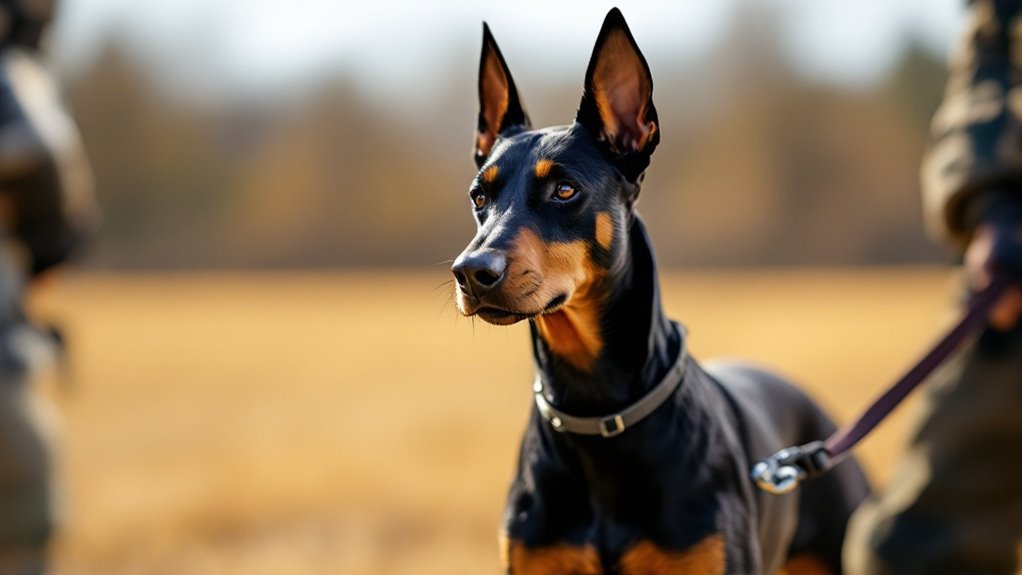
Dobermans are naturally suited to guard work—they’re intelligent, alert, and bred for protection—but instinct alone won’t make them reliable protectors. You need foundation obedience first: solid sit, stay, come, and leave-it commands that hold under distraction. Pair that with early socialization between 8 and 16 weeks to teach accurate threat assessment, then consistent leadership to build trust. Without this framework, even naturally gifted dogs become reactive liabilities. The specific steps to structure your first month matter greatly.
- Key Takeaways
- Are Dobermans Naturally Suited to Guard Dog Work?
- Why Intelligence Doesn’t Guarantee Obedience in Your Doberman
- Trust and Leadership: The Foundation Everything Else Rests on
- Foundation Obedience Commands Every Doberman Needs to Know
- Five Mistakes That Turn Alert Dogs Into Liabilities
- Teaching Bark on Command Without Creating Aggression
- Establishing Territory and Boundaries the Right Way
- Why Early Socialization Prevents Fear-Based Aggression Later
- Sport Training vs. Home Protection: Which Path Is Realistic for You?
- Legal Risks, Liability, and Responsible Ownership Decisions
- Your First 30 Days: Getting Started With Guard Dog Training
- Frequently Asked Questions
- Conclusion
Key Takeaways
- Dobermans are naturally suited for guard work due to bred-in intelligence, alertness, speed, and strong trainability for protection roles.
- Establish foundation obedience with sit, stay, come, and leave-it commands using daily 10–15 minute training sessions before guard-specific work.
- Socialize puppies between 8–16 weeks with varied people, animals, and environments to develop accurate threat assessment and prevent fear-based aggression.
- Teach bark and quiet commands by capturing natural alert barks, marking with “speak,” and rewarding silence to prevent escalation.
- Build consistent leadership through predictable routines and emotional steadiness; trust transforms obedience into reliable, dependable responses under pressure.
Are Dobermans Naturally Suited to Guard Dog Work?
Because Dobermans were originally bred specifically for guarding work, they possess the natural traits that make them consistently rank among the top guard dog breeds—intelligence, alertness, speed, and stamina all work together to give them an advantage in this role.
Their high trainability and strong problem-solving skills mean you can teach alerting and deterrent behaviors relatively straightforwardly through protection training. However, their cleverness cuts both ways; inconsistent rules often lead them to exploit gaps in your structure.
Doberman owners should recognize that genetics and early socialization during the critical window of 8–16 weeks strongly influence suitability for guard work. Well-bred, well-socialized Dobermans typically provide effective deterrence through appearance and alerting in roughly 95% of civilian situations, with true apprehension rarely needed when proper training and handler competence support their natural instincts.
Why Intelligence Doesn’t Guarantee Obedience in Your Doberman
Your Doberman’s sharp mind can work against you if you don’t pair intelligence with consistent structure, because smart dogs learn quickly that rules aren’t always enforced and that repeating a command without immediate consequences trains selective hearing rather than genuine obedience.
When you train your Doberman, your dog evaluates whether following through actually matters, especially in distracting environments with other dogs or noises present. This cognitive ability means your Doberman might comply partially, delay responding, or find loopholes in your expectations unless you set clear criteria for correct responses and apply them consistently.
Pairing obedience training with positive reinforcement and mental stimulation—scent work, problem-solving games—addresses the emotional factors like boredom that can override learned behaviors. Consistency transforms your dog’s intelligence into reliable obedience rather than calculated disobedience.
Trust and Leadership: The Foundation Everything Else Rests on
Consistency alone doesn’t build obedience—it builds the trust that makes obedience possible, and without that foundation, even a well-trained Doberman will second-guess your authority the moment circumstances change.
Your role as a consistent, calm leader means establishing predictable routines and enforcing the same rules every time, which signals to your dog that you’re reliable and in control.
When you stay emotionally steady during training sessions, you prevent your Doberman from picking up on anxiety or frustration that might trigger pushy behavior.
Short daily practice—about 10 to 15 minutes—combined with clear expectations creates the structure where trust and respect actually develop.
Your Doberman learns that following your direction consistently leads to predictable outcomes, making you the decision-maker worth listening to.
Foundation Obedience Commands Every Doberman Needs to Know
You’ll build genuine control over your Doberman by teaching sit, stay, come, and leave it through short daily sessions with high-value treats in distraction-free spaces, which establishes the reliable responses you need before introducing real-world complications.
Consistency matters more than perfection here—you release your dog with the same cue every time, increase difficulty in small increments, and practice until commands hold steady even when people, other dogs, or sudden noises compete for your dog’s attention.
This foundation of obedience, reinforced throughout your dog’s life across different environments, transforms your Doberman from a dog who may react unpredictably into one whose behavior you can direct and shape, which is exactly what prevents territorial escalation and keeps guarding instincts channeled appropriately.
Building Control Through Commands
Before a Doberman can reliably protect your property and respond to real threats, it must first master four foundation commands—sit, stay, come, and leave it—that form the backbone of control in any situation.
You’ll build these skills through daily 10–15 minute sessions using high-value treats and consistent verbal cues, establishing reliable responses that don’t waver under pressure.
The stay command requires progressive training; start with just 1–2 steps away in low-distraction environments, then gradually increase distance and environmental chaos until your Doberman holds position reliably.
Training your Doberman demands immediate, predictable consequences for ignored commands, paired with ongoing reinforcement throughout its life. This consistency prevents selective hearing and makes certain your dog responds when it matters most, transforming obedience into genuine control.
Establishing Consistency and Reinforcement
Once your Doberman understands what sit, stay, come, and leave it mean, the real work begins—making sure those commands stick, especially when distractions mount and pressure rises.
You’ll train your dog most effectively through daily 10–15 minute sessions using consistent verbal cues paired with a single hand signal per command, which prevents confusion and builds reliable responses.
Reward with high-value treats on a short leash, then gradually phase out food rewards while maintaining praise, ensuring your Doberman responds regardless of what motivates him in the moment.
This structured reinforcement creates the foundation that protection work demands, where obedience under stress isn’t optional—it’s essential for safety and control in every situation you’ll encounter.
Five Mistakes That Turn Alert Dogs Into Liabilities
You’ll find that skipping early socialization during the critical 8–16 week window leaves your Doberman prone to fear-based reactions, which can transform an alert bark into a genuine bite when the dog misinterprets a normal situation as a threat.
At the same time, enhancing protective instincts without a solid obedience foundation—reliable sit, stay, come, and leave it commands—means your dog may apply force at the wrong moment or toward the wrong target, creating serious legal and liability problems for you.
The key is building consistent obedience and broad, positive exposure to people and environments first, so your dog’s natural alertness stays calibrated and controllable rather than escalating into fear-driven aggression.
Skipping Socialization Early On
Dobermans frequently develop lifelong fear-based reactivity and poor threat assessment when they miss the critical 8–16 week socialization window, because limited exposure to different people, environments, and handling types during this period leaves their nervous systems unable to distinguish between genuine threats and ordinary situations.
When you skip this foundational training process with new people—children, bearded men, uniformed officers—your dog learns to overreact to harmless stimuli or freeze when protection matters.
Inadequate early exposure also prevents your dog to bark appropriately as deterrence, forcing you toward escalated bite training instead. This creates liability and unpredictability.
Consistent, supervised positive interactions during puppyhood establish the neural pathways that allow calm assessment and measured responses throughout your Doberman’s life.
Enhancing Protective Instincts Recklessly
Amplifying protective drive without discipline creates a dog that can’t tell the difference between a genuine threat and routine activity, turning what should be a measured alert into uncontrolled reactivity that puts you, your dog, and others at serious risk.
Over-rewarding reactive barking during territory drills trains your personal protection dog to escalate rather than assess, flooding your property with false alarms and confusion about what actually warrants response.
Without solid obedience foundation—reliable sit, stay, and recall under distraction—you’re teaching a dog to bite without the handler control necessary to stop it.
Protection sport techniques applied hastily to insecure dogs amplify instability rather than confidence.
Instead, pair any protection work with professional assessment, your active involvement, and consistent obedience reinforcement, ensuring your dog distinguishes between appropriate alertness and dangerous overreaction.
Teaching Bark on Command Without Creating Aggression
Teaching your Doberman to bark on command is often one of the most misunderstood aspects of guard dog training because people frequently confuse alert barking with aggression, when in fact they’re separate behaviors that require deliberate structure to keep distinct.
You’ll capture natural alert barks—when a visitor approaches, for example—and immediately mark the behavior with “speak,” rewarding within seconds with high-value treats.
Short 5–10 minute sessions build clear association between the cue and the bark.
Simultaneously, train a reliable “quiet” command by rewarding silence after brief barking, gradually extending the silent interval.
This dual approach prevents your guard dog from escalating into nuisance or defensive behavior, ensuring alert responses remain controlled and appropriate regardless of diet or exercise levels.
Establishing Territory and Boundaries the Right Way
Once your Doberman understands alert barking and quiet cues, you’ll shift focus to teaching him where his guarding responsibilities actually apply—because a guard dog without clear spatial limits becomes reactive everywhere, not protective where it matters.
Walk your dog along the intended perimeter twice daily on a long leash, reinforcing that physical area as his territory boundaries. Mark fixed landmarks like fencelines or gates as reference points during short 5–10 minute sessions to prevent overarousal.
Reward alerting behaviors when strangers approach during training, then have the person retreat so your dog learns the cause–effect pattern. Practice entry and exit protocols repeatedly with different visitors, establishing consistent rules that generalize across situations and prevent unpredictable aggression.
Why Early Socialization Prevents Fear-Based Aggression Later
While your Doberman’s territorial boundaries are taking shape, the foundation for calm, confident guarding—rather than fear-driven aggression—is laid much earlier, during the critical socialization window between 8 and 16 weeks of age.
For this breed, especially important, early exposure to varied people, animals, and environments teaches accurate threat assessment. Your puppy learns to alert calmly instead of reacting defensively when encountering novelty. Supervised interactions with different adults, children, neutral dogs, and common noises build coping strategies and reduce reactive fear responses.
Pairing these experiences with rewards reinforces an “off-switch” that prevents frustration from escalating into aggression. Lacking early socialization markedly increases later defensive behavior, making remediation difficult, legally risky, and unreliable. Consistent, gentle early exposure is your most effective prevention tool.
Sport Training vs. Home Protection: Which Path Is Realistic for You?
You’ll face a practical choice between sport training, which channels your Doberman’s drive through structured competition and obedience within a club environment, and home protection training, which carries significant legal liability since most jurisdictions hold owners responsible for bite incidents regardless of intent.
Sport disciplines like IGP and Mondioring offer clear rules, measurable progress, and confidence-building without positioning your dog as a weapon, whereas home protection typically relies on deterrence—barking and territorial display handle roughly 95% of real threats—and asking your dog to bite introduces legal and safety complications that most owners aren’t equipped to manage.
Your realistic threat level, household setup, and commitment to ongoing high-quality training and supervision should guide your decision: if you want to compete, seek established sport trainers; if you want home security, invest in thorough socialization, strong obedience commands, and controlled deterrent behaviors instead.
Sport Training Benefits And Outcomes
Channeling a Doberman’s natural guarding drive into sport protection disciplines like IGP/Schutzhund, Ring, or Mondioring transforms reactive impulses into controlled, measurable skills that benefit both dog and handler. You’ll see your working dogs develop genuine confidence and stability through structured bitework combined with high-level obedience, creating performers who respond reliably in competition settings.
Sport training delivers several concrete advantages:
- Physical and mental outlet: Foundational bitework plus handler-driven drills exhausts anxious or reactive dogs, reducing problematic behaviors at home
- Measurable performance: Competition frameworks show exactly where your dog stands, unlike informal protection work
- Reduced liability: Framing protection as sport rather than weaponization protects you legally while still reinforcing controlled protective responses
Success depends entirely on your commitment and instructor quality, so poor programs risk amplifying fear-based reactivity instead of improving it.
Home Protection: Risks And Liabilities
The appeal of a protection-trained Doberman is understandable, but the legal and practical reality differs sharply from sport training: a dog certified in IGP or Ring competition hasn’t been authorized for personal home defense, and that distinction matters significantly when liability enters the picture. Many jurisdictions hold you strictly liable for bites, and insurers frequently deny coverage or raise premiums after incidents involving protection sport dogs.
| Factor | Sport Training | Home Protection |
|---|---|---|
| Legal Status | Competition discipline | Increases owner liability |
| Insurance | Typically covered | Often denied or excluded |
| Handler Role | Active participation required | Long-term management needed |
A well-socialized Doberman that alerts and barks handles ~95% of intrusion scenarios effectively without escalating protective instincts or creating seizure risk through inappropriate engagement.
Legal Risks, Liability, and Responsible Ownership Decisions
Before you commit to protection training for your Doberman, it’s essential to understand that owning a bite-trained dog fundamentally changes your legal standing, and most jurisdictions hold owners strictly liable for any injury their dog causes—meaning you’re responsible for damages and legal fees regardless of whether the bite was justified or provoked.
Protection-trained dogs increase your legal liability markedly, as courts often view them as more dangerous, raising chances of seizure, mandatory muzzling, or euthanasia after an incident.
Take these steps before proceeding:
- Consult your home insurance about coverage gaps and exclusions for bite incidents
- Research local laws regarding protection dogs, as regulations vary widely by jurisdiction
- Assess whether your actual threat level justifies the legal and financial risks involved
Responsible ownership requires honest evaluation of realistic threats and acceptance that legal consequences exist regardless of your dog’s training quality.
Your First 30 Days: Getting Started With Guard Dog Training
Lay a solid foundation during your first month by establishing basic obedience and emotional control before you introduce any guard-specific behaviors, since a dog without reliable sit, stay, come, and leave-it commands will struggle to distinguish between legitimate threats and normal situations.
Start with daily 15-minute sessions using a short leash and high-value treats in distraction-free environments, building consistency and trust.
It’s important to remember that mental exercises like place commands and focused attention work better than any protection drills at this stage, teaching your Doberman to behave with an off-switch that prevents reactive biting.
Pair this foundation with gentle socialization across multiple people and environments so your dog develops accurate threat assessment skills rather than fear-based responses.
Frequently Asked Questions
What Is the 3-3-3 Rule for Dog Training?
You follow the 3-3-3 rule by targeting three critical developmental phases: gentle handling at 3 weeks, intensive socialization by 3 months, and behavioral reassessment at 3 years. You’ll optimize training outcomes at each checkpoint.
Where Should a Doberman Sleep at Night?
You should let your adult Doberman sleep inside your home in a quiet, designated spot like a crate or bed. You’ll promote bonding, reduce anxiety, and improve obedience through indoor sleeping arrangements.
Why Do Police Not Use Dobermans Anymore?
You’ll find modern agencies have “evolved their selection criteria” toward Belgian Malinois and German Shepherds because they’re more versatile for detection work, possess stronger scent drives, and offer easier access to established training pipelines.
Are Doberman Dogs Hard to Train?
You’ll find Dobermans aren’t hard to train because they’re intelligent and keen to please. However, they’ll test your consistency and require confident leadership. Short, engaging sessions work best for keeping their attention sharp.
Conclusion
Think of your Doberman’s training like building a house: you can’t skip the foundation and expect the walls to stand. You’ve laid your foundation through trust, obedience, and proper socialization, then framed the structure with consistent reinforcement. Now you’re ready to build responsibly, understanding that a well-trained protector requires ongoing maintenance and legal awareness. Your commitment determines whether you’ve created a liability or an asset.