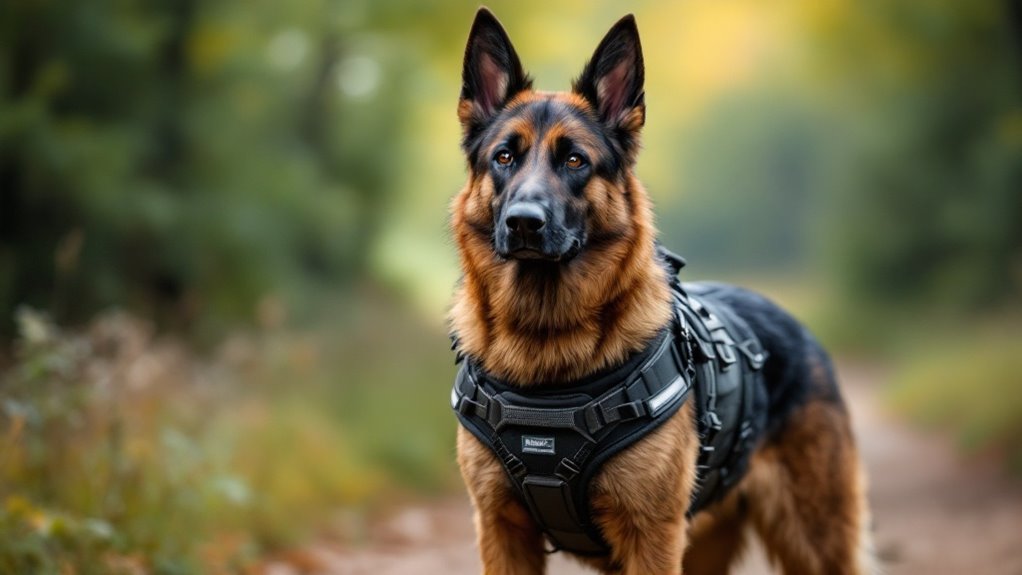
Your German Shepherd needs a harness with welded stainless-steel or forged D-rings and reinforced cross-stitching (box-X or bar-tack pattern) around anchor points, since cheap plated hardware and single straight stitches fail under sustained pulling force. Front-clip harnesses redirect momentum sideways for easier steering and reduced neck strain during training, while wide webbing (1–1.5 inches) and multiple adjustment points guarantee a snug fit without restriction. Proper sizing, consistent loose-leash training, and quality materials work together to give you reliable control.
- Key Takeaways
- Why Your German Shepherd Needs Heavy-Duty Harness Hardware
- Steel D-Rings and Proper Stitching: The Features That Actually Hold
- Front-Clip vs. Back-Clip: Which One Controls Pulling Better?
- Best Pulling Harnesses Tested and Ranked
- Sizing Your German Shepherd for a Secure, Comfortable Fit
- Tactical Branding vs. Real Durability: What Actually Matters
- Frequently Asked Questions
- Conclusion
Key Takeaways
- Front-clip harnesses redirect pulling sideways, reducing forward momentum and neck strain during walks with pulling dogs.
- Dual attachment points enable switching between front-clip no-pull training and back-clip casual walks for versatile control.
- Welded stainless-steel D-rings with reinforced box-X stitching resist deformation under sustained pulling force from large dogs.
- Wide 1–1.5 inch high-tensile webbing with padded contact areas distributes stress across the chest, preventing weak-point failures.
- Proper fit requires four adjustment points: neck, chest, and two side straps with two-finger snugness standard.
Why Your German Shepherd Needs Heavy-Duty Harness Hardware
When your German Shepherd weighs 50 to 90 pounds and possesses the muscular frame and pulling power that defines the breed, a standard harness with flimsy plastic clips and thin webbing simply won’t hold up, which is why heavy-duty hardware becomes a matter of both safety and reliability.
Heavy-duty hardware for German Shepherds isn’t optional—it’s essential for safety and reliability when managing powerful breeds.
Welded stainless-steel D-rings resist deformation during sudden lunges and sustained force, preventing catastrophic failure during reactive moments.
Heavy-duty attachment hardware like cobra clips or high-impact locking buckles outperforms cheap plastic alternatives by maintaining consistent grip under load.
Reinforced stitching paired with wide webbing distributes stress across your dog’s chest rather than concentrating it at weak points.
Multiple leash connection points offer mechanical control and flexibility, while handles with robust anchor points give you secure lift assistance without tearing, ensuring your harness performs reliably through years of demanding use.
Steel D-Rings and Proper Stitching: The Features That Actually Hold
Now that you understand why heavy-duty hardware matters, you need to know exactly what separates a harness that’ll last from one that’ll fail mid-walk.
Look for stainless steel D-rings or forged-steel options at leash attachment points, since plated or hollow cast rings bend under your dog’s pulling force. Equally critical is reinforced cross-stitching around those D-ring anchors, using box-X or bar-tack patterns rather than single straight stitches or glue alone.
Pair stainless steel D-rings with wide high-tensile webbing—at least 1 to 1.5 inches for larger GSDs—to prevent stretch that shifts load to weak stitch points. Dual attachment points let you use a no-pull harness at the front while keeping the back D-ring for restraint, distributing forces and extending durability.
Front-Clip vs. Back-Clip: Which One Controls Pulling Better?
When you attach a front-clip harness to your German Shepherd, the leash redirects her forward momentum toward you rather than allowing her to lean into the pull, which naturally discourages the behavior in a way that back-clip harnesses can’t match since they actually encourage dragging by placing the attachment point where pulling feels rewarding.
However, you’ll find that even the best front-clip design won’t eliminate pulling on its own—you need consistent loose-leash training with structured reinforcement to teach your dog that walking calmly beside you brings better rewards than surging ahead, making the harness a helpful tool rather than a complete solution.
Front-Clip Mechanics And Control
Why does a front-clip harness stop your German Shepherd from pulling more effectively than a back-clip setup? The front-clip harness redirects your dog’s shoulder and head toward you, creating lateral pressure that interrupts forward momentum, while a back-clip harness allows forward pulling along your dog’s spine.
This redirection gives you better control and steering without relying on neck strain.
When you use a front-clip harness, you’ll notice:
- Your dog’s momentum shifts sideways rather than forward
- Steering becomes easier with gentle pressure
- Your German Shepherd’s leverage decreases markedly
- The chest ring should sit low on the sternum, not under the elbows
- Wide, adjustable straps prevent shoulder restriction
A dual-clip harness offers flexibility, letting you switch between front-clip training and back-clip casual walks without changing equipment.
Back-Clip Limitations For Pullers
Back-clip harnesses place the leash attachment over your German Shepherd’s shoulders and spine, which means the leash pulls in line with your dog’s natural forward momentum, providing the least mechanical reduction in pulling force.
When you use a back-clip design with strong pullers, your dog can lean forward without interruption, making control difficult during walks.
Front-clip harnesses redirect that momentum toward your side, turning your dog toward you and creating immediate feedback that reduces pulling mechanically.
For German Shepherds weighing 50–90 pounds, back-clip setups often fail because they don’t interrupt the pulling pattern.
Consider dual-clip harnesses instead, which offer flexibility by letting you switch attachment points based on your dog’s behavior, giving you better structure and consistency during training sessions.
Training Remains The Primary Factor
Although a front-clip harness redirects your German Shepherd’s momentum and provides mechanical feedback that a back-clip design can’t match, the harness itself isn’t what stops pulling—your training does.
A front-clip no-pull harness offers immediate mechanical advantage, turning your dog toward you when they surge forward, yet this tool only works alongside consistent loose-leash training. Without reinforcement through practice, your shepherd will simply learn to pull harder, regardless of the equipment. The harness that works best combines proper fit with structured training sessions, creating the consistency your dog needs to understand leash manners.
Consider pairing front-clip training with a dual front and back attachment point harness, allowing you to shift between no-pull work and secure control:
- Daily loose-leash walks with rewards for slack leashes
- Immediate redirection when pulling begins
- Consistent praise for correct positioning
- Weekly practice sessions focusing on duration
- Gradual introduction to varied environments and distractions
Best Pulling Harnesses Tested and Ranked
Selecting the right harness for your German Shepherd’s pulling requires understanding which hardware, design features, and fit elements actually deliver control under real conditions. For strong pullers weighing 50–90 pounds, you’ll want forged-steel or stainless steel attachment points paired with reinforced stitching, as seen in the Modern Icon Tracking and Ray Allen Guardian harnesses.
Front-clip and no-pull designs like the Auroth and Eagloo models give you better steering authority during walks, while multiple leash connection points let you adjust your approach based on your dog’s behavior. However, the best hardware means little without proper fit—ensure your harness has a Y-front design, at least four adjustment points, and wide webbing to accommodate your German Shepherd’s deep chest and prevent escape.
Sizing Your German Shepherd for a Secure, Comfortable Fit
You’ll need to measure your German Shepherd‘s neck and girth (the widest part of the ribcage just behind the front legs) with a soft tape measure to determine whether you’re working with a Large or X-Large harness, since GSDs typically range from 28–42 inches in girth.
A harness with 4+ adjustment points—at the neck, chest, girth, and belly or side—lets you fine-tune the fit around your dog’s deep chest and tapered belly, preventing both chafing and escape attempts that happen when straps are too loose or positioned poorly.
During fit testing, you’ll check that you can slide two fingers comfortably between each major strap and your dog’s body, and you’ll watch for rubbing under the armpits or other hotspots, adjusting padding or strap placement as needed to keep your dog comfortable during pulling work.
Measuring Your German Shepherd
Getting the right harness fit starts with taking three key measurements, since German Shepherds’ deep chest and tapered bodies don’t always match standard sizing charts.
You’ll need to measure your dog’s girth at the widest part of the ribcage just behind the front legs, neck circumference at the collar base, and the length from neck base to where the harness ends on the ribcage. These measurements reveal your dog’s unique proportions.
- Use a soft tape measure for accuracy
- Measure girth with your dog standing still
- Note neck circumference without pulling tight
- Record body length for harness coverage
- Document all numbers for brand comparison
Once you’ve gathered these specifics, you can compare them directly to each harness brand’s sizing chart rather than relying on weight alone. This consistency guarantees your Y-front harness provides proper fit and adjustability across all contact points.
Adjustable Straps For Precision
Once you’ve identified your German Shepherd’s measurements, the next step is selecting a harness with multiple adjustment points—ideally at least four, including the neck, chest, and two side or girth straps—because these fine-tuning options let you customize the fit around your dog’s distinctive deep chest and tapered belly without compromising shoulder mobility or comfort.
| Adjustment Point | Purpose | Fit Check |
|---|---|---|
| Neck circumference | Prevents forward slipping | Two fingers under strap |
| Chest strap | Distributes pulling force | Snug but unrestricted |
| Girth straps (sides) | Prevents backing out | Firm without chafing |
| Wider webbing | Reinforces structure | Padded contact areas |
Wider webbing distributes pressure evenly across your dog’s body, reducing strain. Position D-rings centered over the spine or chest attachment point rather than allowing them to shift sideways. This consistency makes certain stable control during walks.
Fit Testing And Comfort
Before you finalize any harness purchase, take precise measurements of your German Shepherd’s neck circumference and widest girth—the measurement taken directly behind the front legs where your dog’s chest is fullest—since these two numbers’ll determine whether a harness sits correctly on your dog’s frame and won’t slip during pulls or escape attempts.
A proper fit requires:
- Two flat fingers fitting snugly between strap and dog without pinching
- 4+ adjustment points across neck, chest, and sides for consistency
- A Y-shaped front that allows full shoulder blade motion without restricting stride
- Padded breathable materials on high-contact areas to prevent chafing
- A snug belly strap that reinforces structure and prevents backing out
After fitting, walk your dog at normal pace and observe for rubbing, restricted movement, or harness shifting backward toward the spine, then adjust or try different styles accordingly.
Tactical Branding vs. Real Durability: What Actually Matters
Many harnesses marketed as “tactical” rely on visual branding—MOLLE panels, patch real estate, and military-style aesthetics—rather than the materials and construction methods that actually determine whether a harness will hold up under the strain of a pulling German Shepherd. What matters is steel D-rings, reinforced stitching, and heavy-duty webbing, not visual appeal.
Legitimate tactical harnesses pair forged or stainless-steel attachment points with multiple reinforced handles and a front clip option. Cheaper knockoffs often skimp on hardware quality, using high-impact plastic or poor-quality metal that fails under load.
When evaluating a tactical harness for your German Shepherd, verify steel components, stitch patterns, and real-world testing reports rather than relying on MOLLE presence or military styling alone.
Frequently Asked Questions
What Type of Harness Is Best for a German Shepherd?
You’ll want a no-pull harness with dual front-and-back clips, reinforced stainless-steel D-rings, and wide heavy-duty webbing. It should’ve multiple adjustment points and a Y-shaped front to prevent shoulder restriction while you’re walking or hiking.
How to Stop a German Shepherd From Pulling?
You’ll stop pulling by using a front-clip harness, rewarding loose-leash walking with treats, and practicing short training sessions. Pair this with regular exercise, mental stimulation, and consistent positive reinforcement until slack walking becomes reliable.
What Is the Top Rated No-Pull Dog Harness?
You’ve likely heard the Auroth No Pull Harness mentioned everywhere—that’s because it genuinely is the top-rated option. You’ll get front-clip control, a top handle, and exceptional comfort scoring alongside proven durability.
What Is the Anti Pull Harness for German Shepherds?
You’ll find an anti-pull harness for German Shepherds features a front chest-clip attachment that redirects your dog’s forward momentum toward their chest, discouraging pulling during walks while you maintain better control.
Conclusion
You’ve now got the knowledge to pick a harness that’ll actually hold your German Shepherd steady, but here’s what determines real success: you’ve got to match the right hardware to your dog’s strength, then commit to consistent training. Front-clip designs redirect pulling force, yet they’re only effective when you’re reinforcing calm behavior every single walk. Your choice of harness structure matters, though your follow-through determines everything.