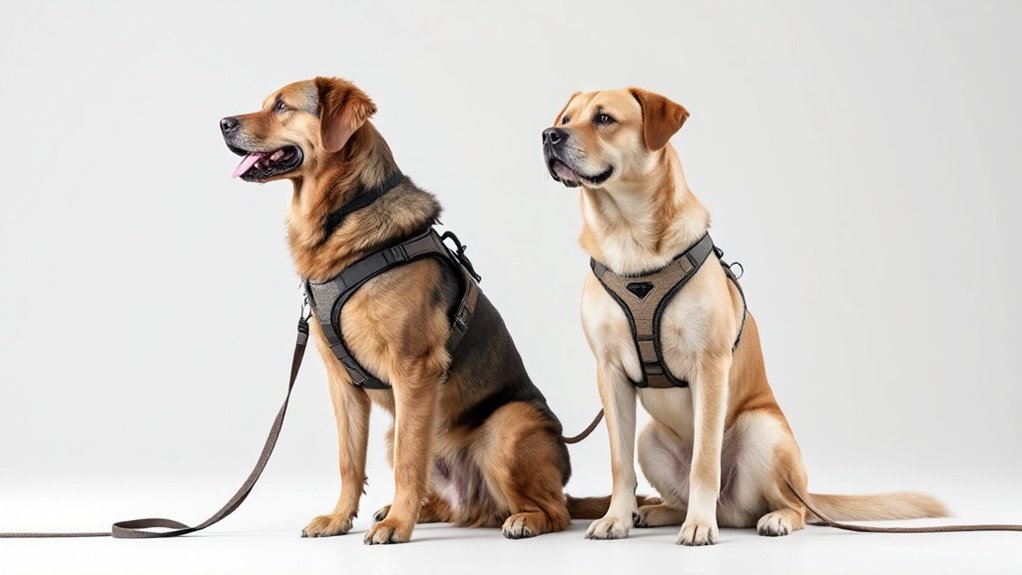
Front-clip no-pull harnesses redirect your large dog’s forward momentum to the side, offering superior training control compared to rear-clip designs, which provide stability but minimal redirection. You’ll find mid-priced tactical models like Auroth balance training effectiveness with reasonable comfort for daily walks, while premium options prioritize ergonomic padding for longer outings. Proper fit—measured at chest girth with two-finger snugness—and reinforced hardware determine real-world success. Understanding which clip placement, durability features, and adjustment system match your priorities will help you choose the harness that works best for your situation.
- Key Takeaways
- Top No-Pull Harnesses for Large Dogs Ranked
- Front-Clip vs. Rear-Clip: How Each Controls Pulling
- Getting the Right Size Before You Buy
- What Makes a Harness Last: Durability, Padding, and Hardware
- Do No-Pull Harnesses Actually Work? Real Results and Expectations
- How Our Top Picks Perform: Trails, Training, and Car Rides
- Premium vs. Budget No-Pull Harnesses: When to Spend More
- Frequently Asked Questions
- Conclusion
Key Takeaways
- Front-clip harnesses redirect forward momentum to the side, making them superior for no-pull training on large dogs.
- Auroth No Pull Harness offers mid-priced value with reinforced handles and multiple adjustment points ideal for large breeds.
- Measure chest girth behind front legs with two-finger clearance; choose larger size if measurement falls between sizes.
- Premium models like Ruffwear Front Range ($55) deliver better ergonomic padding and dog comfort scores than budget alternatives.
- Dual-clip harnesses enable training mode with front-clip and casual walks with rear-clip while maintaining consistency.
Top No-Pull Harnesses for Large Dogs Ranked
When you’re choosing a no-pull harness for a large dog, you’ll find that the best options combine comfort, control, and durability to match both your dog’s size and your specific needs.
The Auroth No Pull Harness stands out as the top choice, offering breathable padded material with a front-clip harness design and multiple adjustment points through its adjustable straps. Its top handle and MOLLE webbing provide versatility for various activities.
The Auroth No Pull Harness excels with breathable padding, front-clip design, and versatile MOLLE webbing for active dogs.
The Eagloo model delivers solid performance at a lower price point, though its padding and handle need reinforcement for larger breeds.
The Ruffwear Front Range prioritizes ergonomic comfort for active dogs, while the OneTigris X Destroyer provides durable heavy-duty construction for working situations.
Proper fit and measurement remain essential—measure your dog’s girth and allow two fingers of slack to reduce pulling while preventing escape.
Front-Clip vs. Rear-Clip: How Each Controls Pulling
Once you’ve narrowed down your harness options based on comfort and durability, the clip placement—front versus rear—becomes the deciding factor in how well your large dog responds to pulling. The leash attachment point fundamentally changes how your dog experiences the harness and whether it effectively redirects pulling behavior.
| Feature | Front-Clip | Rear-Clip |
|---|---|---|
| Leash Attachment | Chest plate | Between shoulder blades |
| Pulling Control | Redirects forward momentum to side | Minimal redirection |
| Training Effectiveness | Superior for no-pull training | Better for casual walks |
| Harness Stability | May gape under heavy loads | More stable structure |
| Best Use Case | Large dogs requiring correction | Running and relaxed outings |
Front-clip designs redirect your dog’s pulling motion sideways, making them superior for no-pull harnesses with pulling large dogs. Rear-clip harnesses offer straightforward control but lack the training leverage needed for serious pullers. Many owners choose dual-clip options, using the front attachment during training sessions and switching to rear-clip for casual activities, creating consistency and reinforcement across different walking scenarios.
Getting the Right Size Before You Buy
You’ll want to measure your dog’s girth at the widest point behind the front legs—not the neck—and then compare that measurement against each brand’s specific size chart, since sizing conventions vary widely between makers and a medium from one company may differ markedly from another.
Once you’ve identified which size range matches your dog’s chest inches, look for harnesses with multiple adjustment points on both the neck and girth, which gives you flexibility if your measurement falls between sizes or if you’re planning to layer clothing underneath.
If you’re choosing between sizes, opt for the larger one when possible, as adjustable straps let you fine-tune the fit to achieve that ideal two-finger snugness without risking chafing or restricting your dog’s movement.
Measuring Your Dog’s Chest
Getting the right harness size starts with an accurate chest measurement, since harness manufacturers base their sizing on girth rather than weight, and a dog’s build can vary widely even within the same breed.
Use a flexible cloth tape measure around the widest part of your dog’s chest, directly behind the front legs, pulling it snug but not tight. You should fit two fingers comfortably between the tape and your dog’s body, which guarantees proper movement and comfort.
Next, compare your measurement to the harness maker’s sizing chart, noting the ranges like 13–22 inches or 22–32 inches, then select the size that includes your measurement or go up one size if your dog falls on the high end. Check the return policy before ordering.
Comparing Size Charts Across Brands
Now that you’ve measured your dog’s chest, the next step is to compare how different brands interpret their size labels, because “Large” on one harness doesn’t necessarily match “Large” on another.
You’ll find that Ruffwear, PetSafe, and Auroth all offer overlapping size ranges, yet their actual chest girth measurements differ markedly.
To guarantee proper fit, match your measurement directly to each brand’s specific chart rather than relying on the size name alone.
Key considerations when comparing:
- Chest girth ranges vary widely between brands offering the same size label
- Head-over designs require larger sizes to accommodate neck opening clearance
- Buckle-on styles provide more flexibility for measurement accuracy
- Adjustment points determine how precisely you’ll customize the fit
- XL and XXL options exist for deep-chested large dogs needing maximum capacity
Adjustable Straps For Perfect Fit
Multiple adjustment points are what separate a harness that fits well from one that shifts and gaps during walks, which is why testers weighted ease of adjustment heavily when evaluating large-dog models. You’ll want a no-pull harness with at least neck and girth adjustments, ideally five-point webbing systems that let you customize the fit across your dog’s chest girth and torso.
Quality adjustable straps use webbing sliders paired with secure buckles, preventing the flopping and slippage common in budget models. After you’ve adjusted the harness to create a perfect fit, slip two fingers between the strap and your dog’s skin to verify consistency and make certain even pressure distribution.
Re-check after a short walk for chafing or strap migration, confirming the secure fit will prevent chafing and work reliably for most dogs during outings.
What Makes a Harness Last: Durability, Padding, and Hardware
Because large dogs exert significant force during walks, pulls, and assisted lifting, a harness’s ability to withstand that stress depends on three interconnected factors: the base fabric, the padding system, and the metal hardware that holds everything together.
You’ll find that durability starts with heavy-duty nylon or reinforced ripstop fabrics, which resist abrasion and punctures during prolonged field use. Padding materials like foam or neoprene improve comfort on long outings, though they can slow drying and collect fur. Hardware longevity matters most at stress points: aluminum V-rings and stainless-steel D-rings outlast plastic alternatives, while welded handle bases and reinforced stitching prevent seam failure when lifting. A padded chest combined with reinforced construction creates consistent protection.
Key durability factors:
- Heavy-duty nylon resists tears and abrasion
- Reinforced stitching prevents seam failure under load
- Aluminum V-rings provide secure leash attachment
- Welded bases strengthen lift handles
- Breathability balances protection with comfort during warm weather use
Do No-Pull Harnesses Actually Work? Real Results and Expectations
A well-built harness with quality padding and reinforced hardware gives you the foundation for control, but the real question is whether that harness actually stops your large dog from pulling during walks—and the answer depends on the design, fit, and how you use it.
Front-clip no-pull harnesses work by redirecting your dog’s forward momentum to the side, and real-world tests show they markedly reduce pulling on 40-lb and larger dogs.
However, effectiveness relies heavily on proper fit and adjustment, since loose or gaping chest pieces lose their redirecting power.
Even the best harness won’t eliminate pulling without consistent leash training, though combining a correctly fitted front-clip harness with structured training creates lasting behavior change and makes walks safer for both you and your large dog.
How Our Top Picks Perform: Trails, Training, and Car Rides
You’ll find that your choice of harness depends heavily on what you’re actually doing with your dog, since different designs excel in specific situations—a lightweight trail harness won’t give you the control handles you’d want for vehicle loading, and a training-focused front clip won’t offer the comfort your dog needs on a six-hour hike.
Each of your top options trades off certain strengths for others: the Ruffwear Front Range prioritizes comfort and weight on backcountry trails, the Auroth No Pull Harness balances training control with reasonable comfort for daily walks, and the OneTigris X Destroyer sacrifices prolonged comfort to give you multiple reinforced handles for heavy-control work.
Understanding these trade-offs helps you match the right harness to your routine, whether that’s steep terrain, obedience work, or safely restraining your large dog during car travel.
Trail Performance and Comfort
Evaluating how a harness performs on the trail requires balancing three often competing demands: keeping your dog comfortable over hours of hiking, making shifts smooth between terrain and vehicle, and maintaining reliable control on steep or technical sections.
You’ll notice that top-performing no pull harnesses prioritize breathability and padded straps to prevent chafing during multi-hour hikes, while incorporating practical features like a top handle for assistance on difficult terrain.
- Breathable mesh materials reduce heat buildup and overheating risk
- Padded straps distribute weight evenly across your dog’s chest and shoulders
- A rear clip provides steady forward guidance without neck strain
- Top handles enable quick assists on scrambles or steep descents
- Lightweight designs maintain comfort without sacrificing durability for working dogs
The Auroth and Ruffwear Front Range excel here, offering genuine trail comfort through thoughtful construction that supports sustained performance.
Training Control and Handling
While trail comfort keeps your dog physically well during long hikes, training control and handling determines whether you can reliably manage your dog’s behavior during training sessions, vehicle transfers, and multi-use outings. The Auroth harness excels here with its no-pull front clip, top handle, and dual-clip versatility, offering consistent reinforcement during training while supporting vehicle transfers.
The OneTigris X Destroyer prioritizes handling with three reinforced handles and side buckles for tight control during fieldwork, though its reduced dog comfort makes it less suitable for extended wear. The Eagloo’s weak handle and poor ease of donning limit its utility for frequent car loading.
For reliable training control and handling across multiple scenarios, prioritize harnesses combining sturdy top handles, dual-clip designs, and practical clip-in points that enable quick shifts between training modes and casual restraint.
Vehicle Transport Practicality
Because getting your dog safely in and out of a vehicle happens multiple times a week for most owners, the harness you choose should balance quick donning with secure lifting and restraint during rides. The OneTigris X Destroyer leads here with three reinforced handles and front/side buckles that avoid donning over the head, though its nylon bulk creates warmth concerns on longer trips.
The Ruffwear Front Range requires head-passage donning and lacks a handle, limiting lift assistance during car transfers. For vehicle-secure travel, prioritize harnesses with seat‑belt tether compatibility and sturdy back clip attachment points that anchor securely during drives, providing crash-connection reinforcement and easier restraint management throughout your journey.
Key Vehicle Transport Features:
- Reinforced handles for steady lifting
- Top handle accessibility without donning over the head
- Seat‑belt tether compatibility for crash protection
- Back clip design for secure vehicle anchoring
- Quick-release buckles for efficient car entries and exits
Premium vs. Budget No-Pull Harnesses: When to Spend More
The price difference between premium and budget no-pull harnesses reflects real trade-offs in materials, comfort, and durability that matter most when your dog’s size, activity level, and how often you use the harness come into play. Premium harnesses like the Ruffwear Front Range ($55) deliver superior comfort and fit through ergonomic padding and refined adjustment points, scoring 8.0 in dog comfort—especially valuable for long rides and backcountry use.
Budget no-pull options like Eagloo ($22) provide solid no-pull functionality with front clips and reflective trim, yet compromise on ease of donning and padding. For large dogs, mid-priced tactical models like Auroth ($30) often offer better overall value, combining robust features with high comfort scores. Spend more when your dog needs specialized features, reinforced handles, or consistent training and control during heavy use.
Frequently Asked Questions
What Is the Best No-Pull Dog Harness for Large Dogs?
The Auroth No Pull Harness is your best overall choice. You’ll get high comfort, a front no-pull clip, a top handle, and MOLLE webbing for versatility—all at an affordable $30 price point.
Which Is the Best Harness to Stop a Dog From Pulling?
You’d think stopping pulling requires complicated gear, yet you’ll find the Auroth No Pull Harness does it best. Its front-clip design redirects your dog’s momentum while its contoured fit guarantees comfort during training sessions.
What Is the Best Harness for a Large Dog?
You’ll find the Auroth No Pull Harness best for large dogs overall. It’s comfortable, versatile, and costs just $30. You’ll also appreciate its front no-pull clip, top handle, and MOLLE webbing for customization.
Why Do Dog Trainers Not Recommend Harnesses?
You’re barking up the wrong tree if you think harnesses solve everything. Trainers worry they mask pulling behavior, enable escape when ill-fitting, and discourage your dog from learning polite leash manners through proper training.
Conclusion
You’ll find that the harness you choose depends on your dog’s size, pulling strength, and your training consistency. Front-clip designs redirect pulling naturally, while rear-clip options suit calm walkers. Investing in quality padding and hardware pays off through durability, though budget options work if you reinforce training regularly. The right fit matters most—measure twice, then test your selection on short walks before committing to longer routes.