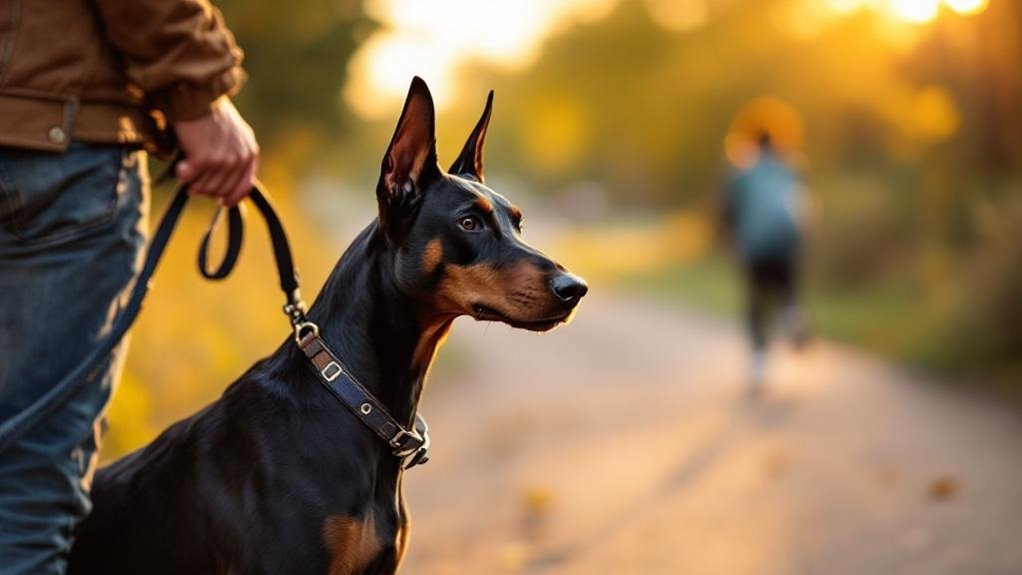
Doberman leash reactivity stems from fear or frustration, not dominance, so you’ll resolve it by addressing the underlying emotion rather than applying tighter control. Identify your dog’s specific trigger—whether it’s cowering avoidance or energetic lunging—then use counter-conditioning with high-value treats paired with distance management and foundational obedience. Short, structured training sessions in quiet environments build confidence while emergency techniques like U-turns and verbal redirects manage immediate situations. Understanding why your Doberman reacts reveals the precise approach that works best.
- Key Takeaways
- What Is Leash Reactivity in Dobermans?
- Fear or Frustration? Diagnosing Your Doberman’s Root Cause
- How to Tell If Your Dog’s Reactivity Is Fear-Based or Frustration?
- The Traumatic Incident Effect: How Past Bad Experiences Create Reactive Dogs
- Why Leash Restraint Intensifies Reactivity
- Identifying Your Doberman’s Personal Triggers
- Emergency De-Escalation When Your Doberman Reacts
- Why Punishment Makes Reactivity Worse
- Does Your Doberman Have Baseline Obedience Skills?
- Dealing With Neighbor Criticism Without Losing Your Mind
- Setting Up Training Sessions Your Doberman Won’t Sabotage
- Counter-Conditioning: Breaking Your Doberman’s Reactive Cycle
- The “Look at That” Game for Leash Reactivity
- Using High-Value Treats to Reward Calm Behavior
- Desensitizing Reactive Dogs: Closing the Distance Gradually
- How to Know If Desensitization Is Working
- Off-Leash Play: Why Confidence Transfers to Leash Walking
- When to Hire a Trainer (And How to Find the Right One)
- Prong Collars for Dobermans: What Works and What Doesn’t
- Brain Games That Rebuild Confidence for Reactive Dobermans
- Why Reactive Dogs Relapse (And How to Prevent It)
- Keeping Your Doberman Calm After Reactivity Resolves
- Frequently Asked Questions
- Conclusion
Key Takeaways
- Establish baseline obedience with commands like “leave it” and “heel” in quiet environments using a non-retractable leash and harness.
- Identify root causes—fear-driven or frustration-driven reactivity—through body language observation to tailor appropriate counter-conditioning strategies.
- Use emergency de-escalation techniques: verbal redirects, U-turn exercises, distance management, and calm spot commands to interrupt reactive episodes.
- Pair triggers with high-value treats at safe distances, gradually decreasing distance as your Doberman displays calm behavior and confidence.
- Incorporate brain games, the “Look at That” game, and controlled socialization to rebuild positive associations and prevent behavioral relapse.
What Is Leash Reactivity in Dobermans?
When your Doberman barks, lunges, or growls at other dogs, people, or moving objects while on a leash, you’re witnessing leash reactivity—a behavioral response that combines fear, frustration, and protective instinct into exaggerated reactions that wouldn’t typically occur if your dog were off-leash.
This behavior often emerges because the leash itself creates vulnerability, making your Doberman feel trapped and unable to escape perceived threats.
The leash creates vulnerability, making your Doberman feel trapped and unable to escape perceived threats.
Dobermans’ strong protective instincts can intensify this response, causing them to react defensively when they sense danger.
Understanding leash reactivity requires recognizing that your dog’s emotional state drives these outbursts.
Addressing this issue demands consistent training using positive reinforcement and counter-conditioning techniques, which gradually shift your dog’s emotional response to triggers from defensive to calm.
Fear or Frustration? Diagnosing Your Doberman’s Root Cause
Why your Doberman reacts on leash depends largely on whether fear or frustration drives the behavior, and identifying which one you’re dealing with will shape your entire training approach.
Fear-driven reactivity shows itself through cowering, tucked tails, or raised hackles when your dog encounters triggers, whereas frustration appears as whining, pawing, or lunging toward something your dog wants to reach.
You’ll notice fear-based reactions intensify in stressful environments like busy streets, where your Doberman attempts to escape perceived threats.
Frustration-driven behavior, by contrast, emerges when leash restraint prevents your dog from engaging with other dogs or stimuli they’re keen to approach.
Carefully observe your dog’s body language during reactive episodes, noting whether stress or enthusiasm dominates, since this distinction determines whether you’ll focus on building confidence or managing impulse control through counter-conditioning techniques.
How to Tell If Your Dog’s Reactivity Is Fear-Based or Frustration?
Distinguishing between fear and frustration requires you to observe your Doberman’s body language and behavior pattern during reactive moments, since the two responses look remarkably different even though both involve barking or lunging.
A fear-based reactive dog will crouch low, tuck its tail, and attempt to create distance from the trigger, often showing avoidance behaviors like turning away or hiding.
Conversely, a frustrated dog displays energetic persistence, spinning or lunging forward with intensity, unable to redirect focus due to leash restraint.
Context matters greatly: if your Doberman approaches calmly when off-leash but reacts intensely on-leash, frustration likely drives the reactive behavior.
Your dog’s history also provides clues—prior negative encounters increase fear-based responses, while repeated restraint situations fuel frustration.
The Traumatic Incident Effect: How Past Bad Experiences Create Reactive Dogs
Past negative experiences often shape how your Doberman perceives and responds to triggers for years afterward, since a single traumatic incident can rewire your dog’s emotional associations and create lasting fear patterns.
When your dog encounters a situation resembling the original trauma, their nervous system activates a protective response, manifesting as reactivity on the leash.
Kenji’s severe dog reactivity following his negative encounter at six months demonstrates how early incidents establish deep-rooted defensive behaviors.
Your Doberman’s brain now interprets similar situations as threats, prompting distance-increasing strategies like barking or lunging to regain control and safety.
Addressing this reactivity requires recognizing the fear beneath the behavior, then implementing consistent counter-conditioning and positive reinforcement to gradually rebuild your dog’s emotional associations with previously threatening triggers.
Why Leash Restraint Intensifies Reactivity
Understanding your Doberman’s trauma helps explain their fearful responses, but it doesn’t fully account for the intensity you’re seeing on walks—that escalation often stems from the leash itself.
Leash restraint fundamentally changes how your dog perceives threats, limiting their ability to escape and preventing them from using natural body language signals to communicate with other dogs. When your Doberman feels physically confined, they interpret approaching dogs as greater threats, triggering defensive barking or lunging.
This pent-up frustration builds because your dog can’t access their usual coping mechanisms. Understanding that the leash amplifies anxiety rather than prevents it shifts your approach, helping you recognize that reactive dogs need structured desensitization, not tighter control, to develop genuine confidence in social situations.
Identifying Your Doberman’s Personal Triggers
What sets off your Doberman’s reactivity on walks, and why does it matter? Identifying your dog’s specific triggers—whether other dogs, bicycles, loud noises, or unfamiliar people—forms the foundation for effective training.
Your Doberman’s reactions likely vary between on-leash and off-leash situations, so observe both contexts carefully to understand what truly provokes the behavior.
Pay close attention to body language cues: tension in the shoulders, pacing, or intense focus signal mounting reactivity before barking or lunging occurs.
Document these encounters in a diary, noting the distance to the trigger, the stimulus type, and your dog’s exact response. This record reveals patterns that guide your training approach, allowing you to gradually introduce triggers in controlled settings and build positive associations through desensitization work.
Emergency De-Escalation When Your Doberman Reacts
Once you’ve identified your Doberman’s specific triggers through careful observation, you’ll need practical tools to manage his reactions in real-time during walks, because knowing what sets him off doesn’t automatically stop him from reacting when he encounters it. When your reactive dog begins escalating, immediate intervention prevents the behavior from intensifying, and you’ve got several proven techniques available.
| Technique | Action | Purpose |
|---|---|---|
| Verbal Redirect | Say “leave it” or “let’s go” | Shifts focus from trigger to you |
| U-Turn Exercise | Turn and walk opposite direction | Disengages from stimulus calmly |
| Distance Management | Maintain safe buffer zone | Prevents reactive escalation |
| Calm Spot Command | Direct focus toward you | Enables immediate de-escalation |
High-value treats reinforced during calm moments build positive associations, gradually decreasing reactivity through consistent structure and repetition.
Why Punishment Makes Reactivity Worse
When you correct your Doberman’s reactive behavior with punishment—whether that’s a sharp leash correction, a loud verbal rebuke, or physical intimidation—you’re addressing only what you see on the surface, not what’s actually driving the reaction underneath.
Punishment creates three significant problems:
- It escalates fear and anxiety, making your dog more likely to react defensively in future encounters rather than less.
- It damages trust, undermining the bond necessary for your dog to look to you for guidance during stressful moments.
- It leaves the root cause untouched, whether that’s fear, frustration, or insecurity, so the reactivity persists or worsens over time.
Positive reinforcement, by contrast, rewards calm behavior near triggers, building new neural pathways and genuine confidence that actually resolves reactivity at its source.
Does Your Doberman Have Baseline Obedience Skills?
Before you can effectively address your Doberman’s leash reactivity, you’ll need to establish whether your dog has mastered foundation commands like “sit,” “stay,” “come,” and “heel,” since these skills give you the control and communication tools necessary to manage reactive situations.
Evaluating your dog’s current obedience level means testing how reliably your Doberman responds to these commands in low-distraction environments first, then gradually in more challenging settings, so you can identify which skills need reinforcement before moving forward with reactivity work.
Building a solid obedience foundation through consistent positive reinforcement with treats and praise actually strengthens your dog’s confidence and focus on you, which becomes the structure that makes all future reactivity training considerably more effective.
Foundation Commands For Control
A Doberman’s leash reactivity often stems from a lack of reliable foundation commands that’d give you practical control when your dog encounters triggers. Building these baseline skills is where you’ll start managing the behavior effectively.
Foundation commands create the structure your dog needs to respond to you instead of reacting to distractions:
- Sit and down establish immediate control during reactive moments, interrupting the impulse to lunge or bark.
- Reliable recall enables you to redirect your dog away from triggers before reactivity escalates.
- Leave it prevents engagement with objects or other dogs that provoke unwanted responses.
Consistent reinforcement through positive training methods builds your dog’s confidence and strengthens your leadership role.
When your Doberman masters these baseline skills, you’ll have the tools necessary to manage leash reactivity during walks and outdoor situations.
Building Obedience Before Reactivity Work
Your Doberman’s ability to respond reliably to basic commands—sit, stay, heel, and recall—creates the mental structure you’ll need before tackling leash reactivity. Without this foundation, your dog won’t have the communication skills to choose compliance over reacting to triggers.
Strong obedience gives you a reliable way to redirect your dog’s focus when distractions appear, turning potential reactions into manageable moments where your dog listens instead of lunges.
You’ll build this obedience in low-distraction environments first, where your Doberman can concentrate fully on your requests without competing stimuli. Once your dog masters commands consistently at home and in quiet settings, you’ve established the baseline needed to introduce reactive situations gradually.
This staged approach prevents overwhelming your dog and guarantees obedience remains solid when real-world challenges emerge.
Assessing Your Dog’s Current Skills
Now that you’ve built obedience in calm settings, the next step involves honestly gauging where your Doberman actually stands with those foundational skills, because the gap between what you think your dog knows and what he’ll reliably execute under stress often determines whether your reactivity work succeeds or stalls.
When assessing your dog’s current skills, test your Doberman’s responses in progressively challenging environments:
- Practice “sit,” “stay,” and “down” commands with minimal distractions to establish baseline consistency.
- Evaluate loose leash walking during quiet neighborhood walks before introducing triggers.
- Monitor how quickly your reactive dog refocuses when you ask for simple commands near other dogs.
This honest evaluation reveals which obedience foundations need reinforcement before addressing leash reactivity directly, ensuring your training builds on solid ground rather than assumptions.
Dealing With Neighbor Criticism Without Losing Your Mind
When neighbors criticize your Doberman’s leash reactivity, the discomfort you feel often stems from a mix of genuine concern for their safety and worry that you’re being judged as an irresponsible owner, even though you’re actively working to improve the behavior.
Open communication reduces tension, so explain Kenji’s reactivity issues and your training strategy to concerned dog owners nearby. An “In Training” vest signals active effort, fostering understanding rather than judgment.
Connect with empathetic dog owners who share similar experiences, creating a supportive community that alleviates isolation. Consistent practice with obedience exercises and brain games demonstrates tangible progress, helping neighbors recognize your dedication.
Patience and consistency minimize incidents over time, gradually shifting perceptions as observers witness genuine behavioral improvements in your Doberman.
Setting Up Training Sessions Your Doberman Won’t Sabotage
How you set up your training environment determines whether your Doberman’s leash reactivity improves or worsens, because even the most well-intentioned dog will struggle to focus when distractions overwhelm their attention.
- Select quiet locations like fenced parks or secluded areas where minimal external stimuli compete for your dog’s focus.
- Use a 4 to 6-foot non-retractable leash paired with a properly-fitted harness for consistent control and safety.
- Schedule short, structured training sessions that prevent fatigue while maintaining your Doberman’s engagement and enthusiasm.
This foundation matters because your dog can’t learn calm behavior amid chaos.
When you remove competing distractions, your Doberman’s brain has capacity to process your cues and build positive associations with previously triggering situations, establishing the consistency necessary for meaningful progress.
Counter-Conditioning: Breaking Your Doberman’s Reactive Cycle
Counter-conditioning works by pairing your Doberman’s trigger—whether it’s another dog, a person, or a vehicle—with positive experiences like high-value treats, so your dog learns to expect something good instead of reacting with aggression or fear.
You’ll start this process at a distance where your Doberman can notice the trigger but remains calm, rewarding that composed behavior immediately, then gradually move closer as your dog demonstrates relaxed body language and consistent responses.
This gradual exposure combined with reinforcement builds new neural pathways, effectively replacing your dog’s reactive cycle with a calm, positive association that strengthens through repeated, focused training sessions.
Building Positive Associations
As your Doberman’s brain forms negative associations between triggers and danger, you can deliberately reshape those connections by pairing the sight of triggers with rewards that matter to your dog, a process called counter-conditioning.
Building positive associations requires strategic timing and patience, transforming fear into anticipation.
- Start at a distance where your dog notices the trigger but stays calm, immediately rewarding them with high-value treats.
- Use the “Look at That” game to encourage focus on triggers while maintaining relaxation, reinforcing calm behavior continuously.
- Gradually decrease distance as confidence grows, maintaining consistency through short, frequent sessions that prevent overwhelm.
This structure prevents regression, allowing your dog’s emotional response to shift from threat detection to treat anticipation, fundamentally changing how they perceive their environment.
Desensitization Through Distance Management
Now that you’ve started reshaping Kenji’s emotional response through positive associations, you’re ready to apply that same principle in a structured way that controls one critical variable: distance.
Your dog might remain calm when other dogs are visible from far away, yet react intensely when they’re close. This distance threshold is your starting point. Position Kenji where he can see another dog but feels safe, then reward his calm behavior immediately with high-value treats.
As he consistently relaxes at this distance, gradually move closer to the trigger. This progressive reduction builds confidence while reinforcing desired behaviors in controlled environments.
Consistent practice transforms his fear or frustration into focus on you instead, breaking the reactive cycle through structured, manageable exposure.
The “Look at That” Game for Leash Reactivity
One of the most effective techniques for managing leash reactivity in Dobermans is the “Look at That” game, a training method that teaches your dog to notice triggers—such as other dogs, cyclists, or pedestrians—without reacting to them.
Here’s how you’ll implement this strategy:
- Position yourself at a distance where your Doberman can see the trigger but remains calm, then reward them immediately when they look back at you instead of lunging.
- Gradually decrease the distance as your dog’s comfort increases, maintaining consistency so they understand the expected behavior.
- Use high-value treats to reinforce calm acknowledgment of the stimulus, creating positive associations over time.
This practice builds your dog’s confidence and emotional response to previously triggering situations, transforming reactivity into relaxed awareness through structured reinforcement.
Using High-Value Treats to Reward Calm Behavior
You’ll want to identify which treats motivate Kenji most effectively, since high-value rewards like small pieces of deli meat or cheese create stronger positive associations than regular kibble, making them essential for reinforcing calm responses when he notices triggers.
Once you’ve established his preferred motivators, you’ll implement distance training by starting at a far enough range from distractions so Kenji can remain calm, then gradually decrease that distance over multiple sessions while rewarding his composed behavior consistently.
This structured approach builds his confidence and teaches him that noticing triggers while staying relaxed results in immediate rewards, which strengthens the desired calm response pattern.
Identifying High-Value Motivators
What makes a treat truly rewarding for your Doberman isn’t just about the flavor—it’s about finding what captures his complete attention and creates a stronger pull than the leash trigger he’s reacting to. This is why high-value treats are so vital when working on calm behavior during walks.
Start by experimenting with different options to discover what motivates your dog most:
- Protein-based treats like small cooked chicken pieces or cheese that provide strong sensory appeal.
- Specially formulated dog treats designed specifically for training that concentrate flavor intensity.
- Novel foods your Doberman rarely encounters, which maintain novelty and sustained interest.
Once you’ve identified his preferred high-value motivators, keep them easily accessible in a treat pouch during training sessions. This accessibility guarantees you can deliver immediate reinforcement when your dog exhibits calm behavior, strengthening the association between triggers and positive outcomes through consistent practice.
Distance Training Protocol
The foundation of successful leash reactivity work rests on teaching your Doberman to remain calm while observing triggers from a distance where he can still process them without escalating into reactive behavior, which is why starting far enough away is essential to the entire training structure. Your distance training protocol begins with identifying that safe starting point, then systematically moving closer as your dog demonstrates consistent calm responses.
| Training Stage | Distance | Reward Timing |
|---|---|---|
| Initial observation | 50+ feet away | Immediate treat delivery |
| Intermediate progress | 25-30 feet away | Within 2 seconds of calm behavior |
| Advanced work | 10-15 feet away | Consistent reinforcement |
High-value treats like cheese or hot dog pieces create powerful positive associations with triggers themselves, shifting your Doberman’s emotional response from reactive to curious, building the consistency your training requires.
Desensitizing Reactive Dogs: Closing the Distance Gradually
Once your Doberman can remain calm during training sessions at a distance where they’re not reacting, you’re ready to begin closing the gap systematically, which means moving gradually closer to triggers while maintaining that calm state.
Desensitizing your dog requires deliberate progression:
Desensitizing your Doberman demands careful, incremental progression—moving closer to triggers only when calm behavior is firmly established.
- Move only a few feet closer when your dog displays relaxed body language and confident behavior, never rushing this process.
- Reward calm acknowledgment of triggers with high-value treats immediately upon sighting, reinforcing the connection between other dogs and positive outcomes.
- Use the “Look at That” game to encourage recognition without reactivity, building focus and calmness simultaneously.
Keep sessions brief to prevent overwhelming your Doberman, allowing them to process each distance increment before advancing further.
This structured approach guarantees your dog adapts comfortably, building genuine confidence rather than mere compliance.
How to Know If Desensitization Is Working
After you’ve spent weeks moving closer to your Doberman’s triggers while maintaining calm responses, you’ll naturally wonder whether the work’s actually paying off, and recognizing the signs of progress becomes your next skill.
Monitor the dog’s body language carefully for relaxation signals: a loose posture, soft eyes, and gentle tail wagging indicate desensitization is taking effect. Your Doberman’s reactivity toward previously triggering stimuli—like other dogs or people—should noticeably decrease as distance closes.
You’ll also notice your dog can focus on you and accept treats even when facing triggers, rather than becoming anxious or distracted.
Keep a training journal documenting each session, noting triggers and responses, which reveals improvement patterns over time and reinforces that consistent desensitization work produces measurable results.
Off-Leash Play: Why Confidence Transfers to Leash Walking
While desensitization work on-leash builds your Doberman’s tolerance for triggers, off-leash play creates the confidence foundation that makes all your leash training stick.
When your dog engages in unrestricted interaction with other dogs in safe environments, you’re establishing neural pathways that reduce anxiety and reactivity.
Here’s what happens:
- Your dog learns self-control through natural play, translating that calmness directly to leash walks.
- Positive associations with other dogs during off-leash sessions decrease defensive barking and lunging responses.
- Increased confidence improves your dog’s focus on you, enhancing command responsiveness during walks.
This isn’t coincidental. Off-leash play desensitizes your Doberman to novel stimuli while reinforcing calm behavior patterns, which your dog then generalizes to leashed encounters.
The key is consistency, allowing your dog repeated opportunities to practice confidence in controlled settings before expecting controlled behavior on-leash.
When to Hire a Trainer (And How to Find the Right One)
When your Doberman’s leash reactivity doesn’t improve despite weeks of consistent training at home, it’s time to contemplate bringing in professional help. A certified trainer can provide the structure and expertise you need to support your dog’s progress, especially when behavior persists despite your efforts.
Professional trainers provide the structure and expertise needed when leash reactivity persists despite consistent home training efforts.
Seek trainers certified by recognized organizations like APDT or IAABC, as these credentials signal solid grounding in positive reinforcement techniques.
Choose someone specializing in reactive behavior with breed-specific experience, since Dobermans have unique traits that informed trainers understand well.
Before committing, observe a training session and ask about methodology to confirm they use humane, force-free approaches prioritizing your dog’s emotional well-being.
Reading reviews and getting referrals from other dog owners helps you identify trainers with proven effectiveness.
Prong Collars for Dobermans: What Works and What Doesn’t
Many dog owners turn to prong collars hoping they’ll solve leash reactivity quickly, believing the pinching sensation will discourage pulling and reactive outbursts during walks. While some report temporary improvements, this approach often misses what’s actually driving your Doberman’s behavior.
Consider these key limitations:
- Prong collars address symptoms, not underlying fear or frustration fueling reactivity.
- Incorrect use increases anxiety, potentially worsening your dog’s personality and long-term responses.
- Without thorough training, behavioral changes won’t stick or transfer to new situations.
Instead, combine any collar use with positive reinforcement and counter-conditioning techniques that target your dog’s specific triggers.
Work with a qualified trainer to build consistency and structure around what frightens or frustrates your Doberman, creating lasting behavioral improvement through understanding rather than punishment.
Brain Games That Rebuild Confidence for Reactive Dobermans
You can rebuild your reactive Doberman’s confidence by introducing brain games that challenge their mind and redirect focus away from environmental triggers. This works because mental engagement activates reward pathways that compete with anxiety responses.
Puzzle toys, scent work activities, and obedience exercises like “find it” or “sit-stay” provide the controlled challenges your dog needs to develop problem-solving skills while building trust in your presence. These activities work best when you increase their difficulty progressively over time.
Building Mental Resilience Through Play
Because reactive Dobermans often struggle with anxiety and defensive responses to external triggers, redirecting their mental energy toward rewarding problem-solving tasks can fundamentally shift how they process stressful situations. Your dog’s personality becomes more adaptable when you build resilience through structured play that challenges their mind.
- Puzzle toys and scent work encourage problem-solving skills, directly reducing anxiety about triggers.
- Interactive games like hide-and-seek foster trust between you and your Doberman, creating safety.
- Gradually increasing game complexity solidifies coping mechanisms as confidence grows.
Consistency matters considerably here. When you practice brain games regularly, you’re not just entertaining your dog; you’re reinforcing positive behaviors and rewiring their response patterns.
This mental engagement redirects focus from reactive stimuli to rewarding tasks, promoting calm behavior during training sessions and everyday situations.
Puzzle Toys And Problem-Solving Skills
Puzzle toys and interactive games work by redirecting your Doberman’s mental energy away from external triggers and toward controllable, rewarding challenges, which fundamentally shifts how their brain processes stressful situations.
You’ll notice that when your dog engages with treat-dispensing balls or interactive feeders, their focus narrows to solving the puzzle rather than reacting to passing stimuli. This mental engagement builds confidence in your dog’s personality through repeated success experiences, encouraging independent problem-solving during stressful moments like walks.
Confidence Development Via Controlled Challenges
While puzzle toys redirect reactive energy effectively, controlled challenges that rebuild confidence work by creating a structured progression where your Doberman experiences manageable difficulty followed by success. This gradually shifts their emotional response to stressful situations.
You’re fundamentally teaching your dog that challenging moments don’t require reactivity.
- Start with low-stress environments where you practice obedience commands like “sit” and “stay,” reinforcing calm behavior through positive rewards.
- Introduce controlled social exposure by meeting calm, non-reactive dogs in quiet settings, allowing your Doberman to experience positive interactions.
- Progress to busier environments where you maintain command practice, building your dog’s confidence through structure and consistency.
This gradual approach prevents overwhelming your Doberman while establishing new patterns of calm response.
Why Reactive Dogs Relapse (And How to Prevent It)
Progress in leash reactivity training isn’t always linear, and setbacks happen more often than you’d expect, even after your Doberman seems to be improving.
Relapse occurs when you skip positive reinforcement sessions or fail to reward calm behavior consistently, which creates confusion about what you actually want from your dog.
Environmental stress, crowded spaces, or sudden exposure to triggers without gradual desensitization can overwhelm your reactive dog and undo months of progress.
To prevent relapse, maintain structured training schedules, expose your Doberman to triggers incrementally in controlled settings, and reward desired responses every single time during early phases.
Consistency matters more than intensity, so prioritize steady, predictable practice over sporadic intense sessions that leave gaps in reinforcement.
Keeping Your Doberman Calm After Reactivity Resolves
Once you’ve successfully resolved your Doberman’s leash reactivity, the real work shifts from breaking the reactive cycle to maintaining the calm behavior you’ve built. This is important because without ongoing reinforcement, your dog can gradually slide back into old patterns.
To keep your Doberman calm and maintain that relaxed body language you’ve worked hard to achieve:
Maintaining your Doberman’s calm requires consistent reinforcement and relaxed body language through ongoing practice and patience.
- Practice consistent positive reinforcement during walks, using high-value treats and praise to strengthen calm responses to previous triggers.
- Engage in regular controlled socialization with non-reactive dogs, reinforcing comfort around other animals in structured settings.
- Continue relaxation exercises like “go to your mat” in different environments, building your dog’s ability to settle when triggered situations arise.
Gradually increasing exposure to triggers while reinforcing calm behavior solidifies learned responses and prevents reactivity from re-emerging as your Doberman encounters new situations.
Frequently Asked Questions
How Long Does It Typically Take to See Improvement in Leash Reactivity With Consistent Training?
You’ll typically notice improvement within 2-4 weeks of consistent training. You’ll see more significant progress over 8-12 weeks as you’re building new neural pathways. You’re establishing lasting behavioral change through repetition and positive reinforcement.
Can Leash Reactivity in Dobermans Be Completely Cured, or Is It a Lifelong Management Issue?
You’ve got to manage it like Sisyphus rolling his boulder—you can’t truly cure it, but you’ll dramatically reduce reactivity through consistent training, proper management, and environmental control strategies tailored to your dog’s triggers.
What Type of Leash and Collar Equipment Works Best for Reactive Dobermans During Training?
You’ll find that a 6-foot fixed leash paired with a front-clip harness works best for reactive Dobermans. Front-clip design redirects lunging, giving you better control. Avoid retractable leashes; they’ll worsen reactivity and compromise your training progress.
How Do I Safely Practice Desensitization Exercises in My Neighborhood Without Triggering Reactive Episodes?
You’ll start at a distance where your dog notices triggers but doesn’t react, gradually decreasing space over weeks. You’re building tolerance by rewarding calm behavior near stimuli, creating positive associations that replace reactive patterns.
Are Certain Dobermans Genetically Predisposed to Leash Reactivity More Than Others?
Yes, you’ll find that some Dobermans inherit stronger prey drives and territorial instincts, making them naturally more prone to leash reactivity. You can’t change genetics, but consistent training manages these predispositions effectively.
Conclusion
You’ll find that addressing your Doberman’s leash challenges requires patience, consistency, and a willingness to understand what’s driving the behavior, whether fear or frustration. By implementing brain games, managing your dog’s environment thoughtfully, and avoiding quick-fix tools that don’t address root causes, you’re building genuine confidence rather than masking symptoms. Your commitment to this gradual process prevents future setbacks and creates a calmer companion.