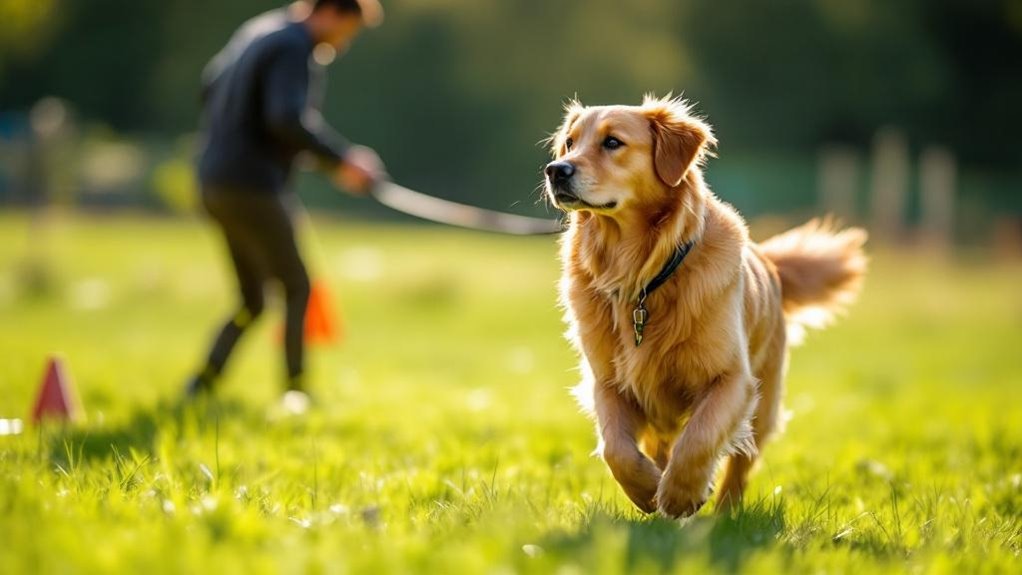
Advanced off-leash obedience training develops your dog’s ability to respond reliably to commands despite distractions, environmental changes, or competing interests. You’ll build this through foundation commands like “come,” “sit,” and “stay,” then progressively introduce real-world distractions in varied locations. Success depends on consistent positive reinforcement, precise reward timing within 1-2 seconds, and tailoring your approach to your dog’s energy level. Understanding your dog’s specific motivations and distraction triggers allows you to create a structured training plan that strengthens both obedience and your bond.
- Key Takeaways
- Why Off-Leash Reliability Transforms Your Dog’s Life
- Foundation Commands: The Prerequisites
- Tailoring Training to Your Dog’s Drive Level
- The Critical Role of Recall in Off-Leash Training
- Teaching the Foundation Recall Command
- Essential Gear for Off-Leash Training
- Selecting Safe Locations for Off-Leash Practice
- Create Your Training Timeline
- Advanced Recall in High-Distraction Zones
- Long-Line Training for Safe Off-Leash Progress
- Distance Sits and Stays: Control Without Proximity
- Off-Leash Safety Commands: Leave It and Drop It
- Off-Leash Heel: Walking Freely Without a Leash
- Emergency Stop Commands for Immediate Safety
- Directional Cues: Left, Right, and Forward Control
- Hand Signals for Silent Off-Leash Communication
- Whistle Training for Off-Leash Recall
- When Your Dog Ignores Commands: Debugging Obedience Breakdowns
- Build Distraction Tolerance in Three Stages
- Spot Your Dog’s Biggest Distractions
- Perfect Your Reward Timing: Why It Matters
- When to Work With a Professional Trainer
- Frequently Asked Questions
- Conclusion
Key Takeaways
- Master emergency commands and off-leash heel by practicing consistently in enclosed areas before introducing real-world distractions.
- Build distraction tolerance through progressive training, starting in quiet spaces and gradually escalating to complex environments.
- Develop reliable recall by reinforcing the “come” command with high-value treats and practicing regularly in varied locations.
- Teach advanced safety commands like “Leave It” and “Drop It” using positive reinforcement in both controlled and stimulating settings.
- Tailor training intensity to your dog’s drive level, adjusting exercise demands and reward systems for optimal obedience outcomes.
Why Off-Leash Reliability Transforms Your Dog’s Life
When your dog can reliably respond to commands even in distracting environments, you’re not just teaching obedience—you’re fundamentally changing how your dog experiences the world and how you interact with each other.
Off-leash reliability grants your dog freedom to explore hiking trails and crowded parks while you maintain safety through consistent communication. This independence builds confidence and adaptability, making your dog more engaged in daily activities.
Your dog learns impulse control and recall skills that navigate unpredictable scenarios effectively. The bond you develop deepens through trust and mutual understanding during outdoor adventures.
Rather than constantly worrying about escape risks, you can relax, knowing your dog will respond when needed. This transformation creates a happier, more secure companion who thrives in varied experiences.
Foundation Commands: The Prerequisites
Before you can expect your dog to respond reliably off-leash, you’ll need to establish a strong foundation with basic commands like “sit,” “stay,” and “come,” which create the structure that all advanced training depends on.
Your recall command—the ability to call your dog back to you in distracting situations—deserves particular attention, since it’s the command that’ll keep your dog safe when they’re not tethered to a leash.
Building this foundation requires consistency in your training sessions, positive reinforcement that motivates your dog, and a close bond based on trust, which helps you understand what drives your dog’s behavior and makes them more likely to listen when it matters most.
Recall Command Reliability
Three foundational commands—sit, stay, and down—form the essential groundwork for teaching your dog a reliable recall, since they train your dog to focus on you, respond to your voice, and hold a position despite distractions. Once your dog masters these basics, you’re ready to build a recall command that works consistently across different environments.
| Environment | Distraction Level | Training Duration |
|---|---|---|
| Quiet room | Low | 2-3 weeks |
| Backyard | Medium | 3-4 weeks |
| Park or trail | High | Ongoing |
Start in low-distraction settings to build confidence, then gradually introduce more stimulating areas. Use positive rewards like treats and praise to reinforce the association between your command and your dog’s response. Regular practice during outdoor activities maintains your dog’s reliability and keeps the recall command sharp over time.
Basic Obedience Mastery
Since your dog’s success with off-leash obedience depends on mastering the fundamentals first, you’ll want to focus on building rock-solid proficiency with sit, stay, and down before attempting advanced training.
Basic obedience mastery creates the foundation that all future skills depend on, establishing clear communication between you and your dog.
You’ll strengthen this foundation by:
- Teaching sit, stay, and down with consistent hand signals and verbal cues
- Practicing daily in familiar environments until your dog responds reliably
- Using positive reinforcement to reward correct behaviors immediately
- Gradually introducing minor distractions as proficiency increases
When you maintain consistency across training sessions, your dog understands exactly what you expect.
This structure builds trust and confidence, making your dog more responsive overall. Without mastering these basics, you’ll struggle with advanced off-leash work later.
Building Strong Bond
The bond you build with your dog forms the emotional foundation that makes off-leash obedience possible, because a dog who trusts you’ll work harder to please you and respond more reliably when you’re not holding a leash.
Building a strong bond requires consistent quality time during training sessions, where positive reinforcement creates motivation for your dog to engage and learn.
When you practice foundational commands in varied environments, you demonstrate reliability to your dog through repeated, rewarding interactions.
This consistency teaches your dog that following your directions produces good outcomes, strengthening trust over time.
Each successful command reinforced with praise or treats deepens the relationship, making your dog more willing to comply even without physical restraint.
This emotional connection becomes the invisible leash guiding their obedience.
Tailoring Training to Your Dog’s Drive Level
Every dog brings a different level of energy and motivation to training, and recognizing your dog’s drive level—whether high, medium, or low—becomes the foundation for an approach that actually works rather than frustrates both of you.
Tailoring training to your dog’s drive level guarantees your advanced obedience training produces real results through methods that match their energy.
Consider these strategies:
- High-drive dogs need intensive, physically stimulating exercises to maintain focus during off-leash work.
- Medium-drive dogs respond well to balanced sessions combining structure with varied activities.
- Low-drive dogs benefit from gradual distraction increases and consistent positive reinforcement.
- Reward systems should align with motivation levels, using toys for high-energy dogs and treats for lower motivation.
Monitoring behavior during sessions reveals patterns, allowing you to adjust techniques accordingly and build genuine responsiveness across different environments.
The Critical Role of Recall in Off-Leash Training
You’ll find that reliable recall forms the foundation of off-leash safety, since a dog who returns consistently on command won’t bolt toward traffic, other animals, or hazards when you’re in open spaces.
Building this skill requires you to practice recall commands in controlled environments first, where you can reward your dog with treats or praise each time they respond, so they learn to associate coming to you with positive outcomes rather than punishment or inconvenience.
Once your dog’s recall is solid at home, you’ll gradually introduce distractions—other dogs, interesting smells, running movements—in increasingly complex outdoor settings, which strengthens their ability to focus on you even when temptation surrounds them.
Foundation of Off-Leash Safety
Before your dog can safely explore off-leash environments, they need to master a reliable recall command—the foundational skill that allows them to return to you promptly regardless of distractions or distance.
You’ll build this foundation through structured recall training that progresses from simple to complex situations.
Here’s how to establish a strong safety base:
- Practice recall in controlled environments first, building consistency before introducing distractions.
- Use long lines during initial training, allowing freedom while maintaining control.
- Reward compliance with treats and praise, reinforcing the desired behavior consistently.
- Gradually increase environmental stimulation once your dog responds reliably.
This methodical approach prevents dangerous situations and guarantees your dog stays safe when exploring off-leash areas, establishing the security framework you’ll need before advancing to more challenging scenarios.
Building Reliable Recall Commands
Because your dog’s safety depends on their ability to return to you instantly, regardless of what’s happening around them, building a reliable recall command requires more than occasional practice—it demands consistency, structure, and strategic reinforcement that teaches your dog to prioritize your signal over competing distractions.
Start training in low-distraction environments, then gradually introduce more challenging stimuli as proficiency improves. Use the same command consistently, pairing it with high-value rewards like treats or praise to strengthen the association.
Practice with a long line, which provides control while allowing exploration. Incorporate distraction training where your dog learns to ignore tempting stimuli, preparing them for real-world scenarios.
This methodical approach transforms recall from a hoped-for behavior into a dependable safety tool.
Progressive Distraction Training Methods
Now that your dog reliably responds to recall in controlled environments, the real challenge begins: teaching them to ignore competing distractions and maintain focus on your command when their surroundings become increasingly stimulating.
Progressive training requires you to systematically introduce distractions while maintaining control through structure and consistency.
- Start in quiet spaces, then gradually move to busier locations as your dog demonstrates reliable responses.
- Use a long line to maintain safety while allowing exploration and reinforcing the recall command’s importance.
- Reward successful recalls with high-value treats, strengthening the positive association despite temptations present.
- Practice regularly in diverse environments like parks and crowded streets to desensitize your dog to real-world stimuli.
This methodical approach builds your dog’s confidence and reliability, ensuring they’ll respond when it matters most.
Teaching the Foundation Recall Command
The foundation recall command, typically signaled by the word “come,” forms the cornerstone of off-leash obedience because it gives you a reliable way to bring your dog back to you in any situation, whether you’re at a park, on a hiking trail, or in your own backyard.
You’ll want to begin training in a distraction-free environment, then gradually introduce more challenging settings as your dog becomes more responsive. Use positive reinforcement immediately after your dog responds—treats and praise work well together to strengthen the behavior.
Maintain consistency by using the same tone and phrasing each time you give the command, which helps your dog understand what you’re asking. Regular practice in varied locations solidifies this essential skill.
Essential Gear for Off-Leash Training
Once your dog has mastered the foundation recall command in controlled environments, you’ll need the right equipment to safely shift to off-leash training in more open spaces.
The essential gear for off-leash training includes:
Essential off-leash training gear: long lines, high-visibility harnesses, GPS collars, clickers, and treats for consistent reinforcement.
- Long lines that provide safety and control while allowing your dog to explore and build confidence gradually.
- High-visibility harnesses that guarantee your dog remains easily seen during outdoor activities across various environments.
- GPS collars that track your dog’s location in real-time, offering peace of mind if your dog wanders beyond sight.
- Clickers that deliver immediate feedback for desired behaviors, strengthening the reinforcement structure of your training sessions.
You’ll also want treats readily available during sessions to maintain motivation and reward good behavior consistently.
This combination of equipment creates the foundation necessary for successful off-leash obedience development.
Selecting Safe Locations for Off-Leash Practice
When you’re ready to practice off-leash obedience, you’ll want to choose fenced parks or private fields where you can control the environment and minimize distractions from other dogs, traffic, or wildlife that might break your dog’s focus.
Private property options give you the most control over variables like terrain and interruptions, while public fenced parks offer established spaces designed specifically for dog training, though you should visit during quieter times to reduce competing stimuli.
Both settings allow you to create the structured, low-distraction conditions your dog needs to build reliable obedience habits without the risks that come with uncontrolled environments.
Fenced Parks and Fields
Because off-leash obedience requires a controlled setting where your dog can focus on commands without overwhelming distractions, fenced parks and fields offer an ideal training environment that balances safety with freedom.
You’ll find that fenced areas provide the minimal distractions necessary for your dog to concentrate on learning, while the physical boundaries create a safe environment for practicing off-leash commands.
When selecting fenced parks and fields, evaluate these essential features:
- Double gates that prevent accidental escapes during training sessions
- Adequate fencing height and integrity to resist jumping or digging attempts
- Ample space allowing your dog to run freely while maintaining easy supervision
- Designated off-leash times that avoid conflicts with other park visitors
These controlled environments enable consistent practice and reliable reinforcement of obedience skills.
Private Property Options
While fenced parks offer reliable training environments, private property can provide even greater control and fewer distractions for developing your dog’s off-leash obedience skills. When exploring private property options, you’ll want to secure the property owner’s permission first, guaranteeing a cooperative training experience without future disputes.
| Safety Element | What to Check |
|---|---|
| Fencing | Verify secure perimeter with no gaps |
| Terrain | Assess for steep drops or hazards |
| Distractions | Confirm absence of aggressive animals |
| Space | Guarantee adequate room for exploration |
| Toxins | Identify and avoid toxic plants |
Spacious fields and large backyards give your dog room to develop skills while you maintain control. Before training begins, thoroughly evaluate the terrain for obstacles like water hazards or steep drops that could injure your dog, allowing you to practice with confidence and consistency.
Create Your Training Timeline
Since off-leash obedience doesn’t develop overnight, you’ll need to build a structured timeline that matches your dog’s current abilities and your realistic expectations for progress.
Off-leash obedience requires a structured timeline aligned with your dog’s abilities and realistic progress expectations.
Start by evaluating where your dog stands right now, then create your training timeline with specific milestones that guide your work forward.
- Evaluate your dog’s obedience level and set realistic goals for the next three to six months
- Allocate specific days each week for practicing essential commands like recall, sit, and stay
- Schedule training sessions across different locations to expose your dog to varied distractions
- Plan check-in points every two weeks to evaluate progress and adjust your approach
This structure provides the consistency and reinforcement your dog needs, turning daily practice into measurable advancement toward reliable off-leash obedience.
Advanced Recall in High-Distraction Zones
Your training timeline has prepared you for the next challenge: getting your dog to respond reliably when distractions compete for their attention.
Advanced training in high-distraction zones requires a structured approach, starting in low-distraction environments before gradually introducing more challenging scenarios. Use long lines during these exercises to maintain control while allowing exploration, which builds confidence without sacrificing safety.
Practice recall around tempting distractions like wildlife or other dogs, reinforcing the command with high-value treats or praise that increase motivation.
Vary your training locations across parks and urban areas so your dog adapts to different environments. This consistent reinforcement across varied settings transforms recall from a controlled command into a reliable response, regardless of what competes for your dog’s attention.
Long-Line Training for Safe Off-Leash Progress
Once you’ve mastered recall in controlled environments, the long line becomes your bridge to off-leash freedom, letting your dog explore with the safety net of your control still in place.
Long-line training gradually builds confidence while you maintain direct influence over your dog’s movements and choices.
Start by selecting the right equipment:
- Choose a long line matching your dog’s size and strength, typically 15 to 30 feet.
- Begin in a secure, enclosed area where distractions remain minimal.
- Use consistent commands paired with positive reinforcement throughout sessions.
- Incorporate distraction training to sharpen focus in real-world scenarios.
This structured approach develops reliability, allowing your dog to experience genuine exploration while you guide their decision-making through gentle corrections and rewards.
Ensuring they respond dependably even with increased freedom.
Distance Sits and Stays: Control Without Proximity
You’ll now build your dog’s ability to stay in position from increasing distances, which creates the foundation for reliable off-leash control by teaching impulse management and focus even when you’re not physically near.
You’ll start with short distances and clear verbal cues or hand signals, then gradually expand the space between you and your dog while reinforcing successful holds with treats and praise, strengthening their understanding that the command applies regardless of proximity.
You’ll then introduce environmental distractions and varied locations—parks, streets, unfamiliar spaces—to guarantee your dog maintains the sit or stay even when temptations increase, which translates directly to safety and reliability in real-world off-leash scenarios.
Building Distance Foundation First
Before your dog can reliably respond to off-leash commands in unpredictable environments, they’ll need to master distance sits and stays in controlled settings where distractions are minimal and their focus can remain on you.
Building this foundation requires patience and consistency as you gradually increase the distance between yourself and your dog.
Start with these essential steps:
- Begin at arm’s length, rewarding immediate compliance with treats and praise
- Move back slowly over multiple sessions, never rushing the process
- Practice in quiet spaces free from competing stimuli or interference
- Reinforce successful responses consistently, establishing reliability before advancing
This structured approach guarantees your dog develops genuine discipline rather than temporary obedience.
Reinforcing Commands From Afar
Three critical shifts happen when you move from arm’s length training to distance work: your dog must learn to hold position without your physical presence as an anchor, interpret your commands from farther away where subtle body language becomes harder to read, and maintain focus on you despite the increased separation that naturally invites distraction.
| Distance Level | Command Type | Reinforcement Method | Success Marker | Timeline |
|---|---|---|---|---|
| 5-10 feet | Sit/stay | Immediate treats | Holds 30 seconds | Week 1-2 |
| 15-20 feet | Sit/stay | Delayed rewards | Holds 60 seconds | Week 3-4 |
| 25+ feet | Sit/stay | Variable schedules | Holds 2+ minutes | Week 5-6 |
You’ll strengthen distance sits and stays by maintaining consistent verbal cues, rewarding compliance reliably, and gradually extending both physical separation and duration, building your dog’s confidence through structured, predictable practice.
Progressing Complexity and Distractions
Once your dog holds sits and stays reliably at moderate distances, the real challenge begins: maintaining that control when distractions enter the picture, because focus naturally fractures when competing stimuli appear in the environment.
Gradual exposure to these distractions strengthens your dog’s impulse control through structured practice.
Introduce challenges systematically using this approach:
- Start with minor distractions like rustling papers or distant sounds.
- Progress to moving objects, such as rolling balls or people walking nearby.
- Add multiple distractions simultaneously once your dog demonstrates consistent focus.
- Practice in varied locations to build reliability across different contexts.
Each session reinforces the command’s importance over environmental temptation. Your dog learns that compliance matters regardless of what’s happening around them, developing genuine obedience rather than situational compliance.
Off-Leash Safety Commands: Leave It and Drop It
Two vital commands form the foundation of off-leash safety: “Leave It” and “Drop It,” which work together to give you control over what your dog interacts with during unsupervised exploration.
“Leave It” teaches your dog to ignore specific items or distractions, preventing engagement with potentially harmful substances or objects.
“Drop It” enables your dog to release items from their mouth, essential for preventing dangerous ingestion.
You’ll strengthen these off-leash safety commands using high-value treats, gradually introducing them in both controlled and stimulating environments.
Consistent verbal cues paired with positive reinforcement—praise or treats—solidify these behaviors in your dog’s repertoire.
Mastery of these commands enhances off-leash safety, allowing your dog to explore freely while you maintain control over their actions in risky situations.
Off-Leash Heel: Walking Freely Without a Leash
Building an off-leash heel requires you to first establish the behavior on-leash, using treats or toys to guide your dog to walk closely beside you. Then gradually remove the leash once your dog understands the position and responds consistently to your verbal or hand signals.
Your progression toward off-leash heel success involves these steps:
- Practice in enclosed, safe areas where distractions remain minimal and controlled.
- Use consistent verbal cues or hand signals to reinforce direction and positioning.
- Reward engagement immediately when your dog maintains the heel position.
- Generalize the off-leash heel across different environments, including parks and urban settings.
Regular practice and positive reinforcement maintain this behavior effectively. Your dog stays engaged and responsive when you remain consistent with rewards and commands, preventing distractions from undermining the off-leash heel foundation you’ve built.
Emergency Stop Commands for Immediate Safety
While your dog’s off-leash heel demonstrates excellent control in routine situations, you’ll need an emergency stop command to handle unexpected hazards like approaching vehicles, loose dogs, or other sudden dangers that could put your dog at serious risk.
Start teaching this command in low-distraction environments, using positive reinforcement like treats or praise when your dog responds correctly. As your dog becomes reliable, gradually increase distractions and test the emergency stop in varied settings—parks, busy streets, and unfamiliar locations.
Consistency across different environments strengthens your dog’s responsiveness when it truly matters. Regular practice under increasing difficulty levels builds the reliability you need, ensuring your dog responds instantly to the command regardless of circumstances, ultimately protecting both your dog and others nearby.
Directional Cues: Left, Right, and Forward Control
You’ll develop directional control by teaching your dog consistent verbal commands paired with hand signals, which builds spatial awareness and allows you to guide them left, right, or forward during off-leash activities.
Starting in low-distraction environments helps your dog focus on understanding the connection between your command and the desired direction, while immediate reinforcement with treats or praise strengthens this association and speeds up learning.
Using visual markers like toys or treats during training captures your dog’s attention and physically guides them toward the correct direction, establishing the foundation needed before you introduce these cues into more stimulating settings.
Teaching Directional Commands Effectively
Directional commands form the foundation of reliable off-leash control, allowing you to guide your dog’s movements with precision through clear verbal cues and hand signals that your dog learns to associate with specific directions.
Teaching your dog these commands requires a structured approach:
- Start in low-distraction environments, rewarding correct responses with treats or praise
- Use consistent verbal cues and hand signals every time you practice
- Gradually increase complexity by introducing commands in varied settings
- Incorporate directional games and off-leash activities to reinforce behaviors
Consistency in your cues, gestures, and rewards enhances your dog’s understanding over time.
As your dog masters these foundational skills, you’ll notice improved responsiveness regardless of surroundings, creating a reliable communication system between you and your dog that supports safe, effective off-leash control.
Practicing Spatial Awareness Training
As your dog becomes confident with basic directional commands, teaching them to navigate left, right, and forward on cue transforms those skills into practical tools for real-world off-leash control.
Spatial awareness training builds on this foundation by requiring your dog to process directional cues while moving through their environment.
Start in controlled spaces, using treats or toys as lures to guide your dog left and right, then reward immediately upon completion.
Pair verbal commands with consistent hand gestures to strengthen their understanding, since visual signals reinforce what they hear.
Gradually introduce obstacles and mild distractions, allowing your dog to practice directional commands amid complexity.
Practice regularly in different environments—parks, trails, open fields—so your dog develops reliable responsiveness across varied settings, building confidence and dependability in their spatial navigation abilities.
Hand Signals for Silent Off-Leash Communication
Many training situations call for communication methods that don’t rely on your voice, and hand signals offer a reliable alternative that works especially well when you’re working off-leash in noisy or distracting environments.
You’ll find that consistent hand signals paired with specific behaviors create clarity for your dog across different settings.
To establish effective silent communication, follow these steps:
- Pair each hand signal with a distinct behavior or command your dog already knows.
- Combine signals with positive reinforcement like treats or praise to strengthen learning.
- Practice in various locations so your dog generalizes the behaviors reliably.
- Maintain consistency in your signal movements to avoid confusion.
This structured approach guarantees your dog responds accurately off-leash, regardless of environmental noise or distractions surrounding you both.
Whistle Training for Off-Leash Recall
While hand signals provide silent communication in many situations, they work best when your dog is close enough to see you clearly, which isn’t always possible during off-leash work in open spaces or at distance.
Whistle guidance offers a practical solution because the sound travels farther than your voice and cuts through environmental distractions effectively.
You’ll start by associating a specific whistle sound with positive rewards like treats or praise, building a strong connection between the signal and the desired behavior.
Begin training in quiet, controlled environments where your dog can easily hear and respond, then gradually introduce distractions as reliability improves.
Consistent practice reinforces the behavior, increasing compliance during actual off-leash scenarios and ensuring your dog returns promptly when called.
When Your Dog Ignores Commands: Debugging Obedience Breakdowns
When your dog ignores commands, you’re likely facing one of several root causes: distractions in the environment have pulled their focus away, inconsistent training methods have created confusion about what you’re asking, or insufficient motivation means the reward isn’t compelling enough to compete with what’s around them.
To debug the breakdown, you’ll need to systematically identify which factor is at play by testing your dog’s response in controlled settings, reviewing whether your commands and rewards have stayed consistent, and evaluating whether the reinforcement you’re offering is actually valuable to your dog in that moment.
Once you’ve pinpointed the cause, you can adjust your approach—whether that means practicing in quieter environments first, standardizing your commands across all handlers, or finding more effective rewards—and rebuild reliable obedience through structured practice.
Identifying Root Causes
Your dog’s decision to ignore a command usually isn’t stubbornness—it’s a signal that something in the training system or environment has broken down, and identifying what’s gone wrong is the first step toward fixing it.
When you’re debugging obedience breakdowns and identifying root causes, consider these common challenges:
- Environmental distractions—other animals, people, or odors competing for your dog’s attention
- Inconsistent training and reinforcement, creating confusion about expectations
- Weak motivation, where treats, praise, or play don’t feel rewarding enough
- Limited practice across different environments, preventing command generalization
Behavioral issues like anxiety or fear may also cause avoidance, requiring specialized behavior modification.
Systematic Correction Strategies
Once you’ve identified the root causes behind your dog’s command avoidance, the next phase involves applying correction strategies that address those specific breakdowns rather than simply punishing the behavior itself.
Systematic correction strategies work because they target the actual problem—whether that’s distraction, insufficient motivation, or inconsistent training methods. You’ll use immediate, consistent corrections like verbal cues or gentle leash corrections to reinforce that responding matters.
The timing of your correction is essential; it must happen the moment your dog ignores the command so they connect the correction to their choice. By pairing corrections with clear expectations and positive reinforcement for compliance, you’re building a structure where your dog understands both what you want and why following through benefits them.
Build Distraction Tolerance in Three Stages
As your dog develops basic obedience skills, you’ll need to systematically expose them to distractions so that commands remain reliable in real-world situations. This process works best when you move through three distinct stages that gradually increase in difficulty.
To build distraction tolerance effectively, follow these progression steps:
- Start in controlled environments with minimal distractions, using short 5-10 minute training sessions.
- Introduce low-level distractions like toys or treats, rewarding focus before escalating difficulty.
- Add real-world distractions such as other dogs or people in structured practice.
- Maintain consistency and positive reinforcement throughout all stages.
This graduated approach prevents frustration while strengthening your dog’s response reliability, ensuring commands hold firm whether you’re in your backyard or traversing busy public spaces.
Spot Your Dog’s Biggest Distractions
What captures your dog’s attention most strongly? To spot your dog’s biggest distractions, you’ll need to observe their responses across different situations and stimuli.
Wildlife, other dogs, and unfamiliar sounds commonly trigger strong reactions, but your dog’s specific triggers depend on their individual temperament and experience.
Watch for changes in body language—ears perking up, nose lifting, or body tensing—which signal distraction levels. Note which environments consistently pull their focus away from you, then rank these distractions from minor to severe.
This ranking helps you understand where to begin training and which stimuli require the most reinforcement work. By identifying patterns in what captures their attention, you’ll create a structured plan for gradually building their distraction tolerance through controlled exposure and consistent practice.
Perfect Your Reward Timing: Why It Matters
Now that you’ve identified what distracts your dog most, you’re ready to tackle one of the most powerful tools in off-leash training: reward timing. When you reward your dog within 1-2 seconds of the desired behavior, you create a clear connection between the action and the positive outcome, which accelerates learning considerably.
Here’s how to master reward timing:
- Deliver treats immediately after your dog completes the behavior
- Maintain consistent timing across all training sessions to avoid confusion
- Use a clicker to mark the exact moment of success, then follow with a reward
- Practice regularly to develop your reflexes and precision
Consistency in timing prevents mixed signals, while precise reinforcement strengthens your dog’s response reliability.
Consistent reward timing eliminates confusion and builds stronger, more reliable responses in your dog’s training.
This structured approach builds trust and deepens your bond through clear communication.
When to Work With a Professional Trainer
You might’ve reached a point where your dog’s off-leash training has plateaued, or you’re encountering behavioral challenges that don’t seem to respond to your current approach, and that’s when a professional trainer becomes invaluable.
A skilled trainer assesses your dog’s specific needs and develops tailored strategies for advanced obedience work that you might struggle with alone. They employ proven techniques like desensitization and counter-conditioning to address anxiety or aggression that can emerge during off-leash training.
Professional trainers also refine your dog’s reliability in high-distraction environments, ensuring commands work consistently across various conditions. Additionally, structured group classes provide socialization opportunities while reinforcing training foundations.
Working with a professional brings structure, expertise, and accountability to your training program.
Frequently Asked Questions
What Is the 7 7 7 Rule for Dogs?
You’ll follow the 7 7 7 Rule by dedicating seven minutes daily to training, seven minutes to play, and seven minutes to rest. This balanced routine guarantees you’re providing mental stimulation, physical activity, and recovery—all essential for your dog’s well-being and better behavior.
How to Train Your Dog Advanced Obedience?
Studies show that dogs retaining advanced obedience commands score 40% higher on reliability tests. You’ll master advanced training by breaking complex commands into smaller steps, consistently practicing in varied environments, and rewarding desired behaviors with treats and praise throughout sessions.
What Is the 3-3-3 Rule for Dog Training?
You’ll find that the 3-3-3 Rule gives you realistic expectations: three days for decompression, three weeks for adjustment, and three months for your dog to fully settle into their new home and bond with you.
What Is the 10-10-10 Rule for Dogs?
You’ll spend thirty minutes daily pretending your dog doesn’t need constant attention. The 10-10-10 rule requires ten minutes each of physical exercise, mental stimulation, and training to keep your pup balanced and well-behaved.
Conclusion
You’ve now learned that off-leash reliability isn’t actually about freedom—it’s about structure, consistency, and reinforcement. Your dog doesn’t gain independence through training; instead, you’re building a communication system where you’re always connected, even without a physical leash. You’ll find that the most reliable off-leash dogs are those whose owners’ve invested time in foundational work, distraction tolerance, and professional guidance when needed.