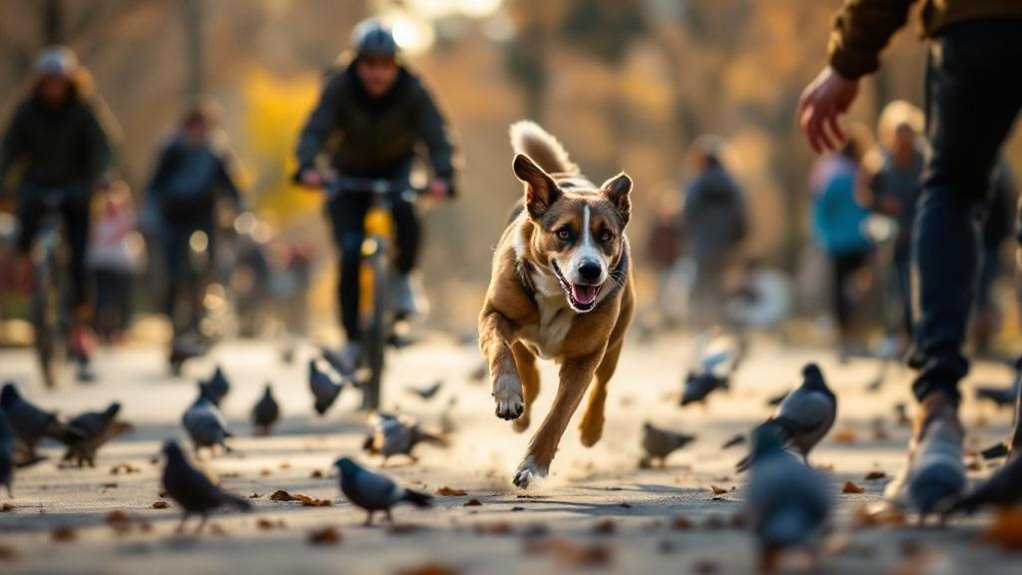
Your dog’s recall fails in high-distraction environments because competing motivations—like prey drive or environmental rewards—temporarily override their training. You’ll need to establish a baseline in controlled settings first, then gradually introduce distractions while using long lines for safety and high-value rewards that outrank what’s around them. Start in quiet indoor spaces, progress to familiar outdoor areas, and layer increasingly challenging situations as your dog succeeds. Understanding your dog’s breed, age, and specific distraction triggers will reveal exactly where your training needs reinforcement.
- Key Takeaways
- Why Dogs Fail Recall in High-Distraction Environments
- Know Your Dog’s Starting Point
- Breed and Age Factors That Affect Your Baseline
- Long Lines: Your Safety Net for Advanced Training
- Choosing High-Value Rewards That Beat Environmental Competition
- Distraction Levels: Where to Start
- Stage 1: Building Reliability in Quiet, Controlled Settings
- Stage 2: Introducing Single Distractions Strategically
- Stage 3: Layering Multiple Distractions Without Overwhelming
- Consistency: Why It Matters More Than Intensity
- Common Mistakes in High-Distraction Settings
- Advanced Refinements: Check-Ins and Emergency Recall
- When Progress Stalls: Diagnosing Plateaus Between Levels
- Keeping Recall Sharp: Maintenance Across Life’s Changes
- Troubleshooting Breed and Age-Specific Setbacks
- Long-Term Recall: Adapting as Your Dog Matures
- Frequently Asked Questions
- Conclusion
Key Takeaways
- Use long lines attached to well-fitted harnesses as safety nets during advanced recall training in distracting environments.
- Establish a reward hierarchy with high-value treats that effectively compete with environmental distractions in the dog’s mind.
- Introduce distractions gradually through stage-based progression, starting in quiet settings before advancing to challenging scenarios.
- Monitor distraction thresholds by observing body language changes like ear position and hesitation to identify skill gaps.
- Practice short, frequent training sessions consistently to maintain recall reliability as dogs age or routines shift.
Why Dogs Fail Recall in High-Distraction Environments
When your dog ignores your recall command in a park full of squirrels or near another dog, it’s not defiance—it’s competing motivation, where environmental distractions offer rewards that feel more valuable than returning to you.
High distraction environments trigger your dog’s natural instincts, especially in breeds with strong prey drives like terriers and sighthounds, making reliable response difficult without proper preparation.
Dogs don’t automatically generalize recall commands from quiet training sessions to chaotic settings; they need training in varied environments to build consistency.
Additionally, if your dog previously experienced negative consequences when returning, they’ll hesitate to respond.
Without positive reinforcement techniques applied consistently across different contexts, your dog develops selectivity about when they’ll obey, leaving you frustrated when distractions appear.
Know Your Dog’s Starting Point
You’ll need to establish where your dog actually stands right now by evaluating their baseline recall performance in controlled settings, then identifying how breed-specific traits—like a terrier’s independent nature or a sighthound’s prey drive—might influence their responsiveness in more demanding situations.
Your dog’s previous training history matters considerably here, since inconsistent reinforcement, gaps in foundational work, or past experiences with punishment can create patterns that you’ll need to recognize and work around as you build forward.
Starting with an honest evaluation of these three factors gives you the accurate picture you need to set realistic expectations and choose training approaches that’ll actually work for your individual dog rather than following generic advice that mightn’t fit their specific needs.
Assessing Your Dog’s Baseline
Before you can improve your dog’s recall, you’ll need to establish where they’re starting from by observing their current responses in controlled conditions, because understanding their baseline helps you set realistic training goals and identify which distractions present the biggest challenges.
Start evaluating in low-distraction environments where your dog can focus, then note how their response changes when you introduce noise or other dogs nearby. Use a clicker or marker word to reinforce successful recalls, which helps you gauge their understanding while recording how many times they respond correctly at different distances.
This data reveals specific problem areas. Consider your dog’s age, breed, and training history, since younger or independent breeds may struggle differently with focus and obedience during evaluation phases.
Identifying Breed-Specific Challenges
Because different dog breeds were developed for specific jobs—hunting, herding, guarding—they’ve inherited distinct instincts that shape how they respond to recall commands. Recognizing these breed tendencies helps you understand why your dog struggles with focus in certain situations rather than assuming a lack of training or obedience.
Your dog’s ability to maintain recall depends largely on their breed’s original purpose and inherent drives.
- Sighthounds and dogs with high prey drive chase moving objects instinctively, making high distraction environments particularly challenging.
- Independent breeds prioritize environmental rewards over your commands, requiring consistent reinforcement and structured training strategies.
- Adolescent dogs from stubborn breeds experience hormonal shifts that temporarily decrease recall reliability.
Understanding these patterns allows you to develop targeted training strategies that address your dog’s specific recall challenges rather than applying generic approaches.
Evaluating Previous Training History
Your dog’s training history acts as the foundation for understanding what comes next, because past experiences—both positive and negative—shape how your dog interprets recall commands and responds to your efforts now.
You’ll want to identify whether previous training established strong reinforcement patterns or created negative associations that now interfere with reliable responses.
Document what motivations worked best during earlier sessions, then note where distractions caused breakdowns in impulse control. These patterns reveal your dog’s individual personality traits and learning style.
Ask yourself: Did your dog respond consistently at home but fail outdoors? Were there particular triggers that caused regression?
This evaluation informs your customized training strategies moving forward, ensuring you’re not repeating ineffective approaches but building on what actually works for your specific dog.
Breed and Age Factors That Affect Your Baseline
When you start recall training with your dog, understanding breed tendencies and life stage will help you set realistic expectations and choose the right approach. Different dogs have vastly different baseline abilities for recall, shaped by their genetics and development.
Your dog’s breed greatly influences motivation and focus:
- Independent breeds like sighthounds struggle with recall because their instincts compete with your commands.
- Terriers and scent hounds face natural predispositions toward distractions rooted in hunting behaviors.
- These traits aren’t character flaws but hardwired tendencies requiring tailored strategies.
Age equally matters for your training timeline. Puppies under six months need brief, frequent sessions due to limited attention spans, while adolescent dogs (6-18 months) often show unreliable recall from hormonal changes and independence.
Older dogs without prior training require patient, gradual reinforcement to unlearn established patterns and build new habits successfully.
Long Lines: Your Safety Net for Advanced Training
Understanding your dog’s baseline helps you recognize what comes next: managing the gap between where your dog’s recall stands now and where you need it to be in real-world situations. Long lines serve as your safety net during advanced recall training, providing control while offering your dog freedom to explore distracting environments.
| Line Length | Dog Size | Primary Purpose |
|---|---|---|
| 10 meters | Medium to large | Extended distance practice |
| 5 meters | Small dogs | Close-range management |
| Waterproof | All sizes | Wet conditions |
| Standard | All sizes | General training |
| Drag line | All sizes | Low-stress introduction |
Always attach long lines to a well-fitted harness rather than a collar, ensuring even pressure distribution. This setup prevents self-rewarding behaviors when distractions pull your dog’s attention, enabling reliable recall development through consistent reinforcement and structured practice in challenging situations.
Choosing High-Value Rewards That Beat Environmental Competition
You’ll need to identify what genuinely motivates your individual dog—whether that’s fragrant treats like chicken, squeaky toys, or other rewards that naturally compete with outdoor distractions—and then strategically escalate these rewards as environmental stimuli intensify during training sessions.
The key to beating environmental competition isn’t just selecting high-value items, but timing your reinforcement immediately after successful recall so your dog forms strong positive associations that outweigh the appeal of smells, other animals, or other distractions in the environment.
Reward Hierarchy and Selection
Because your dog’s motivation to return depends entirely on whether the reward you’re offering beats what’s already competing for their attention, establishing a clear reward hierarchy isn’t optional—it’s foundational to reliable recall.
You’ll structure rewards by motivational value, layering everyday treats with high-value options reserved for challenging situations where environmental distractions are strongest.
Create your hierarchy by identifying what truly entices your dog:
- Chicken or cheese that competes against scents and other animals
- Small, frequent rewards maintaining motivation without overuse
- Immediate reinforcement strengthening the recall command association
Timing matters critically here; delivering rewards instantly when your dog responds to the recall command solidifies the behavior-reward connection.
As your dog progresses, adjust both difficulty levels and reward types, ensuring that what you’re offering always exceeds the allure of environmental distractions present in high-distraction environments.
Competing With Environmental Stimuli
When your dog spots a squirrel, hears another dog barking, or catches an interesting scent on the wind, that environmental stimulus becomes a competing reward—one that your dog’s brain has already deemed valuable and immediate.
To win this competition during recall practice, you’ll need high-value rewards that outrank these distractions in your dog’s mind. This means experimenting with treats or toys your dog finds irresistible, then reserving your absolute best rewards exclusively for advanced recall training in challenging environments.
Dynamic rewards work particularly well here; tossing treats or engaging a favorite toy captures attention away from external stimuli.
When you maintain consistency with these premium rewards, your dog responds reliably through positive reinforcement, gradually learning that returning to you delivers more value than environmental distractions ever could.
Distraction Levels: Where to Start
The foundation of reliable recall rests on starting in environments where your dog can focus entirely on you, which means beginning in low-distraction environments where simple cues and immediate rewards establish the behavior pattern they’ll need later.
Your dog learns best when distractions don’t compete for attention, allowing consistent training to build confidence and understanding.
Consistent training in low-distraction environments builds your dog’s confidence and understanding of recall commands.
As you establish this foundation, consider these progressions:
- Quiet indoor spaces where your dog learns the recall cue without external interference
- Familiar outdoor areas with minimal activity, gradually introducing mild sounds or distant people
- Controlled group settings where you manage distraction levels alongside your dog’s reliability
Understanding distraction levels allows you to develop training protocols that match your dog’s current abilities, ensuring success before advancing to high levels of distraction in real-world environments.
Stage 1: Building Reliability in Quiet, Controlled Settings
Your dog’s success in recall depends on establishing a strong foundation before tackling distractions. This is why Stage 1 focuses on creating an environment where they can learn the behavior without competing stimuli pulling their attention away from you.
Begin in a quiet, enclosed area with minimal environmental noise, then attach a training line to a well-fitted harness for safety and control. Use clear recall commands paired with immediate positive reinforcement like treats or praise when your dog responds correctly, building strong associations between the command and reward.
Keep training sessions brief at 10-15 minutes with 5-10 repetitions, matching your dog’s attention span and maintaining engagement. This consistency and structure establish the reliability necessary before advancing to more challenging environments.
Stage 2: Introducing Single Distractions Strategically
Now that you’ve established reliability in controlled settings, you’re ready to progress through a carefully structured environmental progression where you’ll introduce one manageable distraction at a time, allowing your dog to build confidence without becoming overwhelmed.
Identifying your dog’s distraction threshold—the point where they’ll still respond to recall despite external stimuli—requires you to start with low-level distractions like a toy or person nearby, then gradually increase the challenge as your dog demonstrates consistent success.
This strategic approach prevents self-rewarding behaviors by keeping the training line attached while you use high-value rewards, monitor engagement closely, and call your dog when they’re already attentive, setting them up to succeed at each stage.
Controlled Environmental Progression
Once your dog demonstrates reliable recall in a distraction-free environment, you’re ready to introduce controlled environments that’ll test his focus while you’re still able to manage the situation effectively.
Recall training requires a strategic approach where you gradually increase distractions at a pace your dog can handle, ensuring success rather than failure.
Begin training in environments with minimal visual or auditory stimuli, then systematically add single distractions:
- A toy placed at moderate distance from your training position
- A friend standing quietly 20-30 feet away
- Low-level background noise from a distant source
Use a long training line attached to his harness for safety.
Reward with high-value treats immediately upon successful return, building strong positive association with the recall command across varied settings.
Distraction Threshold Identification
How do you know when your dog has reached his limit with distractions? Watch his body language closely during training sessions, noticing when he stops responding reliably to the recall command.
His distraction threshold—the point where environmental stimuli overwhelm his focus—becomes visible through hesitation, ear position changes, or delayed responses.
Start with mild, single distractions within his visual range, like a person standing nearby or equipment placed at a distance. Observe whether he maintains consistency with the recall command before introducing additional triggers.
Use high-value rewards that genuinely compete against these distractions, making the recall more enticing than surrounding environmental stimuli.
When you see him struggle, you’ve identified his current threshold. This information guides your next training steps, ensuring structured progression without overwhelming him, building sustainable reinforcement patterns.
Stage 3: Layering Multiple Distractions Without Overwhelming
After your dog’s shown reliable recall in quiet, controlled settings, you’re ready to gradually introduce distractions that’ll test their focus and obedience in more realistic situations.
You’ll build your dog’s recall training skills by layering distractions strategically, preventing overwhelm while strengthening motivation in varied training environments.
Start with one or two manageable distractions, such as:
Start with one or two manageable distractions like a nearby dog, rolling toy, or background street noise to build recall skills gradually.
- A familiar dog nearby that your dog can see but not interact with
- A moving object like a toy rolling across the yard
- Background noise from a moderately busy street or park
Use high-value treats or toys as rewards to maintain your dog’s focus despite environmental challenges.
Monitor your dog’s body language carefully, watching for stress signals that indicate you’ve introduced too much too quickly.
Adjust difficulty levels accordingly to preserve positive reinforcement and consistency throughout your training progression.
Consistency: Why It Matters More Than Intensity
Reliability, not intensity, is what transforms recall from an occasional success into a dependable behavior you can trust when it matters most. You’ll find that using the same recall commands consistently establishes clear understanding for your dog, making responses accurate even amid distractions. A predictable reward system reinforces this behavior far more effectively than sporadic rewards, creating genuine association between recall and positive experiences.
| Training Element | Inconsistent Approach | Consistent Approach |
|---|---|---|
| Recall Commands | Varying words/signals | Same cue every time |
| Rewards | Random timing | Predictable system |
| Practice Schedule | Irregular sessions | Regular, scheduled training |
Inconsistencies in training methods confuse your dog, resulting in unreliable recall when facing strong distractions like other animals or people. Regular practice sessions solidify learned responses in your dog’s memory, while practicing across varying environments with consistent cues strengthens their ability to generalize skills reliably.
Common Mistakes in High-Distraction Settings
Even though you’ve built a solid foundation with consistent training, high-distraction environments can expose gaps in your recall work, especially when you’re unaware of how your own actions undermine the behavior you’ve worked to establish.
Common mistakes during your recall training process include:
- Using the recall command to end fun activities, which creates negative consequences and teaches your dog to avoid returning
- Allowing your dog to self-reward by exploring distractions before you call them, which shifts their preference away from you
- Delivering rewards with ineffective timing, causing confusion about which behavior earned the reinforcement
Gradually increasing distraction levels prevents your dog from struggling to generalize skills across environments.
Without high-value rewards during the training process, your dog loses motivation when competing stimuli appear.
Understanding these patterns helps you protect the foundation you’ve established.
Advanced Refinements: Check-Ins and Emergency Recall
Once you’ve addressed the common pitfalls that undermine recall in distracting environments, you can build on that foundation with more sophisticated behaviors that keep your dog engaged with you even when temptations abound.
Implement check-in games during play sessions, rewarding your dog for briefly returning to you amid distractions, which builds responsiveness without relying solely on commands. Establish a distinct emergency recall cue separate from standard recalls, pairing it with high-value rewards and practicing monthly to reinforce its urgency.
Start check-in games with immediate reinforcement to establish the pattern, then shift to variable rewards for sustained engagement. Practice these behaviors in controlled environments first, gradually increasing difficulty as your dog demonstrates reliability, ensuring consistent responsiveness across varying distraction levels.
When Progress Stalls: Diagnosing Plateaus Between Levels
When your dog’s recall performance plateaus between difficulty levels, you’re likely encountering a threshold where the environmental distractions exceed what they’ve reliably mastered. This signals that you’ll need to step back and reinforce success at the current level before advancing further.
Identifying which specific distractions—whether distance, unfamiliar sounds, or competing stimuli—trigger the decline helps you design targeted practice sessions that gradually build tolerance, rather than pushing forward into scenarios where your dog can’t consistently succeed.
Identifying Training Thresholds
Most dogs won’t suddenly fail at recall; instead, they’ll show you exactly where their training stops holding up by responding inconsistently or refusing altogether when distractions increase beyond what you’ve prepared them for.
Identifying training thresholds means recognizing when your dog’s recall performance plateaus despite consistent practice. You’ll notice this when they succeed in low-distraction settings but struggle when exposed to:
- Other dogs nearby, triggering prey drive or social interest
- Wildlife or moving objects that capture their attention
- Unfamiliar environments where confidence wavers
Monitor your dog’s engagement and motivation carefully, as these reveal whether distractions exceed their current capacity.
Evaluate each session by noting where successful recalls stop happening. When progress stalls, return to foundational exercises in controlled settings, then gradually increase distraction intensity at manageable levels, ensuring each threshold gets mastered before advancing further.
Breaking Through Plateaus Strategically
You’ve now identified where your dog’s recall breaks down, and that knowledge reveals something important: plateaus don’t happen because your dog’s stopped learning, but because the current training structure no longer matches the difficulty of their environment.
When you’re facing plateaued recall performance, you’re actually seeing a mismatch between your dog’s skill level and the training demands.
Start by evaluating specific high-distraction scenarios to pinpoint exact triggers inhibiting progress. Then introduce gradual complexity by adding just one new distraction at a time.
Vary your high-value rewards to maintain motivation, and work at your dog’s threshold distance where they stay responsive. Use short practice sessions frequently rather than extended sessions, which prevent boredom and desensitization.
This structured approach rebuilds consistency and momentum.
Keeping Recall Sharp: Maintenance Across Life’s Changes
As your dog moves through different life stages or faces shifts in routine, the recall command doesn’t automatically stay sharp—it requires deliberate, ongoing commitment to maintain its reliability.
You’ll notice that maintenance sessions become essential, especially as your dog ages or activity levels change, since attention spans and energy naturally shift over time.
To keep recall strong:
- Incorporate high-value rewards during practice to sustain motivation when distractions intensify
- Schedule shorter, more frequent training sessions that match your dog’s current physical and mental capacity
- Practice gradually increasing environmental challenges to build confidence and instinctual responses
Adjust your approach as your dog’s needs evolve, reinforcing the recall command consistently across new settings, so responsiveness remains dependable throughout every season of their life.
Troubleshooting Breed and Age-Specific Setbacks
While maintaining recall through life’s changes requires consistent effort, you’ll find that breed tendencies and developmental stages can create specific obstacles that demand targeted adjustments beyond standard practice routines. Certain breeds exhibit inherent instincts that complicate recall in high-distraction environments, while age-specific setbacks emerge predictably across developmental phases.
| Age Group | Primary Challenge | Training Duration | Key Strategy |
|---|---|---|---|
| Under 6 months | Limited focus capacity | 5-10 minutes | Short, frequent sessions |
| 6-18 months | Hormonal inconsistency | 10-15 minutes | Patience and repetition |
| Adolescents | Independence patterns | Varied lengths | Structured reinforcement |
| Independent breeds | Entrenched decision-making | Extended sessions | Consistent value reinforcement |
| All ages | Lack of generalization | Variable | Different settings exposure |
You’ll address these challenges through structured training that acknowledges breed predispositions and developmental realities, building reliability across different settings systematically.
Long-Term Recall: Adapting as Your Dog Matures
Recall reliability doesn’t remain static throughout your dog’s life; instead, it requires continuous adjustment because your dog’s physical abilities, mental development, and motivational patterns shift importantly across different life stages.
As your dog matures, long-term recall demands consistent reinforcement through frequent practice in varied environments, ensuring reliability persists beyond puppyhood.
Your dog’s needs evolve considerably, requiring you to adapt your approach:
- During adolescence, temporary regressions occur, necessitating increased reward frequency and intensity to maintain motivation.
- Adult dogs benefit from ongoing practice sessions that combat natural skill decay over time.
- Senior dogs may need visual cues or shorter distances, accounting for age-related physical changes.
Effective recall requires understanding these changes.
Dogs learn best when reinforcement schedules match their current developmental stage, so adjust training in low-distraction settings first, then gradually progress to complex environments, maintaining the foundation you’ve built.
Frequently Asked Questions
How Long Does Advanced Recall Training Typically Take Before Reliable Results?
You’ll typically see reliable results within 4-6 weeks of consistent daily practice. You’re building neural pathways that strengthen your recall abilities, though you’ll notice improvements faster if you’re training in progressively challenging environments regularly.
Can Older Dogs Learn Advanced Recall, or Is It Only for Puppies?
Your older dog’s brain is like clay that’s been fired—it’s set but still moldable. You can absolutely teach advanced recall to mature dogs; they’ve got patience and focus puppies lack, though you’ll need consistency and higher-value rewards than younger learners require.
What Should I Do if My Dog Ignores Recall Despite High-Value Treats?
You’ll need to reassess your dog’s motivation level and the treat value. Gradually reduce distractions, practice in quieter settings first, then systematically increase environmental complexity. You’re likely progressing too quickly through difficulty levels.
How Often Should I Practice Recall Training to Maintain Long-Term Reliability?
You’d think practicing once weekly would suffice, but you’ll actually need to train three to four times weekly to maintain your dog’s recall reliability. Consistent practice prevents skill degradation and strengthens your bond.
Is Professional Training Necessary, or Can I Train My Dog Independently?
You can train your dog independently if you’re consistent and patient. However, professional trainers accelerate progress, troubleshoot issues effectively, and guarantee you’re using correct techniques. They’re worthwhile for complex behaviors.
Conclusion
You’ve now discovered that your dog’s recall won’t magically improve through wishful thinking alone, which you’ve probably suspected all along. You’ll maintain consistency across changing environments, reinforce competing behaviors systematically, and adapt your approach as your dog matures. The structure you’ve built—from baseline assessment through long-line training to maintenance protocols—creates the foundation for reliable recall that actually works when it matters most.