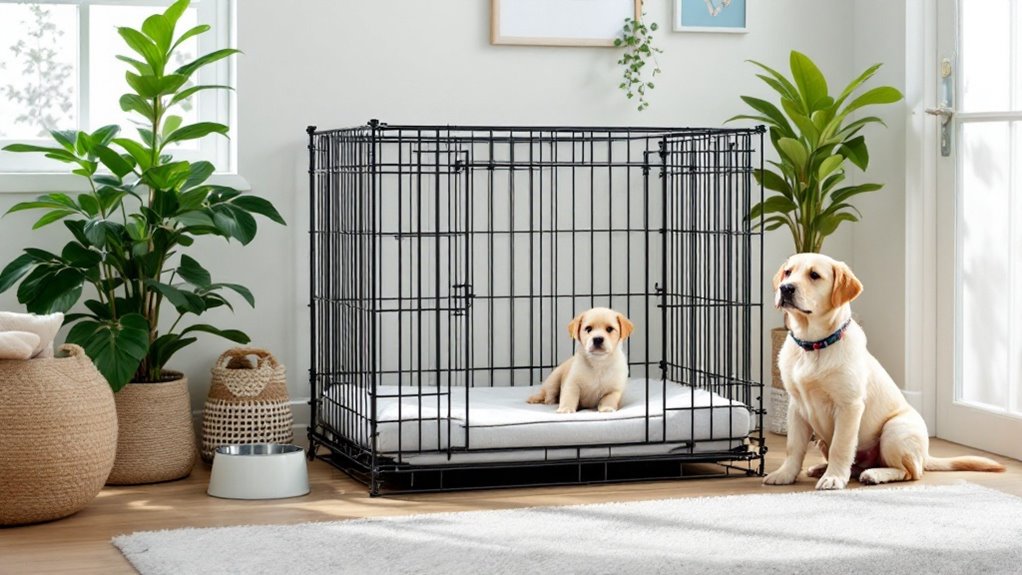
You need a crate sized for your puppy’s adult dimensions using the Stand-Turn-Lie-Down Rule: measure nose-to-tail and floor-to-head, then add 4–6 inches to each. For large breeds (50–90+ lb), expect 36–48 inch crates with removable dividers to prevent soiling and accommodate growth without buying multiple crates. Wire fold-and-carry models with adjustable dividers work best, offering visibility, airflow, and longevity. Prioritize secure latches, removable trays for cleaning, and proper ventilation. Understanding which features truly support training consistency and durability will guide your selection.
- Key Takeaways
- Why Large Breed Puppies Need Purpose-Built Crates
- Size Your Puppy’s Crate: The Stand-Turn-Lie-Down Rule
- Which Material Works Best as Your Puppy Grows?
- Make One Large-Breed Crate Last With Dividers
- Best Crates for Large Breed Puppies: Our Top Picks
- Safety and Ventilation Features That Matter
- Portability or Durability: What Matters More?
- Train Your Puppy to Love Their Crate
- When Your Puppy Outgrows Their Crate?
- Frequently Asked Questions
- Conclusion
Key Takeaways
- Use the Stand-Turn-Lie-Down Rule: measure nose-to-tail and floor-to-head, then add 4–6 inches to each dimension.
- Choose a wire fold-and-carry crate with adjustable divider to accommodate growth without purchasing multiple crates.
- Select crates sized 36–48 inches for large breeds (50–90+ lb) with secure latches and removable trays.
- Prioritize models with open mesh panels on three sides, 1–2 inch bar spacing, and full ventilation.
- Upgrade when puppy cannot turn comfortably, head touches ceiling, or cannot stretch fully when lying down.
Why Large Breed Puppies Need Purpose-Built Crates
Because large-breed puppies grow rapidly and possess strong, inquisitive natures, they need crates specifically designed to accommodate their size and strength rather than standard or small-breed options. Large-breed puppies need purpose-built crates sized to allow standing, turning, and lying flat—often requiring XL or giant crates, such as the Midwest XL recommended for dogs approximately 43″ nose-to-tail and 26″ tall.
Rapid growth makes a crate with a removable divider essential so the same crate can safely confine a puppy during potty training without forcing the puppy to soil its sleeping area. Purpose-built crates for large-breed puppies prioritize sturdiness and secure latches to prevent escapes and injuries as strong, curious puppies test boundaries, using metal wire or heavy-duty plastic rather than flimsy soft-sided options.
Ventilation, visibility, and a removable tray for easy cleaning matter greatly because large puppies produce more mess and heat, and wire crates provide good airflow and easy-to-clean floors.
Size Your Puppy’s Crate: The Stand-Turn-Lie-Down Rule
Choosing the right crate size isn’t about picking the biggest option available; it’s about matching your puppy’s current measurements plus growth allowance to create a space where she can stand, turn, and lie down comfortably without excess room that encourages soiling. The stand-turn-lie-down rule guarantees your crate provides just enough space for these essential movements.
Measure your puppy from nose to tail and floor to head, then add 4–6 inches to both dimensions. Your puppy should stand without scrunching her head, turn around easily in any direction, and lie down fully stretched with spare room.
For large-breed puppies projected to reach 50–90+ pounds, a 36–48 inch crate typically works. This balanced sizing reinforces housetraining consistency while supporting comfortable growth.
Which Material Works Best as Your Puppy Grows?
You’ll want to choose wire crates for your large-breed puppy’s early years because they adapt as your dog grows—the open design lets you see what’s happening, adjust dividers to match your puppy’s size, and remove the tray for quick cleaning when accidents happen.
Plastic kennels, while incredibly durable and secure for travel or adult dogs, can’t expand with your puppy and often become too small within months, forcing you to buy a larger crate anyway. Wire or collapsible metal options give you the flexibility to grow with your puppy without the waste and expense of upgrading multiple times.
Wire Crates For Growth
As your large-breed puppy grows, a heavy-duty coated metal wire crate becomes one of the most practical long-term housing options because it combines durability with flexibility during the critical development stages. You’ll benefit from removable dividers, which let you adjust the interior space to match your dog’s current size, supporting both effective potty training and gradual expansion as your puppy approaches adult height.
Wire crates collapse flat for easy storage and transport, making moves between locations manageable without sacrificing long-term sturdiness. The removable plastic floor trays simplify cleanup during messy puppy phases, though you should expect heavier models to present maneuvering challenges through narrow doorways. Monitor your puppy’s behavior closely, and consider alternative den-style options if anxiety emerges.
Plastic Construction Durability Limits
While wire crates excel at accommodating your puppy’s growth through adjustable dividers, plastic crates offer a different set of trade-offs that depend heavily on construction quality and material type.
Rigid high-density polyethylene resists cracking and endures rough handling far better than thin, lightweight plastics prone to deformation and stress fractures as your puppy matures. Best dog crates feature reinforced edges, metal-reinforced door frames, and multi-point latches that dramatically increase longevity compared to single-snap closures.
Look for plastics rated for travel or air cargo, manufactured to higher-impact standards scaling with your large breed’s development. Heavier, thicker plastic crates offer superior durability and safety but sacrifice portability, requiring you to weigh long-term structure against practical maneuverability needs.
Make One Large-Breed Crate Last With Dividers
Investing in one properly sized crate with a divider system lets you skip the expense and hassle of buying multiple crates as your large-breed puppy grows, since you can adjust the interior space to match each stage of development.
Wire and collapsible crate models typically include removable divider panels that create a smaller, confined space, preventing your puppy from soiling one end while keeping enough room to stand, turn, and lie down comfortably.
As your dog matures, you’ll gradually move the divider back to expand the usable area.
Choose a crate sized for your dog’s adult dimensions, verify it fits your breed’s full measurements, and make sure the divider system remains secure and adjustable throughout your puppy’s growth, making one quality crate sufficient from puppyhood through adulthood.
Best Crates for Large Breed Puppies: Our Top Picks
You’ll want a wire fold-and-carry crate with an adjustable divider, which lets you resize the space as your puppy grows without buying multiple crates.
The removable tray design makes cleanup straightforward after accidents or spills, and the durable wire construction withstands the wear that comes with a large-breed pup’s size and energy.
This combination of practical features—growth accommodation, easy maintenance, and sturdy build—gives you a crate that adapts through your puppy’s development stages while staying within a reasonable budget.
Adjustable Dividers For Growth
As your large-breed puppy grows, a crate with an adjustable divider becomes one of your most practical training tools, letting you shrink the usable floor space to match your pup’s size and prevent accidents.
Dog owners looking for efficiency should choose wire or foldable crates like Midwest Life Stages or Frisco Fold & Carry, which include removable dividers that adapt as your puppy matures. This single-crate approach proves budget-friendly compared to buying multiple sizes, though you’ll want to confirm the folded thickness and weight for your home setup.
Look for dividers with sturdy hooks or clips that reposition easily, and select a tray design that simplifies cleaning.
For very large breeds, purchase an adult-sized crate and use the divider to create appropriately small puppy quarters, ensuring consistency in your training structure.
Durable Wire Construction Options
Durability and practicality come together in wire crates, which provide sturdy, well-ventilated confinement that works from puppyhood through adulthood when you’re raising a large breed. Heavy-duty coated metal construction supports dogs up to 43 inches nose-to-tail, folding flat for convenient storage when not in use.
Two-door models offer flexible placement and access, though they produce metal clanking during latching that requires patience during dog training consistency. The removable plastic tray and divider panel enable you to adjust interior space as your puppy grows, reinforcing the same crate’s structure throughout different life stages.
Budget-friendly options like the Frisco Fold & Carry deliver comparable performance at lower cost, though premium models may offer enhanced robustness and more reliable latching mechanisms for long-term use.
Easy-Clean Removable Tray Design
When you’re managing a large-breed puppy’s accidents and messes, a removable slide-out tray can make the difference between a quick cleanup and a frustrating scrubbing session. Full-width trays on heavy-duty wire models like Midwest and Frisco crates let you lift out the entire bottom for fast sanitizing—you can hose it down or run it through a dishwasher cycle depending on material.
Look for reinforced plastic or metal construction, which resists chewing and cracking better than thin molded plastics, and verify raised edges that contain bedding without bunching. When selecting a crate for air travel or daily use, confirm tray dimensions match your puppy’s size, ensuring proper fit and complete removability that supports consistent, efficient cleaning routines.
Safety and Ventilation Features That Matter
Because large-breed puppies generate considerable body heat and spend extended periods confined in their crates, you’ll want to prioritize ventilation features that keep air circulating freely around your puppy’s living space.
Choose crates with open mesh or wire panels on at least three sides, which allow superior airflow compared to solid plastic walls, reducing dangerous heat buildup for your new dog. Verify bar spacing measures 1–2 inches so your puppy can’t trap a paw or snout while maintaining unobstructed ventilation.
For wire crates, select models with removable, perforated trays that prevent moisture pooling and simplify cleaning. If traveling by air, confirm your hard-sided kennel meets airline ventilation standards with appropriately sized ports on multiple sides.
Finally, position crates away from direct sunlight, heating vents, and enclosed vehicles to maintain safe temperatures consistently.
Portability or Durability: What Matters More?
The trade-off between portability and durability hinges on how you’ll use the crate over your puppy’s first year and beyond, so you’ll want to match the crate’s design to your lifestyle and your dog’s needs rather than choosing one feature at the expense of the other. Your living situation and travel frequency determine which factor takes priority, while your puppy’s temperament shapes what construction style actually works.
| Use Case | Best Choice | Weight | Folded Size | Priority |
|---|---|---|---|---|
| Frequent travel | Foldable wire (Midwest) | 30–40 lb | ~3″ depth | Portability |
| Car/airline trips | Crash-tested kennel (Gunner G1) | 50+ lb | Minimal | Durability |
| Moving between rooms | Collapsible plastic (Kindtail) | 15–25 lb | Compact | Portability |
| High-energy chewer | Heavy-gauge wire | 45+ lb | Standard | Durability |
| Calm puppy, stationary | Lightweight collapsible | 20 lb | Ultra-compact | Portability |
A certified professional dog trainer recommends evaluating whether you’ll relocate the crate daily—if yes, prioritize foldable designs; if stationary, invest in reinforced durability that withstands growth and chewing pressure over years.
Train Your Puppy to Love Their Crate
Start crate training as soon as you bring your large-breed puppy home, because the first weeks set the foundation for how your dog’ll view confinement for years to come.
Pet owners should begin with short, frequent sessions of 5–10 minutes while staying nearby, then gradually extend duration as your puppy remains calm.
Make the crate inviting by adding a comfortable bed, favorite toy, and positioning it in your family area so your puppy associates it with positive social time rather than isolation.
Feed meals inside the crate and provide long-lasting, safe chews like Kongs to build positive associations.
Always reward calm behavior with treats and praise, reinforcing that the crate represents safety.
Never use it as punishment, since this destroys trust and undermines your training progress.
When Your Puppy Outgrows Their Crate?
Once you’ve established a solid crate routine and your puppy’s body grows stronger, you’ll notice physical signs that indicate it’s time for a larger space. Monitor your puppy’s comfort level by checking these key indicators:
Once your puppy grows stronger, physical signs will indicate when it’s time to upgrade to a larger crate for continued comfort.
- Your puppy can’t turn around comfortably inside the crate
- Your puppy’s head touches the ceiling when standing
- Your puppy can’t lie down in a natural, stretched position
- Your puppy appears anxious or stressed in the current space
- Your puppy has grown noticeably since the last measurement
When you notice these signs, upgrade immediately to prevent discomfort. Keep the familiar bedding from the old crate to maintain consistency, then reintroduce the larger crate gradually with treats and short sessions, reinforcing positive associations with the new structure.
Frequently Asked Questions
What Size Crate for a Large Breed Puppy?
You’ll want a 36–48 inch crate for your large-breed puppy, depending on their expected adult size. Buy an adult-size crate now with an adjustable divider so you’re not replacing it as they grow.
What Is the 10:1 Rule for Puppy Crate Training?
Your puppy’s bladder is like a ticking clock—you’ve got roughly one hour for every ten weeks of age for daytime crating. Don’t push it; exceeding this risks anxiety, accidents, and physical strain on developing systems.
Can You Leave an 8 Week Old Puppy in a Crate All Night?
You shouldn’t leave your 8-week-old puppy crated all night. You’ll need to set an alarm for a midway potty break since puppies can’t hold their bladders longer than 3–4 hours at this age.
How to Crate a Dog With IVDD?
You’ll want a crate with a firm, supportive bottom and orthopedic bedding. Keep it just large enough for movement, use low-entry access or a ramp, and avoid wire flooring that strains your dog’s spine.
Conclusion
You’ve learned that puppies spending consistent time in properly sized crates develop stronger bladder control, with studies showing 85% of crate-trained dogs housetrain successfully by six months. Your investment in the right crate, combined with patience and routine, creates the structure your large breed puppy needs to thrive. Moving forward, you’ll find that this foundation supports better behavior and security throughout your dog’s life.