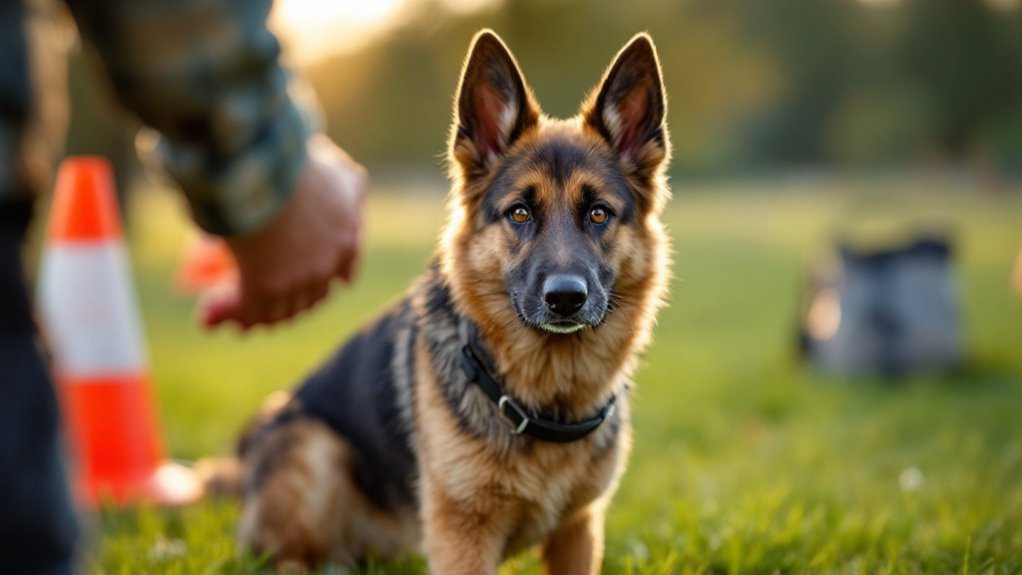
Your adolescent German Shepherd‘s sudden disobedience stems from neurological rewiring between 8 and 18 months, not willfulness—heightened prey drive and independence flood his attention while obedience lapses. Combat this by replacing long sessions with three to six five-minute drills scattered daily, anchored to natural routines like before walks or after meals. Pair short, focused commands with immediate high-value rewards and consistent enforcement using long leads in progressively distracting environments. Mental enrichment through foraging and problem-solving addresses brain stimulation more effectively than extra exercise alone. Understanding these specific shifts reveals why adolescence demands a fundamentally different training structure than puppyhood.
- Key Takeaways
- What’s Happening Now: Why Adolescence Flips Your Dog’s Brain
- Reading Body Language and Spotting Overwhelm
- Mental Enrichment Over Extra Mileage: Why Foraging Works Better
- Managing Stubbornness and Refusal to Comply
- Building Reliable Recall in Distracting Environments
- Loose-Leash Walking and Handler Engagement
- Quick Disengagement From Other Dogs
- Calm Greetings: Meeting People Without Jumping
- Short, Frequent Training Sessions: Why Scattered 5-Minute Drills Work
- Long Leads and E-Collars: Temporary Tools for Training Reliability
- Socialization During Adolescence: Building on Puppy Foundations
- Frequently Asked Questions
- Conclusion
Key Takeaways
- Use three to six five-minute training drills scattered throughout the day instead of one long session.
- Never give a command unless you can immediately enforce it with a long lead or backup tool.
- Watch for overwhelm signals like panting, yawning, and lip-licking; end sessions before the dog shuts down.
- Practice recall on a long lead (10–30 meters) in gradually more distracting environments to build reliability.
- Provide mental enrichment through problem-solving challenges; physical exercise alone cannot tire an adolescent’s brain.
What’s Happening Now: Why Adolescence Flips Your Dog’s Brain
Watching your German Shepherd shift from a clingy puppy into an independent adolescent can feel like someone’s flipped a switch in your dog’s brain, and in many ways, that’s exactly what’s happening.
Around 8 months old, hormonal and cognitive changes trigger a marked changeover, transforming your velcro companion into a more autonomous, reactive adolescent dog. Your pup’s sleep decreases, hyperactivity increases, and previously reliable obedience suddenly lapses as environmental distractions flood their attention.
Around 8 months, hormonal shifts transform your velcro puppy into an autonomous, reactive adolescent as obedience lapses and distractions take over.
New fears emerge alongside stronger prey and social drives, making recall unreliable around other dogs and causing stubborn resistance to leaving the park.
This phase typically peaks between 8 and 18 months, though intermittent teen behaviors can linger. Understanding these neurological shifts lets you adjust expectations and rebuild reliability through focused training across increasingly demanding environments.
Reading Body Language and Spotting Overwhelm
As your adolescent German Shepherd encounters new people, environments, and training demands, their body will broadcast stress signals long before behavior breaks down, and learning to read these cues lets you step in before your dog hits a tipping point. Your dog’s body language reveals their internal state through consistent, recognizable patterns that shift with arousal and stress levels.
| Stress Signal | What It Looks Like | What It Means | Your Next Step |
|---|---|---|---|
| Panting, yawning, lip-licking | Rapid breathing, jaw movements, tongue flicks | Overwhelm building | Reduce session length, increase distance |
| Tucked tail, pinned ears, avoided eye contact | Lowered body, rear shift, looking away | Fear or stress present | Provide distance, remove trigger |
| Stiff posture, raised hackles, fixed stare | Tense muscles, bristled fur, locked focus | High arousal or predatory focus | Step back, use calming cues |
| Shortened attention, refusal of handling | Quick distraction, resistance to touch | Developmental overwhelm | End positively, offer choices |
Notice when your dog deviates from previously relaxed behaviors, as these changes signal mounting pressure rather than disobedience. Use proactive management by ending sessions on positive notes and offering movement choices when you spot micro-signals like brief lip-licks or flank turning, preventing escalation before it occurs.
Mental Enrichment Over Extra Mileage: Why Foraging Works Better
You’ve likely noticed that your adolescent German Shepherd still has energy after a long run, which signals that physical exercise alone won’t tire their brain or build the focus you need for reliable training.
Foraging—hiding meals around your home or yard and letting your dog search—taps into their natural problem-solving drive far more effectively than extra mileage, creating mental fatigue that translates directly into better impulse control and attention during obedience work.
In the sections ahead, you’ll learn why physical tiredness and mental tiredness work differently, how to set up foraging routines that stick, and which games build the kind of focus that holds up when distractions appear.
Why Physical Exercise Isn’t Enough
Many owners assume that an adolescent German Shepherd‘s stubbornness, hyperactivity, and destructive behavior stem from insufficient physical exercise, so they add extra miles to daily runs or extend play sessions—yet the real issue is often mental understimulation, not physical tiredness. Experienced trainers recognize that your dog’s developing brain requires problem-solving challenges more than endurance building. A tired body doesn’t guarantee a calm mind; in fact, under-stimulated adolescents often channel excess mental energy into zoomies, chewing, and ignoring commands.
Your German Shepherd’s 8–18 month independence phase demands cognitive engagement through short, focused tasks rather than longer physical activity. By prioritizing mental enrichment, you’re addressing the hormonal and behavioral drivers behind teenage disobedience, creating genuine calm instead of exhaustion.
Building Mental Fatigue Through Foraging
Redirecting your German Shepherd’s mental energy through foraging activities works far more effectively than simply adding miles to daily runs, because problem-solving and scent work engage the brain’s attention circuits in ways that physical exhaustion alone cannot.
Hide meals or kibble in 10–20 small caches throughout your house or yard, converting one feeding into a 30-minute search session that addresses both enrichment and dog behaviour concerns like destructiveness and hyperactivity.
Structured “find it” games with progressively difficult hides—behind furniture, under towels, inside boxes—build focus and impulse control while replicating the cognitive challenge lost through exercise-only routines.
Rotating foraging formats such as snuffle mats, scatter feeding, and food-stuffed Kongs prevents habituation, maintaining mental engagement without increased cardiovascular demand.
Practical Enrichment Games For Adolescents
Adolescent German Shepherds possess enough physical stamina to run for hours, yet they’ll still destroy furniture, ignore commands, and display reactive behavior because their brains aren’t getting adequate stimulation—a gap that extra mileage alone can’t fill.
Foraging games scatter kibble in grass or hide food across multiple rooms, engaging scent-driven hunting instincts far more effectively than running equivalent distances.
“Find it” drills build problem-solving by starting with visible toys, then progressively hiding them in short 3–5 minute bursts matching your dog’s mental stamina.
Toy differentiation—teaching names for ball versus tug, then rewarding correct choices—enhances discrimination and sustained attention, reducing stubborn refusal.
These dog training tips combine physical play with immediate mental puzzles, channeling adrenaline into cognitive tasks and preventing reinforcement of ignoring commands.
Managing Stubbornness and Refusal to Comply
Your adolescent German Shepherd‘s refusal to comply—especially in distracting environments like parks—stems from developmental stubbornness and the reward value of ignoring you, which means you can’t enforce a consequence on the spot and the dog learns that refusing works.
You’ll need to establish real enforcement by practicing commands only when you can follow through immediately, using long leads or e-collars in progressively challenging settings, paired with high-value rewards the instant he obeys to rebuild his motivation to listen.
Consistency matters most here: every time you give a cue, you must be prepared to guarantee compliance, because each unrewarded refusal reinforces his stubbornness and teaches him your commands are optional suggestions rather than non-negotiable structure.
Understanding Adolescent Stubbornness Triggers
When your German Shepherd suddenly refuses to come at the dog park or sits down mid-walk and won’t budge, you’re likely witnessing adolescent stubbornness—a normal developmental phase that typically emerges around 8 months and can persist until roughly 18 months of age. This isn’t defiance; it’s biology. Hormonal surges, increased independence, and competing social or prey drives overwhelm your dog’s ability to focus on you, even if previously reliable commands suddenly fail. Understanding these triggers helps you respond strategically rather than emotionally. Professional dog trainers often emphasize that setbacks during this period are temporary, not character flaws. Your adolescent’s brain is reorganizing, and consistency from you prevents reinforcement of noncompliant behavior.
| Trigger | Context | Response |
|---|---|---|
| High-value distractions | Dog parks, other dogs | Use long lead initially |
| Hormonal peaks | Natural developmental surge | Expect temporary setbacks |
| Independence drive | Off-leash freedom | Proof commands first |
| Social motivation | Peer interaction | Manage environment closely |
| Prey focus | Moving stimuli present | Redirect with rewards |
Enforcement and Consistent Follow-Through
Enforcement means you don’t give a command unless you’re prepared to follow through with a consequence, because adolescent German Shepherds will test your resolve by “planting”—refusing to move or comply—when they sense uncertainty in your commitment.
Every time you issue a cue without enforcing it, you reinforce the behavior of ignoring you, which deepens the problem. Your adolescent learns that noncompliance sometimes works, so he’ll keep trying.
Consistency across all handlers matters equally; mixed signals from family members teach him to comply selectively.
Short training sessions with clear consequences—quiet waits, removed access, or brief timeouts—rebuild compliance faster than lengthy corrections. Follow through reliably on every command you give, and you’ll stop reinforcing stubbornness before it hardens into habit.
High-Value Rewards and Motivation
High-value rewards become essential when an adolescent German Shepherd has learned that ignoring you sometimes pays off, because ordinary kibble or mild praise won’t outweigh the excitement of a distraction—a playful dog, an interesting smell, or the freedom of an open park.
Pet parents must use real food like cheese, boiled chicken, or hotdogs exclusively during proofing sessions to create genuine motivation. Deliver treats within one second of compliance, paired with an enthusiastic verbal marker, so your dog connects obedience directly to the payoff.
Early training demands frequent rewards for every correct response; as reliability improves in distracting environments, you’ll gradually shift to intermittent schedules and eventually substitute play or high-value toys, maintaining that stronger reinforcement structure throughout.
Building Reliable Recall in Distracting Environments
Because your German Shepherd’s recall will fail under real-world pressure unless you’ve systematically prepared for it, you’ll want to start with a long lead—typically 10 to 30 meters—in gradually more distracting environments before you ever trust off-leash work. A lot of practice across multiple sessions builds the consistency you need, and you’ll deliver rewards at your dog’s location to prevent running past you. Short, frequent drills—5 to 10 reps daily—with progressive distance and distraction increases work better than expecting immediate generalization.
| Training Phase | Environment | Lead Length |
|---|---|---|
| Foundation | Quiet yard | 10 meters |
| Intermediate | Park edges | 20 meters |
| Advanced | High distraction | 30 meters |
Never ask for recall unless you can enforce it with a long lead or backup tool, calmly retrieving and rewarding compliance.
Loose-Leash Walking and Handler Engagement
While reliable recall gives you confidence that your German Shepherd will return on command, loose-leash walking builds the foundation for everyday handling and teaches your dog that staying connected to you—rather than pulling ahead or lagging behind—is rewarding.
During adolescence, your GSD will test boundaries and chase distractions, so keep training sessions brief, around three to five minutes, before engagement drops.
Use high-value rewards to reinforce eye contact and quick check-ins within one second, teaching your dog to follow your speed and direction.
When your dog plants or refuses to move, stop and wait silently until slack returns; this shows that pulling produces no reward.
Proof these skills progressively by adding distance, duration, and distractions over time.
Quick Disengagement From Other Dogs
As your German Shepherd moves through adolescence, the pull to engage with other dogs grows stronger, making it essential that you build a reliable disengagement cue before your dog’s social drive overrides your commands.
Start teaching “leave” or “look” at home using games that reward your dog for turning attention away from distractions, then gradually introduce other dogs in controlled settings like quiet parks.
Practice short drills daily, reinforcing the cue with high-value treats so your GSD becomes comfortable around other dogs while remaining responsive to you.
Use a long line during this phase to prevent rehearsal of unwanted behavior, and proof the disengagement across different locations and dog types, because adolescent German Shepherds need consistent, repeated reinforcement to generalize this critical skill reliably.
Calm Greetings: Meeting People Without Jumping
Jumping during greetings is one of the most common and persistent challenges with adolescent German Shepherds because their growing size, social excitement, and natural instinct to seek attention create a perfect storm of unwanted behavior, especially when visitors reward jumping with attention—even negative attention like scolding or pushing the dog away.
Instead, you’ll teach an alternative greeting by practicing “sit” or “touch” indoors, then proofing it outdoors with varied people and distractions. Use high-value treats delivered the moment all four paws stay grounded, gradually phasing out rewards as consistency improves.
Enlist helpers to simulate real scenarios, ignoring jumping and rewarding only calm behavior. Manage your environment with leashes and gates to prevent rehearsal, combine training with adequate physical exercise, and maintain short, frequent sessions throughout adolescence when impulsivity peaks.
Short, Frequent Training Sessions: Why Scattered 5-Minute Drills Work
Your adolescent German Shepherd‘s brain doesn’t work like an adult dog’s—it can’t sustain focus for long training blocks without mental fatigue setting in, so you’ll get better results from three to six brief, five-minute sessions scattered throughout your day than from one or two lengthy workouts.
By training in short bursts across different times and locations, you build consistency and reinforcement without overwhelming your dog’s developing attention span, which naturally resists boring repetition and environmental distractions.
This scattered approach lets you catch your dog in a focused state, reward compliance quickly, and move on before boredom triggers stubbornness or ignoring behavior.
Mental Stamina Over Extended Sessions
When you’re training an adolescent German Shepherd, a single thirty-minute session will likely exhaust their mental capacity long before it exhausts your patience, leaving you with a frustrated, shutdown dog rather than a learner who’s ready to absorb new information.
Instead, you’ll find it’s easier to teach using four to six scattered five-minute drills throughout the day, which align with how your dog’s brain actually functions during adolescence. Each brief session delivers ten to twenty focused repetitions without triggering boredom or cognitive overload, while spacing sessions across different environments—hallway, yard, park entry—builds proof under varied distractions.
This structure, combined with immediate reinforcement and high-value rewards, makes learning feel like play rather than work, transforming teenage stubborn refusals into consistent engagement and genuine progress.
Building Focus Through Scattered Practice
Through scattered five-minute drills spread across your day, you’ll build genuine focus in your adolescent German Shepherd far more reliably than longer, consolidated sessions ever could, because these brief, frequent repetitions match how your dog’s developing brain actually learns and retains information.
Many people think one intensive training block accomplishes more, yet adolescent dogs fatigue mentally faster and lose engagement when pushed too long.
Instead, you’ll space three to five short drills throughout morning, afternoon, and evening, rotating between recall, sit-stay, and toy discrimination tasks.
This approach prevents boredom-driven refusal while creating multiple reinforcement opportunities daily.
Each drill uses a single clear cue repeated eight to twelve times, ensuring predictable success that strengthens neural pathways and builds reliable focus across varied environments without mental overload.
Training Frequency Across Daily Routines
The most effective training schedule for adolescent German Shepherds isn’t built around one long session each day, but rather spread across four to eight brief drills woven into your existing routines, because your dog’s developing brain consolidates learning through frequent, spaced repetitions rather than through marathon practice blocks.
You’ll anchor these 3–7 minute sessions into natural shifts: before walks, after meals, at door exits, during outdoor time. This predictable structure works whether you’re training a new puppy or an adolescent, embedding expectations into daily life without requiring extra time.
Variable reinforcement—treats, play, praise—maintains motivation across sessions. By rotating specific drills like recall, leave-it, and impulse control, you build consistency while preventing mental fatigue, allowing your dog’s focus to sharpen incrementally rather than diminish.
Long Leads and E-Collars: Temporary Tools for Training Reliability
As your German Shepherd moves through adolescence, you’ll likely discover that known commands—like recall and disengagement—suddenly feel unreliable in high-distraction environments such as parks or around other dogs, and that’s when two tools become especially useful: the long lead and the e-collar.
| Tool | Purpose | Timeline |
|---|---|---|
| Long Lead (15–30m) | Maintains physical control while allowing exploration | Weeks to months |
| E-Collar | Reinforces commands when ignored during high distraction | Last-resort backup |
| Consistency | Builds reliable response across environments | Ongoing |
A 15–30 meter long lead lets your dog explore safely while you maintain immediate control, preventing off-leash failures. An e-collar, used only after professional instruction, adds remote reinforcement when your adolescent ignores commands. Pair high-value treats with correct responses, then gradually fade both tools as reliability improves, typically around 18 months when your dog demonstrates consistent off-leash response. Your dog walker should understand this phased approach.
Socialization During Adolescence: Building on Puppy Foundations
Continuing your German Shepherd’s social development past puppyhood requires deliberate effort because adolescence—roughly 8 to 18 months—brings a natural shift toward independence and heightened prey drive that can undo early manners if you’re not consistent.
Adolescence demands consistent socialization effort—German Shepherds’ natural independence and prey drive can quickly erase early training gains without deliberate reinforcement.
Expert advice emphasizes short, positive exposures to varied dogs, people, and environments rather than long uncontrolled play sessions, since recall and disengagement become unreliable around other dogs during this phase.
Before attempting off-leash interactions, proof social skills by practicing quick disengagement and reliable recall on a long lead in low-distraction areas.
During social outings, use short training games like find-it or brief obedience drills to maintain focus and reinforce calm approaches.
This structured approach prevents regression while your dog’s independence naturally increases.
Frequently Asked Questions
How Long Does the Teenage Phase Last in German Shepherds?
Your German Shepherd’s teenage phase typically lasts from around 8 months to 18 months old. You’ll notice marked improvement by 18 months, though you shouldn’t expect full maturity until 2–3 years.
How to Tell Who a German Shepherds Favorite Person Is?
Studies show 73% of German Shepherds develop primary attachments to their primary caregiver. You’ll identify your dog’s favorite person by observing who they follow consistently, seek during stress, and obey most reliably during distracting situations.
What Not to Do to a German Shepherd?
Don’t force off-leash freedom before proven recall. Don’t repeatedly command what you can’t enforce. Don’t skip handling desensitization for vet visits. Don’t rely solely on exercise to fix behavior. Avoid these during adolescence, and you’ll prevent frustration.
What Is the Behavior of an Adolescent German Shepherd?
You’ll notice your adolescent German Shepherd becoming increasingly independent and distractible around 8 months. They’re developing stronger prey drive, showing inconsistent obedience, heightened reactivity to environmental triggers, and unreliable recall—especially near other dogs.
Conclusion
You’re steering your adolescent German Shepherd through a phase like piloting a ship through shifting currents—constant adjustment keeps you on course. The strategies you’ve learned work because they address what’s actually happening in your dog’s developing brain, not what you wish were happening. Stay consistent with structure, mental enrichment, and clear boundaries, and you’ll transform this challenging phase into a foundation for a reliable adult dog.