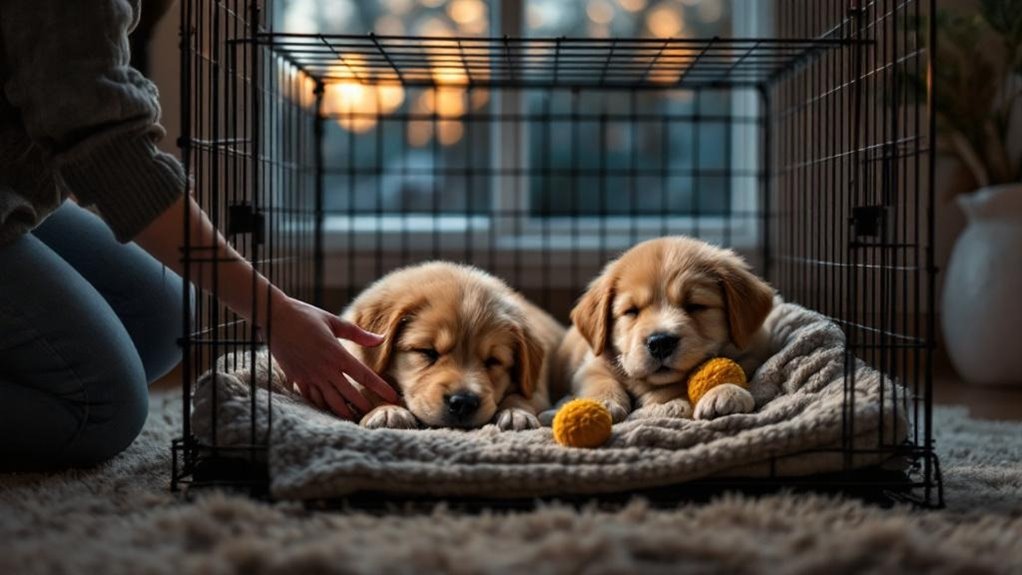
Stop Crying Before It Starts. Large breed puppies cry from separation anxiety, not manipulation—so don’t reward it by opening the crate. Instead, tire them out first: exercise depletes energy and reduces anxiety. Use proper sizing (30-42 inches), schedule potty breaks 15-30 minutes after meals, and feed inside the crate to build positive associations. Establish consistent routines; predictability calms growing dogs instinctively. Reward silence, not noise. This strategic approach prevents crying rather than endures it—discover exactly how to execute each step.
- Key Takeaways
- Why Large Breed Puppies Need Crate Training
- Why Puppies Cry in Crates (and Why You Shouldn’t Give In)
- Choose the Right Crate Size for Your Large Breed Puppy
- Set Up Your Crate in a Smart Location
- Tire Out Your Puppy Before Crating (It Works)
- Establish a Feeding Schedule to Control Bathroom Needs
- Build a Bathroom Schedule Around Crate Time
- When to Crate Your Puppy to Minimize Crying
- Crate Training Success Starts With Positive Associations
- Introduce the Crate With Treats and Calm Exploration
- Feed Meals Inside the Crate to Build Comfort
- Use Bedding and Comfort Items Strategically
- Cover the Crate to Reduce Environmental Overstimulation
- Practice Short Daytime Sessions Before Overnight Crating
- How to Respond When Your Puppy Stays Calm
- Increase Crate Duration Gradually for Large Breed Puppies
- Why Ignoring Whining Actually Stops It
- Is Your Puppy Crying or Genuinely Anxious?
- Teach Your Puppy the ‘Kennel’ Command for Easy Crating
- Stick to Your Routine: It’s What Stops the Crying
- Track Progress: What Improvement Looks Like Week by Week
- 5 Owner Mistakes That Make Crate Training Harder
- Alternative Confinement Options If Crating Isn’t Working
- When Your Puppy’s Behavior Signals a Need for Professional Help
- Managing Your Expectations: Realistic Timelines for Large Breed Puppies
- Frequently Asked Questions
- Conclusion
Key Takeaways
- Start crate training early with short sessions and positive reinforcement to build comfort before separation anxiety develops.
- Avoid reinforcing crying by never opening the crate during distress; reward calm behavior instead to discourage the pattern.
- Use properly sized crates (30-42 inches for large breeds) with soft bedding and familiar scents to create security.
- Schedule potty breaks 15-30 minutes after meals and avoid feeding 2-3 hours before crating to prevent urgent bathroom needs.
- Establish consistent daily routines for feeding, exercise, and crating to reduce anxiety and foster predictable, positive crate associations.
Why Large Breed Puppies Need Crate Training
Because your rapidly growing puppy can’t tell the difference between a chew toy and your favorite shoe, crate training isn’t just helpful—it’s essential.
Large breed puppies grow rapidly—sometimes gaining 100+ pounds in their first year—making supervision challenging.
Safety & Destructive Behavior Prevention
Crate training creates a secure space preventing injury during destructive phases.
Crate training provides a secure sanctuary that prevents injury while your puppy navigates destructive developmental phases.
Your puppy’s instincts kick in naturally: dogs avoid soiling sleeping areas, which accelerates housebreaking through routine bathroom breaks.
Emotional Well-Being
Your puppy develops a calm sanctuary—a safe refuge reducing anxiety during changes.
This emotional anchor helps them adapt to travel, vet visits, and changes.
The Bottom Line
Consistent crate training transforms your large breed puppy’s behavior and mental health, establishing boundaries that protect both your home and your growing companion.
Why Puppies Cry in Crates (and Why You Shouldn’t Give In)
Your puppy’s cries aren’t manipulation—they’re survival instincts kicking in.
You’ve got to understand what’s actually driving those tears: anxiety, loneliness, or their natural need to keep their den clean.
Here’s the tough love: giving in teaches them crying works, but staying calm and letting them settle builds the resilience they’ll need as a large, powerful adult dog.
Understanding The Root Causes
When your large breed puppy wails in their crate, they’re not being dramatic—they’re communicating real discomfort.
Your puppy experiences several root causes triggering this vocalization:
- Separation anxiety — Your pup fears abandonment, activating their survival instinct.
- Unfamiliar environment — The crate feels foreign, triggering uncertainty responses.
- Bathroom urgency — Their developing bladder demands immediate relief.
- Excess energy — Pent-up physical tension seeks release through noise.
Large breed puppies possess heightened sensitivity during developmental stages. Their brains haven’t yet learned that crates equal safety.
Understanding these root causes prevents you from accidentally rewarding crying through attention or release.
Puppies instinctively vocalize distress—it’s biological communication, not manipulation. Your job? Remain patient and consistent.
They’ll eventually recognize their crate as sanctuary rather than prison.
Resisting Reinforcement Traps
you hear that heart-wrenching cry, you feel guilty, and you let them out—teaching your pup that crying works like a magic key.
You’ve just reinforced the exact behavior you’re trying to eliminate.
Why You Must Resist
Large breed puppies naturally communicate through vocalization.
When you respond to crying, you’re accidentally rewarding it. Your puppy learns: *crying = freedom*.
This cycle strengthens the behavior, making crate training harder.
The Smart Strategy
Ignore whining unless it signals a genuine need.
Instead, reward calm behavior with praise and treats.
Establish a consistent routine—puppies feel secure with predictability.
Combine gradual desensitization with positive reinforcement. Your pup learns the crate reduces anxiety, not causes it.
Stay strong. Resisting reinforcement traps today means peaceful confinement tomorrow.
Building Long-Term Comfort
Large breed puppies need time to develop positive associations with their crate. Your consistency creates security.
What Creates Long-Term Comfort:
- Proper crate sizing prevents anxiety and claustrophobia—puppies need space to stand and turn around.
- Soft bedding and familiar scents establish emotional safety within their secure space.
- Gradual exposure through short, rewarding sessions builds confidence systematically.
- Scheduled potty breaks before crating eliminate physical desperation.
When you resist giving in, you’re teaching your puppy that patience—not panic—works. Crying diminishes over time as their brain recalibrates.
Building long-term comfort means establishing the crate as refuge, not punishment. Your patience today prevents years of anxiety tomorrow.
Choose the Right Crate Size for Your Large Breed Puppy
Three critical measurements—length, width, and height—determine whether your puppy’s crate becomes a cozy den or an uncomfortable cage.
The Sweet Spot: 30-42 Inches
You’ll want a crate large enough for your pup to stand, turn around, and lie down comfortably. Most large breed puppies thrive in 30-42 inch crates, depending on their breed’s adult size.
Too-spacious crates backfire: puppies eliminate in one corner, sleep in another—defeating housetraining goals.
Smart Strategy: Go Adjustable
Consider adjustable crates that grow with your puppy. They maintain that snug, den-like feeling while accommodating rapid growth.
Build It Strong
Choose metal wire or heavy-duty plastic—large breeds chew relentlessly. Sturdy construction withstands their developing strength and destructive tendencies, ensuring your investment lasts years.
Set Up Your Crate in a Smart Location
Now that you’ve got the right-sized crate—sturdy and ready for action—location becomes your next game-changer.
Where you place your crate dramatically impacts your puppy’s success. Your large breed pup needs a sanctuary—not a spotlight. Think strategically about positioning.
Where you place your crate dramatically impacts your puppy’s success. Your large breed pup needs a sanctuary—not a spotlight.
Smart Crate Placement:
- Low-traffic zones: Position your crate in family rooms or offices, away from chaos and commotion.
- Visibility matters: Keep it where your puppy sees and hears you—this builds security and trust.
- Avoid high-traffic areas: Entrances and hallways trigger startle responses with sudden noises and movements.
- Den-like coverage: Drape a light blanket over the crate, reducing visual overstimulation that causes anxiety.
As your puppy grows, gradually move the crate to different locations.
This builds confidence in unfamiliar spaces while maintaining emotional security.
You’re fundamentally teaching your large breed dog that safety travels with them—anywhere, anytime.
Tire Out Your Puppy Before Crating (It Works)
You’ve probably noticed that a worn-out puppy settles faster in the crate—and there’s solid science backing this up.
The key is matching the right exercise types to your large breed’s needs, timing those activities strategically before crate time, and staying alert to your puppy’s energy signals.
Let’s explore how you can turn pre-crating exercise into your secret weapon for crate training success.
Exercise Types For Large Breeds
A tired puppy is a calm puppy—and that’s exactly what you want before crating.
Large breed puppies have incredible energy levels. They need specific exercise types to properly exhaust themselves. Here’s what works:
- High-energy games like fetch and tug-of-war burn massive calories quickly.
- Brisk walks or jogs (30+ minutes daily) tire muscles and minds simultaneously.
- Mental stimulation activities—puzzle toys and training sessions—challenge their developing brains.
- Supervised dog playtime encourages socialization while providing a physical outlet.
As your puppy grows, gradually intensify these activities.
A German Shepherd puppy needs different exercise than a Labrador, but both require consistent, vigorous movement.
Your large breed’s skeletal system develops until 18-24 months, so varied exercise prevents injury while building endurance.
The result? A genuinely exhausted puppy settles into their crate peacefully—no crying, no frustration.
Timing Exercise Before Crating
Before your puppy ever sees the inside of that crate, they should be genuinely tired—not just a little drowsy, but actually ready to rest.
You’ll want to schedule at least 30 minutes of vigorous exercise before crate time.
Why This Works:
Activities like fetch, brisk walks, or intense play sessions deplete pent-up energy. When your large breed puppy expends significant physical effort, their body naturally craves recovery. This biological need—not force—makes them settle quietly.
The Strategic Approach:
Combine physical activity with mental stimulation through puzzle toys or training exercises. This dual engagement amplifies tiredness. Your puppy’s brain and muscles both work, creating genuine readiness for rest.
Building Consistency:
Establish a routine: exercise first, then crating. Your puppy learns that active play precedes quiet time, creating positive associations with their crate rather than viewing it as punishment.
Monitoring Puppy Energy Levels
How do you know when your puppy’s actually tired enough for the crate?
Reading Your Puppy’s Signals
You’ll notice clear signs your large breed pup is genuinely exhausted. Here’s what to watch for:
- Slower movements and decreased interest in toys
- Heavy panting that gradually slows down
- Seeking out comfortable spots independently
- Yawning repeatedly and blinking slowly
The Right Amount of Time
Most large breed puppies need 30-60 minutes of vigorous activity beforehand. This isn’t just running around—it’s structured play like fetch or tug-of-war that truly depletes their energy reserves.
Their brain chemistry genuinely shifts during intense exercise. Endorphins release, naturally calming them down.
When you monitor this amount of time consistently, your puppy learns to expect rest after exertion.
Watch their individual energy patterns. Some puppies crash faster than others. You’re effectively reading your puppy’s personal fatigue meter—adjusting exercise accordingly guarantees smoother crate changes.
Establish a Feeding Schedule to Control Bathroom Needs
When you establish a feeding schedule, you’re controlling when your puppy needs bathroom breaks. Large breed puppies digest food within 4–6 hours, so timing matters tremendously.
Here’s the strategy: avoid feeding your pup within 2–3 hours before crating. This prevents urgent bathroom needs right after confinement.
Additionally, monitor water intake by removing the bowl an hour before crating. Watch your puppy’s individual patterns closely. Every pup differs. Notice when they typically eliminate after eating, then schedule crate time accordingly.
This predictability reduces accidents dramatically and builds confidence during training.
Build a Bathroom Schedule Around Crate Time
You’ll want to establish predictable feeding times—feeding your large breed puppy at the same hours each day creates a reliable biological clock for elimination.
Monitor elimination patterns closely by tracking when your puppy goes potty after meals, since puppies typically need to eliminate within 15 to 30 minutes of eating.
Align your crate schedule strategically around these patterns so you’re taking your pup outside before accidents happen, keeping crate time under 3-4 hours for puppies under 6 months old.
Establish Predictable Feeding Times
Since your large breed puppy‘s digestive system works like clockwork, feeding at consistent times—ideally 2-3 times daily—lets you predict almost exactly when they’ll need to go potty.
This predictability transforms house training. You’ll know precisely when bathroom breaks should happen, making crate training far more effective.
Here’s why timing matters:
- Eliminates guesswork about when accidents might occur
- Reduces crate anxiety by meeting elimination needs first
- Strengthens the crate-comfort connection through successful routines
- Creates security through predictable patterns your puppy understands
Align meals with crate schedules. Feed, then immediately take your puppy outside for bathroom breaks before crating. This reinforces that the crate is a clean, comfortable space—not a prison.
Your consistency builds trust.
Puppies thrive on predictability, and you’re fundamentally teaching them: “After eating comes outdoor time, then crate rest.”
That’s a powerful house training foundation.
Monitor Elimination Patterns Closely
| Activity | Time After Event | Frequency |
|---|---|---|
| Post-meal bathroom break | 15-30 minutes | Every feeding |
| After drinking water | 10-20 minutes | Multiple daily |
| Post-playtime relief | 20-30 minutes | After sessions |
| Before crate time | Immediately prior | Every 2-3 hours |
| Upon waking | First thing | Every instance |
Large breed puppies’ bladders develop gradually. At eight weeks, they can’t hold it longer than two hours—that’s biology, not misbehavior. You’ll adjust this schedule as your puppy matures, eventually spacing breaks further apart.
Align Crate Schedule Strategically
Building a bathroom schedule around crate time is where training success truly happens.
Your large breed puppy’s bladder capacity grows weekly—roughly one hour per month of age. You’ll align crate schedule strategically by coordinating feeding, water access, and bathroom breaks into one predictable routine.
Smart Scheduling Strategies:
- Feed your puppy at consistent times daily, then crate them 15-30 minutes later.
- Limit water intake 2-3 hours before crating to prevent urgent elimination needs.
- Take them outside immediately before entering the crate—this reinforces the bathroom-outside connection.
- Gradually extend crate duration as bladder control improves.
Why This Works: Puppies naturally eliminate after eating and drinking. By controlling these triggers, you’re effectively predicting when they’ll need bathroom breaks.
This predictability transforms crate time from stressful to manageable. Your pup learns: crate means rest, not panic.
When to Crate Your Puppy to Minimize Crying
Timing is everything when introducing your puppy to the crate. You’ll dramatically reduce crying by crating your puppy during naturally calm periods—think post-nap or after meals. Your pup’s nervous system relaxes after eating; their body naturally winds down. Here’s your strategic timing guide:
| Time of Day | Puppy State | Crying Risk |
|---|---|---|
| After meals | Digesting, drowsy | Very low |
| Post-play session | Tired, content | Very low |
| Mid-afternoon | Energy dip | Low |
| After potty breaks | Relieved, calm | Low |
| High-energy moments | Overstimulated, anxious | Very high |
Pro tip: Always empty your puppy’s bladder first. A full bladder triggers discomfort and increased vocalization. Consistency matters too—crate at identical times daily so your large breed anticipates the routine.
Crate Training Success Starts With Positive Associations
You’re about to discover that your large breed puppy’s entire crate experience hinges on one vital factor: positive associations.
By pairing the crate with treats, praise, and rewards, you’ll transform it from a confining space into your pup’s favorite hangout spot.
The key? Making your puppy choose to enter willingly—because when *they* decide the crate’s awesome, you’ve already won half the battle.
Building Trust Through Treats
The foundation of successful crate training rests on one powerful principle: positive association.
You’re fundamentally rewiring your large breed puppy’s brain—creating new neural pathways that link the crate with joy, not fear.
Here’s how treats transform your training:
- High-value rewards (chicken, cheese, special treats) make crates irresistible magnets.
- Gradual progression builds confidence while your puppy stays relaxed and close to safety.
- Consistent timing reinforces that good behavior earns immediate rewards.
- Selective reinforcement strengthens calm behavior patterns over anxious ones.
Start by placing premium treats near the crate entrance.
Gradually move them deeper inside during feeding sessions. Your puppy learns: crate equals delicious things happening.
Watch for relaxed body language—soft eyes, slow movements. That’s your signal to reward heavily.
You’re not bribing; you’re building trust one treat at a time.
Creating A Safe Haven
Your puppy’s crate isn’t a cage—it’s a bedroom, a den, a sanctuary. Creating a safe haven starts with selecting the right size: your large breed puppy needs enough space to stand, turn, and stretch comfortably.
| Element | Purpose |
|---|---|
| Proper sizing | Prevents anxiety and claustrophobia |
| Soft bedding | Mimics den-like comfort |
| Low lighting | Triggers natural calming responses |
| Quiet location | Reduces overstimulation |
| Accessible entry | Encourages voluntary exploration |
Position the crate away from chaos. Line it with blankets to create den-like comfort—dogs instinctively seek enclosed spaces for security. Add a favorite toy inside. Leave the door open initially, letting curiosity guide exploration.
Your puppy’s brain releases calming neurochemicals in secure environments. That’s biology working for you. Patience transforms the crate from intimidating box into your pup’s favorite retreat.
Introduce the Crate With Treats and Calm Exploration
When you’re ready to start crate training, timing and patience are everything. Your large breed puppy needs to view the crate as a haven, not a prison. Here’s how to introduce the crate with treats and calm exploration using positive reinforcement:
- Place treats inside the crate for your puppy to discover independently.
- Gradually move treats deeper to encourage full exploration at their pace.
- Keep sessions short to prevent stress or feelings of confinement.
- Reward calm behavior with praise and gentle encouragement consistently.
Position the crate in a quiet area where your puppy feels safe. Allow voluntary entry and exit without forcing anything.
Your puppy’s body language tells the story—watch for relaxed ears and natural curiosity. This foundation builds lasting comfort and trust with their new space.
Feed Meals Inside the Crate to Build Comfort
You’ll transform your puppy’s crate from a confinement space into a dining destination—one that builds genuine comfort and trust.
By establishing consistent mealtime routines inside the crate, you’re leveraging your puppy’s natural food motivation (a biological drive hardwired into their survival instincts) to create powerful positive associations.
Ready to discover how strategic food placement and interactive feeders can turn every meal into a confidence-building opportunity?
Positive Associations Through Feeding
Your large breed puppy‘s brain forms lasting connections between places and experiences. When you feed meals inside the crate, you’re literally rewiring how your pup perceives this space. Instead of viewing it as confinement, they’ll see it as their personal dining room—and safe haven.
Here’s why this strategy works so well:
- Builds comfort gradually by moving the food bowl deeper into the crate
- Enhances rewards using food-dispensing toys for mental stimulation
- Establishes routine that reinforces calmness and relaxation
- Relieves anxiety by replacing fear with positive memories
Consistent feeding schedules create predictable patterns your puppy craves. They’ll anticipate mealtime excitement rather than dread crate time.
This biological response—associating safety with food—taps into your pup’s natural instincts, making crate training feel natural and rewarding.
Gradual Food Placement Progression
The magic happens when you move your puppy’s bowl—one small step at a time. Start by placing the food bowl just outside your crate’s entrance. Your puppy explores naturally, associating the crate with something wonderful: meals.
The Progressive Journey
Each day, move that food bowl slightly deeper inside. This gradual progression—called systematic desensitization in dog training—reduces anxiety without overwhelming your pup.
Within a week, the bowl sits at the crate’s back.
Keep the Door Open Initially
Your puppy eats comfortably without feeling trapped. This builds trust.
Once your large breed puppy consistently enters freely, you’ll notice increased confidence and curiosity.
Consistency Creates Comfort
Feed at the same times daily. Puppies thrive on routine.
Regular meals in the crate transform it from unknown territory into their favorite dining destination—a safe haven they choose voluntarily.
Mealtime Routine Establishment Strategy
Once your puppy confidently enters the crate, it’s time to transform mealtimes into your secret weapon for building lasting comfort.
Your mealtime routine establishment strategy becomes the foundation for feeding large breed puppies successfully. Consistency matters tremendously here. You’re literally rewiring your puppy’s brain—associating the crate with positive experiences, not confinement.
Here’s what works:
- Feed at scheduled times daily to establish predictable routines your puppy anticipates
- Use high-value treats or meal replacement toys to boost engagement and excitement
- Start with short sessions, gradually extending duration as confidence builds
- Place the dish deeper inside progressively, encouraging natural exploration
Large breed puppies develop rapidly—their bones need proper nutrition timing. By feeding consistently in the crate, you’re creating a safe feeding zone.
Your puppy learns: “The crate means good things happen here.” That’s powerful psychology working in your favor, transforming anxiety into anticipation naturally.
Use Bedding and Comfort Items Strategically
Making your puppy’s crate feel like a cozy den—not a cage—transforms how they view confinement.
Select Durable Bedding
Large breed puppies chew. A lot. Choose bedding that withstands their powerful jaws while providing warmth and support for growing bodies. Orthopedic foam mattresses work wonderfully—they cushion developing joints and resist shredding.
Layer in Familiarity
Place a worn blanket or favorite toy inside. These familiar scents reduce anxiety and trigger relaxation responses in your puppy’s brain. It’s biology: comfort items lower cortisol levels.
Create a Den Effect
Add a crate cover to darken the space. This den-like environment—mimicking ancestral wolf dens—encourages natural settling behaviors.
Maintain Hygiene
Replace bedding weekly. A fresh, inviting crate prevents negative associations and keeps your puppy healthy.
Strategic bedding transforms crating from stressful to safe.
Cover the Crate to Reduce Environmental Overstimulation
While comfortable bedding creates the foundation, adding a cover elevates your puppy’s crate into a genuine sanctuary.
When you cover the crate, you’re mimicking the den-like environments where dogs naturally feel secure. This approach taps into your puppy’s ancestral instincts—wolves and wild dogs seek enclosed spaces for protection and rest.
Creating Your Puppy’s Safe Haven
- Breathable blankets or specialized crate covers reduce visual distractions and dim bright lights.
- Adequate airflow prevents overheating while maintaining that cozy, secure atmosphere.
- Gradually introduce the cover during short sessions to build positive associations.
- Monitor your puppy’s reactions—calmness indicates the cover’s working effectively.
The science is straightforward: less environmental stimulation means lower anxiety levels.
Practice Short Daytime Sessions Before Overnight Crating
You’ve got to start small—literally—before your large breed puppy tackles overnight crating.
Short daytime sessions build the foundation: consistency in routine, positive associations with treats, and gradual duration increases keep stress at bay.
Your pup’s daytime success directly predicts nighttime rest, so you’re fundamentally training both the behavior and the confidence simultaneously.
Building Comfort Through Consistency
Before your large breed puppy spends a single night confined, they need practice—lots of it. Building comfort through consistency means establishing predictable routines in short periods of time.
Why Routine Matters
Your puppy’s brain craves predictability. Consistency triggers neurological changes that reduce anxiety and promote calm behavior.
- Feed at the same times daily
- Schedule bathroom breaks before crating
- Use identical crate placement in family areas
- Pair crating with positive rewards consistently
The Comfort Formula
You’re not just confining your puppy—you’re creating a safe den. Regular, short sessions teach them the crate means security, not punishment.
Position it where your family gathers. This proximity reassures them they’re not isolated.
Gradually lengthen sessions as comfort increases. Your patience now prevents crying later. Consistency transforms the crate from scary to sanctuary.
Gradual Duration Increases Matter
The key to crate success? You’ll start small—really small.
Your large breed puppy’s comfort grows when you increase crate time gradually. Begin with 10–15 minute daytime sessions. Why? Their developing brains need time to adjust. You’re building tolerance, not forcing it.
| Week | Session Length | Your Puppy’s Progress |
|---|---|---|
| 1–2 | 10–15 minutes | Learns crate isn’t scary |
| 3–4 | 20–30 minutes | Shows calm behavior |
| 5–6 | 45–60 minutes | Ready for overnight sessions |
Gradual duration increases matter because puppies’ nervous systems—their internal alarm systems—need adjustment time. Extend sessions by only 5–10 minutes when your pup shows zero distress signals.
Here’s what works: playtime before crating, bathroom breaks, consistent routines. Your puppy associates the crate with comfort, not confinement. That’s the breakthrough moment.
Daytime Success Ensures Nighttime Rest
Master daytime crating first—it’s your secret weapon for nighttime success. When you build daytime success guarantees nighttime rest, your large breed puppy’s nervous system actually adapts biologically. Short sessions rewire their stress response, making them calmer after dark.
Your Daytime Crate Strategy:
- Start with 10-15 minute sessions to let your dog relax gradually.
- Use treats and praise immediately—positive reinforcement creates neural pathways favoring the crate.
- Exercise your puppy beforehand; tired puppies sleep, not cry.
- Certify comfortable, secure setup that feels like a den (dogs’ ancestral safe spaces).
Why This Works
Daytime practice desensitizes your puppy to confinement. Their brain learns: crate equals safety, not abandonment. This biological shift prevents nighttime anxiety spirals.
You’re fundamentally teaching their amygdala (fear center) to stand down. Consistent daytime sessions? They’re non-negotiable for peaceful nights ahead.
How to Respond When Your Puppy Stays Calm
Your puppy’s brain releases dopamine—a “feel-good” chemical—when rewarded within two seconds of calm behavior. This neurological response strengthens neural pathways, making calmness their default choice. You’re literally rewiring their brain for relaxation.
| Reward Type | Best Timing | Impact Level | Puppy Response | Long-term Effect |
|---|---|---|---|---|
| Treats | Immediate (0-2 sec) | Highest | Keen repetition | Strong association |
| Praise | Immediate (0-2 sec) | High | Tail wagging | Emotional bonding |
| Toys | Within 5 seconds | Moderate | Playful interest | Entertainment value |
| Petting | Immediate (0-2 sec) | High | Relaxed contentment | Trust building |
| Quiet approval | Ongoing | Moderate | Sustained calm | Independence |
Consistency Creates Champions
Practice short sessions throughout your day. Watch for lying down or settling quietly. You’ll transform crate time into their favorite sanctuary.
Increase Crate Duration Gradually for Large Breed Puppies
Once you’ve got your puppy reliably calm in the crate—rewarding those dopamine-triggered moments of relaxation—it’s time to stretch those sessions out.
Building Your Duration Timeline
You’ll increase crate duration gradually. Start with 5-10 minute intervals. Watch your pup closely—are they still relaxed? Great! Here’s your progression strategy:
- Begin sessions at 5-10 minutes, then extend by 5-minute increments weekly
- Monitor behavior constantly; calm equals readiness for longer stays
- Never exceed 3-4 hours for puppies under six months old
- Use treats and praise when releasing them—reinforce positive associations
The Science Behind Patience
Large breed puppies need slower progression. Their bladders develop around 16 weeks old. Consistency prevents anxiety. Stick to your routine. Your puppy’s comfort builds confidence.
This gradual approach transforms crate training into a secure sanctuary—not a prison.
Why Ignoring Whining Actually Stops It
As counterintuitive as it sounds, silence is your secret weapon.
The Science Behind Ignoring Whining
When you respond to whining, you’re accidentally rewarding it. Your puppy learns: “Noise equals attention.” That’s the opposite of what you want.
How Ignoring Actually Works
Ignoring whining teaches your large breed pup an essential lesson: vocalizations don’t produce results. No relief. No attention. Nothing.
Your puppy’s brain rewires itself. Over time, they stop testing boundaries through noise. Instead, they self-soothe—a biological process where they calm their own nervous system.
The Timeline
Consistency matters most. Puppies need repeated, identical responses to learn patterns.
When you ignore whining every single time, your pup gradually relaxes in their crate.
The result? A calmer, more confident dog who actually enjoys confined spaces.
Is Your Puppy Crying or Genuinely Anxious?
How do you know if your puppy’s cries mean genuine distress or just typical adjustment?
Watch for These Key Indicators:
- Prolonged whining lasting beyond 30 minutes without calming down
- Excessive pacing, scratching, or escape attempts inside the crate
- Behavioral patterns tied to specific needs (hunger, elimination, tiredness)
- Timing consistency—does crying occur at predictable intervals?
The Critical Difference
Your large breed puppy’s crying doesn’t automatically signal anxiety. Initial adjustment cries are normal.
Your puppy’s initial cries signal normal adjustment, not automatic anxiety.
However, genuine anxiety manifests differently. You’ll notice persistent, frantic behavior rather than brief protests.
What to Monitor
Observe your puppy’s response over consecutive days. Are they settling faster? Do they show signs of comfort?
These improvements indicate successful adaptation—not anxiety. If crying intensifies or remains constant, you’re likely facing deeper anxiety requiring gradual desensitization techniques.
The key: patience combined with careful observation.
Teach Your Puppy the ‘Kennel’ Command for Easy Crating
Now that you’ve learned to distinguish your puppy’s cries from genuine anxiety, you’re ready for the next game-changer: teaching the ‘kennel’ command.
This command transforms crating from a struggle into a smooth routine. Here’s your strategic approach:
| Training Phase | Your Action | Expected Result |
|---|---|---|
| Introduction | Use treats and praise when dog enters | Positive association builds |
| Positioning | Place crate in familiar, secure area | Puppy feels safe naturally |
| Distance | Gradually increase space from crate | Independent entry develops |
| Reinforcement | Feed meals inside the crate | Willingness increases dramatically |
| Consistency | Use calm, steady tone always | Routine establishes reliably |
Start by saying “kennel” with enthusiasm. When your large breed puppy enters voluntarily, reward immediately with high-value treats and genuine praise. Position that crate where your puppy already feels secure—not isolated. Gradually step back, allowing your pup to dog to enter independently. During feeding times, place meals inside. Your consistent, calm tone conveys safety.
Stick to Your Routine: It’s What Stops the Crying
Your large breed puppy’s brain craves predictability—and that’s your secret weapon against endless crying.
Your large breed puppy’s brain craves predictability—and that’s your secret weapon against endless crying.
Dogs need structure like they need food. When you stick to your routine, your puppy knows exactly what happens next. This certainty transforms crate training from stressful to manageable.
Why Consistency Crushes Crying:
- Feeding, bathroom breaks, and exercise on schedule reduce anxiety dramatically
- Puppies thrive when they can predict their day
- Your dog in the crate feels secure, not abandoned
- A consistent routine rewards silence and builds positive associations
Here’s the biological truth: puppies’ brains release calming hormones when routines are established. That’s real neuroscience working for you.
Before crating, incorporate quiet time—light play or relaxation exercises.
Then crate your puppy at the same times daily. Avoid reacting to crying; reward silence instead.
Your calm demeanor teaches your large breed that consistency equals safety.
Stick with it, and crying becomes history.
Track Progress: What Improvement Looks Like Week by Week
Tracking your puppy’s crate time progress isn’t just helpful—it’s essential. You’ll notice distinct improvements across five weeks that signal genuine success.
Week 1-2: Initial Adaptation
Your puppy cries less frequently. Document baseline behavior—how long before settling occurs.
Week 3: Duration Gains
You’re hitting 30-minute calm stretches. That’s significant progress. Whining decreases noticeably during crate time sessions.
Week 4: Comfort Emerges
Extended sessions feel manageable now. Your puppy enters the crate willingly—a major milestone indicating positive associations developing.
Week 5: True Acclimation
Your large breed puppy relaxes and sleeps undisturbed. Restlessness vanishes. This signals successful habituation.
Track These Markers:
- Reduced crying duration
- Increased voluntary crate entry
- Calm sleeping patterns
- Minimal whining during separation
These concrete improvements prove your consistency works.
5 Owner Mistakes That Make Crate Training Harder
Even the most well-intentioned owners sabotage their progress without realizing it.
Your owner mistakes during crate training often stem from rushing the process or misunderstanding your puppy’s needs. Here’s what derails success:
- Skipping routine consistency — Irregular feeding and potty schedules spike anxiety and crying.
- Forcing rapid crate exposure — Skipping gradual acclimation creates negative associations that stick.
- Ignoring exercise needs — Excess energy transforms into destructive anxiety and vocalization.
- Using the crate as punishment — This tanks your pup’s trust and safety perception.
Large breed puppies especially need patience. Their developing brains (still maturing until 18 months) require predictable patterns.
Leaving them crated too long without breaks causes genuine distress—not stubbornness.
Recognize these pitfalls now. Adjust your approach. Your consistency matters far more than perfect technique.
Alternative Confinement Options If Crating Isn’t Working
Not every puppy thrives in a traditional crate—and that’s perfectly okay.
Explore Alternative Confinement Options
Your large breed puppy needs space to stretch. Consider these effective alternatives:
Playpens and Gates
Playpens create safe zones with more freedom than crates. They let puppies move around while preventing destructive behavior.
Small Room Confinement
A bathroom or laundry room works wonderfully. You’ll monitor your puppy easily while they stay secure.
Exercise Pens
These spacious enclosures let puppies lie down comfortably—crucial for large breeds needing room to grow.
Outdoor Dog Runs
Adjustable yard runs provide fresh air access while keeping escape artists contained.
Success Strategy
Introduce any alternative confinement option gradually. Maintain consistent routines and use positive reinforcement—treats, praise, play.
This approach reduces anxiety and builds security naturally. Your puppy’ll soon feel confident in their space.
When Your Puppy’s Behavior Signals a Need for Professional Help
Sometimes, despite your best efforts and consistent training over weeks, your large breed puppy’s anxiety doesn’t improve—it worsens.
Red Flags You Shouldn’t Ignore
When should you call a professional? Watch for these warning signs:
- Persistent excessive crying, destruction, or elimination in the crate
- Panting, pacing, or desperate escape attempts signaling overwhelm
- Separation anxiety that intensifies despite your consistency
- Regression or increased stress affecting your entire household
Professional Assessment Matters
A certified dog behaviorist identifies underlying issues—health problems, inadequate socialization, or trauma—that simple training won’t solve.
They’ll develop thorough strategies tailored to your puppy’s specific needs, modifying techniques that clearly aren’t working.
Your large breed’s distress signals real discomfort, not stubbornness.
Professional intervention transforms frustration into progress, protecting both your puppy’s wellbeing and your sanity.
Managing Your Expectations: Realistic Timelines for Large Breed Puppies
Because large breed puppies develop differently than smaller dogs, you’ll need patience—lots of it.
Large breed puppies demand patience—lots of it—because their development fundamentally differs from smaller dogs.
Managing your expectations isn’t pessimism; it’s smart planning.
The Timeline Reality
Large breed puppies mature slower than their tiny counterparts. Their brains—specifically the prefrontal cortex controlling impulse regulation—don’t fully develop until 18-24 months.
You’re looking at weeks, not days, for crate comfort.
Crating Duration Guidelines
- Puppies under 6 months: 3-4 hours maximum
- Gradually increase as they age
- Premature large breeds need extended timelines
Why Patience Pays Off
Your puppy’s higher anxiety threshold means slow progress feels normal. That’s not failure—that’s biology.
Celebrate incremental wins: longer quiet periods, voluntary crate entry, peaceful napping.
Realistic timelines reduce frustration and strengthen your training foundation.
Frequently Asked Questions
How Do I Get My Puppy to Stop Crying While Crate Training?
You’ll reduce crying by establishing consistent feeding schedules, providing adequate exercise before crate time, gradually increasing crate duration, and rewarding calm behavior with treats and praise.
What Is the 7 7 7 Rule for Puppies?
You might think the rule’s rigid, but it’s actually flexible guidance. The 7-7-7 rule gives you a structured timeline: seven days for acclimation, seven weeks for socialization, and seven months for training and establishing routines.
What Is the 10 Minute Rule for Crate Training?
You’ll crate your puppy for just 10 minutes initially during training sessions. This short duration prevents overwhelming them and builds positive associations with the crate. You’ll gradually double the time as they become comfortable and calm.
What Is the Hardest Month of a Puppy?
You’ll find that 3 to 4 months is typically the hardest month for puppies. They’re experiencing developmental changes, testing boundaries more frequently, teething, and showing increased anxiety. You’ll notice heightened chewing, biting, and whining during this challenging period.
Conclusion
You’ve got this. Crate training isn’t torture—it’s structure. Your large breed puppy will cry, whine, and test you. Don’t cave. Stay consistent: exercise before crating, reward calm behavior, ignore protests. You’re building security, not imprisonment. Within weeks—sometimes days—your puppy associates the crate with safety. That’s freedom for both of you. Patience now means peace later.