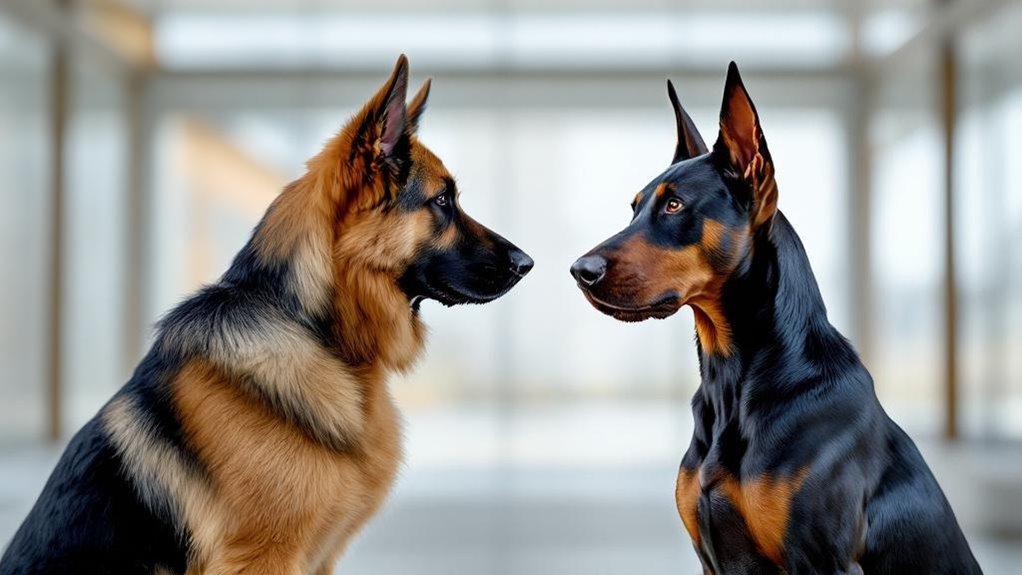
German Shepherd vs Doberman: Which Fits You? Both breeds demand experienced handlers—they’re smart enough that DIY training backfires. Shepherds bond with your whole family; Dobermans fixate on one person, risking separation anxiety. Shepherds need more space and grooming; Dobermans adapt to apartments better. Budget $5,000–$6,000 annually for either. German Shepherds show more patience with kids. Professional training isn’t optional—it’s essential. Before committing, honestly assess your budget, living space, and training dedication. Your ideal match depends entirely on these factors—discover how to evaluate yourself systematically.
- Key Takeaways
- Is a German Shepherd or Doberman Right for You?
- Why Dobermans Are Handler-Focused and Shepherds Are Family-Oriented
- Choose Your Living Space: Apartment, Yard, or Somewhere Else
- Temperament Under Pressure: What Sets These Breeds Apart
- Both Breeds Are Smart: Why DIY Training Fails
- Exercise Reality: Daily Walks vs. Mental Jobs
- Socializing Your Doberman or Shepherd: Why Starting Early Matters
- Protection Gone Wrong: Why Insurance and Training Save You
- Shedding and Grooming: Which Breed Demands Less Maintenance
- Health Problems to Plan For in Each Breed
- First-Year Budget: What First-Time Owners Miss
- Finding Ethical Breeders and Rescues: Where to Source Safely
- Mistakes New Owners Make (and How to Avoid Them)
- Kids in the House? How Dobermans and Shepherds Differ With Children?
- Red Flags at the Breeder: Spotting Unstable Temperament Early
- Your Decision Scorecard: Rate Yourself on Budget, Space, and Training Readiness
- Frequently Asked Questions
- Conclusion
Key Takeaways
- Both breeds demand experienced leadership and professional training; their intelligence requires consistent boundaries to prevent behavioral problems.
- German Shepherds bond with multiple family members and adapt better to diverse households, while Dobermans intensely bond with one handler.
- Both require 1-2 hours daily exercise and mental stimulation; German Shepherds need more space than Dobermans for activity.
- German Shepherds have higher grooming needs due to thick coats; Dobermans face serious heart disease risks requiring veterinary monitoring.
- First-year ownership costs range $3,000–$6,000; professional training is non-negotiable, and owners must assess readiness before committing to either breed.
Is a German Shepherd or Doberman Right for You?
Both German Shepherds and Doberman Pinschers demand experienced leadership. They’re incredibly intelligent, which means they need structured training and consistent boundaries. Without proper guidance, their smarts work against you—not for you.
Intelligent dogs need experienced leadership—their smarts work against you without proper training and consistent boundaries.
Consider these factors:
- High energy requires daily exercise and mental stimulation
- Professional training isn’t optional—it’s essential
- First-year costs reach $5,000–$6,000
- They need experienced owners who understand canine psychology
Dobermans especially bond intensely with one person, creating challenges for unprepared households.
Unless you’re committed to serious training and have ample space, explore easier breeds first.
Why Dobermans Are Handler-Focused and Shepherds Are Family-Oriented
You’re probably wondering why your Doberman seems glued to your side while your friend’s German Shepherd happily mingles with the whole family—and it all comes down to what these breeds were originally bred to do.
Dobermans were developed as personal protection dogs, so they’re hardwired to focus intensely on one handler, while German Shepherds evolved herding livestock, which required them to work with groups and adapt to different situations.
Understanding these historical origins—and how they shaped each breed’s natural bonding style—is essential for deciding which dog fits your lifestyle and family structure.
Origins Shape Behavioral Bonds
When you understand where these breeds came from, their personalities make perfect sense.
The Doberman’s Single-Handler Blueprint
Dobermans were developed in 1890s Germany specifically for personal protection. This focused purpose created their signature behavioral traits: intense loyalty to one person.
You’ll notice they’re often called “Velcro dogs” because they literally stick to their handler’s side. They’re watching, waiting, ready to defend.
The German Shepherd’s Versatile Design
German Shepherds evolved from herding livestock across vast farms. This job required them to bond with entire families and adapt to different situations.
They needed flexibility—working with multiple handlers, various animals, changing environments.
Why This Matters for You
Your living situation shapes which breed fits better. Single households? Dobermans thrive with focused attention.
Families? German Shepherds spread their loyalty naturally.
Understanding these origins helps you choose wisely.
Handler Attachment vs. Family Loyalty
The Doberman’s intense focus on one person—and the German Shepherd’s natural spread-the-love approach—stems directly from their original jobs.
Why This Matters for You
You’re getting two completely different attachment styles. Dobermans were bred as personal protection dogs, so they bonded intensely with *one* handler.
German Shepherds? They herded livestock alongside multiple farm workers, building loyalty across groups.
What You’ll Actually Experience
A Doberman shadows you relentlessly—the “Velcro dog” phenomenon. They seek *your* approval, *your* attention, *your* leadership.
Meanwhile, a German Shepherd distributes affection throughout your household. They thrive on family interaction.
The Real Difference
This shapes training needs dramatically.
Dobermans require individualized attention and consistent boundaries from their primary owner.
German Shepherds respond better to teamwork-focused training involving multiple family members, developing more balanced temperaments through diverse socialization.
Socialization and Bonding Differences
This attachment style—intense versus distributed—doesn’t happen by accident. You’re witnessing biology meets breeding history.
Why Dobermans Bond Intensely
Dobermans were originally bred as personal protection dogs. They needed laser focus on one handler for security work. This selective breeding hardwired their handler-focused bonding into their DNA.
You get unwavering loyalty—but potential separation anxiety.
Why German Shepherds Think “Family First”
German Shepherds evolved as herding dogs managing entire flocks. They naturally distributed their attention across multiple pack members.
This means your German Shepherd bonds with everyone—your spouse, kids, even visitors.
The Socialization Factor
Early socialization determines everything. Your Doberman needs exposure to multiple people to prevent handler fixation.
Your German Shepherd thrives with diverse experiences, building confidence through varied interactions.
Both breeds require consistent engagement—but shepherd owners enjoy easier multi-person household integration.
Choose Your Living Space: Apartment, Yard, or Somewhere Else
You’ve got to face a tough reality: your living situation makes or breaks your success with either breed.
Both German Shepherds and Dobermans are large dogs—averaging 80 to 90 pounds—so you’ll need to honestly assess whether you’re offering an apartment, a yard, or something in between.
Here’s the key question: can you commit to the daily exercise and mental stimulation these breeds demand, no matter where you live?
Apartment Living Considerations
Before committing to either breed, here’s what matters most: where you live shapes everything.
Apartment living demands honest self-assessment. German Shepherds struggle in compact spaces—their exercise needs are genuinely intense. Dobermans adapt better, yet both breeds require serious daily commitment.
Consider these critical factors:
- Daily exercise requirements: Both breeds need 1-2 hours of vigorous activity. Skipping walks triggers destructive behavior.
- Space constraints: At 80-90 pounds, they’re substantial. Lawn damage becomes inevitable without adequate room.
- Mental stimulation demands: These intelligent dogs need puzzle toys and training, not just physical activity.
You’re not choosing a low-maintenance pet. You’re committing to consistent engagement.
Dobermans edge ahead for apartments, but only if you’re genuinely dedicated. German Shepherds? They’ll resent confined living.
Your lifestyle determines everything here—be realistic about your capacity.
Yard Space Requirements
If you’re considering either breed, a fenced yard isn’t optional—it’s essential. Both German Shepherds and Dobermans need secure outdoor space for safe exercise and mental stimulation. Their strong prey drive—an instinct developed through centuries of selective breeding—makes containment critical.
| Breed | Minimum Yard Size | Fence Height | Exercise Needs | Damage Risk |
|---|---|---|---|---|
| German Shepherd | ½ acre | 6 feet | 2+ hours daily | High |
| Doberman | ¼ acre | 6 feet | 1.5+ hours daily | Moderate |
You’ll notice lawn damage from their activity levels and powerful paws. A securely fenced yard prevents escape attempts while providing necessary yard space requirements for daily exercise. Without adequate outdoor room, both breeds develop destructive behaviors—chewed furniture, excessive digging, aggression. Your yard investment directly impacts their wellbeing and your home’s condition.
Temperament Under Pressure: What Sets These Breeds Apart
When stress hits, these two breeds don’t react the same way—and that difference matters big time for first-time owners. Your temperament—and theirs—directly shapes how they perform when things get tough.
Stress reveals how differently these breeds react—a distinction that fundamentally impacts first-time dog owners and their success.
How These Working Breeds Differ:
- German Shepherds stay adaptable under pressure, remaining calm in unfamiliar situations and responding consistently to commands.
- Dobermans mirror your anxiety, staying glued to you like emotional sponges—they’re “Velcro dogs” who absorb your stress.
- German Shepherds excel at independent thinking, while Dobermans sometimes question commands, complicating their reactions.
German Shepherds bring steadiness to chaos. They’re built for police and service work because they maintain focus.
Dobermans? They’ll protect fiercely but might become overly alert around strangers. For first-timers, the German Shepherd’s balanced temperament offers more breathing room when pressure mounts.
Both Breeds Are Smart: Why DIY Training Fails
Their brainpower actually works against you. Without professional guidance, you’ll face confusion. Inconsistent methods? Your smart dog learns to manipulate you instead of obey. These breeds need firm structure—something DIY approaches lack.
| Problem | DIY Training | Professional Classes |
|---|---|---|
| Consistency | Weak | Strong |
| Leadership | Unclear | Established |
| Behavioral Issues | Worsen | Resolve |
Your intelligence plus their intelligence doesn’t equal success. You need training classes with experienced handlers who understand these breeds’ specific needs. That’s not optional—it’s essential.
Exercise Reality: Daily Walks vs. Mental Jobs
You’ve nailed the training classes—now comes the harder part. Your dog needs more than neighborhood strolls. Both breeds require structured exercise and mental stimulation to thrive—not just survive.
Why Daily Walks Fall Short
Think of their brains like powerful computers. They need actual tasks, not just treadmill time.
Consider these activity types:
- Herding-based work – German Shepherds need jobs mimicking their ancestral duties
- Tracking exercises – Dobermans bond deeply through scent-work engagement
- Agility training – Both breeds flourish with problem-solving challenges
Without adequate mental engagement, behavioral issues emerge rapidly. Destructive chewing, aggression, and anxiety develop when intelligence stays unstimulated.
You’ll discover that varied experiences—playtime, training sessions, interactive games—prevent boredom effectively.
Your commitment determines whether you’re managing a pet or releasing potential.
Socializing Your Doberman or Shepherd: Why Starting Early Matters
You’ve got a critical window—roughly between 8 weeks and 16 weeks—to shape your puppy’s brain before those protective instincts harden into place.
During this period, you’re literally rewiring their neural pathways through exposure: different people, environments, sounds, and animals help them build confidence instead of fear-based suspicion.
Start early socialization now, and you’ll manage their natural guarding instincts before they become behavioral problems that haunt you for years.
Critical Window For Development
When your puppy hits 3 weeks old, their brain’s already wiring itself—and you’ve got a narrow window to shape it. This critical window—lasting until about 14 weeks—is when socialization truly matters.
Your puppy’s brain is like wet cement during this period. Here’s what you need to do:
- Expose them to diverse environments (parks, streets, homes) to build confidence and adaptability.
- Introduce varied people and animals to prevent fear-based aggression later.
- Engage in puppy classes and playdates to teach appropriate behaviors early.
During this timeframe, consistent handling and exposure directly influence your Doberman or German Shepherd’s long-term temperament.
Skip this critical window, and you’re risking an overly protective or suspicious adult dog. Your first-time owner success depends on starting now—not later.
Building Confidence In New Environments
As your puppy explores the world—parks, car rides, crowded streets, friendly neighbors—their brain’s literally building neural pathways that’ll shape their entire personality.
Why Early Exposure Matters
During those critical first 16 weeks, your German Shepherd or Doberman’s brain is exceptionally plastic—meaning it absorbs experiences like a sponge. You’re fundamentally programming their confidence levels during this window.
Building Confidence Through Structured Experiences
Introduce your puppy to:
- Varied sounds (traffic, vacuum cleaners, children)
- Different surfaces (grass, tile, gravel)
- Friendly people and other pets
Supervised puppy classes work brilliantly here. They combine early socialization with professional guidance, preventing fear-based behaviors before they develop.
The Protection Instinct Reality
Both breeds carry strong protective genes. Without diverse exposure, that instinct can become aggression.
You’re not weakening their guardianship—you’re channeling it productively.
Consistent early socialization transforms protective instincts into confident, measured responses.
Managing Protective Instincts Early
Both Dobermans and German Shepherds possess centuries of breeding for protection work—meaning their brains come hardwired to detect threats and react decisively.
You’ll want to manage protective instincts early through deliberate early socialization during that critical 3-14 week window.
Here’s why timing matters:
- Puppies learn what’s normal. Exposing them to varied people, environments, and animals prevents later suspicion of strangers.
- Fear becomes manageable. Positive experiences now reduce defensive aggression as adults.
- Trust in you deepens. Your dog learns you’re the confident leader—not them.
Start introducing your pup to different situations today.
Structured, gentle training works alongside socialization.
You’re not suppressing their protective nature—you’re channeling it wisely.
Well-socialized adult dogs distinguish between genuine threats and everyday situations.
That’s the goal: a balanced, dependable companion.
Protection Gone Wrong: Why Insurance and Training Save You
Without proper training, your German Shepherd’s or Doberman’s protective instincts can become a legal and financial nightmare.
The Real Cost of Uncontrolled Protection
You’re facing serious liability if your dog injures someone—even on your own property. Most homeowners’ insurance policies exclude or heavily limit coverage for these breeds without documented training.
Why Training Matters
Professional programs teach your dog to distinguish actual threats from normal interactions. They harness protective instincts safely, preventing unnecessary aggression escalation.
Professional training teaches dogs to recognize real threats, harnessing protective instincts safely without unnecessary aggression.
The Numbers
Dog bite lawsuits average $50,000+ in damages. One incident can destroy your finances and your dog’s future.
Your Action Plan
- Enroll in certified obedience classes early
- Maintain ongoing behavioral management
- Document all training completion
- Verify your insurance covers your breed
Smart owners invest in training upfront. You’ll protect your family, your wallet, and your dog’s life.
Shedding and Grooming: Which Breed Demands Less Maintenance
Ever wondered why your friend with a Doberman doesn’t vacuum constantly while you’re battling tumbleweeds of fur?
The Shedding Reality
German Shepherds shed moderately—especially during seasonal changes. Their thick, double coats require consistent grooming attention.
Dobermans? Their short coats mean lighter shedding and minimal maintenance demands.
Key Differences You’ll Notice:
- Grooming frequency: German Shepherds need regular brushing sessions; Dobermans require only occasional brushing.
- Cleanup commitment: You’ll spend considerably more time cleaning fur around your home with a German Shepherd.
- Long-term investment: Doberman ownership demands less grooming time and cleaning effort overall.
The Bottom Line
First-time owners often underestimate grooming demands.
German Shepherds require dedication to coat health.
Dobermans offer easier maintenance.
Your lifestyle, schedule, and tolerance for shedding should guide your choice between these protective breeds.
Health Problems to Plan For in Each Breed
When you’re choosing between these two powerful breeds, you’ll want to know what health challenges might lie ahead.
Dobermans face serious heart risks. Dilated cardiomyopathy (DCM)—a condition where the heart weakens and enlarges—threatens their lifespan.
They’re also prone to hypothyroidism, causing weight gain and sluggishness without medication.
German Shepherds struggle with joints. Hip and elbow dysplasia (malformed sockets) leads to arthritis and mobility problems.
Responsible breeders perform health testing to catch these issues early.
Both breeds share a blood disorder. Von Willebrand’s disease impairs clotting ability, requiring veterinary monitoring.
You’ll need regular check-ups and appropriate health testing for either choice.
Early detection prevents suffering and unexpected expenses. Budget for screening costs—they’re investments in your dog’s quality of life.
First-Year Budget: What First-Time Owners Miss
You’ll quickly realize that the puppy price tag—whether $1,000 to $3,500 for a Doberman or $2,000 to $4,000 for a German Shepherd—is just the beginning of your financial commitment.
Beyond that initial purchase, you’re facing hidden expenses like professional training (essential for these intelligent, high-energy breeds), grooming costs that spike with German Shepherds’ heavy shedding, and specialized veterinary care that’ll drain your wallet fast.
First-year totals routinely hit $5,000 to $6,000 when you factor in food, healthcare, and training—then annual recurring costs exceed $2,000 indefinitely, a reality many first-time owners simply don’t anticipate.
Hidden Expenses Beyond Purchase
Most first-time dog owners budget for the obvious costs—the puppy price, food, and basic vet visits—but they’re often blindsided by what comes next.
These large, energetic breeds demand more than you’d expect. Beyond the initial purchase, you’ll encounter expenses that quietly drain your wallet:
- Professional training costs ($500–$2,000+) become essential when behavioral issues emerge from improper handling.
- Property damage expenses accumulate as their size and energy levels demolish landscaping and fencing.
- Specialized veterinary care exceeds routine checkups, including joint evaluations and preventative screenings.
Annual maintenance alone surpasses $2,000 through premium nutrition and ongoing healthcare.
German Shepherds and Dobermans have high metabolic needs—their powerful frames require quality fuel.
You’re not just purchasing a dog; you’re investing in continuous, substantial care that transforms your household budget.
Annual Recurring Costs
Three categories’ll consume your wallet during that critical first year: food, veterinary care, and training—and they’re far steeper than most first-timers anticipate.
Budget Reality for First-Time Owners
You’ll spend $2,000+ annually on both breeds. Here’s the breakdown:
- Premium kibble: $600–$800 yearly (large dogs eat substantial portions)
- Routine vet visits: $500–$800 (vaccinations, check-ups, preventatives)
- Training reinforcement: $300–$500 (ongoing sessions prevent behavioral problems)
- German Shepherd grooming: $200–$400 (moderate shedding requires regular brushing)
The Hidden Truth
Skipping professional training now? You’ll pay exponentially more fixing aggression or anxiety issues later.
These intelligent breeds demand mental stimulation—neglecting it costs thousands in behavioral rehabilitation.
First-time owners consistently underestimate food quality’s importance. Cheap kibble triggers digestive issues, vet bills skyrocket. Invest upfront in premium nutrition instead.
Finding Ethical Breeders and Rescues: Where to Source Safely
Because these intelligent, powerful breeds demand responsible ownership from day one, where you source your German Shepherd or Doberman matters enormously.
Avoiding Pitfalls
You’ll want to steer clear of Facebook ads and Craigslist. These platforms often harbor unethical breeders prioritizing profit over puppy welfare—potentially landing you an unstable dog.
What Reputable Breeders Offer
- Health testing on parent dogs, reducing inherited problems like hip dysplasia.
- Early socialization and lifelong support for your growing pup.
- Transparent breeding practices bred in the U.S. with documented lineages.
Smart Sourcing Strategies
Research breed-specific rescues too. They’ll share honest temperament insights and histories, helping you find your perfect match.
A quality reputable breeder or rescue prioritizes your success, not just the sale.
Mistakes New Owners Make (and How to Avoid Them)
Even with the best intentions, first-time owners of German Shepherds and Dobermans often stumble in ways that create unnecessary problems.
Underestimating Training Demands
You’ll quickly discover these breeds need professional guidance—not just basic classes. Their intelligence demands sophisticated training strategies you can’t find online.
Setting Boundaries Early
Without consistent rules, you’re surrendering leadership. These dogs require clear structure to thrive behaviorally.
Exercise Isn’t Optional
Your Shepherd or Doberman needs rigorous, structured activities daily. Neglecting this triggers destructive behaviors and anxiety.
Financial Reality Check
Have you calculated the true cost? First-year expenses reach $5,000 easily: food, veterinary care, training, supplies.
Understanding this financial commitment prevents heartbreaking rehoming situations later.
These mistakes aren’t inevitable—they’re preventable through preparation and realistic expectations.
Kids in the House? How Dobermans and Shepherds Differ With Children?
Now that you’ve got realistic expectations about training and costs, you’re ready for an honest conversation about something many first-time owners worry about: how these dogs interact with kids.
Ready for an honest conversation about how these dogs interact with kids? Here’s what you need to know.
The Key Differences
German Shepherds and Dobermans aren’t equally suited for every family. Here’s what separates them:
- Patience levels: German Shepherds show more tolerance around small children compared to Dobermans, who bond intensely with single household members.
- Protective instincts: Dobermans’ guarding nature requires careful supervision to prevent aggressive behavior development.
- Energy management: Both breeds’ size and power can cause unintentional roughness during play without proper training.
Your Action Plan
Start socialization early with both breeds. Consistent training prevents problems.
Supervise playtime always.
German Shepherds typically adapt better to chaotic family environments, while Dobermans demand experienced handlers who understand their protective temperament.
Red Flags at the Breeder: Spotting Unstable Temperament Early
Reputable breeders provide health testing for both parents. This reveals inherited temperament issues—genetic factors affecting emotional stability. Ask for documentation before visiting.
What to Observe
Watch the litter closely. Puppies showing aggression, extreme shyness, or nervousness? Red flags. Stable temperaments develop early; unstable ones persist into adulthood.
Socialization Questions
Ask breeders: How’ve these puppies been raised? Different environments? Various people? Inadequate early experiences create fearful, unpredictable dogs later.
Verify Reputation
Check references and online reviews. Ethical breeders prioritize stable temperaments and responsible practices—they’re proud discussing their programs.
Trust your gut. Wrong breeders cut corners; right ones invest in quality puppies.
Your Decision Scorecard: Rate Yourself on Budget, Space, and Training Readiness
Before you bring home a German Shepherd or Doberman, ask yourself the hard questions.
These breeds aren’t impulse purchases. You’ll need serious commitment across three critical areas:
- Budget Reality: First-year costs hit $3,000–$6,000. Annual expenses exceed $2,000 afterward. Can you afford veterinary emergencies, quality food, and professional training classes without stress?
- Space Requirements: Both breeds demand ample room and daily exercise. German Shepherds particularly need large areas to thrive—not cramped apartments.
- Training Readiness: Professional training is non-negotiable, not optional. Their intelligence and size demand structured, consistent guidance.
Score yourself honestly on each factor.
If you’re wavering on any area, reconsider your decision. These powerful dogs deserve owners fully prepared for them.
Frequently Asked Questions
Should I Get a Doberman or a German Shepherd?
You shouldn’t get either breed as a first-time owner. Both demand experienced handlers, rigorous training, and substantial daily exercise. You’ll face behavioral problems without proper structure and commitment to their intensive needs.
What Is the #1 Guard Dog in the World?
You’ve found your answer in the German Shepherd—a fortress of loyalty and intellect. This breed stands as the world’s #1 guard dog, excelling in police and military roles through unmatched intelligence, unwavering devotion, and natural protective instincts that you’ll witness firsthand.
Is a Doberman a Good Dog for First-Time Owners?
No, you shouldn’t get a Doberman as your first dog. You’ll need professional training expertise, consistent leadership, and significant time for exercise. They’re complex dogs demanding dedicated owners with experience.
Which Breed Is Better for First-Time Owners?
Neither breed suits you as a first-time owner—yet if forced to choose, a German Shepherd’s independence proves slightly more forgiving than a Doberman’s intense single-person bonding. You’ll still need professional training.
Conclusion
You’ve got the roadmap—now it’s your move. Think of choosing between these breeds like selecting the right horse for your trail: one thrives solo with a skilled rider, the other flourishes in a bustling family pack. You’ve weighed space, training commitment, and temperament. Trust your scorecard. Your perfect companion‘s waiting—the question isn’t which breed’s better. It’s which one matches *your* life.