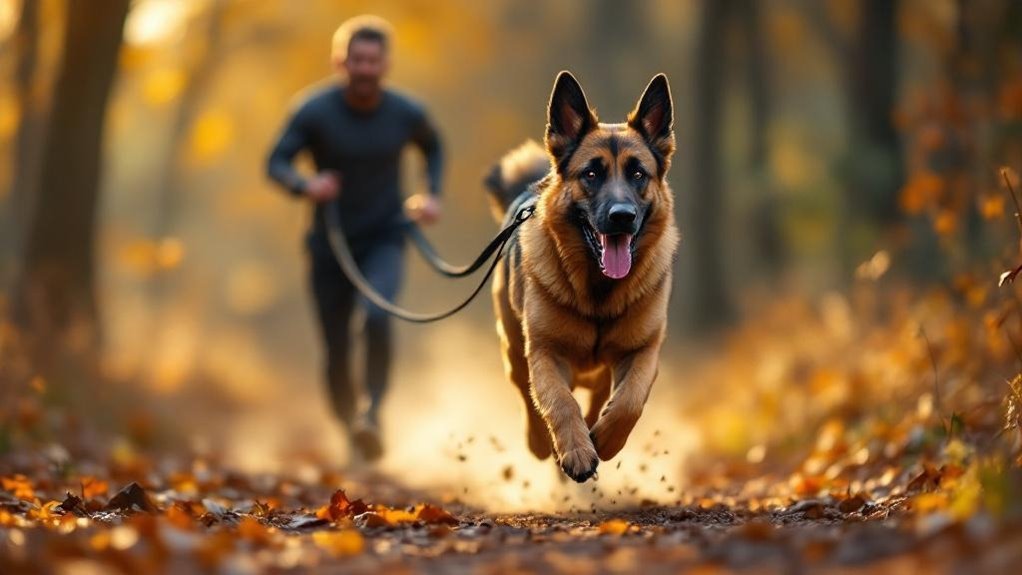
Your German Shepherd needs 1–2 hours of daily exercise to maintain physical fitness, mental sharpness, and behavioral stability. Puppies require shorter sessions based on age, adults demand consistent high-intensity activity, and seniors benefit from gentler routines adjusted for joint health. Without adequate exercise, you’ll likely see destructive behavior, excessive barking, and restlessness. The right amount depends on your dog’s age, health status, and individual temperament, so understanding what your specific GSD needs makes all the difference.
- Key Takeaways
- Why German Shepherds Need 1-2 Hours of Daily Exercise
- How Age Changes Your GSD’s Exercise Needs
- Puppies: Building Strength Without Overdoing It
- Adults: Meeting High-Energy Demands
- Seniors: Keeping Them Active (Without Injury)
- Physical Exercise and Mental Stimulation: Both Required
- Long Walks and Runs: The Daily Foundation
- Fetch and Retrieval Games for High-Energy Play
- Agility Training: Mental Challenge Meets Fitness
- Swimming: Low-Impact Exercise for Joint Protection
- Hiking: Building Endurance and Bonding
- Rainy Day Exercise: Indoor Activities That Work
- Puzzle Toys: Mental Exercise for Smart Dogs
- Brain Games: Training as Exercise and Bonding
- Exploration Walks: Let Your GSD Lead
- Build an Exercise Routine That Actually Sticks
- Is Your GSD Getting Enough Exercise?
- Too Much of a Good Thing: Signs of Over-Exercise
- Exercise With a Health Condition: When to Modify
- Tailoring Your Plan With Your Vet
- Frequently Asked Questions
- Conclusion
Key Takeaways
- Adult German Shepherds require 1.5 to 2 hours of daily exercise including brisk walks, running, and play to maintain fitness.
- Puppies need five minutes of exercise per month of age, twice daily, adjusted as they grow into adulthood.
- Senior German Shepherds should transition to 30 to 60 minutes of gentle daily exercise with regular veterinary monitoring.
- Mental stimulation through puzzle toys, agility sports, and exploration walks is essential alongside physical exercise to prevent behavioral issues.
- Monitor for exercise imbalance indicators like excessive barking, destructive chewing, or lethargy, adjusting routines based on individual health and temperament.
Why German Shepherds Need 1-2 Hours of Daily Exercise
Because German Shepherds were originally bred as working dogs with high energy levels, they require 1-2 hours of daily exercise to maintain both their physical and mental health.
You’ll notice that without a consistent exercise routine, your German Shepherd may develop behavioral issues, including excessive barking, destructive chewing, and restlessness that stems from pent-up energy.
Daily exercise serves multiple purposes beyond burning calories, as it strengthens their cardiovascular system, builds muscle, and maintains joint flexibility.
Daily exercise strengthens cardiovascular health, builds muscle, and maintains joint flexibility in German Shepherds.
When you establish and maintain an exercise routine with varied activities, you’re actively preventing obesity and related health problems like joint damage and heart disease that commonly affect this breed.
This consistency reinforces their well-being and creates structure that supports a longer, healthier life while deepening your bond with your dog.
How Age Changes Your GSD’s Exercise Needs
Just as your German Shepherd’s body develops and changes throughout their life, so too do their exercise requirements shift at different stages.
Puppies need only five minutes of formal exercise per month of age, twice daily maximum, protecting their developing joints from damage.
Adults require the full 1.5 to 2 hours daily to maintain health and prevent behavioral problems.
As your senior German enters their later years, you’ll reduce their routine to 30 to 60 minutes of gentle exercise, adjusting based on their mobility and fitness level.
Monitor your dog regularly for signs of obesity or stiffness, since decreasing activity can lead to weight gain.
Mental stimulation becomes increasingly important during senior years, encouraging engagement through activities tailored to their current capabilities rather than their younger selves.
Puppies: Building Strength Without Overdoing It
You’ll want to follow the five-minute rule—multiplying your puppy’s age in months by five to determine daily exercise minutes—because this guideline helps build strength gradually while protecting developing joints and bones from damage.
A four-month-old German Shepherd, for example, needs about twenty minutes of exercise twice daily, mixing gentle play with short training sessions rather than intense physical exertion that could strain their growing skeletal system.
Sticking to age-appropriate activities now establishes a foundation for healthy development and prevents the joint problems that can emerge from overexercising young puppies.
The Five-Minute Rule
Many German Shepherd puppy owners don’t realize that too much exercise during the growth phase can damage developing joints and bones, which is why veterinarians recommend the five-minute rule as a practical framework for safe activity.
You’ll multiply five minutes by your puppy’s age in months to determine daily exercise per month, allowing up to twice daily sessions. A four-month-old puppy needs twenty minutes twice daily, focusing on exploration and gentle play rather than intense activities.
This structure prevents obesity and long-term mobility problems while building strength gradually. You’ll monitor your puppy’s energy levels during and after exercise, adjusting intensity as needed.
Consistency with this framework fosters healthy development without overwhelming their growing body.
Preventing Joint Damage
While the five-minute rule provides a solid foundation for managing your puppy’s activity level, understanding what happens during exercise matters just as much as how much exercise you’re giving.
Your German Shepherd puppy‘s bones and joints are still developing, making them vulnerable to damage from high-impact activities like running or jumping. Instead of these strenuous exercises, you’ll want to focus on low-impact options such as short walks, controlled play sessions, and training routines that build strength without stressing developing joints.
Gradually introducing activities and carefully monitoring for signs of fatigue or discomfort helps you prevent injuries during this critical growth phase. This measured approach to preventing joint damage protects your puppy’s long-term health and mobility.
Adults: Meeting High-Energy Demands
You’ll want to establish daily activity guidelines of 1.5 to 2 hours, which gives your adult German Shepherd’s body and mind the consistent challenge they require to stay healthy and prevent destructive behaviors.
The best approach combines varied exercise types—brisk walks, running, fetch, obedience training, and agility work—so you’re addressing both cardiovascular fitness and mental stimulation at the same time.
Monitor your individual dog’s energy levels, health status, and preferences throughout the week, then adjust the intensity and duration of sessions to match their needs while building a routine you can maintain long-term.
Daily Activity Guidelines
Adult German Shepherds need a minimum of 1.5 to 2 hours of exercise daily because their breed was developed for demanding work that required sustained physical activity and mental engagement throughout the day.
Exercise does a German Shepherd’s body and mind good when you combine brisk walks, runs, and interactive play into a structured routine. Regular exercise prevents obesity and related health problems like joint issues, while also reducing behavioral challenges that stem from pent-up energy.
You’ll notice that varying your dog’s activities—incorporating agility training, puzzle toys, and different terrain—maintains their interest and provides thorough stimulation.
Since individual needs differ based on age, health status, and energy levels, you should regularly assess and adjust your dog’s exercise routine to guarantee it remains appropriate and effective.
Optimal Exercise Combinations
Because German Shepherds were bred for demanding work that required sustained physical and mental engagement, they need more than just basic exercise—they need a deliberate combination of activities that challenges both body and mind. You’ll find that much exercise alone won’t satisfy your dog’s needs without mental stimulation integrated throughout the week.
| Activity Type | Duration | Frequency |
|---|---|---|
| Brisk walks or running | 30-45 minutes | Daily |
| Dog sports (agility, obedience) | 20-30 minutes | 3-4 times weekly |
| Fetch and retrieval games | 15-20 minutes | Daily |
Structure your routine by alternating high-intensity activities with problem-solving tasks, which reinforces consistency and prevents boredom. Swimming provides valuable low-impact conditioning, particularly benefiting joint health. This balanced approach guarantees your German Shepherd receives the thorough physical and cognitive engagement necessary for maximum wellness.
Monitoring Energy Levels
While the balanced approach you’ve established through varied activities creates a strong foundation, your German Shepherd’s individual energy levels will determine whether your routine is truly meeting their needs.
You’ll notice that monitoring energy levels requires consistent observation of how your dog responds after exercise sessions. If your German Shepherd remains restless, exhibits destructive behaviors, or shows signs of weight gain, these indicate insufficient activity.
Conversely, excessive fatigue may signal overexertion. Pay attention to your dog’s age, health status, and temperament when adjusting exercise requirements for German Shepherds.
Some dogs need closer to two hours daily, while others thrive with slightly less. By tracking patterns and adjusting your routine accordingly, you’ll create structure that supports both physical fitness and mental well-being.
Seniors: Keeping Them Active (Without Injury)
As your German Shepherd enters their senior years, you’ll need to shift your approach to exercise, recognizing that their bodies require gentler activity while still benefiting from consistent movement.
Older dogs benefit most from 30 to 60 minutes of daily, low-impact exercise tailored to their individual health status and mobility levels. Leisurely walks, swimming, and gentle fetch games protect their joints while maintaining fitness and mental stimulation.
You’ll want to monitor for signs of over-exercise like limping or excessive panting, adjusting intensity accordingly. Maintain a consistent routine, yet remain flexible enough to respond to your dog’s energy fluctuations and any health changes.
Consulting your veterinarian regularly helps you develop personalized exercise plans that accommodate existing conditions and guarantee safe, appropriate activity for exercise for German Shepherds during their senior years.
Physical Exercise and Mental Stimulation: Both Required
You’ll find that German Shepherds need both vigorous physical exercise and challenging mental tasks to stay balanced and content, since one without the other leaves them restless and prone to destructive behaviors.
When you combine activities like running or fetch with puzzle toys and obedience training, you’re not just burning energy—you’re building their confidence and strengthening your bond through consistent engagement.
Watch for warning signs like excessive barking or furniture destruction, which typically signal that your dog isn’t getting enough mental engagement or variety in their daily routine, and adjust your approach by mixing up activities to keep them genuinely challenged.
Balancing Physical Activity Needs
German Shepherds thrive when their exercise routine addresses both their physical stamina and their sharp, problem-solving minds, since neglecting either one can lead to frustration and unwanted behaviors.
You’ll find that combining diverse activities creates the structure and consistency your dog needs for ideal mental health and sustained well-being.
To balance physical activity needs effectively, consider the following:
- Alternate between high-intensity exercise like running and moderate activities such as walking to prevent overexertion.
- Incorporate puzzle toys and training sessions alongside physical exercise and activity.
- Adjust intensity based on your dog’s age, health status, and individual energy levels.
- Rotate activities regularly to maintain engagement and mental stimulation.
- Monitor your dog’s response to different routines, adjusting accordingly for reinforcement of positive behaviors.
This balanced approach guarantees thorough development while strengthening your bond.
Mental Enrichment Strategies
Both physical exercise and mental stimulation work together to keep your German Shepherd healthy and content, since addressing only one creates an incomplete routine that leaves your dog vulnerable to boredom and destructive behaviors.
You’ll find that mental enrichment activities for German Shepherds keep their minds engaged and prevent the frustration that leads to problem behaviors.
Puzzle toys, hide and seek games, and training sessions all provide the cognitive challenge your dog needs alongside daily walks. Varying these activities maintains your dog’s interest, so rotating between different enrichment strategies prevents habituation.
Dog sports like agility combine both physical workouts with mental focus, offering extensive exercise in one activity. Swimming, meanwhile, delivers low-impact physical conditioning while allowing exploration and mental engagement.
Recognizing Imbalance Signs
Imbalances in your German Shepherd’s exercise routine—whether too much physical activity, too little mental engagement, or an uneven combination of both—typically show up as behavioral changes that signal something needs adjustment.
You’ll notice patterns that reflect either excess energy or insufficient stimulation, both requiring different responses.
Watch for these key indicators:
- Excessive barking, destructive chewing, and restlessness from pent-up energy
- Lethargy or unusual passivity suggesting over-exercise or fatigue
- Digging and pacing behaviors indicating inadequate mental stimulation
- Hyperactivity that persists despite daily exercise sessions
- Inconsistent mood swings reflecting poor consistency in your routine
Addressing imbalance requires evaluating both components.
You should exercise daily while incorporating varied mental stimulation, then observe how your dog responds.
Adjusting intensity, duration, and enrichment activities restores balance and reinforces the behavioral stability your German Shepherd needs.
Long Walks and Runs: The Daily Foundation
Since these dogs need substantial daily exercise to stay physically and mentally healthy, long walks and runs form the foundation of their activity routine, requiring at least 30 to 60 minutes per session to meet their baseline needs.
You’ll notice that consistency matters greatly—establishing a regular schedule reinforces structure in your dog’s day and prevents the behavioral problems that emerge from pent-up energy. Varying your routes engages their natural curiosity, transforming routine exercise into mental stimulation alongside physical conditioning.
For puppies, you’ll want to follow the five-minutes-per-month-of-age guideline during walks and runs, preventing over-exertion that stresses developing joints. These long walks and runs aren’t just about burning calories; they build cardiovascular health, improve flexibility, and create the stability your German Shepherd needs for overall well-being.
Fetch and Retrieval Games for High-Energy Play
You can develop your German Shepherd’s natural retrieval instincts through consistent fetch sessions that tap into their inborn drive to chase and carry objects, which builds the foundation for reliable returns and sustained engagement.
Safe, high-visibility toys combined with proper techniques—such as consistent reinforcement, varied throwing patterns, and appropriate distances based on your dog’s age and fitness—ensure you’re building strength and coordination without risking injury.
These games deliver significant mental stimulation alongside physical exercise, as your dog must process commands, anticipate movements, and problem-solve obstacles, all of which channel their energy constructively and reduce behavioral issues that stem from boredom and excess tension.
Building Retrieval Drive Naturally
When you tap into a German Shepherd’s natural instinct to chase and retrieve, you’re setting up a foundation for both physical conditioning and mental engagement that’ll serve your dog well throughout their life. Building retrieval drive naturally requires consistent practice and strategic reinforcement through structured play sessions.
Start with these foundational steps:
- Begin with short throws using a favorite toy, gradually increasing distance as your dog shows engagement.
- Use clear commands like “fetch” and “drop it” to reinforce obedience during retrieval activities.
- Vary toys and playing environments to maintain interest through new scents and sights.
- Practice for at least 10-15 minutes per session to effectively develop retrieving skills.
- Rotate different toys regularly to sustain your dog’s curiosity and enthusiasm.
This approach builds both physical and mental stimulation while strengthening your bond through consistent, purposeful interaction.
Safe Techniques and Equipment
Once your German Shepherd’s retrieval drive is developing through consistent practice, the equipment you choose and the methods you use during fetch sessions directly affect both your dog’s safety and the effectiveness of the exercise.
You’ll want to invest in high-quality, lightweight balls or frisbees specifically designed for dogs, as these reduce injury risk during vigorous activity.
Varying your throwing techniques and distances maintains mental engagement while adjusting intensity levels. Safe techniques and equipment work together: incorporate commands like “drop it” and “come” to reinforce obedience during fetch and retrieval games, strengthening both physical conditioning and behavioral structure.
Monitor session duration carefully, watching for excessive panting or reluctance to continue, since limiting playtime prevents over-exertion and supports long-term health.
Mental Stimulation Through Games
Fetch and retrieval games aren’t just physical outlets; they’re powerful tools for engaging your German Shepherd’s mind while channeling their natural instinct to chase and pursue.
These activities combine mental stimulation with physical exercise, addressing your dog’s need for both cognitive engagement and movement. You’ll find that varying your approach keeps sessions fresh and prevents boredom.
- Use different toys like frisbees, balls, and sticks to maintain interest and mental engagement
- Play in diverse environments such as backyards, parks, or open fields to challenge your dog’s adaptability
- Incorporate training commands like “drop” or “stay” during retrieval to reinforce obedience
- Adjust intensity based on your dog’s age and energy level for sustainable participation
- Establish consistent routines to build structure and reinforce positive behaviors
Regular engagement reduces destructive behaviors while promoting your dog’s overall well-being through structured, purposeful activity.
Agility Training: Mental Challenge Meets Fitness
Agility training taps into what German Shepherds do naturally—leap, weave, and respond to direction—while channeling their high energy and sharp minds into structured activity that counts toward their 1-2 hours of daily exercise.
You’ll set up an agility course with jumps, tunnels, and weave poles that require your dog to navigate obstacles while following your cues, building coordination and obedience simultaneously. This physical activity strengthens the mental connection between you and your shepherd through teamwork and communication.
Agility courses build coordination and obedience while strengthening the mental connection between you and your shepherd through teamwork.
Regular sessions contribute up to an hour of daily exercise, directly addressing their substantial energy needs.
Beyond fitness, agility competitions offer opportunities for socialization and mental engagement, allowing your dog to demonstrate their capabilities while staying mentally stimulated through novel challenges and environmental changes.
Swimming: Low-Impact Exercise for Joint Protection
Why should you consider water as one of your German Shepherd’s most valuable exercise environments? Swimming delivers a low-impact exercise that protects your dog’s joints while building strength and endurance.
Unlike running or jumping, water supports your dog’s body weight, reducing stress on ligaments and joints. This makes swimming particularly valuable for senior German Shepherds and dogs recovering from injury.
Regular swimming sessions enhance your dog’s:
- Full-body muscle tone and cardiovascular fitness
- Joint mobility and flexibility without impact stress
- Overall endurance and long-term joint health
- Comfort in water through gradual introduction
- Safe physical activity during recovery periods
Introduce your German Shepherd to water gradually, always supervising swimming sessions.
Consistency with water-based exercise reinforces joint protection while maintaining the fitness level your dog needs for ideal health and mobility.
Hiking: Building Endurance and Bonding
While swimming provides joint protection through water’s supportive environment, hiking challenges your German Shepherd’s cardiovascular system and builds the sustained endurance they need for long-term fitness and mobility.
A typical hiking outing lasts one to three hours, depending on your dog’s fitness level and age, which directly meets their daily exercise requirements.
As you hike varied terrain, your German Shepherd experiences both physical strengthening and mental stimulation from new scents and environmental changes.
This shared outdoor activity reinforces the bond between you and your dog through consistent, trust-building experiences.
Remember to choose age-appropriate trails, provide frequent hydration breaks, and allow rest periods, particularly on longer routes, ensuring hiking remains a sustainable part of your dog’s exercise routine.
Rainy Day Exercise: Indoor Activities That Work
When weather prevents outdoor activities, indoor exercises become essential for maintaining your German Shepherd’s physical fitness and mental engagement, since these dogs require consistent activity regardless of conditions.
You’ll find that rainy days don’t mean sacrificing your dog’s routine; instead, they offer opportunities to develop new skills and strengthen your bond through structured indoor activities.
Consider these effective options:
- Interactive puzzle toys that challenge problem-solving abilities and prevent boredom
- Tug-of-war games that build muscle strength in a controlled space
- Indoor obstacle courses with jumps, tunnels, and weave poles for agility work
- Hide and seek with treats or toys that utilize scent-tracking instincts
- Short training sessions focused on new commands or tricks for mental stimulation and reinforcement
This approach maintains consistency while providing both physical exercise and mental engagement during inclement weather.
Puzzle Toys: Mental Exercise for Smart Dogs
You’ll find that puzzle toys come in various designs—sliding compartments, treat-dispensing balls, and multi-level interactive games—each requiring your German Shepherd to manipulate parts or solve sequences to access hidden rewards, which combines physical play with genuine cognitive work.
These toys strengthen your dog’s behavioral health by channeling mental energy into problem-solving rather than destructive outlets like chewing or excessive barking, while also building consistency and reinforcement through structured play sessions that keep your dog engaged for 20-30 minutes at a time.
As your German Shepherd masters each puzzle, you can gradually increase the difficulty level, ensuring the challenge stays relevant and maintaining the mental stimulation that prevents boredom-related behaviors from developing.
Types Of Puzzle Toys
Because German Shepherds possess sharp minds that require regular mental stimulation, puzzle toys offer an effective way to engage their problem-solving abilities while reducing the boredom that often leads to destructive behaviors.
You’ll find several types of puzzle toys designed to challenge dogs at different skill levels, each providing distinct mental exercise benefits.
- Treat-dispensing puzzles require your dog to manipulate sliding pieces or flip compartments to access hidden rewards.
- Rotating puzzle boards feature multiple sections that dogs must work through sequentially.
- Layered difficulty toys allow you to increase complexity as your dog’s skills improve.
- Nina Ottosson by Outward Hound series offers graded options from beginner to advanced levels.
- Interactive toys combine physical manipulation with problem-solving, reinforcing cognitive development through consistent use.
Benefits For Behavioral Health
Beyond simple entertainment, puzzle toys directly address the behavioral challenges that arise when German Shepherds lack adequate mental engagement, making them a practical tool for promoting emotional stability and reducing destructive habits.
When you provide consistent mental stimulation through puzzle toys, you prevent boredom-related behaviors like chewing and digging that stem from understimulation. These toys also reduce stress and anxiety by channeling your dog’s natural problem-solving instincts into productive activity.
As your German Shepherd works through puzzles, their mind stays occupied, which creates a calmer demeanor and better overall behavioral health.
Brain Games: Training as Exercise and Bonding
While physical exercise forms the foundation of a German Shepherd’s daily routine, mental stimulation through brain games and training sessions provides equally important benefits that strengthen both the dog’s cognitive health and its relationship with you.
Puzzle toys and obedience training engage your dog’s mind, preventing boredom and destructive behaviors that stem from pent-up energy. Training sessions that introduce new commands or tricks reinforce good behavior through positive reinforcement while deepening your bond.
Consider incorporating these mental exercises:
- Puzzle toys that require problem-solving
- Obedience training with consistent commands
- Hide-and-seek games combining cognitive and physical challenge
- Learning new tricks using positive reinforcement
- Daily mental stimulation routines for focus and contentment
Interactive games challenge your German Shepherd’s cognitive skills while encouraging physical activity, making them an efficient way to combine both exercise types into your daily routine.
Exploration Walks: Let Your GSD Lead
When you set aside time to let your German Shepherd choose the direction and pace of a walk, you’re tapping into their natural instincts to investigate, track scents, and explore their environment, which provides mental stimulation that structured exercise alone can’t replicate. Exploration walks lasting 30-60 minutes deliver both physical exercise for German Shepherds and cognitive engagement, reducing behavioral issues like chewing or digging by channeling their energy productively.
| Benefit | Duration | Location | Safety |
|---|---|---|---|
| Scent tracking | 30 minutes | Familiar areas | Leashed |
| Confidence building | 45 minutes | Parks | Controlled |
| Mental stimulation | 60 minutes | Varied terrain | Supervised |
| Boredom reduction | Mixed | Multiple routes | Monitored |
Allowing your GSD to lead enhances their confidence and emotional well-being, though maintaining a leash guarantees safety in unfamiliar areas, preventing unwanted interactions with other animals or people.
Build an Exercise Routine That Actually Sticks
Creating a sustainable exercise routine for your German Shepherd requires consistency, structure, and regular adjustments based on what you observe about your dog’s energy and health. You’ll find that hours of exercise daily—roughly 1-2 hours of varied activities—keep your dog physically and mentally fit.
It’s important to monitor your dog’s response to different activities, adjusting intensity as needed.
Monitor your German Shepherd’s response to activities, adjusting intensity based on their individual energy levels and health needs.
- Combine 30-minute walk sessions with interactive play and training
- Rotate activities like agility, hiking, and playtime to prevent boredom
- Track progress using apps like PitPat to set age-appropriate goals
- Adjust intensity based on your dog’s energy levels and health status
- Establish a regular schedule that fits your lifestyle and reinforces commitment
This structured approach guarantees your German Shepherd receives adequate exercise while remaining sustainable for you, creating lasting habits that benefit both dog and owner.
Is Your GSD Getting Enough Exercise?
Now that you’ve established a routine, you need to know whether your German Shepherd’s current activity level actually meets their needs, since what works on paper doesn’t always match what your individual dog requires.
Watch for signs indicating your GSD isn’t getting enough exercise per day: weight gain, excessive barking, restlessness, and destructive behaviors signal inadequate activity.
Adult German Shepherds typically need 1-2 hours daily, while seniors benefit from 30-60 minutes of gentler exercise. However, your dog’s specific requirements depend on age, health, and temperament.
Beyond physical activity, confirm you’re incorporating mental stimulation through puzzle toys and training games. This combination maintains both their physical fitness and psychological well-being, preventing the behavioral problems that emerge from boredom and underexertion.
Too Much of a Good Thing: Signs of Over-Exercise
Just as insufficient exercise creates behavioral problems, excessive activity can strain your German Shepherd’s body and undermine their long-term health. Over-exercise can damage joints and worsen existing conditions, particularly in older dogs, so you’ll want to recognize the signs of fatigue your dog displays.
Your GSD may show these indicators of over-exercise:
- Excessive panting or limping after activity
- Stiffness or reluctance to move the following day
- Decreased appetite and disinterest in food
- Lethargy and reduced enthusiasm for usual activities
- Reluctance to participate in play or walks they normally enjoy
To prevent over-exercise, gradually increase activity based on your dog’s individual health needs. Incorporate rest days into their routine, and consult your veterinarian to tailor an appropriate exercise plan that supports their physical and mental well-being.
Exercise With a Health Condition: When to Modify
When your German Shepherd has a health condition like hip dysplasia, arthritis, or other joint issues, you’ll need to modify their exercise routine to protect their body from further damage while still keeping them active enough for mental and physical well-being. You should reduce exercise intensity and duration to approximately 30 to 60 minutes of gentle activity daily, incorporating low-impact options like swimming or leisurely walks that minimize joint strain.
| Health Condition | Recommended Activity | Duration | Monitoring |
|---|---|---|---|
| Hip Dysplasia | Swimming, gentle walks | 30-45 minutes | Watch for limping |
| Arthritis | Low-impact movement | 30-60 minutes | Monitor panting levels |
| Senior GSD | Tailored gentle exercise | 30-60 minutes | Assess regularly with vet |
| Post-injury recovery | Controlled activity | 20-30 minutes | Track distress signs |
Your veterinarian can help determine appropriate exercise levels aligned with your dog’s specific condition, preventing overexertion while maintaining necessary activity.
Tailoring Your Plan With Your Vet
Because every German Shepherd has different health needs, age-related requirements, and fitness levels, you’ll want to work with your veterinarian to create an exercise plan that’s specific to your dog rather than following a generic routine.
Consulting with your veterinarian guarantees you’re accounting for your dog’s individual circumstances and fitness level. Your vet can identify underlying health conditions, recommend appropriate exercise types, and suggest gradual intensity increases to prevent injury.
Consider these essential steps when tailoring your plan:
- Schedule regular veterinary assessments to monitor your dog’s health status
- Discuss your dog’s current fitness level and exercise history
- Request specific activity recommendations based on age and condition
- Establish a timeline for gradually increasing exercise duration and intensity
- Use tracking tools alongside veterinary guidance to maintain consistency
This partnership creates structure and reinforcement for sustainable, safe exercise habits.
Frequently Asked Questions
Is a 30 Minute Walk Enough for a German Shepherd?
No, a 30-minute walk isn’t enough. You’ll need to provide 1-2 hours of daily exercise combined with playtime and mental stimulation. You’re risking behavioral issues and obesity if you don’t meet your German Shepherd’s full requirements.
How Much Exercise Do German Shepherds Actually Need?
You need to give your German Shepherd one to two hours of daily exercise. Mix physical activities like walks and fetch with mental stimulation through puzzle toys. Puppies require five minutes per month of age, while seniors need gentler thirty to sixty-minute routines.
What Is the Leading Cause of Death in German Shepherds?
Cancer claims your cherished companion most commonly in German Shepherds. Hemangiosarcoma and lymphoma plague the breed particularly. You’ll want regular veterinary checkups to catch these conditions early and extend your dog’s life.
Is a 2 Mile Walk Too Long for a Dog?
A 2-mile walk isn’t too long for you if your German Shepherd’s healthy and fit. You’ll want to take into account your dog’s age, health status, and fitness level. You should monitor for fatigue signs like limping or excessive panting.
Conclusion
You’ve now got the framework to keep your German Shepherd thriving through consistent, age-appropriate exercise that strengthens both body and mind. By observing how your dog responds to activity, adjusting for life stages, and consulting your vet when needed, you’re building a sustainable routine that prevents boredom and behavioral problems. This structured approach, reinforced regularly, guarantees your GSD stays balanced, healthy, and content throughout every phase of life.