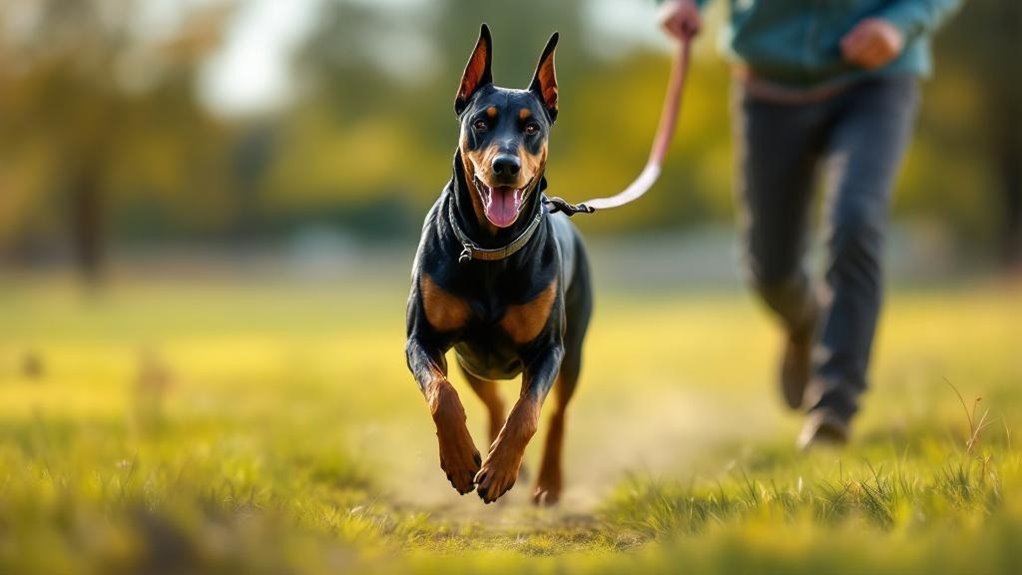
Your Doberman needs a minimum of 70 minutes of daily exercise, though 1.5 to 2 hours is ideal for managing their high energy and preventing behavioral issues. This should include brisk walks, jogging, and safe off-lead running across three 15-minute sessions. Mental stimulation through training, puzzle toys, and scent work is equally important, as their working dog heritage creates strong prey drives that require consistent engagement. Understanding how to adjust these needs as your dog matures reveals what truly works for your individual companion.
- Key Takeaways
- How Much Exercise Does a Doberman Need Daily?
- Why Dobermans Have Such High Energy Levels
- Exercise Needs for Doberman Puppies
- Exercise Needs for Adult Dobermans
- Exercise Needs for Senior Dobermans
- Mental Stimulation Activities Beyond Walks and Runs
- Behavioral Problems From Insufficient Exercise
- Walking and Hiking: Building Endurance and Bond
- Running and Jogging for Cardiovascular Health
- Swimming and Low-Impact Exercises for Joint Health
- Agility Training: Physical and Mental Challenges Combined
- Play Sessions: Engaging Your Doberman’s Prey Drive
- Off-Leash Training: Prerequisites and Safety Steps
- Signs Your Doberman Is Over-Exercised
- 5 Exercise Mistakes That Harm Doberman Development
- Build Your Weekly Exercise Schedule
- Schedule Workouts for Peak Energy and Recovery
- Adapting Exercise for Heat, Cold, and Seasonal Changes
- Track Your Doberman’s Daily Exercise With GPS Devices
- How to Transition Exercise as Your Doberman Grows Up
- Real-World Exercise Routines: What Actually Works
- Frequently Asked Questions
- Conclusion
Key Takeaways
- Healthy adult Dobermans require a minimum of 70 minutes of daily exercise for optimal health and behavior.
- Exercise should include brisk walks, jogging, and safe off-lead running across at least three 15-minute sessions.
- Mental stimulation through training, puzzle toys, and scent work is equally critical alongside physical activity.
- Puppies need approximately 5 minutes of exercise per month of age with gentle, low-impact activities.
- Senior Dobermans need 30 to 60 minutes of low-impact exercise like swimming or gentle walking daily.
How Much Exercise Does a Doberman Need Daily?
Healthy adult Dobermans require a minimum of 70 minutes of exercise each day, which should include a combination of brisk walks, jogging, and safe off-lead running to keep them physically fit and mentally engaged.
This consistent physical activity addresses your dog’s substantial exercise needs and prevents behavioral problems that arise from boredom and excess energy. Your Doberman’s mental stimulation depends equally on the variety of activities you provide, so rotating between different types of exercise maintains their interest and engagement.
Consistent physical activity prevents behavioral problems while varied exercise routines maintain your Doberman’s mental stimulation and engagement.
Consider that these high-energy dogs were bred for work, making structured routines essential for their well-being. Without adequate daily physical activity, your Doberman may develop destructive behaviors, anxiety, or health complications.
Tailoring exercise intensity to your dog’s individual condition guarantees sustainable fitness and reinforces their role as an active family member.
Why Dobermans Have Such High Energy Levels
Your Doberman’s impressive energy levels aren’t random—they’re deeply rooted in the breed’s history as working dogs developed for protection and demanding physical tasks that required stamina, strength, and responsiveness. Understanding this background helps you recognize why Dobermans need a lot of consistent activity and engagement.
The breed’s high energy stems from several interconnected factors:
- Breeding purpose: Their ancestors were selected for endurance work, which created dogs naturally inclined toward vigorous activity and alertness.
- Strong prey drives: Dobermans possess instincts encouraging them to chase, run, and engage in high-intensity pursuits throughout the day.
- Intelligence combined with athleticism: Their sharp minds paired with powerful bodies require both physical and mental stimulation to stay balanced.
This combination means you’ll need to provide structured exercise, training, and problem-solving opportunities daily to prevent boredom and destructive behaviors.
Exercise Needs for Doberman Puppies
Because Doberman puppies are still developing physically and mentally, they need exercise that’s carefully measured and age-appropriate rather than the intense activity that adult dogs can handle.
You should provide approximately five minutes of exercise per month of age, up to twice daily, which protects their developing joints from injury.
Doberman puppies benefit from gentle activities like indoor play, basic obedience training, and socialization with other dogs that combine mental stimulation and physical movement without overexertion.
These exercise and stimulation sessions build consistency and structure into their routines while preventing behavioral problems.
As your puppy grows, you’ll adjust exercise levels gradually to keep them engaged but not overworked.
Monitoring their activity through GPS tracking helps you tailor their routines effectively as they mature.
Exercise Needs for Adult Dobermans
Once your Doberman reaches adulthood, their exercise requirements shift dramatically from the carefully measured routines of puppyhood to a much more substantial daily commitment.
Your adult Doberman needs a minimum of 70 minutes of exercise daily to maintain physical fitness and mental sharpness.
You’ll want to incorporate diverse activities into their routine:
- Brisk walking and jogging sessions that elevate their heart rate and build endurance
- Safe off-lead running in secure spaces where they can move freely and burn energy
- Mental exercise through obedience training and puzzle toys that stimulate their intelligence
These vigorous activities are essential given their high endurance levels. You can enhance their cardiovascular health with longer sessions, and monitoring their activity with a GPS tracker guarantees they’re getting adequate exercise while staying safe during outdoor excursions.
Exercise Needs for Senior Dobermans
As your Doberman enters their senior years, their exercise requirements shift considerably from the demands of adulthood, requiring you to recalibrate both the duration and intensity of their daily activities.
Senior Dobermans generally need 30 to 60 minutes of exercise daily, though you’ll adjust this based on their individual energy levels and physical condition. Rather than lengthy, vigorous sessions, you should provide shorter, more frequent outings that prevent fatigue and discomfort.
Low-impact activities like swimming or gentle walks protect their aging joints while maintaining their fitness and muscle tone. Monitor your dog closely during exercise for signs of exhaustion or pain, scaling back when necessary.
As your Doberman ages, consistent routine adjustments guarantee they remain healthy and comfortable throughout their senior years.
Mental Stimulation Activities Beyond Walks and Runs
You can strengthen your Doberman’s mind through training exercises and obedience games that require focus and decision-making, which tire their brain as effectively as physical activity tires their body.
Interactive puzzle toys and scent work activities tap into their natural problem-solving abilities, offering mental challenges that prevent boredom and the destructive behaviors that often follow from an understimulated mind.
Training and Obedience Games
Mental stimulation through training and obedience games provides your Doberman with cognitive challenges that go beyond the physical exercise of walks and runs. This type of engagement is essential for managing their energy and preventing destructive behaviors.
When you incorporate structured obedience training into daily routines, you’re not only enhancing discipline but also delivering the mental engagement your dog needs.
Consider these training approaches:
- Obedience commands that require focus and problem-solving, strengthening the bond while building consistency and reinforcement through repetition
- Scent work activities that tap into natural tracking abilities, tiring your dog mentally while developing decision-making skills
- Puzzle toys and interactive games that challenge your Doberman to work for rewards, preventing boredom through cognitive engagement
These structured activities create the mental structure your dog craves, resulting in a calmer, more balanced companion.
Interactive Puzzle Toys
While physical exercise tires your Doberman’s body, interactive puzzle toys engage their mind in ways that walks and runs alone cannot achieve, making them an essential complement to your dog’s daily exercise routine. These toys provide mental stimulation by challenging your dog to find hidden treats, which develops problem-solving skills and keeps them engaged for extended periods. By reducing boredom-related behaviors like destructive chewing, puzzle toys address behavioral issues before they develop.
| Toy Type | Difficulty Level | Best Use |
|---|---|---|
| Treat-dispensing balls | Beginner | Initial introduction |
| Sliding compartment puzzles | Intermediate | Weekly rotation |
| Multi-stage puzzle boxes | Advanced | Ongoing challenge |
| Hide-and-seek toys | Varied | Indoor entertainment |
You’ll notice that incorporating puzzle toys into your daily routine creates structure, allowing you to gradually increase challenges as your Doberman masters simpler tasks, ensuring consistent mental engagement throughout their week.
Behavioral Problems From Insufficient Exercise
When your Doberman doesn’t get enough exercise, you’ll likely notice destructive behaviors like chewing on furniture and digging, which stem from pent-up energy and boredom rather than defiance.
Insufficient physical activity and mental engagement also trigger anxiety-related accidents indoors, especially in younger dogs who haven’t yet learned to manage their frustration and restlessness.
Establishing a consistent exercise routine with structured activities addresses both problems by channeling your dog’s high energy productively and reducing the stress that drives these unwanted behaviors.
Destructive Chewing And Digging
Destructive chewing and digging represent two of the most common behavioral problems you’ll encounter with an under-exercised Doberman, stemming directly from their inability to expend the considerable energy they’re born with.
When your Doberman lacks adequate physical exercise and mental stimulation, these behaviors emerge as outlets for pent-up frustration and boredom.
Here’s what typically happens:
- Destructive chewing intensifies when your dog doesn’t receive sufficient physical activity to tire them out properly.
- Digging increases as your Doberman seeks ways to redirect energy, often targeting furniture, walls, or yard areas.
- Anxiety escalates without structured activities, obedience training, and puzzle toys to engage their mind.
The pattern’s clear: insufficient exercise directly fuels these destructive tendencies.
Anxiety-Related Indoor Accidents
Anxiety from insufficient exercise often manifests as indoor elimination, a behavior that differs fundamentally from housebreaking failures because it stems from emotional distress rather than a lack of training.
When your Doberman doesn’t receive adequate physical activity, stress builds up and seeks release through accidents inside your home, particularly when you’re away or during changes in routine. You’ll notice this pattern coincides directly with periods of reduced exercise or mental stimulation.
To address this issue, establish a structured daily routine incorporating at least 70 minutes of exercise, which greatly reduces anxiety levels. Combine physical activity with mental stimulation through obedience training and puzzle toys, addressing both energy outlets and cognitive engagement.
This thorough approach targets the root cause, creating consistency and reinforcement that eliminates stress-related accidents.
Walking and Hiking: Building Endurance and Bond
Walking and hiking serve as the foundation for managing your Doberman’s considerable energy demands while simultaneously strengthening the bond between you and your dog.
Walking and hiking form the foundation for managing your Doberman’s energy while strengthening your bond together.
You’ll find that consistent exercise routines prevent behavioral problems and promote physical health.
Here’s how to structure your Doberman’s walking and hiking schedule:
- Daily walks: Aim for at least three 15-minute walks per day to maintain steady energy management throughout your routine.
- Weekend hikes: Plan longer outings up to 3 miles on weekends, which build endurance while exposing your dog to new environments and scents for mental stimulation.
- Enhanced training: Consider using a weighted vest during walks to increase physical demands and strengthen your dog’s overall fitness.
This structured approach guarantees your Doberman receives the minimum 70 minutes of daily exercise needed for ideal well-being and strengthens your connection.
Running and Jogging for Cardiovascular Health
You’ll want to build your Doberman’s running capacity gradually, starting with shorter distances and slower speeds before progressing to the 70 minutes of brisk activity they need daily, since their joints and cardiovascular system require consistent reinforcement to handle high-impact exercise safely.
Your pace and duration should match your dog’s current fitness level, with frequent breaks to monitor breathing and prevent overheating, allowing their body to adapt over weeks rather than days.
This structured approach to distance and intensity prevents injury while establishing the consistency that transforms running into an effective tool for maintaining their heart health and channeling their natural endurance.
Building Endurance Gradually
Building your Doberman’s cardiovascular fitness through running and jogging requires a gradual approach that matches the dog’s physical development and maturity level.
You’ll want to start with shorter distances and slower speeds, then increase intensity as your dog’s body strengthens and joints fully develop. This structure prevents injury and builds sustainable endurance capacity.
Consider these key strategies:
- Begin with 20-30 minute sessions at a comfortable pace, gradually extending duration as your dog adapts to physical exertion.
- Mix shorter, brisk runs with longer, slower-paced jogs to balance cardiovascular gains with proper recovery periods.
- Monitor your dog closely for fatigue signs, adjusting exercise levels to maintain consistency without overexertion.
Patience during this phase creates a stronger foundation for your Doberman’s long-term fitness and mental well-being.
Pace And Duration Guidelines
Once your Doberman has adapted to regular physical activity through the gradual buildup process, establishing specific pace and duration targets becomes the next step in developing cardiovascular fitness.
You’ll want to incorporate running or jogging into your exercise routine at least 1.5 to 2 hours weekly, maintaining a brisk pace throughout these sessions to elevate your dog’s heart rate effectively.
Varying the intensity and speed during each outing keeps your Doberman mentally engaged while building stamina, so alternate between faster intervals and moderate-paced long walks. This structure reinforces consistency and prevents boredom, ensuring your dog stays challenged.
Start conservatively with distance and speed, then gradually increase both as your Doberman’s fitness improves, allowing proper adaptation and injury prevention.
Swimming and Low-Impact Exercises for Joint Health
When your Doberman needs exercise that strengthens muscles and improves heart health without stressing joints, swimming offers an ideal solution, especially for seniors or dogs recovering from injury. This low-impact exercise provides full-body conditioning while protecting their skeletal system from strain.
Swimming benefits your Doberman through:
- Improved cardiovascular fitness and muscle strength, which help maintain healthy weight and prevent obesity-related conditions
- Enhanced joint flexibility and stability without the impact damage caused by running or jumping
- Mental stimulation and enjoyment, since most Dobermans naturally engage with water activities
Introduce swimming gradually in a safe environment, using a dog life jacket to build confidence.
Regular low-impact swimming sessions contribute greatly to long-term joint health, making it especially valuable for maintaining mobility throughout your dog’s life.
Agility Training: Physical and Mental Challenges Combined
While swimming provides excellent low-impact conditioning, your Doberman’s high intelligence and energy levels also require mental engagement and varied physical challenges to stay satisfied and well-behaved.
Agility training delivers both elements simultaneously, as your dog navigates obstacle courses that demand physical coordination, speed, and problem-solving skills. This high-impact exercise strengthens the bond between you and your Doberman through teamwork and communication, while consistent practice keeps your dog mentally stimulated and helps fulfill the recommended 1.5 to 2 hours of daily exercise.
Joining an agility club offers additional benefits: structured training, socialization opportunities with other dogs, and competitive motivation. Regular participation alleviates boredom and reduces destructive behaviors, creating a more balanced and obedient companion.
Play Sessions: Engaging Your Doberman’s Prey Drive
Because Dobermans possess a natural prey drive that’s deeply ingrained in their breeding history, play sessions that capitalize on chasing and retrieving activities offer you an ideal way to channel their energy constructively while simultaneously meeting their mental and physical exercise needs.
Interactive games effectively satisfy your Doberman’s instincts through:
- Fetch and retrieval games that allow them to chase and capture objects, providing immediate satisfaction of their hunting impulses
- Flirt pole play that mimics prey movement, engaging their reflexes while building strength and coordination
- Hunting-simulation games that reinforce obedience commands during excitement, strengthening your control and their responsiveness
Regular play sessions strengthen the bond you share while preventing boredom-related destructive behaviors.
Regular play sessions strengthen your bond with your Doberman while preventing destructive behaviors rooted in boredom.
Complementing these activities with scent work or puzzle toys enriches their experience further, ensuring thorough physical exercise and mental engagement that supports long-term behavioral stability.
Off-Leash Training: Prerequisites and Safety Steps
Before you attempt off-leash training, you’ll need to establish a foundation of reliable recall commands and prey drive control, since a Doberman’s natural instinct to chase can override training if you haven’t built sufficient consistency and reinforcement first.
Start by practicing recall consistently in low-distraction environments, using treats and praise to reward immediate responses. Then gradually introduce controlled distractions as your dog demonstrates dependable focus and obedience.
This structured approach guarantees you’re building genuine control rather than simply hoping your dog will respond, which creates the safety foundation necessary for successful off-leash experiences.
Building Prey Drive Control
Your Doberman’s ability to respond reliably to commands forms the foundation upon which all off-leash training depends, since a dog who won’t consistently obey “come” or “stay” on a leash can’t safely be trusted without one.
Their high prey drive makes this consistency essential, as distractions can override their instincts to listen.
Building prey drive control requires structured training sessions that emphasize impulse management:
- Practice recall commands repeatedly in low-distraction environments before progressing to challenging settings
- Use positive reinforcement consistently, rewarding immediate responses to strengthen the behavior
- Gradually introduce mild distractions during training sessions, allowing your dog to practice focus despite temptations
Once your Doberman demonstrates reliable obedience in controlled spaces, you can confidently shift to supervised off-leash activities in secure areas, knowing they’ll respond when called.
Establishing Reliable Recall Commands
Recall training builds directly on the obedience foundation you’ve already established with your Doberman, since a dog who won’t reliably sit or stay on a leash can’t be expected to return when called off-leash.
Begin in a secure, enclosed area where your Doberman can focus on commands without distractions from other animals or people. Use positive reinforcement—treats and praise—to encourage your dog to return when you call, gradually increasing distances and environmental distractions.
Consistency matters greatly; practice recall commands regularly in various settings to reinforce expectations. Monitor your Doberman’s behavior closely during training, and if distraction or disobedience appears, return to leash-based exercise and training to rebuild reliability before attempting off-leash work again.
Signs Your Doberman Is Over-Exercised
While Dobermans are bred for athleticism and stamina, they can absolutely be over-exercised, and recognizing the signs early helps you adjust their activity level before fatigue or injury occurs.
You’ll notice several physical and behavioral indicators that signal your dog needs less intense exercise:
- Physical fatigue signs: Excessive panting, reluctance to continue activities, and noticeably decreased energy levels after exercise suggest your Doberman’s pushed beyond their limits, requiring immediate activity reduction.
- Movement changes: Limping, sensitivity when moving, or lagging behind during walks indicate joint stress or injury from overly intense routines that demand scaling back.
- Behavioral shifts: Increased destructive behaviors like chewing or digging reveal mental and physical overstimulation, while persistent restlessness and anxiety after exercise confirm your dog needs recovery time and lower activity levels.
5 Exercise Mistakes That Harm Doberman Development
You can damage your Doberman’s development by pushing too hard during growth phases, ignoring their need for mental challenges alongside physical activity, and failing to maintain consistent training routines that reinforce good behavior.
When you exceed the recommended 5 minutes per month of age guideline, you stress developing joints and risk long-term mobility problems, while skipping mental stimulation leads to destructive behaviors since Dobermans are intelligent dogs that need engagement beyond just running.
Creating a structured plan that balances appropriate physical exercise, obedience training, and puzzle activities—and sticking to it regularly—protects your dog’s joints, prevents boredom-related issues, and establishes the discipline your Doberman needs to thrive.
Overexertion During Growth Phases
Because a Doberman’s bones, joints, and growth plates don’t fully mature until around 18 months of age, excessive exercise during these critical periods can cause lasting damage that won’t show up until your dog is older.
You’ll want to carefully monitor physical exercise and avoid the common mistake of pushing your puppy too hard, even when she seems energetic and willing.
Consider these key concerns:
- High-impact activities like jumping or running on hard surfaces stress developing joints and increase hip dysplasia risk
- Overexertion causes fatigue that masks pain, making injuries harder to detect until they’ve progressed considerably
- Growth plate damage during rapid development phases can result in permanent mobility problems later
Instead, you should prioritize gentle indoor play and short walks matched to your puppy’s age, maintaining consistency with low-stress activities that support healthy growth without overwhelming her developing body.
Ignoring Mental Stimulation Needs
Protecting your Doberman’s physical development is only half the equation—her mind needs just as much attention during these formative years. You can’t overlook mental stimulation without consequences, since insufficient mental exercise creates anxiety, frustration, and destructive behaviors like furniture chewing or excessive barking. Without structured mental challenges, young Dobermans develop underdeveloped social skills and behavioral issues that persist into adulthood.
| Mental Activity | Benefits | Frequency |
|---|---|---|
| Obedience training | Reinforces positive behavior, builds focus | Daily |
| Puzzle toys | Engages problem-solving, reduces boredom | Multiple times weekly |
| Agility work | Combines mental and physical exercise | 2-3 times weekly |
| Scent work | Stimulates natural instincts, builds confidence | Weekly |
Combining mental and physical exercise through activities like agility training or scent work prevents behavioral issues while keeping her stimulated. Consistency matters throughout her life, as neglecting mental stimulation hinders overall development and well-being.
Inconsistent Training And Routine
When training and exercise routines shift from day to day, your Doberman’s development suffers because she can’t build the habits and confidence that come from predictable structure. Variation in your approach confuses her learning process and weakens the reinforcement she needs to succeed.
Inconsistent training creates several problems:
- Behavioral confusion: Your dog doesn’t know what you expect, leading to poor obedience and unreliable good behavior across different situations.
- Physical setbacks: An irregular exercise routine prevents proper muscle development and cardiovascular conditioning, especially in puppies who need controlled activity.
- Anxiety buildup: Unpredictable schedules frustrate your Doberman, triggering destructive behaviors like chewing and digging.
Your Doberman thrives when you establish a steady exercise routine with consistent training methods. This predictability builds her confidence, strengthens her bond with you, and maintains reliable behavior development over time.
Build Your Weekly Exercise Schedule
Building a consistent weekly exercise schedule is essential for meeting your Doberman’s substantial physical and mental demands, since these athletic dogs thrive on structure and variety rather than the same routine day after day. You should aim for at least 70 minutes of vigorous exercise daily, splitting activities like brisk walks, runs, and fetch sessions throughout your week.
Incorporate diverse options such as agility training and off-leash play to maintain physical engagement and prevent boredom. Additionally, weave mental stimulation through training sessions and puzzle toys into your schedule, which complements physical exertion and reinforces good behavior.
For senior Dobermans, adjust intensity with low-impact activities like swimming. This structured approach creates the consistency and reinforcement your dog needs to stay healthy and well-adjusted.
Schedule Workouts for Peak Energy and Recovery
Three well-spaced workout sessions throughout the day work better than one long exercise block, since they’ll help your Doberman maintain steady energy levels while allowing adequate recovery time between activities.
This approach prevents fatigue and supports consistent high energy throughout each day.
Structure your exercise routine by:
- Scheduling three 20-30 minute brisk walks at different times, spacing them evenly across morning, afternoon, and evening
- Timing more intensive workouts during cooler parts of the day to avoid overheating, particularly in warm climates
- Incorporating varied activities like jogging, fetching, and agility training through structured play to enhance recovery and prevent boredom
This framework creates reinforcement through consistency, ensuring your Doberman receives adequate stimulation while maintaining the structure necessary for ideal physical and mental development.
Adapting Exercise for Heat, Cold, and Seasonal Changes
While your structured workout schedule maintains your Doberman’s fitness throughout the day, environmental conditions can greatly impact how well your dog tolerates and benefits from those activities. You’ll need to adjust exercise intensity and timing based on seasonal temperatures, ensuring your dog stays safe and comfortable year-round.
| Season | Exercise Timing | Key Consideration |
|---|---|---|
| Summer | Early morning or late evening | Heat stress risk |
| Winter | Midday, with limited duration | Cold sensitivity |
| Spring/Fall | Flexible scheduling | Moderate conditions |
During heat, exercise your Doberman in cooler hours and prioritize hydration by offering fresh water before, during, and after activity. In cold weather, shorten outdoor sessions and monitor for discomfort. Swimming and indoor play provide excellent low-impact alternatives when extreme conditions prevent regular outdoor exercise, helping you maintain consistency without overexertion.
Track Your Doberman’s Daily Exercise With GPS Devices
Because maintaining consistent exercise routines requires objective data, GPS trackers offer a practical way to monitor your Doberman’s daily activity and guarantee they’re meeting their minimum requirement of 70 minutes of exercise each day.
GPS trackers provide objective data to ensure your Doberman meets their essential 70-minute daily exercise requirement.
These devices provide several valuable functions:
- Real-time location tracking during off-lead activities, giving you confidence while your dog explores outdoor spaces
- Activity level monitoring that helps you prevent overexertion, especially important for younger or senior Dobermans requiring adjusted routines
- Goal-setting features tailored to your dog’s age and energy levels, creating accountability and structure
How to Transition Exercise as Your Doberman Grows Up
Your Doberman’s exercise needs shift markedly as they progress through different life stages, requiring you to adjust both the intensity and type of physical activity to match their developing body and changing energy levels.
A Doberman puppy needs approximately five minutes of exercise per month of age, with careful attention to protecting developing joints.
During adolescence around six to nine months, your dog experiences peak energy levels, demanding high exercise and mental stimulation to prevent destructive behaviors.
As an adult, you’ll increase activity to one and a half to two hours daily, mixing brisk walks and jogging.
Finally, senior Dobermans benefit from shorter, more frequent outings that accommodate declining stamina.
Monitoring your dog’s behavior throughout these age levels guarantees you’re providing appropriate structure and consistency for their health.
Real-World Exercise Routines: What Actually Works
Understanding what exercise routines work in practice requires looking beyond general guidelines to see how they actually fit into daily life with your Doberman, because theory doesn’t always match reality when you’re managing a high-energy dog alongside work, family, and other responsibilities.
You’ll find success by structuring your day around three key components:
Structure your day around three key components to unlock sustainable exercise success with your Doberman.
- Morning sessions that combine brisk walks with mental stimulation through training or puzzle toys, establishing consistency and early energy release.
- Midday activities incorporating varied exercises like jogging or safe off-lead play, preventing restlessness and behavioral issues from building throughout the day.
- Evening routines balancing physical exertion with calmer interactive play, helping your Doberman wind down while reinforcing your bond.
This structure guarantees your dog receives the 70 minutes of daily exercise they need while maintaining sustainable patterns you can actually sustain long-term.
Frequently Asked Questions
Do You Have to Walk a Doberman Every Day?
Yes, you must walk your Doberman daily. You’ll need to provide at least 70 minutes of physical activity each day. You can’t skip walks without risking anxiety and destructive behaviors in your dog.
Is a 20 Minute Walk a Day Enough for My Dog?
No, a 20-minute walk leaves your Doberman like a pressure cooker about to burst. You’ll need at least 70 minutes daily of varied activities—walks, play, and mental stimulation—to prevent behavioral problems and destructive habits.
Can You Over Exercise a Doberman?
Yes, you can over exercise your Doberman. You’ll want to avoid overly strenuous workouts that cause fatigue or injuries. Watch for excessive panting, reluctance to continue, or limping—these signs mean you need to reduce activity intensity immediately.
Are Dobermans Good for Long Walks?
Yes, you’ll find your Doberman’s a natural athlete built for distance—like a finely tuned engine that thrives on long walks. They’re perfect companions for brisk, extended outings that satisfy their high endurance and mental stimulation needs.
Conclusion
You’ve learned that your Doberman’s exercise needs shift throughout their life, requiring you to adjust routines as they age and seasons change. A two-year-old Doberman you exercise for ninety minutes daily might need only forty-five minutes by age ten, yet consistency remains critical for preventing behavioral problems and maintaining health. Track progress through GPS devices, monitor your dog’s response, and adjust intensity accordingly, ensuring sustainable routines that work for your lifestyle.