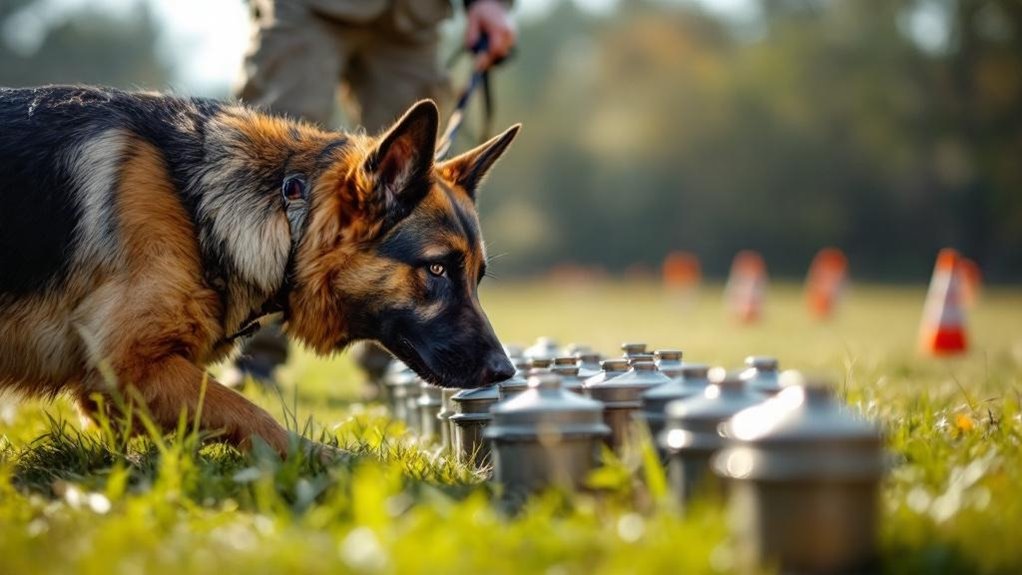
German Shepherds excel at scent work because they’re equipped with 300 million olfactory receptors, athletic builds, and natural enthusiasm to please. You can start training at any age or fitness level by using basic gear—treats, a leash, scented oils, and cardboard boxes—to build associations between scent and reward. Short, consistent sessions in familiar settings establish confidence before progressing to complex trails and varied environments. Success hinges on reading your dog’s alerts correctly, maintaining routine structure, and adjusting intensity based on weather and fatigue signals.
- Key Takeaways
- Why German Shepherds Excel at Scent Work
- How Your German Shepherd’s Nose Actually Works
- Is Scent Work Right for Your Dog? (Age, Fitness, and Suitability)
- Why Scent Work Differs From Other Canine Sports
- Gear You’ll Need to Start Training
- Your First Scent Work Session: A Step-by-Step Walkthrough
- Teaching Your Dog to Alert When They Find the Scent
- Designing Trails Your Dog Will Master
- Indoor and Outdoor Scent Work: When to Use Each Setting
- Progression Levels: From Box Searches to Multi-Room Hunts
- Common Scent Work Mistakes That Stall Progress
- When Your Dog Gets Sidetracked: Managing Distractions
- Training for AKC Scent Work Trials and Competitions
- The Mental Health Benefits of Scent Work
- Why Scent Work Builds Unbreakable Handler-Dog Teams
- Rebuilding Focus When Your Dog Stops Engaging
- How Weather and Seasons Affect Scent Work Training
- Competing vs. Recreational Scent Work: Which Path Fits Your Goals?
- Channeling Scent Skills: Pet Sport vs. Working Dog Paths
- Keeping Your Dog Hungry: Avoiding Training Fatigue
- Frequently Asked Questions
- Conclusion
Key Takeaways
- German Shepherds excel at scent work due to 300 million olfactory receptors and natural intelligence, making them ideal for detection tasks.
- Scent work provides mental and physical stimulation, reduces anxiety, prevents destructive behaviors, and strengthens the handler-dog bond significantly.
- Begin training with short trails using high-value treats, cardboard boxes, and scented oils like Birch, Anise, and Clove in familiar settings.
- Gradually introduce environmental variety including different terrains, weather conditions, obstacles, and distractions to build adaptability and real-world reliability.
- Maintain consistent training schedules with proper documentation to track progress, avoid common mistakes, and reinforce learned scent detection behaviors effectively.
Why German Shepherds Excel at Scent Work
Because German Shepherds possess highly developed olfactory glands that allow them to detect odors at distances far beyond human capability, they’re naturally suited for scent work tasks like search and rescue, tracking, and explosive detection.
Their exceptional sense of smell, combined with high intelligence and strong desire to please, makes them ideal candidates for scent training. You’ll find that German Shepherds respond well to structured training programs because they’re motivated to work alongside their handlers, creating effective teamwork.
Additionally, their athletic build and abundant energy thrive when channeled into scent work, providing both physical and mental stimulation.
This breed’s natural loyalty strengthens the bond between dog and handler, which reinforces consistent performance during training and operational scenarios, establishing German Shepherds as reliable specialists in detection work.
How Your German Shepherd’s Nose Actually Works
Your German Shepherd’s nose operates through a remarkably sophisticated system that explains why these dogs excel at scent work far beyond human capability.
Inside their nose, your German Shepherd possesses approximately 300 million olfactory receptors, compared to your mere 5 million, allowing them to detect scents at incredibly low concentrations.
Beyond sheer receptor count, their nasal structure includes the Jacobsen’s organ, a specialized area designed to analyze pheromones and scent molecules with precision.
This anatomical advantage means your dog can recognize odors across vast distances and differentiate between specific scents within complex environments.
Through training, you can direct these natural abilities toward detection work, teaching your German Shepherd to identify drugs, explosives, or other target scents with consistency and reliability.
Is Scent Work Right for Your Dog? (Age, Fitness, and Suitability)
Now that you understand how your German Shepherd’s nose works, you might wonder whether scent work fits your dog’s life and abilities. The answer is yes for most dogs, regardless of age or fitness level.
You can introduce scent work to German Shepherds at any stage, even older dogs, since the activity doesn’t require peak physical condition. Dogs working in scent work benefit from both mental stimulation and physical exercise, making it ideal for high-energy dogs needing engagement.
Scent work suits German Shepherds at any age, providing mental stimulation and physical exercise without demanding peak fitness levels.
Additionally, dogs with physical limitations or anxiety issues gain confidence through scent work without excessive physical demands. Regular participation enhances your dog’s focus and drive, reducing boredom-related behavioral problems.
Whether your German Shepherd is young, elderly, or managing limitations, scent work offers practical benefits tailored to your dog’s individual needs.
Why Scent Work Differs From Other Canine Sports
How does scent work stand apart from traditional canine sports?
You’ll find that scent work emphasizes your dog’s natural ability to detect scent independently, rather than demanding strict obedience or physical agility like agility trials or dock diving.
While other sports require your dog to perform specific tasks under rigid regulations, scent work encourages varied search styles and independent problem-solving. You tailor training to your German Shepherd’s individual abilities and interests, creating a flexible curriculum rather than following standardized protocols.
This approach builds your dog’s confidence and sense of purpose through mental stimulation, prioritizing your dog’s natural instincts over standardized performance judgment.
Additionally, scent work remains accessible across all ages and fitness levels, making it inclusive compared to physically demanding competitive events that may exclude older or less athletic dogs.
Gear You’ll Need to Start Training
Getting started with scent work requires surprisingly little equipment, and that accessibility is one of the sport’s greatest advantages for German Shepherd owners at any experience level.
You’ll want tasty treats for reinforcement, cardboard boxes for hiding scents, and a 6-foot leash to maintain control during sessions. A scented oil kit containing target odors such as Birch, Anise, and Clove becomes essential as you progress in scent work training.
Tasty treats, cardboard boxes, a 6-foot leash, and scented oils like Birch, Anise, and Clove form your essential scent work toolkit.
Long cotton leads, around 15 feet without handles, enhance your dog’s ability to explore scent trails freely. You can introduce odor kits and boxes at home, creating a controlled environment that supports consistent practice.
This straightforward setup means you can begin scent work immediately, regardless of your background or experience level.
Your First Scent Work Session: A Step-by-Step Walkthrough
Your first scent work session should be structured to build your German Shepherd’s confidence and establish the foundation for all future training, so you’ll want to start by gathering your cardboard boxes, treats, and a quiet space where your dog won’t watch you set up. Set up the working area away from your dog’s view, bait the boxes with treats, and use the command “find it” to encourage independent searching that taps into their natural hunting instincts.
| Phase | Duration | Action | Goal | Track Progress |
|---|---|---|---|---|
| Setup | 5 min | Arrange boxes | Create environment | Note placement |
| Introduction | 2 min | Show dog area | Build interest | Observe excitement |
| Search | 10 min | Release dog | Find treats | Count successful finds |
| Reinforcement | 3 min | Praise heavily | Strengthen behavior | Record motivation level |
| Cool down | 5 min | Rest period | Prevent fatigue | Plan next session |
Limit sessions to fifteen minutes, maintaining focus while allowing multiple search rounds. Incorporate regular praise and rewards throughout, which reinforces learning and strengthens your bond with your dog through consistent, positive engagement.
Teaching Your Dog to Alert When They Find the Scent
Once your German Shepherd has mastered the basic search and reliably finds treats in boxes, the next phase involves teaching them to communicate their discovery through a deliberate alert behavior, which transforms their natural hunting instinct into a clear, recognizable signal you can understand and reward.
- Start by exposing your dog to the target odor using a scented oil kit, allowing them to explore and become familiar with the specific scent they’ll detect during scent work sessions.
- Use positive reinforcement with treats and praise when your dog shows interest, gradually encouraging them to indicate their find through a specific action like sitting or pawing.
- Practice regularly in short 15-minute sessions with multiple rounds, maintaining engagement while building consistency in their alert response.
Designing Trails Your Dog Will Master
You’ll want to build your dog’s tracking foundation with short, simple trails before advancing to complex patterns, since mastering basic scent following creates the consistency and confidence they’ll need for longer distances and environmental challenges.
As your German Shepherd demonstrates reliable performance on straightforward paths, you can gradually introduce curves, corners, and distractions that force them to maintain focus and adapt their approach, which reinforces their ability to problem-solve rather than simply memorize a route.
Throughout this progression, you should incorporate different terrains and weather conditions into your training plan, allowing your dog to develop the versatility and resilience required for real-world scent work scenarios.
Trail Complexity and Progression
Because German Shepherds possess strong natural tracking instincts, they’ll progress faster when trails are structured intentionally rather than left to chance. Trail complexity should increase gradually as your dog demonstrates consistent performance on foundational exercises.
- Start with short, straightforward paths using high-value treats that motivate engagement and build enthusiasm for the work.
- Add curves and turns once your dog masters basic trails, challenging them to navigate different scent patterns and maintain focus through directional changes.
- Introduce varied surfaces and environments alongside distractions like competing scents or noises, strengthening your dog’s resilience and adaptability in real-world tracking situations.
Extend trail length progressively while monitoring performance. This structured reinforcement builds confidence and skill systematically, preventing frustration and establishing sustainable progress in your German Shepherd’s tracking development.
Environmental Variety and Challenges
As your German Shepherd gains confidence on basic trails, introducing different terrains and environments becomes essential for developing a well-rounded tracker who can perform reliably in real-world situations.
Environmental variety challenges your dog’s adaptability by requiring them to navigate grass, gravel, and sand surfaces, each presenting unique scent dispersal patterns. Incorporate natural obstacles like trees and bushes to simulate realistic search and rescue scenarios, forcing your dog to problem-solve around barriers.
Vary trail length, complexity, curves, and turns to maintain engagement and build confidence progressively. Introduce distractions—competing scents, noises, or visual stimuli—to strengthen your dog’s focus and scent discrimination abilities.
Practice across diverse locations, from indoors to open fields, ensuring your dog applies learned skills consistently in any environment they’ll encounter.
Foundation Skills Before Tracking
Successful tracking starts with establishing the fundamental building blocks—a strong association between scent and reward, confidence in confined spaces, and the understanding that following a scent trail leads to positive outcomes.
Your foundation skills training requires consistency and structure before advancing to complex trails. Begin in familiar indoor or backyard settings where distractions remain minimal, allowing your German Shepherd to focus entirely on the task:
- Use high-value treats mashed into the ground to create prominent scent trails your dog can easily detect.
- Practice the Sit & Search method by having your dog sit while you place a tracking item nearby, rewarding successful discoveries.
- Conduct short training sessions regularly, as repetition builds confidence and reinforces positive associations with scent work.
This methodical approach guarantees your dog develops reliable foundation skills necessary for eventual outdoor tracking success.
Indoor and Outdoor Scent Work: When to Use Each Setting
Both indoor and outdoor settings offer distinct advantages for scent work training, and choosing the right environment depends on your goals, the dog’s current skill level, and practical constraints like weather or available space.
Indoor and outdoor scent work serve different purposes in your German Shepherd’s development. You’ll find indoor sessions ideal for building independent searching skills in controlled conditions, especially during bad weather or when space is limited. You can easily set up cardboard boxes and treats for consistent practice.
Outdoor training, however, exposes your dog to varied scents and environments, naturally enhancing tracking abilities and mental stimulation.
You’ll want to alternate between both settings regularly, as this variety maintains your dog’s engagement, reinforces training progressively, and strengthens your bond through shared activities.
Progression Levels: From Box Searches to Multi-Room Hunts
Once your German Shepherd has mastered the fundamentals of independent searching in controlled environments, you’ll gradually progress from simple box searches to more complex multi-room hunts that challenge their problem-solving abilities and strengthen their scent discrimination skills.
Start by establishing a solid foundation with these progression levels:
- Box searches use cardboard boxes filled with treats or target scents, encouraging your dog to search independently and build confidence in basic scent work.
- Multi-room hunts require your dog to navigate various spaces within your home, expanding their search area and demanding greater focus and persistence.
- Environmental variation introduces different indoor settings and outdoor locations, keeping scent work engaging while building adaptability.
Maintain 15-minute sessions initially, gradually increasing duration and complexity as your dog demonstrates consistent reliability and enthusiasm throughout their training journey.
Common Scent Work Mistakes That Stall Progress
You’ll find that inconsistent training sessions disrupt your German Shepherd’s learning rhythm, making it harder for them to retain behaviors and build confidence in their detection work.
When you don’t gradually increase environmental complexity—moving too quickly from simple box searches to challenging multi-room hunts—your dog can’t develop the adaptive skills they need to handle new scent scenarios.
Additionally, misreading your dog’s alerts or failing to recognize the subtle signals they’re sending will create confusion about what behavior you’re actually rewarding, which undermines their motivation and slows their overall progress.
Inconsistent Training Sessions
When training schedules become sporadic or unpredictable, your German Shepherd’s scent recognition skills can deteriorate faster than you’d expect, because the brain needs regular reinforcement to solidify learned behaviors. Inconsistent training sessions disrupt the neural pathways your dog develops during scent work, forcing them to relearn skills they’ve already mastered.
To maintain progress, establish a structured routine:
- Schedule training sessions at the same time daily or every other day to build predictable expectations.
- Dedicate 15-20 minutes per session, keeping duration consistent rather than varying from five minutes to an hour.
- Document each session’s results so you track patterns and identify gaps in your dog’s retention.
Regular practice transforms scent work from occasional activity into reliable skill, ensuring your German Shepherd retains proficiency and continues advancing through training levels.
Inadequate Environmental Challenges
While maintaining consistent training schedules builds the neural pathways your German Shepherd needs for scent work, staying in the same location week after week actually undermines that progress. Your dog’s brain adapts to a single environment’s scent landscape and stops working as hard to detect target odors. You’ll notice your dog loses interest or becomes desensitized to the task itself.
Variation in environments directly strengthens adaptability and prepares detection dogs for real-world applications like search and rescue. Introduce different locations, weather conditions, and training scenarios that include obstacles and distractions.
Gradually increase complexity in your scent work exercises to develop genuine problem-solving skills. This mental stimulation prevents plateaus and guarantees your German Shepherd transfers learned skills across diverse settings effectively.
Misreading Dog Alerts
One of the most common training errors that halts scent work progress is misinterpreting your German Shepherd’s alert behavior, since distinguishing between a genuine find and random sniffing or barking requires understanding what your dog’s specific alert looks like. Misreading a dog’s alerts creates confusion that stalls advancement, as you may reinforce incorrect behaviors without realizing it.
Develop clarity by establishing these distinctions:
- Target alerts—nose bumps, sits, or paws that consistently indicate scent presence
- Distraction behaviors—ground sniffing, excessive barking, or movement unrelated to targets
- Reinforcement timing—rewards given only when your dog displays the chosen alert signal
Regular evaluation of your dog’s responses helps you adjust training methods accordingly. Consistent communication between you and your German Shepherd builds a reliable signaling system, strengthening scent work skills over time and preventing progress stalls.
When Your Dog Gets Sidetracked: Managing Distractions
Because your German Shepherd’s nose is naturally drawn to every scent in the environment, you’ll find that distractions are one of the most common obstacles in scent work training, especially when you’re first starting out.
To manage distractions effectively, keep sessions short—around 15 minutes—maintaining focus and engagement throughout. Start in controlled environments with minimal interference, allowing your dog to build confidence before tackling complex scenarios.
Use high-value treats to reward immediate responses to target scents, reinforcing concentration despite surrounding distractions. Regularly create scent trails with varied obstacles, rewarding successful focus and redirection to designated scents.
Consistency in your routine and positive reinforcement strengthen your German Shepherd’s resilience to distractions over time, developing their ability to stay on track.
Training for AKC Scent Work Trials and Competitions
Before you enter your German Shepherd into an AKC Scent Work Trial, you’ll need to complete the odor recognition test, which requires your dog to reliably alert on three target scents—Birch, Anise, and Clove—demonstrating consistent and clear responses that judges can verify.
The trials themselves are organized into different divisions and difficulty levels, starting with Novice and advancing through Intermediate and Advanced classes, with each level introducing more complex search scenarios, distractions, and environmental variables that challenge your dog’s scenting ability and your communication as a handler.
Understanding these progression levels helps you choose the right starting point for your dog’s experience and skill development, ensuring you’re building competence systematically rather than overwhelming your dog with challenges beyond its current training.
Odor Recognition Test Requirements
The Odor Recognition Test, or ORT, serves as the essential first step your German Shepherd must pass before competing in any AKC Scent Work trial, and it’s designed to verify that your dog can reliably identify and alert to specific target odors—Birch, Anise, and Clove—under controlled conditions.
During this assessment, you’ll provide a single odor sample among multiple containers, requiring your dog to demonstrate independent searching skills and accurate alerting behavior. The test evaluates your dog’s consistency and speed in locating the target scent within a specific timeframe.
To prepare effectively, focus on:
- Building strong scent discrimination through structured reinforcement
- Developing reliable alert responses your dog shows consistently
- Practicing under varied conditions to guarantee reliability
Successful ORT completion establishes your German Shepherd’s foundational readiness for advanced scent work competition.
Trial Divisions and Difficulty Levels
Once your German Shepherd passes the Odor Recognition Test, you’ll enter the competitive structure of AKC Scent Work trials, which organizes competition through distinct divisions and difficulty levels designed to build your dog’s skills progressively.
The trial divisions include containers, interior, exterior, and buried searches, each evaluating different capabilities and environmental challenges. You’ll start at the Novice level, where tasks are straightforward and introduce your dog to the competition format.
As you advance through Intermediate and Excellent levels, searches become increasingly complex, requiring your dog to demonstrate refined detection abilities and greater independence. Each difficulty level builds consistency and reinforcement of skills learned previously, ensuring your German Shepherd develops the precision and efficiency necessary for successful competition performance at higher tiers.
The Mental Health Benefits of Scent Work
Beyond the physical exercise your German Shepherd gets from scent work, this training activity offers substantial mental health benefits that directly improve your dog’s overall well-being.
When you engage your dog in regular scent work sessions, you’re actively addressing behavioral issues that stem from boredom and excess energy.
Your dog experiences these key advantages:
- Enhanced cognitive function and mental stimulation that prevents destructive behaviors
- Reduced anxiety through productive channeling of natural instincts and drive
- Strengthened bond with you, fostering trust and communication during shared activities
High-energy German Shepherds particularly benefit from scent work’s structured focus, which gives their instincts a positive outlet.
As you practice consistently, you’ll notice your dog displays calmer behavior and increased confidence.
This combination of mental engagement and emotional security creates lasting improvements in your dog’s overall mental health.
Why Scent Work Builds Unbreakable Handler-Dog Teams
When you and your German Shepherd work together on scent detection tasks, you’re building a partnership around a shared mission that gives both of you a clear role and purpose, which creates mutual respect and understanding that extends beyond training sessions.
Trust develops naturally through this collaborative structure, where your dog learns to rely on your guidance and communication while you learn to recognize and respond to their signals, establishing a foundation of dependability in high-pressure situations.
The mental engagement required for scent work strengthens your bond on a deeper level than basic obedience alone, as consistent practice and positive reinforcement reinforce your dog’s confidence in you as a capable leader, which solidifies the connection between handler and dog into something genuinely unbreakable.
Shared Purpose And Mission
Partnership, like any working relationship, thrives when both members understand they’re working toward the same goal, and scent work creates exactly this kind of aligned mission between you and your German Shepherd.
When you establish this shared purpose, you’re building more than just obedience; you’re constructing a framework where both handler and dog recognize their individual roles within a larger objective.
This alignment manifests through several key mechanisms:
- Clear communication where you signal what’s needed, and your dog responds with focused effort
- Mutual reinforcement as successful finds reward both your dog’s effort and your validation
- Consistent structure that teaches your dog exactly what outcomes you’re pursuing together
Your dog’s natural tracking abilities combine with your guidance, creating an operational team rather than simply a handler controlling a dog, which fundamentally transforms how effectively you work together.
Trust Through Collaborative Training
The shared mission you’ve built through scent work creates the foundation for something deeper: a working relationship built on genuine trust rather than command compliance alone.
When you and your German Shepherd search together for specific scents, you’re not simply executing tasks, you’re communicating consistently through varied environments and challenges.
This structured practice develops mutual understanding because your dog learns to interpret your guidance while you learn to read her responses, creating a feedback loop that strengthens over time.
Positive reinforcement during successful searches reinforces this pattern, showing your dog that cooperation with you produces rewards.
This collaborative approach transforms scent work from obedience training into genuine partnership, where reliability and trust become inseparable from how you work together.
Bonding Via Mental Engagement
How does your German Shepherd’s brain develop differently when she’s actively solving scent-detection problems compared to following basic obedience commands? Scent work engages her cognitive abilities in ways that strengthen your bonding through mental challenge and collaborative success.
When you train together, you’re building something deeper than compliance—you’re creating mutual reliance and understanding.
Here’s how mental engagement transforms your relationship:
- Your dog learns to trust your guidance while you interpret her responses, establishing two-way communication.
- Solving scent problems together creates shared victories that reinforce positive associations between handler and dog.
- Consistent training builds predictable patterns, allowing both of you to anticipate each other’s needs and reactions.
This structured mental work satisfies her natural instincts while anchoring your connection through purposeful, collaborative problem-solving.
Rebuilding Focus When Your Dog Stops Engaging
During scent work training, your German Shepherd may lose focus for several reasons—fatigue, overstimulation, low motivation, or simply a shift in interest—and recognizing these patterns early allows you to intervene before disengagement becomes a habit.
When you notice your dog’s attention wandering, use high-value treats or toys to re-engage them immediately, signaling that searching remains rewarding. Deliver praise and positive reinforcement the moment they show renewed interest in the scent, rebuilding their connection to the task quickly.
Keep training sessions to approximately 15 minutes, preventing boredom and mental fatigue that erode focus. Monitor your dog’s body language carefully for stress signals, adjusting your environment as needed to accommodate their needs and refocus their attention effectively.
How Weather and Seasons Affect Scent Work Training
You’ll find that temperature shifts directly influence your German Shepherd’s stamina and motivation, since high heat can exhaust your dog faster, while cooler weather often energizes engagement in detection work.
As seasons change, the scent profiles around you shift too—different plants, animals, and environmental conditions create new tracking challenges that force your dog to adapt techniques and stay sharp.
To keep your training consistent across these variations, you should monitor both temperature and seasonal factors when planning sessions, adjusting intensity and duration based on conditions while maintaining the reinforcement structure your dog’s learned.
Temperature’s Impact on Detection
Because temperature considerably influences how scents behave in the air and on the ground, you’ll need to adjust your training approach based on weather conditions to keep your German Shepherd’s detection skills sharp. Understanding temperature’s impact on detection helps you prepare your dog for real-world scenarios where conditions vary greatly.
- Warmer temperatures cause scents to rise and dissipate quickly, making detection more challenging and requiring you to increase training difficulty gradually.
- Cold conditions settle scents closer to the ground, improving tracking conditions but necessitating extra care to prevent your dog from becoming distracted or chilled.
- Extreme heat decreases working efficiency through fatigue, so you’ll schedule shorter training sessions during hot weather.
Regular practice across different temperatures builds your German Shepherd’s consistency and reinforcement, ensuring reliable performance regardless of seasonal changes or environmental conditions.
Seasonal Scent Variations and Challenges
While adjusting your training for temperature extremes establishes a solid foundation, the broader shifts that come with changing seasons introduce a different layer of complexity to your German Shepherd’s scent work.
Warm, humid months enhance scent mobility, allowing your detection dog to track more easily, whereas cold or dry seasons cause scents to settle or dissipate rapidly.
Rain amplifies scent detection by saturating air and ground, yet snow obscures trails and alters scent paths, requiring adjusted techniques.
High winds disperse scents unpredictably, complicating training sessions unless you account for wind direction and intensity.
You’ll maintain consistency by recognizing these season variations, adjusting your reinforcement strategies accordingly, and structuring practice sessions around seasonal patterns rather than fighting against them.
Competing vs. Recreational Scent Work: Which Path Fits Your Goals?
When you’re deciding how to pursue scent work with your German Shepherd, the choice between competing and recreational training shapes not only your dog’s experience but also your training structure, commitment level, and long-term goals.
Competing and recreational scent work both develop your dog’s abilities, yet they demand different approaches:
- Competing requires formal odor recognition tests and NACSW eligibility, offering titles and recognition that motivate rigorous training standards.
- Recreational scent work emphasizes enjoyment and bonding without formal evaluations, reducing pressure while building engagement.
- Both paths use similar techniques like scent discrimination and independent searching, differing mainly in structure and objectives.
Recreational training accommodates dogs of all ages and abilities, promoting mental stimulation accessibly.
If you seek formal recognition and performance metrics, competing provides clear benchmarks.
If you prioritize flexibility and connection with your German Shepherd, recreational scent work delivers meaningful skill development without competition demands.
Channeling Scent Skills: Pet Sport vs. Working Dog Paths
Your German Shepherd’s scent skills can be channeled into two distinct paths: pet sports like AKC Nose Work, which prioritize enjoyment and accessible competition, or working dog roles in search and rescue, which demand specialized training for real-world detection tasks.
Pet sports provide mental stimulation through scent detection games that you and your dog can enjoy together, building your bond while reducing boredom.
Working dog paths require more rigorous preparation, focusing on tracking, trailing, and disaster response with strict certification standards.
Both approaches give your German Shepherd a sense of purpose, though they differ in intensity and commitment.
Consider your available time, resources, and goals when deciding which path aligns with your situation, since each demands different levels of consistency and structure.
Keeping Your Dog Hungry: Avoiding Training Fatigue
Maintaining a slight hunger before training sessions keeps your German Shepherd’s motivation high and his focus sharp, since a dog who’s moderately hungry shows more enthusiasm for both the search work and the rewards you’re offering.
Keeping your dog hungry doesn’t mean deprivation; it means strategic meal timing that aligns with your training schedule.
- Schedule meals several hours before training sessions to guarantee your dog arrives with genuine motivation for treats and praise.
- Reduce regular meal portions slightly, allowing you to distribute more rewards during training without overfeeding.
- Monitor your dog’s energy levels and adjust treat frequency accordingly to prevent burnout while maintaining engagement.
This structure creates consistency in reinforcement, helping your German Shepherd associate scent work with positive outcomes while sustaining enthusiasm across multiple training sessions.
Frequently Asked Questions
Are German Shepherds Good at Scent Work?
Yes, you’ll find German Shepherds excel at scent work due to their highly developed sense of smell, intelligence, and willingness to please. You can train them quickly in tracking, trailing, and air scenting tasks. They’ll thrive in structured programs.
How to Do Scent Work With a German Shepherd?
You’ll start by introducing target odors like birch and anise using basic scent kits. Then you’ll create search scenarios with baited cardboard boxes, gradually increasing difficulty. Keep sessions short—around fifteen minutes—and train in varied environments indoors and outdoors.
What Do 30 Minutes of Sniffing Do for a Dog?
You might think 30 minutes of sniffing is just play, but you’re actually giving your dog significant mental stimulation, stress reduction, and behavioral improvement while strengthening your bond through shared teamwork.
How to Keep a German Shepherd Entertained While at Work?
You’ll keep your German Shepherd entertained by rotating puzzle toys, hiding treats for scent work, scheduling midday walks, establishing a comfortable den space, and practicing short training sessions during breaks to maintain mental stimulation.
Conclusion
You’ve now learned that your German Shepherd’s greatest strength—that powerful nose—requires careful management to prevent burnout. Ironically, the dog you’ve trained to seek scents everywhere will grow bored if you don’t establish consistent structure and proper reinforcement schedules. Success demands you stop training before your dog wants to stop, maintaining the hunger that makes scent work rewarding for both of you.