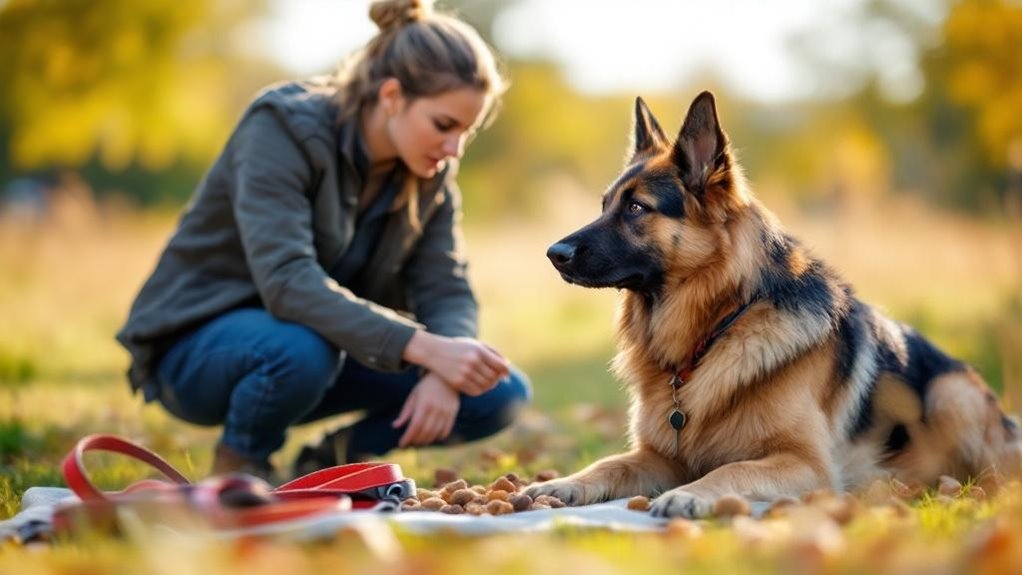
You’re likely making one critical mistake: skipping early socialization during your German Shepherd’s 3-14 week window—when their brain develops fastest. Missing this period locks in anxiety and aggression. You’re also probably using inconsistent commands, confusing your pup’s learning pathways. Harsh corrections? That breeds fear, not obedience. Instead, reward within 1-3 seconds of good behavior using high-value treats. Keep rules consistent across all family members. Your dog needs structure, positive reinforcement, and quality bonding time—not punishment. The science is clear: trust builds obedience. Stick around to uncover exactly how these mistakes compound.
- Key Takeaways
- Starting Training Too Late: Why Puppies Need Early Foundation
- Inconsistent Commands Derail German Shepherd Training
- Replace Harsh Corrections With Positive Reinforcement
- Socialization Windows Close Fast: Don’t Miss Them
- Mental Stimulation Is Non-Negotiable Training
- Repeating Commands Until Your Dog Ignores You
- Reward Timing: Seconds Matter, Not Minutes
- Clear Household Boundaries Prevent Chaos
- Structured Daily Routines Build Obedience
- Redirect Mistakes Instead of Punishing Them
- Recognizing Stress Signals Before Behavior Spirals
- Stop Treating Training as Punishment Time
- Sit, Stay, and Come: Non-Negotiable Commands
- Match Your Reward Value to Task Difficulty
- Catch Reactive Behavior Before It Worsens
- Consistency Requires Regular Daily Practice
- Generalize Commands Across Different Environments
- Frustration as a Training Killer
- Loose-Leash Walking: The Foundation Most Owners Skip
- Your Dog Needs Bonding Time Beyond Training
- Command Poisoning: Why Repetition Backfires
- Frequently Asked Questions
- Conclusion
Key Takeaways
- Delaying training past eight weeks risks missing the critical socialization window, leading to anxiety-driven and aggressive behaviors that are harder to correct later.
- Using inconsistent commands across family members confuses dogs and slows learning; all caregivers must enforce the same rules and cues consistently.
- Punishing mistakes instead of redirecting them damages trust and impedes learning; guide acceptable actions with immediate positive reinforcement instead.
- Ignoring stress signals like excessive barking and pacing allows behavioral issues to escalate; create safe spaces and structured routines to alleviate anxiety.
- Relying solely on training sessions isolates learning; integrate commands into daily activities like walks and meals to build emotional security and confidence.
Starting Training Too Late: Why Puppies Need Early Foundation
If you’ve ever wondered why some German Shepherds grow up confident and well-behaved while others develop aggression or anxiety, the answer often traces back to one critical window: puppyhood.
The Eight-Week Window
The American Kennel Club recommends starting training at eight weeks old. This early foundation—basic obedience, socialization, exposure to people and environments—shapes your dog’s entire personality.
Early training at eight weeks builds the foundation that shapes your German Shepherd’s entire personality.
Why It Matters
Puppies’ brains develop rapidly during early months. Without proper socialization, they develop suspicious or aggressive behaviors later. You’re literally rewiring their neural pathways through consistent interaction.
Your Action Plan
- Enroll in puppy classes
- Schedule supervised playdates
- Expose them to varied environments
- Reinforce positive interactions
Starting late? You’ll face uphill battles with destructive habits and anxiety.
Begin now—your future adult German Shepherd depends on it.
Inconsistent Commands Derail German Shepherd Training
You’ve laid the groundwork with early socialization and consistent puppy classes—excellent work.
Now comes the critical part: keeping your commands consistent****. Inconsistent commands create confusion. When different family members use varying cues, your German Shepherd’s brain struggles to form reliable associations.
Here’s what happens when inconsistent commands derail training:
- Your dog experiences frustration—they can’t predict what you want.
- Mixed messages trigger anxiety and behavioral problems.
- Training progress stalls because learning slows dramatically.
- Your bond weakens when expectations feel unclear.
Why consistency matters: German Shepherds’ brains work like filing systems. One command = one action. When you switch it up—saying “sit” versus “down boy”—you’re fundamentally asking them to file information in multiple folders simultaneously.
The solution: Establish one command per action. Everyone uses identical cues, identical rewards, identical timing. Your shepherd learns faster, feels secure, and responds reliably. That’s obedience built on solid foundations.
Replace Harsh Corrections With Positive Reinforcement
You’re probably wondering why your German Shepherd shuts down during training—harsh corrections actually trigger fear responses in their amygdala (the brain’s alarm center), making learning harder, not easier.
When you swap punishment for rewards instead, you’re tapping into their natural motivation system: dogs repeat behaviors followed by positive outcomes, which scientists have proven through decades of behavioral research.
Building Trust Through Rewards
Transform your German Shepherd’s behavior—and your entire training relationship—by ditching harsh corrections and embracing positive reinforcement instead.
Why Rewards Work Better
Your dog’s brain responds powerfully to positive reinforcement. When you reward good behavior immediately, your German Shepherd’s brain releases dopamine—a chemical that strengthens learning pathways. This creates lasting associations between actions and positive outcomes.
Build Trust With These Reward Strategies:
- Use varied rewards tailored to your dog’s preferences—treats, praise, or play sessions.
- Time rewards within seconds of desired behavior for maximum impact.
- Create a fun, secure training environment where your dog feels confident.
- Strengthen your bond through consistent, predictable positive outcomes.
Harsh corrections damage trust and create anxiety. Instead, you’ll foster a responsive, obedient German Shepherd who genuinely wants to please you.
Your relationship transforms from fear-based to trust-based—the foundation of exceptional training success.
Understanding Canine Motivation
When your German Shepherd ignores a command, it’s not stubbornness—it’s motivation. Your dog operates on instinct, driven by what matters most: food, play, or praise.
Why Motivation Matters
German Shepherds evolved as working dogs. They’re hardwired to respond when incentives align with their needs. You’re not bribing—you’re speaking their language.
Matching Rewards to Tasks
- High-value treats: challenging behaviors
- Praise: everyday commands
- Play sessions: energy release
The Positive Behavior Connection
When you reward positive behavior immediately, your dog’s brain releases dopamine—a chemical reinforcing that action. This biological response makes learning stick faster than corrections ever could.
Your dog doesn’t need punishment. They need you understanding what drives them, then channeling that motivation into obedience. That’s true training mastery.
Creating Positive Learning Environments
Once you’ve opened what drives your German Shepherd, the real magic happens in how you structure their learning space. You’re not just teaching commands—you’re building trust and confidence together.
Here’s why your training atmosphere matters deeply:
- Dogs absorb your emotions like sponges, so your joyful energy directly influences their willingness to engage.
- Immediate rewards create crystal-clear connections between actions and positive outcomes in their brains.
- Fear-based corrections trigger anxiety, causing them to associate training with dread rather than opportunity.
- Harsh methods damage the bond you’re working so hard to develop.
Replace corrections with positive reinforcement—treats, praise, and play. This approach isn’t soft; it’s scientifically proven.
Your German Shepherd’s brain releases dopamine (a motivation chemical) when rewarded, making them enthusiastic to repeat desirable behaviors consistently.
Socialization Windows Close Fast: Don’t Miss Them
You’ve got a narrow window—just 3 to 14 weeks—to shape your German Shepherd’s entire social future, and it closes faster than you’d think.
Miss this critical exposure period, and you’re not just losing training time; you’re potentially building a dog prone to suspiciousness or aggression despite their natural pack instincts.
The good news? Structured strategies like puppy classes and supervised playdates can maximize this window and set your pup up for lifelong confidence.
Critical Early Exposure Window
Your German Shepherd’s brain develops rapidly during their first 14 weeks—and you’ve got a narrow window to shape their future.
This critical early exposure window won’t last forever. Miss it, and you’re fighting an uphill battle later. Here’s what happens if you don’t act now:
- Your puppy becomes suspicious of unfamiliar people—making vet visits and social outings stressful.
- New environments trigger fear responses instead of curiosity.
- Other dogs seem threatening rather than friendly.
- Destructive behaviors emerge as anxiety takes root.
The Science Behind It
During these 14 weeks, your German Shepherd’s neural pathways form rapidly. Positive experiences literally rewire their brain for confidence and adaptability.
Your Action Plan
Enroll in puppy socialization classes. Arrange playdates with friendly dogs.
Expose them to varied environments—safely. Consistent supervision matters; don’t force uncomfortable situations. Let exploration happen naturally, at their pace.
The clock’s ticking. Start today.
Long-Term Behavioral Consequences
Your puppy doesn’t learn appropriate interactions. Instead, fear-based reactions take root. Aggression toward strangers or other dogs becomes the default. That suspicious temperament? It’s hardwired now.
The destructive spiral:
Unsocialized dogs develop anxiety-driven behaviors. They’ll destroy furniture, bolt through doors, or snap defensively.
These aren’t training issues anymore—they’re deep psychological patterns.
Why German Shepherds suffer most:
Pack animals need early bonding experiences. Missing this 16-week window means your shepherd never learned “who’s safe.”
Rebuilding trust takes months of dedicated work.
The lesson? Enroll in puppy classes now. Arrange playdates immediately. This window won’t wait—and neither will regret.
Structured Socialization Strategies
Because German Shepherds are hardwired pack animals, they’ll thrive—or struggle—based entirely on early exposure.
Your Critical Window: 3 to 14 Weeks
You’ve got roughly eleven weeks to shape your puppy’s social skills forever.
Miss this window? You’re fighting an uphill battle against suspicion and aggression later.
Four Essential Strategies:
- Enroll in socialization classes immediately—diverse environments beat isolation.
- Arrange supervised playdates with friendly dogs weekly for confidence building.
- Introduce varied settings, people, and sounds systematically—not randomly.
- Create positive experiences consistently; never force uncomfortable situations.
The Long Game
You’ll continuously reinforce socialization throughout your dog’s life.
This strengthens your bond while promoting balanced temperament.
Puppies exposed early develop adaptability. They handle unfamiliar people and animals with composure instead of fear-based aggression.
Your structured approach today prevents behavioral problems tomorrow.
That’s not just training—that’s responsible ownership.
Mental Stimulation Is Non-Negotiable Training
Intelligence without challenge breeds chaos. Your German Shepherd’s brain demands constant engagement—it’s wired that way. These dogs were bred to think, problem-solve, and make decisions alongside handlers. Without mental stimulation, they’ll create their own entertainment: destructive chewing, excessive barking, anxiety spirals.
Intelligence without challenge breeds chaos. German Shepherds need constant mental engagement—or they’ll create destructive entertainment themselves.
Why It Matters
Their intelligence rivals a two-year-old child’s cognitive abilities. Boredom triggers behavioral meltdowns faster than physical exercise alone prevents them.
Your Action Plan
Rotate puzzle toys weekly.
Practice obedience drills daily.
Introduce novel tasks regularly.
Hide treats for scent work.
These aren’t luxuries—they’re necessities.
A tired body satisfies temporarily. A stimulated mind? That creates contentment, loyalty, and partnership. You’re not just training; you’re revealing your dog’s potential.
Repeating Commands Until Your Dog Ignores You
You’re probably repeating commands hoping your German Shepherd will finally listen—but you’re actually teaching them to ignore you.
When you repeat cues, you’re “poisoning” the command itself, making it lose its power and creating a dog that only responds after multiple attempts.
Instead, you’ll learn how to give clear, single commands and build that rock-solid obedience your shepherd truly needs.
The Poisoning Effect Explained
When you repeat a command over and over without your dog responding, something troubling happens in their brain—they start associating that cue with *failure*, not action.
This destructive process is called poisoning the cue. Your German Shepherd’s mind learns: “Sit” means nothing happens. The command loses power.
Here’s what happens when you repeat commands:
- Your dog tunes out the cue entirely
- Trust in your leadership deteriorates
- Future training becomes exponentially harder
- Frustration builds for both you and your pet
The Brain Connection
Dogs learn through association. Repeated cues without results create neural pathways linking commands to inaction.
Once poisoned, that command’s effectiveness vanishes—sometimes permanently.
The Fix
Get attention first. Use focus techniques before issuing commands.
If your German Shepherd’s distracted, find alternative methods instead of repeating yourself endlessly.
Protect your cues. They’re valuable training tools worth preserving.
Building Reliable Command Response
Envision this: you’ve said “sit” five times, your German Shepherd’s staring at a squirrel, and you’re about to repeat it a sixth. Stop right there.
Repeating commands teaches your dog to ignore you—literally. Each iteration signals that compliance isn’t required immediately. Instead, use attention-getting techniques before commanding. Make eye contact. Use their name. Guarantee focus exists first.
Why This Training Methods Approach Works:
| Problem | Result | Solution |
|---|---|---|
| Repeated commands | Delayed responses | Get attention first |
| Unclear cues | Confusion | Distinct command sounds |
| Negative associations | Command avoidance | Positive reinforcement only |
Your German Shepherd’s brain is wired for one-time responsiveness. Their ancestors—wolves—obeyed pack signals immediately or faced consequences. Modern training methods should mirror this biological reality.
Give commands once. Wait. Reward compliance instantly. This builds reliability that actually sticks.
Reward Timing: Seconds Matter, Not Minutes
Your dog’s brain works fast—really fast. You’ve got roughly 1-3 seconds to reward your dog after they nail a command. Miss that window, and they won’t connect the treat to their behavior.
Here’s why timing crushes everything:
- Your GSD’s memory fades instantly without immediate reinforcement.
- Delayed rewards confuse which action earned the praise.
- Their learning slows dramatically compared to instant feedback.
- Bad habits accidentally get rewarded instead of the good ones.
The Clicker Game-Changer
Use a clicker—it bridges the gap perfectly. Click the *exact moment* they obey, then reward. This precision tool lets your German Shepherd understand exactly what earned that treat.
Consistent timing builds reliability. Fast rewards? That’s your secret weapon.
Clear Household Boundaries Prevent Chaos
Without structure, your German Shepherd’s home becomes a minefield of confusion.
Why Boundaries Matter
Clear household boundaries aren’t cruel—they’re compassionate. Your dog’s brain craves predictability. When you establish off-limits zones (kitchen, bedrooms, furniture), you’re reducing anxiety, not imposing tyranny.
Clear boundaries reduce anxiety. Your German Shepherd’s brain craves predictability—structure isn’t tyranny, it’s compassion.
Making Boundaries Stick
Use visual cues: gates, specific mats, designated areas. Your German Shepherd responds to environmental signals.
All family members must enforce identical rules consistently. Mixed messages create behavioral chaos.
The Science Behind Structure
Dogs evolved alongside wolves—pack animals requiring clear hierarchies. Your consistent boundaries replicate this natural need for order.
Regular training sessions with positive rewards reinforce these limits, strengthening your bond simultaneously.
Bottom Line
Structured homes produce confident, obedient dogs. Without clear household boundaries, you’re setting everyone up for failure.
Structure wins.
Structured Daily Routines Build Obedience
You’re probably making one of the biggest mistakes right now: skipping consistency.
When you establish fixed times for feeding, training, and exercise—your German Shepherd’s brain actually rewires itself to expect structure, making obedience feel natural rather than forced.
Without this daily blueprint, you’ll watch behavioral problems multiply faster than you can say “sit.”
Consistency In Daily Training
One of the biggest reasons German Shepherds fail to obey commands isn’t because they can’t learn—it’s because their owners don’t teach them consistently.
Your dog’s brain works like a muscle. Without regular training repetition, those neural pathways weaken.
Here’s what consistency truly demands:
- Same commands, same cues from every family member—no variations
- Training sessions woven into daily life: walks, meals, playtime
- Unified approach across your household—confusion destroys progress
- Scheduled routines that create predictability and security
When you’re inconsistent, your German Shepherd struggles to understand expectations. They’re not being stubborn; they’re genuinely confused.
Daily structured training—even just five minutes during feeding time—builds obedience rapidly.
Your dog thrives on stability. Consistency isn’t boring; it’s transformative.
Structure Prevents Behavioral Problems
Consistency builds the foundation—now structure erects the walls. You’ll prevent destructive behaviors by establishing predictable daily routines. Your German Shepherd thrives on knowing what comes next: feeding at 7 AM, walks at noon, training at 3 PM.
Why Structure Matters
Dogs descend from wolves—pack animals requiring order. Without structure, your shepherd develops anxiety and destructive habits. Boredom breeds trouble: chewing furniture, excessive barking, aggression.
Building Your Framework
Set specific times for:
- Meals
- Exercise
- Mental stimulation
- Training sessions
This consistency strengthens your bond dramatically. Your dog understands expectations clearly. Reinforced commands stick faster. Regular training sessions—integrated into daily life—cement obedience.
Structure doesn’t restrict your German Shepherd. It liberates them. A well-organized routine creates confidence, reduces stress, and transforms a potentially chaotic pet into a balanced, happy companion.
Redirect Mistakes Instead of Punishing Them
When your German Shepherd knocks over the trash can, your first instinct might be to scold them—but here’s the thing: punishment actually backfires. Fear-based corrections damage trust and intensify anxiety-driven mistakes rather than fix them.
Why Redirecting Works Better
Redirecting means guiding your dog toward acceptable behaviors instead of punishing unwanted ones. This approach maintains your bond while teaching what you actually want.
Consider these powerful benefits:
- Your dog learns faster without fear clouding their judgment
- Anxiety decreases naturally through positive associations and success
- Trust deepens because you’re their guide, not their threat
- Behaviors stick permanently since motivation comes from reward, not avoidance
When your Shepherd lunges at the door, redirect that energy. Offer a toy. Issue a sit command. Reward compliance immediately.
You’re not ignoring the mistake—you’re smartly reshaping it into something brilliant.
Recognizing Stress Signals Before Behavior Spirals
Redirecting destructive behaviors works brilliantly—but here’s what many owners miss: your German Shepherd’s displaying warning signs long before chaos erupts.
Catching Stress Signals Early
Your dog communicates distress through specific stress signals: excessive barking, pacing, panting, and destructive tendencies. These aren’t random misbehaviors—they’re SOS messages. German Shepherds, originally bred as working dogs, internalize pressure differently than other breeds.
Why Early Recognition Matters
Observing body language prevents escalation. Watch for: stiff posture, whale eye (showing whites), tucked tail, and lip licking. Environmental changes—new homes, unfamiliar situations, poor socialization—trigger these responses.
Your Action Plan
Create a safe, quiet space immediately. Establish structured routines. Use positive reinforcement consistently.
You’ll notice stress signals fade within weeks when you address root causes instead of punishing symptoms.
Stop Treating Training as Punishment Time
You’re making a critical mistake if you treat training sessions like punishment time—your German Shepherd’s brain actually releases stress hormones during negative interactions, creating anxiety instead of learning.
Transform those moments by infusing fun activities, genuine praise, and upbeat energy into every training session, because you’ll build trust and enthusiasm rather than fear.
When you shift your mindset from “correcting mistakes” to “celebrating wins,” you’re not just changing behavior—you’re reshaping your entire relationship with your dog.
Create A Fun Atmosphere
Training shouldn’t feel like a trip to the principal’s office—for you or your German Shepherd.
Your dog thrives when you create a fun atmosphere during training sessions. A cheerful demeanor transforms learning into genuine enjoyment rather than drudgery. Here’s why this matters:
- High-pitched praise sparks joy and encourages repeat good behavior
- Playful games strengthen your bond while reinforcing commands
- Enthusiastic tone reduces anxiety and boosts engagement
- Light-hearted sessions prevent disinterest and disengagement
German Shepherds—bred originally for herding work—possess natural intelligence that responds powerfully to positive energy. When you incorporate games and playful methods, your dog approaches tasks with genuine enthusiasm.
Ditch the serious face. Your dog doesn’t understand punishment; they understand fun.
Make training sessions rewarding, interactive experiences. That’s how you activate your German Shepherd’s full potential and build lasting obedience.
Use Positive Reinforcement Methods
When your German Shepherd associates learning with fear instead of fun, you’ve already lost half the battle.
Ditch the Punishment Mindset
You’ve got to use positive reinforcement methods—not harsh corrections. Rewards trigger dopamine release in your dog’s brain, creating genuine excitement about training. This neurological response makes learning stick faster than punishment ever could.
| Reward Type | Best For | Timing | Motivation Level |
|---|---|---|---|
| High-value treats | Difficult commands | Immediately after | Maximum |
| Praise & petting | Basic behaviors | Within 2 seconds | Moderate |
| Playtime | Active dogs | Right away | High |
| Variety rotation | Sustained interest | Throughout session | Consistent |
Why This Works
Your German Shepherd thrives on mental challenges. Mixing treats, praise, and games keeps sessions engaging. Immediate rewards cement the behavior-to-success connection instantly. Skip the fear-based approach entirely. You’ll watch your dog transform from anxious to enthusiastic—genuinely keen for training time.
Maintain An Upbeat Attitude
Your energy sets the entire tone—dogs read your mood like a book. German Shepherds sense your frustration instantly, which sabotages training effectiveness.
Transform sessions into games, not interrogations. Here’s how to create a positive learning environment:
- Use high-pitched, enthusiastic praise that reinforces desired behaviors
- Embrace goofy attitudes—your genuine joy becomes contagious
- Keep commands light-hearted to prevent negative associations
- Celebrate small wins with authentic excitement
Why This Matters
Dogs respond positively when they perceive training as play rather than punishment. Your upbeat demeanor reduces their anxiety dramatically.
When you’re excited, they’re excited—it’s biological. Their brains release dopamine (a feel-good chemical) during positive interactions.
Stop treating training sessions like chores. Your German Shepherd wants to please you. Meet that enthusiasm halfway.
That’s when real learning—and bonding—happens.
Sit, Stay, and Come: Non-Negotiable Commands
Three commands form the foundation of German Shepherd obedience—and they’re absolutely non-negotiable for your dog’s safety and your peace of mind. “Sit,” “Stay,” and “Come” aren’t just fancy tricks; they’re lifelines.
Your German Shepherd’s dog behavior depends on mastering these essentials early. Start training at eight weeks old when their intelligence peaks and willingness to please runs highest.
Early training at eight weeks unlocks your German Shepherd’s peak intelligence and natural desire to please you.
Here’s what makes consistency critical:
- All family members must use identical commands
- Prevents confusion that derails learning
- Strengthens obedience across situations
Use positive reinforcement religiously—treats, praise, enthusiastic voice. This builds a loving training environment where your dog actually wants to cooperate.
Practice regularly. Weekly drills reinforce learning and improve responsiveness everywhere: parks, streets, homes.
Your German Shepherd’s safety hinges on these three commands becoming second nature.
Match Your Reward Value to Task Difficulty
One critical mistake dog trainers make is treating all rewards equally. Your German Shepherd won’t respond the same way to kibble as he does to his favorite chicken treat—and that’s exactly why you need to match reward value to task difficulty.
Here’s how to get it right:
- Reserve premium treats for challenging commands your dog hasn’t mastered yet.
- Use basic rewards for established behaviors he’s performed hundreds of times.
- Rotate life rewards—walks, playtime, fetch sessions—to maintain enthusiasm.
- Watch his eyes light up when you pull out the high-value reward he craves most.
Start by rewarding every correct behavior, then gradually shift to random rewards as confidence builds. This strategic approach keeps your German Shepherd motivated and engaged throughout his entire training journey.
Catch Reactive Behavior Before It Worsens
Early intervention prevents escalation. Watch for warning signs: lunging, barking, rigid posture. These signal your dog’s nervous system is hijacked. Your immediate action interrupts the behavioral chain reaction.
Your Action Plan
Catch that first bark before it becomes three. Use commands or distractions redirecting focus instantly. This prevention strategy works because you’re blocking the neural pathway that reinforces reactivity.
Building Confidence Through Consistency
Combine early interruption with desensitization exercises. Positive reinforcement transforms negative responses into calm behavior. Your German Shepherd learns: triggers don’t require explosive reactions.
Socialization and training make situations feel manageable, not threatening.
Consistency Requires Regular Daily Practice
Because German Shepherds are incredibly intelligent—their brains actually process information faster than most dog breeds—they need consistent daily reinforcement to lock in learned behaviors.
You’re making a critical mistake if you skip training days. Inconsistency confuses your dog and frustrates you both. Here’s why daily practice matters:
- Your German Shepherd learns faster with regular engagement—missing days erases progress.
- Consistency establishes clear expectations; your dog knows exactly what you want.
- Daily sessions prevent bad habits from developing in this enthusiastic-to-please breed.
- Shared training experiences strengthen your bond through achievements and trust-building.
Start at eight weeks old during the critical socialization window. Even fifteen minutes daily works wonders.
Your German Shepherd thrives on routine and predictability. Consistency isn’t optional—it’s essential. Without it, you’re fundamentally retraining your dog constantly.
Generalize Commands Across Different Environments
your German Shepherd can sit perfectly in your living room but completely ignore you at the dog park.
This common mistake happens because you haven’t taught your dog to generalize commands across different environments. Your pup thinks “sit” means something totally different outside versus inside—confusing, right?
Why Generalization Matters
German Shepherds need consistent verbal cues and hand signals everywhere. Parks, busy streets, and homes all present new distractions. Your dog’s brain requires practice processing these stimuli while obeying you.
Build Adaptability Gradually
Start training in quiet spaces.
Slowly introduce busier environments while maintaining your structured routine. Practice the same commands using identical signals. This reinforces that rules stay constant everywhere.
Your dog gains confidence. You strengthen your bond. Suddenly, your Shepherd listens reliably—regardless of location or distraction level. That’s powerful training done right.
Frustration as a Training Killer
Impatience doesn’t just slow training—it derails it entirely. Your frustration bleeds into every command, every correction. German Shepherds sense your negativity immediately, and they shut down.
Why Frustration Fails:
- Dogs disengage when you’re upset—they stop listening.
- Inconsistent corrections confuse them and amplify your frustration.
- Negativity replaces the safety they need to learn.
- Your emotions trigger their anxiety, blocking progress.
You’re sensitive to their struggles. They’re equally sensitive to yours. When frustration builds, consistency crumbles. Commands become unclear. Mistakes pile up.
The Fix: Keep sessions upbeat and brief. Reward desired behaviors aggressively. Focus on what they’re doing right, not wrong. Positive reinforcement creates the productive learning space your German Shepherd needs.
Your patience? It’s your most powerful training tool.
Loose-Leash Walking: The Foundation Most Owners Skip
Most German Shepherd owners skip the one foundation that changes everything—loose-leash walking. You’re letting control slip away before your dog even reaches full strength. Starting at eight weeks old prevents pulling disasters later when your shepherd weighs eighty-plus pounds.
| Age | Training Focus | Duration | Expected Progress |
|---|---|---|---|
| 8-12 weeks | Basic commands | 5-10 min | Attention building |
| 3-6 months | Leash introduction | 10-15 min | Foundation habits |
| 6-12 months | Consistency practice | 15-20 min | Reliable loose-leash walking |
| 12+ months | Maintenance | 20+ min | Sustained obedience |
You’ll strengthen your bond considerably through regular practice. Every family member must use identical commands—no exceptions. Rewards like treats make walking enjoyable, not a battleground. Your German Shepherd thrives on consistency, clarity, and positive reinforcement.
Your Dog Needs Bonding Time Beyond Training
Training commands won’t fix a lonely dog—and that’s where most owners miss the mark entirely.
You’re making a critical mistake if you think obedience work replaces genuine bonding time. Your German Shepherd’s brain actually releases oxytocin—the “trust hormone”—during quality interaction with you. Without this chemical bonding, training stalls.
Why Bonding Time Matters Beyond Commands
Your dog needs more than sit-and-stay sessions. Include these activities in your weekly routine:
- Fetch sessions that let your pup chase freely and celebrate wins together
- Gentle grooming that builds trust through touch and relaxation
- Leisurely walks where you simply enjoy each other’s company
- Family time where your Shepherd feels genuinely included and valued
Consistent bonding prevents separation anxiety and behavioral problems. Your German Shepherd thrives when they’re part of your daily life—not just your training schedule.
This emotional security transforms everything else you teach them.
Command Poisoning: Why Repetition Backfires
When you repeat “sit, sit, sit!” without getting results, you’re actually teaching your German Shepherd to ignore you—not obey you. This phenomenon is command poisoning—when repeated cues lose their power.
Your dog’s brain adapts to repetition. Each time you repeat a command without success, the word weakens. Eventually, your Shepherd responds only after multiple repetitions, undermining your training entirely.
| Problem | Cause | Solution |
|---|---|---|
| Ignored commands | Excessive repetition | Issue once, then act |
| Delayed responses | Diluted effectiveness | Use attention-getters first |
| Confusion | Mixed signals | Change approach instead |
| Frustration | Punishment association | Maintain positive energy |
| Broken bond | Negative experiences | Reward compliance consistently |
Prevention strategies matter. Get your dog’s attention first—clap or call their name—before issuing commands. If they don’t respond, don’t repeat; instead, change tactics. Avoid poisoning commands with frustration or punishment. Your Shepherd thrives on clear, positive reinforcement.
Frequently Asked Questions
What Not to Do With a German Shepherd Puppy?
Don’t neglect early socialization or you’ll risk aggressive behavior. Avoid harsh, inconsistent training methods. Skip routine vet care and you’ll miss health issues. Don’t forget daily exercise and mental stimulation.
What Is the 3-3-3 Rule for Dog Training?
Studies show 30% of adopted dogs struggle during their first month. You’ll follow the 3-3-3 Rule: three days adjusting, three weeks settling routines, three months understanding expectations. This framework helps you manage patience and consistency throughout your dog’s adjustment.
What Is a Red Flag Behavior in Puppies?
You should watch for excessive barking, aggressive behavior, separation anxiety, persistent fear responses, and incessant chewing or digging. These red flags indicate you’re not addressing your puppy’s anxiety, socialization, or mental stimulation needs properly.
How Do German Shepherds Pick Their Favorite Person?
You’re the heart they’ll follow. Your German Shepherd picks you as their favorite through consistent love, attention, and positive reinforcement. They’re reading your scent and body language, gravitating toward whoever makes them feel safest and most understood.
Conclusion
You’ve now got the roadmap. Training your German Shepherd isn’t rocket science—it’s consistency, patience, and positive vibes. Start early, keep commands clear, and skip the harsh corrections. Your pup’s brain is like a sponge; you’re either filling it with gold or mud. Which will you choose? The difference between an amazing dog and a challenging one? Your commitment today. You’ve got this.