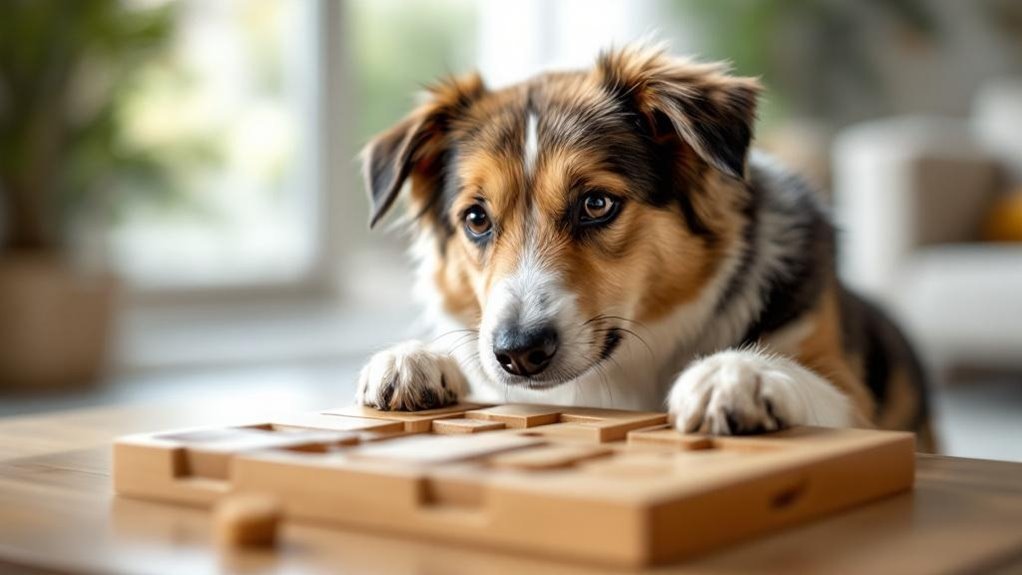
Your intelligent dog’s brain craves constant challenges—without them, destructive behavior emerges. Brain games like puzzle toys, hide-and-seek, and food-dispensing toys activate their prefrontal cortex, releasing dopamine and reducing anxiety. These activities mimic ancestral foraging instincts, preventing boredom-driven destruction. Start simple with treat-hiding games, then gradually increase difficulty as your dog masters each challenge. Rotating games every two weeks keeps engagement fresh. The specific techniques that transform restless pups into mentally satisfied companions await below.
- Key Takeaways
- Why Mental Stimulation Prevents Destructive Behavior and Anxiety
- Signs Your Dog Needs More Brain Games
- Start Simple: Three Beginner Brain Games to Try This Week
- Build Problem-Solving Skills With Puzzle Toys
- Make Mealtimes a Challenge With Food-Dispensing Toys
- Train Eye Contact to Boost Focus and Bonding
- Switch Up Walking Routes to Keep Your Dog Engaged
- Play the Hot and Cold Game for Verbal Communication Skills
- Master Hide-and-Seek Using Scent Work and Treats
- Use Snuffle Mats for Natural Foraging Behavior
- Create DIY Brain Games With Household Items
- Reinforce Learning Through Obedience Training
- Organize Playdates for Social Problem-Solving
- Introduce Automated Fetch Toys for Independent Play
- Brain Game Products Ranked by Difficulty Level
- Agent 008: The Expert-Level Brain Game Challenge
- Birthday Cake Toy: Multi-Drawer Problem-Solving
- Dogs Flower: Unlock Your Smart Dog’s Curiosity
- Match Toy Difficulty to Your Dog’s Current Skill
- Rotate Brain Games Every Two Weeks to Prevent Boredom
- Layer Multiple Games for Cumulative Mental Challenge
- Supervise Play Sessions Without Micromanaging
- Build a Weekly Brain Game Routine (Sample Schedule Included)
- Track Progress: Behavioral Changes That Show It’s Working
- Avoid These Five Mental Enrichment Mistakes
- Gradually Increase Difficulty as Your Dog Gets Smarter
- Set Weekly Milestones and Celebrate Small Wins
- Frequently Asked Questions
- Conclusion
Key Takeaways
- Interactive puzzle toys and food-dispensing games stimulate neural growth, enhance problem-solving skills, and reduce stress in intelligent dogs.
- Hide-and-seek and scent-based games like snuffle mats leverage foraging instincts while improving listening abilities and cognitive engagement.
- Intelligent breeds like Border Collies need higher difficulty challenges to prevent frustration and maintain sustained mental engagement.
- Obedience training activates the prefrontal cortex and releases dopamine, sharpening minds while strengthening the owner-dog bond.
- Rotating brain games every two weeks and layering multiple activities prevents boredom while supporting continuous learning and mental health.
Why Mental Stimulation Prevents Destructive Behavior and Anxiety
When your dog’s mind isn’t engaged, their paws—and teeth—get busy causing trouble. Boredom triggers destructive behaviors: furniture chewing, hole digging, and constant restlessness. Here’s why: your dog’s brain needs exercise just like their body does.
The Brain-Behavior Connection
Mental stimulation directly combats anxiety by channeling excess energy into constructive activities. Brain games activate your dog’s problem-solving abilities, reducing nervous behaviors naturally.
Studies confirm dogs require both physical and mental exercise for ideal mental health.
A dog’s mental health thrives when both physical exercise and cognitive stimulation are prioritized daily.
Real Results
Interactive toys and training exercises enhance cognitive function, improving focus and decreasing restlessness.
When you engage your dog’s mind regularly, you’re not just preventing destruction—you’re building confidence. Plus, these activities strengthen your bond, creating emotional security that alleviates stress and anxiety.
Signs Your Dog Needs More Brain Games
You’ve likely noticed your pup exhibiting destructive behavior patterns—chewing furniture, excessive digging, or nonstop barking—which signals their brain isn’t getting enough workout.
Excessive boredom indicators like ignoring their favorite toys or seeming restless throughout the day reveal an important gap: your dog’s experiencing lack of mental engagement that brain games are specifically designed to fill.
When you understand these warning signs, you’re already halfway toward transforming your dog’s behavior and well-being through targeted mental stimulation.
Destructive Behavior Patterns
If your dog’s chewing, digging, or scratching has spiraled into full-blown furniture demolition, you’re witnessing boredom in action.
Why Intelligent Dogs Destroy
Your dog’s destructive behavior often stems from insufficient mental stimulation. Intelligent breeds—like Border Collies and German Shepherds—possess sharp minds requiring constant engagement.
Without adequate cognitive challenges, frustration builds, and your furniture becomes the target.
The Science Behind It
Dogs’ brains need activation just like ours do. When unstimulated, they experience what behaviorists call “cognitive frustration.”
This triggers destructive outlets: shredded cushions, demolished drywall, obliterated toys.
What This Means
Your dog isn’t being spiteful—they’re literally struggling with boredom.
The solution? Brain games. Puzzle toys, scent work, and training sessions redirect that mental energy productively, transforming destructive patterns into engaged, content companions.
Excessive Boredom Indicators
Your dog’s attention span drops when boredom sets in. You’ll notice excessive chewing, destructive behavior, and increased barking or whining.
These vocalization changes signal your pup craves engagement.
Watch for pacing, digging, and repetitive behaviors—frustration manifests physically. Your dog loses interest in usual toys and playtime, indicating they need fresh challenges your dog can tackle mentally.
Excessive licking and grooming? That’s anxiety talking. Boredom creates stress in your dog’s brain, just like unstimulated humans feel restless.
The solution: Brain games bridge the gap between physical exercise and mental engagement. Interactive puzzles and challenges combat boredom effectively, transforming your frustrated pup into a happier, calmer companion.
Lack Of Mental Engagement
Dogs crave stimulation the way humans crave meaningful work—without it, they spiral into frustration and bad behavior. A lack of mental engagement doesn’t just bore your pup; it actively damages their well-being.
Warning Signs Your Dog Needs Brain Games
- Excessive barking, destructive chewing, or constant digging for outlets
- Restlessness, hyperactivity, or inability to settle down
- Whining, pacing, or obvious frustration during downtime
- Struggling with basic obedience or showing disinterest in routine activities
Your dog’s mind requires daily challenges.
Without mental stimulation, anxiety and behavioral problems develop rapidly.
Teach your dog brain games—puzzle toys, scent work, or obedience training—to keep their cognitive abilities sharp. Mental engagement isn’t optional; it’s essential for preventing frustration and building a happier, more balanced companion.
Start Simple: Three Beginner Brain Games to Try This Week
When you’re ready to strengthen your dog’s mental muscles, these three accessible games’ll get you started this week.
Hide-and-Seek with Treats
You’ll build your dog’s attention span by hiding treats around your house. Start in obvious spots. Your pup uses scent—their nose contains 300 million olfactory receptors—to locate rewards.
Gradually increase difficulty as confidence grows.
The Hot and Cold Game
You guide your dog toward hidden treats using verbal cues: “warmer” or “colder.” This puzzle toy alternative sharpens listening skills and problem-solving abilities simultaneously.
Your dog learns to interpret your voice patterns.
Snuffle Mat Magic
Scatter treats throughout a snuffle mat during mealtime. Your dog engages natural foraging instincts while experiencing mental stimulation.
This mimics ancestral hunting behaviors, satisfying deep biological drives.
These beginner games transform ordinary afternoons into enriching sessions.
Build Problem-Solving Skills With Puzzle Toys
You’re ready to level up your dog’s mental fitness—and puzzle toys are your secret weapon.
These brain-boosting tools don’t just hide treats; they actually rewire your pup’s problem-solving pathways through strategic challenges and sensory engagement.
Ready to explore how food-dispensing toys can transform your dog’s cognitive abilities while keeping boredom at bay?
Puzzle Toys Enhance Cognition
By engaging your dog’s brain through puzzle toys, you’re activating the same neural pathways—called the prefrontal cortex and striatum—that humans use for critical thinking.
These puzzle toys aren’t just fun; they’re powerful tools for enhancing your dog’s mental stimulation and cognitive functions.
Why Cognition Matters
When your dog works through puzzles, their brain strengthens and adapts.
Here’s what happens:
- Neural growth: Problem-solving creates new brain connections
- Enhanced learning: Your dog processes information faster and remembers better
- Improved focus: Concentration skills sharpen with regular mental challenges
- Stress reduction: Mental engagement releases calming chemicals in their brain
Your intelligent dog thrives when challenged.
Puzzle toys transform playtime into brain-building sessions, making your pup sharper, happier, and better equipped to handle life’s demands.
Strategy Through Mental Challenges
Puzzle toys don’t just entertain your dog—they’re problem-solving laboratories where your pup learns to think strategically. Your dog’s mind develops new neural pathways each time they manipulate, nudge, or paw at hidden compartments. This cognitive engagement transforms a simple fun game into genuine mental exercise.
How Strategy Develops:
When your dog tackles puzzle toys, they experiment with different approaches—trial and error creates learning. Older dogs particularly benefit, as mental stimulation combats age-related cognitive decline. Each puzzle level demands increasingly complex thinking patterns.
The Brain Connection:
Your dog’s prefrontal cortex—the decision-making region—activates during problem-solving. They’re literally rewiring their brain for better memory and focus. Regular engagement builds confidence and reduces anxiety-driven destructive behaviors.
Challenge your intelligent companion consistently.
Watch their strategies evolve and their confidence soar.
Food-Dispensing Toy Benefits
When treats aren’t just handed over, they’re *earned*—and that’s when the real magic happens.
Food-dispensing toys transform ordinary snack time into mental workouts. Your dog’s brain lights up solving puzzles while accessing rewards. This isn’t just fun; it’s scientifically proven enrichment.
Why Your Dog Needs Puzzle Toys:
- Sharpens problem-solving skills through strategic thinking and trial-and-error learning
- Engages their sense of smell as they hunt for hidden treats within compartments
- Reduces anxiety and boredom by providing rewarding mental challenges
- Promotes slower eating, preventing digestive issues from overeating
These toys work alongside basic obedience training—complementing Free AKC guidelines for thorough canine development.
Adjustable difficulty levels let your pup progress gradually, building confidence with each solved puzzle.
Your dog’s happiness depends on mental stimulation. Food-dispensing toys deliver exactly that: engagement, challenge, and delicious rewards combined.
Make Mealtimes a Challenge With Food-Dispensing Toys
These toys provide essential mental stimulation. Dogs solve problems as they manipulate the toy—activating their brains like puzzle games activate yours. This engagement reduces boredom greatly.
Health Advantages:
Slowed consumption helps prevent overeating. When dogs eat quickly, they consume more before feeling full. Food-dispensing toys extend mealtime naturally. This slower pace improves digestion and supports healthy weight management.
Physical Activity Bonus:
Your dog must move, push, and manipulate the toy. This combines mental challenges with physical exercise—a winning combination for overall wellness.
Train Eye Contact to Boost Focus and Bonding
One simple skill—eye contact—unlocks remarkable mental power in your dog. You’re not just paying attention; you’re building a neural connection that strengthens focus and deepens your bond.
Why Eye Contact Matters
Here’s what happens when your dog locks eyes with you:
- Hold treats near your forehead to encourage looking at your face.
- Gradually replace food lures with hand signals and verbal commands.
- Release oxytocin—the “bonding hormone”—in both your brains.
- Enable JavaScript to view comments powered by Disqus sharing success stories.
The Results
Consistent practice transforms your dog’s responsiveness. Your pup becomes sharper during distractions. Commands stick better. Advanced training becomes easier.
Eye contact isn’t just a trick—it’s a foundation. You’re developing a partnership built on mutual attention and trust.
Start today. Watch your dog’s focus soar.
Switch Up Walking Routes to Keep Your Dog Engaged
You’ve probably noticed your dog gets excited about new places—that’s their brain working! When you break monotonous patterns by switching routes, you’re actually stimulating their olfactory cortex (the smell-processing part of their brain) with fresh scents and sights they haven’t encountered before.
This kind of environmental exploration transforms ordinary walks into mental workouts that sharpen their focus, boost their confidence, and strengthen the bond you’re building together.
Breaking Monotonous Patterns
When your dog trots the same sidewalk day after day, their brain fundamentally enters autopilot mode—and boredom follows quickly behind.
Transform Walks Into Mental Workouts
Your pup’s brain craves novelty. New environments activate their senses like a pop-up blocker stops unwanted ads—they simply can’t ignore fresh stimulation.
Different routes introduce varied sights, sounds, and smells that demand their full attention.
Why Route Changes Matter:
- Prevents mental stagnation and behavioral problems
- Strengthens listening skills and obedience outdoors
- Builds confidence through unfamiliar territory exploration
- Engages their natural hunting and tracking instincts
Safety First, Adventure Always
Before exploring new neighborhoods, verify they’re dog-friendly and secure.
Altering your direction—even mid-walk—keeps focus sharp and engagement high. Your dog’s intelligence flourishes when challenged.
View the comments powered by their improved behavior: better focus, enhanced responsiveness, and genuine enthusiasm during outings.
Environmental Exploration Benefits
Every dog’s brain responds powerfully to novelty—it’s hardwired into their DNA. When you switch up walking routes, you’re activating their sensory systems in profound ways.
Why New Routes Matter:
- Fresh sights, sounds, and smells trigger heightened alertness.
- Mental stimulation keeps boredom at bay.
- Dogs stay more responsive to your commands.
The Science Behind It:
Your pup’s brain releases dopamine—a “feel-good” chemical—when encountering unfamiliar environments. This neurological boost strengthens their focus and engagement during exercise.
Practical Benefits:
You’ll notice improved obedience in new areas. Your dog’s problem-solving skills sharpen. They develop confidence exploring safely.
Varied pathways transform routine walks into adventures. You’re not just exercising their body; you’re building a sharper, happier mind.
Play the Hot and Cold Game for Verbal Communication Skills
Transform your dog’s listening skills with a deceptively simple game that taps into their natural hunting instincts.
Your pup already possesses incredible auditory abilities—they hear frequencies up to 65,000 Hz compared to your measly 20,000 Hz. The Hot and Cold game leverages this superpower brilliantly.
How It Works:
- Hide a treat or toy out of sight
- Use a calm, quiet voice for “colder” (farther away)
- Switch to excited, higher tones for “hotter” (getting closer)
- Reward discovery immediately with praise and the treat
You’re fundamentally creating a shared language with your dog. They’ll learn interpreting vocal nuances—not just words. This strengthens your communication bond dramatically while providing mental stimulation that problem-solving demands.
Plus, you’re reinforcing how tone matters during commands, making future training easier. Your dog gets entertained. You get a sharper, more attentive companion.
Master Hide-and-Seek Using Scent Work and Treats
Your dog’s nose—equipped with roughly 300 million scent receptors compared to your mere 6 million—is basically a supercomputer.
Your dog’s nose—equipped with roughly 300 million scent receptors—is basically a supercomputer compared to your mere 6 million.
You’re tapping into their most powerful sense.
Start Simple, Build Confidence
Begin hiding treats in obvious spots.
Use verbal cues like “search” or “find it.” Your dog learns to associate commands with nose work.
Increase the Challenge
Gradually hide items under furniture or in separate rooms.
You’re developing their problem-solving abilities—not just their sniffing skills.
Add Excitement
Incorporate a timer.
Your dog hunts faster, making the game more thrilling for both of you.
Reward Success
Praise enthusiastically.
Offer extra treats.
You’re reinforcing positive behavior and building their motivation to engage repeatedly in scent work adventures.
Use Snuffle Mats for Natural Foraging Behavior
Snuffle mats—fabric surfaces layered with fabric strips and pockets—mimic how dogs forage in nature.
You’ll engage your dog’s natural instincts while boosting mental stimulation. Here’s why they’re game-changers:
- Activate scent-work skills: Your dog uses their incredible nose (which contains 300 million olfactory receptors!) to locate hidden treats.
- Slow down eating: Dogs prone to gulping benefit from this interactive feeding method.
- Reduce boredom: Regular snuffle mat use decreases destructive behaviors linked to understimulation.
- Build problem-solving abilities: Your pup develops cognitive strategies through rewarding exploration.
Whether your dog’s a small Chihuahua or large Labrador, snuffle mats work beautifully.
You’re fundamentally creating a puzzle—one that taps into their ancestral foraging instincts.
The result? A happier, more mentally engaged companion.
Ready to watch your dog’s nose do the work?
Create DIY Brain Games With Household Items
While snuffle mats tap into your dog’s natural foraging instincts, you don’t need fancy store-bought toys to keep that brilliant brain engaged. Your home contains everything necessary for enrichment.
Your home contains everything necessary to keep your dog’s brilliant brain engaged through enrichment.
Cardboard Box Puzzles
Cut holes into cardboard boxes. Hide treats inside. Your dog problem-solves while reaching through openings.
Toilet Paper Roll Dispensers
Seal both ends of empty rolls with treats inside. Dogs unroll and manipulate—mimicking how wolves shred prey. This satisfies natural instincts.
Stacked Container Challenge
Stack plastic containers with hidden rewards underneath. Your dog lifts and removes each one systematically, building persistence and focus.
Towel Scent Games
Roll treats inside old towels. Your dog unrolls fabric, engaging their 300-million scent receptors. This mentally exhausts them faster than physical exercise.
These DIY options cost almost nothing while delivering maximum mental stimulation and genuine satisfaction.
Reinforce Learning Through Obedience Training
You’ll sharpen your dog’s mind through mental stimulation with commands—each new instruction fires up their brain and builds stronger neural pathways, much like how human brains grow when learning something fresh.
Positive reinforcement techniques work because treats create powerful associations in your dog’s brain, triggering dopamine release that makes them enthusiastic to repeat good behavior.
When you practice these commands consistently, you’re not just teaching tricks—you’re building your dog’s focus, attention span, and confidence all at once.
Mental Stimulation Through Commands
One of the most powerful ways to sharpen your dog’s mind is through consistent obedience training. When you teach commands, you’re literally activating your dog’s prefrontal cortex—the brain region responsible for decision-making and problem-solving.
Why Commands Work as Brain Games
Each new command requires your dog to think critically and anticipate your cues. Here’s what happens:
- Problem-solving stimulation: Your dog analyzes what you want before responding
- Neural pathway strengthening: Repeated commands build lasting mental connections
- Dopamine release: Successfully following commands triggers reward chemicals in their brain
- Anxiety reduction: Structure and purpose decrease stress through predictable routines
Variety keeps training engaging. Mix simple sits with complex sequences. Your dog’s brain thrives on challenge, so rotate commands regularly.
You’ll notice improved focus, reduced destructive behaviors, and a noticeably sharper companion.
Positive Reinforcement Techniques Work
You’re not just giving treats; you’re building neural pathways. When you reward immediately after good behavior, your dog’s brain releases dopamine—a chemical that strengthens learning and memory. Dogs trained with positive reinforcement show markedly less fear and anxiety than those trained harshly.
| Reward Type | Best For | Timing | Result |
|---|---|---|---|
| Treats | High-value moments | Immediate | Fast learning |
| Praise | Everyday commands | During behavior | Bonding boost |
| Toys | Active dogs | After completion | Sustained focus |
| Play | Social learners | Intermittent | Confidence |
Your Game Plan
Mix varied rewards to keep sessions fresh. Clicker training lets you mark the *exact* moment your dog succeeds—precision timing wins. Consistency strengthens your bond while making training genuinely enjoyable for both of you.
Organize Playdates for Social Problem-Solving
Playdates aren’t just fun—they’re cognitive gyms where dogs tackle real challenges together. When you organize supervised gatherings, your dog encounters fresh social dynamics that demand quick thinking.
What Your Dog Learns:
- Communication skills: Dogs decode body language, barks, and play bows from peers
- Real-time adaptation: Your pup responds instantly to playmates’ shifting behaviors
- Collaborative problem-solving: Together they strategize games, navigate conflicts, and coordinate play
- Energy channeling: Playful competition reduces destructive behaviors through healthy engagement
These interactions strengthen neural pathways—the brain’s communication routes. Your dog’s prefrontal cortex (decision-making center) activates constantly.
They’re not just running around; they’re processing social cues, anticipating moves, and adjusting strategies mid-play.
Regular playdates create measurable cognitive growth. Dogs develop enhanced adaptability and emotional intelligence through peer interaction.
You’re fundamentally building their mental resilience while they’ve a blast.
Introduce Automated Fetch Toys for Independent Play
While playdates build social brainpower, automated fetch toys release a different kind of cognitive challenge—independent problem-solving.
Why Your Dog Needs Solo Play
You’ll notice these devices transform boredom into engagement. Your dog learns cause-and-effect: retrieve correctly, launch fires again.
This pattern-recognition strengthens neural pathways—literally building brain connections.
What Makes Them Effective
- Adjustable distances match your dog’s size and energy
- Built-in retrieval requirements enhance decision-making
- Anxiety and restlessness decrease noticeably
Your pup practices critical thinking without you orchestrating every move. They’re problem-solving independently, which reduces stress and builds confidence.
The Real Benefit
You’re not replacing interaction—you’re multiplying mental stimulation. Dogs engage their natural retrieval instincts while exercising judgment. They think: “How do I make this work?”
That’s powerful brain development happening automatically.
Brain Game Products Ranked by Difficulty Level
Not all puzzle toys challenge your dog’s brain equally—difficulty levels matter tremendously. Your pup’s cognitive abilities deserve the right match. Consider these ranked options:
- Agent 008 ($32.00)—The most challenging option available, designed for enhanced mental engagement and strategic thinking
- Dogs Flower ($38.00)—Interactive problem-solving features encouraging curious dogs to engage actively
- MICE ($40.00)—Cat-specific challenge providing unique difficulty tailored for feline play styles
- Birthday Cake ($46.00)—Features four orange cylinders blocking drawers; currently sold out
Each brain game stimulates your dog’s mind through puzzle-solving mechanics.
These toys promote strategic thinking—the mental processes dogs use when problem-solving. Matching difficulty to your dog’s intelligence level prevents frustration while maximizing engagement.
Higher difficulty toys? They’re perfect for intelligent dogs seeking substantial mental challenges.
Agent 008: The Expert-Level Brain Game Challenge
If your dog’s already bored with basic puzzle toys, Agent 008‘s calling their name.
Why Agent 008 Stands Apart
At $32.00, this expert-level brain game isn’t just another toy—it’s a mental marathon. You’re investing in genuine cognitive stimulation that challenges your intelligent pup’s problem-solving abilities.
How It Works
Your dog uses paws and nose to uncover hidden treats, activating natural foraging instincts. This taps into ancestral behaviors dogs developed over thousands of years hunting prey.
The Proof Is in the Sellout
Agent 008’s currently sold out. That’s not coincidence—it’s demand from serious dog owners like you who recognize premium brain games‘ value.
Quick Access Options
You’ll find Quick Add, Add to Cart, and Add to Wishlist features ready when stock returns.
Birthday Cake Toy: Multi-Drawer Problem-Solving
You’ll discover how the Birthday Cake toy’s drawer blocking mechanisms—those four orange cylinders—create genuine obstacles that demand your dog’s active problem-solving.
Your pup’s brain engages in what scientists call “cognitive enrichment,” mimicking the natural foraging behaviors dogs’ wolf ancestors used to survive.
When you watch your dog work through each blocked drawer, you’re witnessing real mental engagement that builds patience, reduces boredom, and reveals hidden rewards.
Drawer Blocking Mechanisms
When your dog encounters the Birthday Cake toy, they’re facing a puzzle that mimics real foraging challenges—four orange cylinders strategically block four separate drawers, each hiding four hidden treats inside.
How the Blocking System Works
You’ll notice the design taps into your dog’s natural instincts. The cylinders force strategic thinking:
- Physical obstacles require nose-nudging and paw-manipulation skills
- Sequential problem-solving demands your dog think multiple steps ahead
- Reward discovery strengthens neural pathways associated with persistence
- Difficulty variation lets you adjust challenge levels by repositioning blockers
This mechanism isn’t random—it’s based on canine cognition research showing dogs learn fastest through multi-sensory engagement. Your clever pup must analyze, experiment, and adapt.
Each successful drawer access releases dopamine, reinforcing their problem-solving behavior. You’re fundamentally building their mental muscles while preventing boredom-related destructive behaviors.
Mental Engagement Strategy
The Birthday Cake toy transforms treat-hunting into a cognitive workout—one that taps directly into your dog’s ancestral foraging skills. Your pup descends from wolves that spent hours strategizing hunts. This toy channels that same problem-solving brilliance.
| Engagement Element | Dog Benefit | Time Investment |
|---|---|---|
| Multi-drawer format | Sustained focus | 15-20 minutes |
| Orange cylinder blockers | Strategic thinking | Varies by dog |
| Hidden treats | Natural foraging | Ongoing motivation |
You’ll notice your dog working methodically—not frantically. They’re developing patience. Each drawer requires a different approach, encouraging them to think, adjust, and persist. This isn’t mindless munching; it’s mental gymnastics. Your intelligent companion stays engaged, challenged, and genuinely entertained while building confidence through successful problem-solving.
Dogs Flower: Unlock Your Smart Dog’s Curiosity
Curiosity drives every intelligent dog—and it’s actually hardwired into their brains. You’ve probably noticed your smart pup gets bored with basic toys.
That’s because their brains crave stimulation and problem-solving challenges.
Why Dogs Flower Delivers Results:
- Hidden treats reward exploration and investigation
- Manipulatable components engage problem-solving skills naturally
- Mental stimulation prevents destructive boredom behaviors
- Educational playtime strengthens your dog’s cognitive abilities
At $38.00, you’re investing in your dog’s brain health—not just entertainment.
This puzzle toy transforms regular play into an engaging challenge. Your dog investigates, discovers, and thinks through each interaction.
Smart dogs thrive when challenged mentally. They’re like problem-solvers seeking puzzles.
Does your pup seem restless? Dogs Flower releases their curiosity, keeping them mentally sharp and genuinely satisfied.
Match Toy Difficulty to Your Dog’s Current Skill
You’ll want to figure out where your dog’s problem-solving abilities actually stand—observing which toys they solve quickly versus ones that frustrate them.
As your pup masters each challenge, you’re fundamentally building their neural pathways for learning, so gradually ramping up difficulty keeps their brain engaged and prevents boredom.
Ready to spot when they’ve conquered a puzzle and know it’s time to level up?
Assessing Your Dog’s Level
Watch how your dog tackles new toys. You’ll notice patterns quickly:
- Speed: Does your pup solve it in seconds or minutes?
- Persistence: Do they keep trying, or give up immediately?
- Frustration signals: Whining, pacing, or disinterest means it’s too hard
- Enthusiasm: Are they excited, or just going through the motions?
Start simple. Offer toys requiring just nudging or pawing—basic actions revealing baseline abilities.
If your dog demolishes easy puzzles within moments, they’re ready for complexity. Their brain craves challenge; boredom leads to destructive behavior.
Monitor closely during these initial sessions. Your observations become your roadmap.
You’ll soon recognize your individual dog’s unique cognitive style, allowing you to customize their brain-game journey perfectly.
This assessment phase matters—it’s your foundation for success.
Progressive Difficulty Advancement
As your dog masters basic puzzles, it’s time to level up their brain games. You’ve noticed they solve simple toys quickly—that’s your cue to introduce moderate challenges.
Building Complexity Strategically
Start introducing:
- Two-step puzzle toys requiring sequential problem-solving
- Hide-and-seek games combining memory with searching
- Toys demanding different tactile approaches
Monitoring Progress Indicators
Watch for these signs your dog’s ready to advance:
- Completes puzzles in under five minutes consistently
- Shows decreased frustration levels
- Maintains focus and engagement throughout
Dogs’ brains develop problem-solving pathways through progressive challenge exposure—similar to human neural plasticity. When you gradually increase difficulty, you’re literally strengthening their cognitive connections.
The Sweet Spot
You’ll know you’ve found appropriate difficulty when your dog persists without giving up. They should work actively for 10-15 minutes, displaying both determination and enjoyment.
This balanced progression prevents boredom while building confidence and mental resilience.
Recognizing Mastery and Readiness
Three critical signs tell you when your dog’s ready for the next level: they solve current puzzles in under five minutes, they stay focused without frustration, and they actively seek out brain games.
Your pup’s brain works similarly to yours—it craves novelty and challenge. Watch for these mastery indicators:
- Your dog completes puzzles consistently without help.
- They show enthusiasm, not exhaustion, during playtime.
- Puzzle-solving speed increases noticeably week-to-week.
- They bring you toys unprompted, seeking engagement.
Progression signals matter tremendously. When your dog masters a toy, their dopamine levels spike—that’s the “reward chemical” their brain releases during success. This motivates continued learning.
Don’t rush advancement though. Premature difficulty jumps frustrate dogs and kill their enthusiasm.
You’ll know it’s time when your intelligent companion genuinely wants *more*—not just plays along.
Rotate Brain Games Every Two Weeks to Prevent Boredom
Your dog’s brain needs variety—just like yours does.
Your dog’s brain needs variety—just like yours does. Mental stimulation through rotating games keeps their mind sharp and engaged.
Why Rotation Matters
When you repeat the same brain game too long, your dog’s mind adapts—the challenge disappears. Rotating games every two weeks keeps their cognitive skills sharp and prevents mental fatigue.
Think of it like switching workout routines: your muscles plateau without new stimuli.
The Benefits You’ll Notice
- Better problem-solving abilities
- Reduced destructive behaviors from boredom
- Stronger bond through varied play
Different game types—puzzles, hide-and-seek, interactive treat toys—trigger unique neural pathways (brain connections). Each challenges your dog differently.
Introducing fresh games encourages continuous learning and adaptation, essential for their mental health.
Your dog will stay engaged, motivated, and mentally sharp. Ready to mix things up?
Layer Multiple Games for Cumulative Mental Challenge
While rotating games keeps your dog’s mind fresh, combining them creates something even more powerful—cumulative mental challenges.
Building Stronger Brain Connections
Layering multiple activities amplifies cognitive stimulation dramatically. Your dog’s prefrontal cortex—the problem-solving center—activates more intensely when facing sequential challenges.
- Complete a treat puzzle, then hide toys throughout your home.
- Follow snuffle mat exploration with automated fetch sessions.
- Combine scent games with interactive toys for dual engagement.
- Use puzzle toys before hide-and-seek for progressive difficulty.
This stacking approach strengthens neural pathways. Your intelligent pup learns adaptability and flexibility—critical skills for smart breeds. They’re not just entertained; they’re genuinely learning.
The Results Matter
Cumulative challenges prevent boredom more effectively than single activities. Your dog develops enhanced problem-solving abilities, stays mentally sharp, and remains engaged longer.
You’ll notice increased focus and enthusiasm during playtime.
Supervise Play Sessions Without Micromanaging
You’ve got to walk that tightrope between giving your dog freedom to explore and stepping in when things get dicey—it’s all about balancing freedom and guidance.
Your pup’s confidence actually grows when you let them work through minor squabbles themselves, so you’ll want to recognize warning signs early like stiff postures or intense staring before situations escalate.
That trust you build by staying hands-off (yet attentive) creates a brain-sharpening environment where your dog tackles challenges knowing you’ve got their back.
Balance Freedom and Guidance
How do you know when to step in—and when to let your dog figure things out?
The Sweet Spot Between Control and Freedom
You’re striking gold when you observe without interrupting constantly. This approach builds your dog’s independence and confidence naturally.
Here’s how to balance guidance with freedom:
- Set clear boundaries before play begins—establishing safe zones and off-limit areas
- Use verbal cues strategically—encouraging good behavior without overwhelming correction
- Allow problem-solving opportunities—letting your dog make choices within your limits
- Gradually increase freedom—expanding playtime latitude as reliability improves
Interactive play strengthens your bond through trust. Dogs who make decisions develop better self-regulation and responsiveness.
You’re fundamentally coaching, not controlling. Watch their interactions closely. Notice environmental risks. Step in only when safety’s compromised.
This measured approach? It’s scientifically proven to enhance cognitive development and foster decision-making skills.
Recognize Warning Signs Early
Your dog’s body language tells you everything—if you know what to look for.
Key Visual Indicators
Watch for these stress signals during play:
- Stiff posture or tucked tail
- Whale eye (showing whites)
- Pinned-back ears
- Lip licking or yawning
What They Mean
These signs indicate your dog feels overwhelmed.
Dogs evolved to communicate discomfort before aggression—a survival mechanism dating back thousands of years.
Recognizing these cues prevents conflicts before they escalate.
Your Role
You’re not a referee; you’re a safety net.
Allow your dog autonomy to navigate interactions.
Step in only when warning signs appear.
This balance builds confidence while preventing disaster.
Pro Tip
Rotating playmates reduces stress-related behaviors.
Different companions challenge your dog differently, strengthening adaptability and social skills.
Think of it like cross-training for canine confidence.
Build Confidence Through Trust
Once you step back from constant intervention, something remarkable happens—your dog starts trusting their own judgment.
Your pup learns to navigate social interactions independently when you supervise without micromanaging. This balance builds genuine confidence—not the false kind.
Here’s how to foster trust effectively:
- Set clear boundaries upfront so your dog understands acceptable play behaviors
- Use positive reinforcement to reward confident choices during interactions
- Allow natural success moments where your dog solves problems independently
- Observe quietly while your dog explores and engages with their environment
When you step back strategically, your dog’s problem-solving skills sharpen. They learn to trust their instincts *and* your guidance simultaneously. This creates a powerful partnership.
Dogs who experience supervised freedom develop resilience—they’re less anxious and more self-assured. You’re not abandoning leadership; you’re cultivating independence within safe boundaries.
Build a Weekly Brain Game Routine (Sample Schedule Included)
Creating a structured brain game routine isn’t just about keeping your dog entertained—it’s about rewiring their brain for better focus, reduced anxiety, and genuine happiness.
Your Sample Weekly Schedule:
- Monday: Puzzle toys (solo play)
- Wednesday: Hide-and-seek (interactive)
- Friday: Obedience training (skill-building)
Pro Tips for Success:
Dedicate 15-30 minutes daily to mental challenges.
Rotate activities weekly to prevent boredom and maintain engagement.
Mix solo activities with interactive games involving friends—human or canine.
This balanced approach addresses both independent and social play needs.
Your dog’s brain works like a muscle: it grows stronger through consistent use.
Track Progress: Behavioral Changes That Show It’s Working
After weeks of consistent brain games, you’ll notice something remarkable—your dog’s behavior starts shifting in real, measurable ways.
Signs Your Dog’s Brain Games Are Working:
- Enhanced focus and eye contact during training sessions reveal genuine engagement with activities
- Successful puzzle navigation demonstrates improved problem-solving abilities and cognitive growth
- Reduced destructive behaviors indicate your dog’s mental stimulation needs are finally met
- Increased willingness to participate showcases developing confidence and intellectual development
Your dog’s relaxed home behavior tells you something important: they’re mentally satisfied.
When dogs receive adequate cognitive stimulation—that’s brain exercise—anxiety decreases naturally. You’ll observe fewer destructive habits because your pup channels energy productively instead of destructively.
Watch for improved eye contact during sessions. This signals real engagement, not just compliance.
Track these behavioral shifts weekly. They’re your concrete proof that brain games deliver results beyond entertainment—they’re transforming your dog’s overall well-being and emotional balance.
Avoid These Five Mental Enrichment Mistakes
While tracking your dog’s progress feels rewarding, you’re likely wondering: what could actually derail all this mental work?
1. Skipping Variety
Repetitive games bore intelligent dogs. They’ll disengage faster than you’d expect. Rotate different puzzle toys and challenges weekly.
2. Overusing Treats
Too many rewards? They lose their motivating power. Your dog stops trying hard. Use treats strategically—not constantly.
3. Ignoring Supervision
Unsupervised puzzle toys cause problems. Dogs accidentally swallow pieces. Destructive behavior emerges quickly. Always watch initial sessions.
4. Jumping Difficulty Too Fast
Frustrated dogs quit entirely. Gradual progression matters tremendously. Increase challenges slowly—one step at a time.
5. Skipping Breaks
Mental exhaustion overwhelms intelligent dogs. They need rest between sessions. Short, frequent activities work better than marathon sessions.
Gradually Increase Difficulty as Your Dog Gets Smarter
The best brain games don’t stay the same forever—and neither should your dog’s challenges.
Your dog’s brain—like yours—needs progressive stimulation to stay sharp. As their puzzle-solving skills improve, you’ll notice faster completion times and decreased interest. That’s your signal to level up.
Progressive Difficulty Strategies:
- Start simple, then introduce multi-step puzzles requiring sequential thinking
- Vary treat sizes and reward types to increase complexity
- Use adjustable-difficulty toys you can modify as mastery grows
- Rotate new games—scent trails, interactive toys, novel challenges
Watch your dog’s body language carefully. Tail wagging and focused engagement mean they’re ready for harder puzzles. Frustration signals—whining, pawing frantically—mean you’ve jumped too far ahead.
This graduated approach mirrors how human brains develop through challenge. Your dog won’t plateau when you consistently innovate their mental workout.
Set Weekly Milestones and Celebrate Small Wins
Just as you wouldn’t expect yourself to run a marathon without training milestones, your dog needs concrete weekly goals—not just endless puzzle attempts.
Why Weekly Goals Matter
Your dog’s brain thrives on measurable progress. Setting specific targets keeps training focused and prevents frustration.
Your Action Plan:
- Track achievements through documented wins
- Establish realistic goals based on current skill levels
- Celebrate completions—treats, playtime, or praise
- Adjust difficulty when your dog masters challenges
The Motivation Connection
Small wins trigger dopamine release in your dog’s brain—the same chemical that drives human motivation.
When you acknowledge each success, you’re reinforcing positive behavior while strengthening your bond.
This approach transforms training from monotonous repetition into an exciting partnership where your dog stays intensely engaged and genuinely enthusiastic for the next challenge.
Frequently Asked Questions
What Games Stimulate Dogs Brain?
You can stimulate your dog’s brain through puzzle toys, hide-and-seek games, the hot and cold game, snuffle mats, and obedience training. Each activity challenges their problem-solving skills, encourages foraging instincts, and strengthens your bond together.
What Is the 7 7 7 Rule for Dogs?
While you might assume all dogs need identical exercise, the 7 7 7 rule actually tailors activity to your dog’s size. You’ll provide seven minutes of exercise daily per seven pounds of body weight, ensuring your dog stays physically and mentally stimulated.
How to Stimulate a Highly Intelligent Dog?
You’ll stimulate your intelligent dog by offering puzzle toys, playing hide-and-seek, training obedience commands, arranging social playdates, and using automated fetch throwers to keep them mentally engaged.
What Is “I Love You” in Dog Language?
Your dog’s “I love you” comes through tail wags, eye contact, leaning against you, gentle vocalizations, following you around, bringing toys, and resting their head on your lap—all signs they’re bonded and feel safe with you.
Conclusion
You’ve got this. Your dog’s brain—weighing just 1.2 ounces—craves challenges like you crave solutions. Remember: “A tired dog is a good dog.” By investing weekly in brain games, you’re not just preventing destructive behavior; you’re releasing your pup’s genius potential. You’ll notice calmer afternoons, fewer anxious habits, and stronger bonds. Start small, celebrate wins, and watch your intelligent companion flourish.